


5G network planning in connecting urban areas for trains service using a genetic algorithm
Evangelos D. Spyrou, Vassilios Kappatos
https://doi.org/10.1016/j.hspr.2025.04.003
摘要:The adoption of 5G for Railways (5G-R) is expanding, particularly in high-speed trains, due to the benefits offered by 5G technology. High-speed trains must provide seamless connectivity and Quality of Service (QoS) to ensure passengers have a satisfactory experience throughout their journey. Installing base stations along urban environments can improve coverage but can dramatically reduce the experience of users due to interference. In particular, when a user with a mobile phone is a passenger in a high speed train traversing between urban centres, the coverage and the 5G resources in general need to be adequate not to diminish her experience of the service. The utilization of macro, pico, and femto cells may optimize the utilization of 5G resources. In this paper, a Genetic Algorithm (GA)-based approach to address the challenges of 5G networkplanning for 5G-R services is presented. The network is divided into three cell types, macro, pico, and femto cells—and the optimization process is designed to achieve a balance between key objectives: providing comprehensive coverage, minimizing interference, and maximizing energy efficiency. The study focuses on environments with high user density, such as high-speed trains, where reliable and high-quality connectivity is critical. Through simulations, the effectiveness of the GA-driven framework in optimizing coverage and performance in such scenarios is demonstrated. The algorithm is compared with the Particle Swarm Optimisation (PSO) and the Simulated Annealing (SA) methods and interesting insights emerged. The GA offers a strong balance between coverage and efficiency, achieving significantly higher coverage than PSO while maintaining competitive energy efficiency and interference levels. Its steady fitness improvement and adaptability make it well-suited for scenarios where wide coverage is a priority alongside acceptable performance trade-offs.
引用格式:E.D. Spyrou, V. Kappatos.5G network planning in connecting urban areas for trains service using a genetic algorithm[J]. High-speed Railway, 2025, 3(2):155-162.

下载原文
Influence of particle size distribution and normal pressure on railway ballast: A DEM approach
Z. Yan, Ali Zaoui, W. Sekkal
https://doi.org/10.1016/j.hspr.2024.12.001
摘要:Developing the railway transport sector is a challenging scientific, economic and social research topic starting with ensuring human security. The main topic that should be developed in that sense is the ballast stability and dynamical behaviour under external loading and environmental changes. This paper investigates the effect of particle size distribution and normal pressure on the mechanical response of a ballast bed. Grading curves of ballast layers with different sizes are illustrated to discuss their strength behaviour under various strains to deduce the significant effect on the direct shear performance of the ballast layer. Direct shear tests with different Particle Size Distribution (PSD) were reproduced using the Discrete Element Method (DEM). It is noticed that when the number of small-sized ballast increases, the shear strength and the friction angle increase to varying degrees under different normal pressures, with an average increase of 27 % and 8 %, respectively. When the number of large-sized ballast decreases, the shear strength and the friction angle decrease to varying degrees under different normal pressures, with an average decrease of 6 % and 3 %, respectively.
引用格式:Z. Yan, A. Zaoui, W. Sekkal. Influence of particle size distribution and normal pressure on railway ballast: A DEM approach[J]. High-speed Railway, 2025, 3(1):28-36.

下载原文
Anti-spoofing performance analysis of typical GNSS-based railway train positioning schemes
Siqi Wang, Jiang Liu, Baigen Cai, Jian Wang, Debiao Lu, Wei Jiang
https://doi.org/10.1016/j.hspr.2025.01.005
摘要:Global Navigation Satellite Systems (GNSSs) are vulnerable to both unintentional interference and intentional attacks, making it difficult to meet the stringent safety requirements of railway train control systems. The growing threat to information security posed by spoofing attacks has received limited attention. This study investigates the impact of GNSS spoofing attacks on train positioning, emphasizing their detrimental effects on the accuracy and availability of train location report functions for train operation control. To explore the anti-spoofing performance of typical GNSS-based train positioning schemes, specific approaches, and system architectures are designed under two GNSS-alone and two GNSS-integrated train positioning schemes. Field data are utilized to establish spoofing attack scenarios for GNSS-based train positioning, with which the anti-spoofing capabilities of different train positioning schemes are evaluated. Experimental results indicate that under specific conditions, the GNSS-integrated positioning schemes demonstrate superior GNSS spoofing suppression capabilities. Results of the tests present valuable guidance for designers and manufacturers in developing more advanced and resilient train positioning solutions and equipment for the next generation of train control systems, thereby promoting the applications of GNSS technology in railway systems.
引用格式:S.Q. Wang, J. Liu, B.G. Cai, et al. Anti-spoofing performance analysis of typical GNSS-based railway train positioning schemes[J]. High-speed Railway, 2025, 3(1):37-43.

下载原文
Passenger choice between demand-responsive train and pre-scheduled train in high-speed railway: A stated preference study
Tao Li, Dewei Li, Yongsheng Wang, Han Gao, Jialun Ma, Haotian Ji
https://doi.org/10.1016/j.hspr.2025.04.002
摘要:Demand-responsive transportation has been introduced in many cities around the world. However, whether it is applicable in the railway is still questionable, an exploration of passenger choice behavior between demand-responsive trains and pre-scheduled trains is pivotal in addressing this issue. To delve into passengers’ choice preferences when facing demand-responsive trains and to dissect the feasibility of implementing demand-responsive service in high-speed railways, the stated preference survey method is employed to investigate travel intention of passengers. Based on the survey data obtained in China, the heterogeneity of passengers is analyzed from three aspects: personal socio-economic characteristics, travel characteristics, and travel mode choice. Considering the situation that demand-responsive train cannot operate, the risk attributes are considered. To bolster the appeal of demand-responsive trains, personalized service product attributes are added. Mixed Logit mode, which takes into account the heterogeneous travel choice behavior of passengers, is developed, and Maximum Likelihood Estimation and the Monte Carlo method are used to calibrate model parameters. The willingness to pay in terms of different factors of passengers is determined. The results indicate that early arrival deviation time, late arrival deviation time, demand response time, and success rate of ticket purchase remarkable influence passengers’ decision regarding demand-responsive train, with only the success rate of ticket purchase positively impacting train choice. Moreover, the significant difference in train ticket price is observed solely in the self-funded long distance scenario, while demand-responsive trains are found to be particularly appealing in self-funded short distance scenario. Through the Willingness To Pay (WTP) analysis, it is discovered that by shortening demand response time, enhancing the success rate of ticket purchase, and minimizing the deviation times of early arrival and late arrival of trains, the attractiveness of the demand-responsive train to passengers under three travel scenarios can be augmented. This study provides profound insights into the possibility of railway enterprises operating demand-responsive trains.
引用格式:T. Li, D.W. Li, Y.S. Wang, et al.Passenger choice between demand-responsive train and pre-scheduled train in high-speed railway: A stated preference study[J]. High-speed Railway, 2025, 3(2):125-136.

下载原文
Advanced 6 G wireless communication technologies for intelligent high-speed railways
Wei Chen, Bo Ai, Yuxuan Sun, Cong Yu, Bowen Zhang, Chau Yuen
https://doi.org/10.1016/j.hspr.2024.11.007
摘要:The rapid expansion of railways, especially High-Speed Railways (HSRs), has drawn considerable interest from both academic and industrial sectors. To meet the future vision of smart rail communications, the rail transport industry must innovate in key technologies to ensure high-quality transmissions for passengers and railway operations. These systems must function effectively under high mobility conditions while prioritizing safety, eco-friendliness, comfort, transparency, predictability, and reliability. On the other hand, the proposal of 6 G wireless technology introduces new possibilities for innovation in communication technologies, which may truly realize the current vision of HSR. Therefore, this article gives a review of the current advanced 6 G wireless communication technologies for HSR, including random access and switching, channel estimation and beamforming, integrated sensing and communication, and edge computing. The main application scenarios of these technologies are reviewed, as well as their current research status and challenges, followed by an outlook on future development directions.
引用格式:W. Chen, B. Ai, Y.X. Sun, et al.Advanced 6 G wireless communication technologies for intelligent high-speed railways[J]. High-speed Railway, 2025, 3(1):78-92.

下载原文
期刊介绍
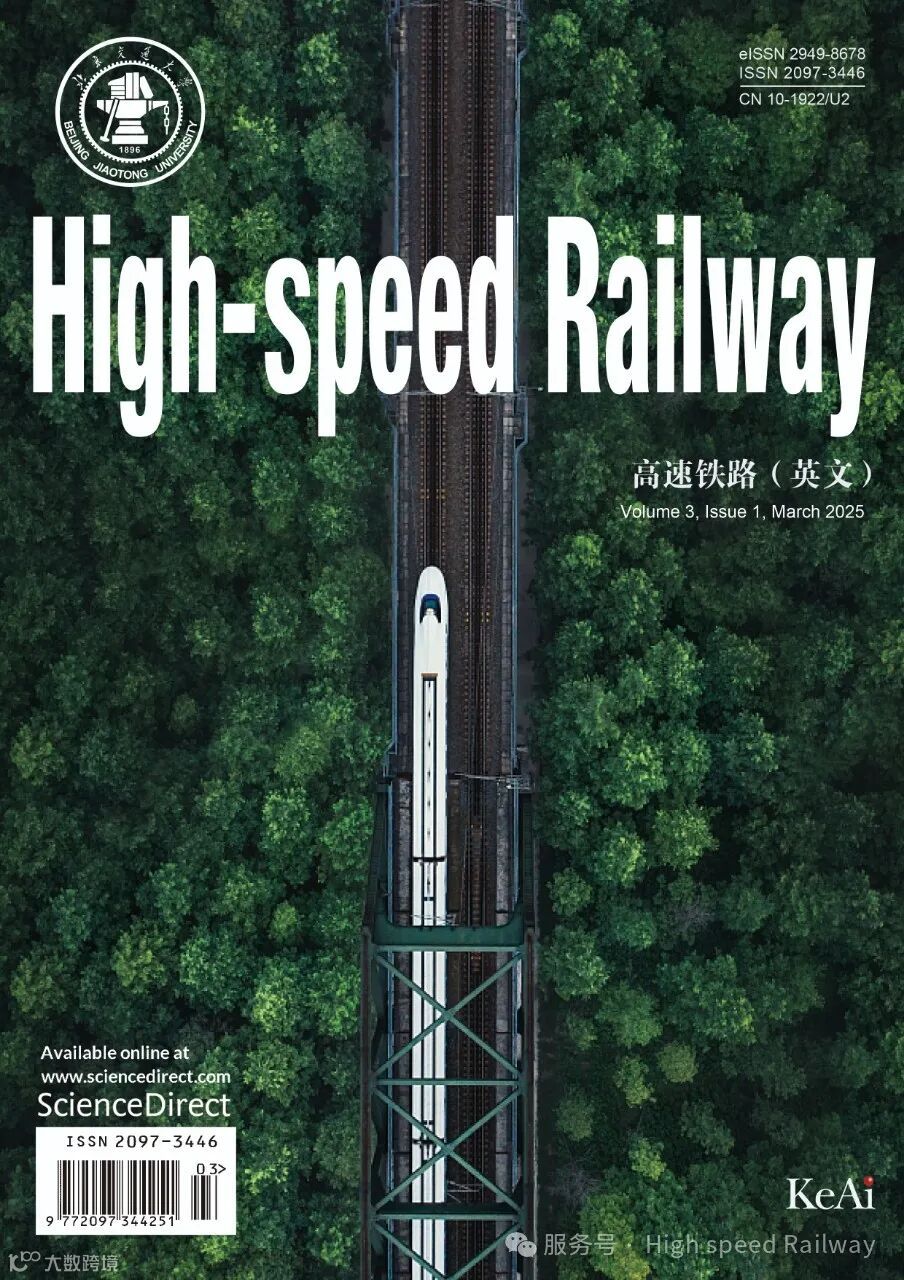
High-speed Railway(《高速铁路(英文)》ISSN 2949-8678;英文缩写HSPR)是由北京交通大学主办的开放获取型英文学术期刊,期刊入选2022年度中国科技期刊卓越行动计划高起点新刊项目。期刊主编由卢春房院士担任。
High-speed Railway主要刊发交通运输类相关的综述性论文和研究性论文。期刊以传播新理论、新技术,探讨高速铁路发展中的理论与实践问题为导向,坚持理论与实践、引进与创新相结合的方针,努力反映高速铁路规划与设计、运营与管理,高速铁路设备及铁路工程等方面的最新成果,促进国际间的学术交流与合作,为提升我国高速铁路事业的国际影响力,促进世界高速铁路技术的发展服务。
High-speed Railway期刊收录的所有文章都经过严格、高水平的同行评审,一经收录将发表在月活用户超过1700万的ScienceDirect平台,供领域内的学者及全球读者免费阅读、下载及引用。
主编:卢春房
中国铁道学会理事长
中国工程院院士
铁路工程技术和管理专家
长期从事铁路建设管理和科技创新工作
执行主编:余祖俊
北京交通大学校长、教授
中国铁道学会理事
中国铁道学会智能铁路委员会副主任委员
中国智能交通协会常务理事
轨道交通安全监控技术领域知名专家
期刊主页:

https://www.keaipublishing.com/en/journals/high-speed-railway/
投稿地址:

https://www.editorialmanager.com/hspr/default2.aspx
联系邮箱:
sgu@bjtu.edu.cn
往期精彩:
期刊High-speed Railway第二卷第四期论文已上线!
期刊High-speed Railway2024年第三期论文已上线!
期刊High-speed Railway2024年第二期论文已上线!
期刊High-speed Railway2024年第一期论文已上线!

END
期待您的投稿!
编辑 | 刘泽琳
审核 | 顾 爽