


The ICH Q7 guideline has been existing since 2000 and was amended in 2015 with a Questions and Answers document supporting a clear interpretation and modernizing the guideline. ICH Q7 was unique at its time because it included in a holistic and comprehensive way the modern elements of quality assurance and quality management: for example risk control, computer system validation and integrated quality approaches. The Q&A document officially adapted the ICH Q9 and Q10 risk-based approaches and clearly integrated Q7 in the ICH Pharma Quality System (PQS). ICH Q7 anticipates major elements of Data Integrity (DI), even though it was created just before Data Integrity became a major topic in the pharmaceutical industry.
ICH Q7指南自2000年起就已存在,并于2015年进行了修订,同时发布了一份问答文件,以提供清晰的解释并使该指南现代化。在当时,ICH Q7是独一无二的,因为它以全面和综合的方式纳入了质量保证和质量管理的现代元素:例如风险控制、计算机系统验证以及综合质量方法。问答文件正式采用了ICH Q9和Q10基于风险的方法,并明确将Q7整合到ICH药品质量体系(PQS)中。ICH Q7预见了数据可靠性的主要要素,尽管它是在数据可靠性成为制药行业重要议题之前创建的。
The question we want to explore is whether Data Integrity is a completely new approach or just a different perspective on already existing GMP requirements as those arising from ICH Q7.
我们想要探讨的问题是:数据可靠性是否是一种全新的方法,还是只是对现有的 GMP要求(包括源自ICH Q7的要求)的一种不同解读。
Data Integrity can be described as "the opposite of data corruption, which is a form of data loss. … In short, data integrity aims to prevent unintentional changes to information." And "Data integrity refers to maintaining and assuring the accuracy and consistency of data over its entire life-cycle, and is a critical aspect to the design, implementation and usage of any system which stores, processes, or retrieves data."
数据可靠性可以被描述为“与数据损坏的对立面,而数据损坏是一种数据丢失的形式……简而言之,数据可靠性旨在防止信息出现非故意的更改。”并且“数据可靠性指的是在整个数据生命周期内保持并确保数据的准确性和一致性,这是任何存储、处理或检索数据的系统的设计、实施和使用中一个至关重要的方面。”
In general, Data Integrity elements are categorized by
总的来说,数据可靠性要素是按照以下方式进行分类的:
Physical Integrity (e.g. safety, security, durability)
物理完整性(例如安全性、安全性、耐久性)
Logical Integrity (e.g. context, plausibility)
逻辑完整性(例如上下文、合理性)
Scientific Integrity (e.g. correctness, accuracy)
科学完整性(例如准确性、精确性)
It is important to understand that Data Integrity is not Data Quality, even though it is one of the elements and a prerequisite to it. Using data, we collect information which is aggregated to knowledge; if we use wrong data, we may use wrong information to conclude wrong things. This can be a threat to patients at the end.
需要明白的是,数据可靠性并非数据质量,尽管它是其中的一个要素,并且是其前提条件之一。通过使用数据,我们收集信息并将其汇总为知识;如果使用了错误的数据,就可能会使用错误的信息来得出错误的结论。这最终可能会对患者构成威胁。
Data Integrity requirements and measures can be divided into the following facts:
数据可靠性要求及措施可归纳为以下几点:
Organizational 组织类
Technical 技术类
Records/Documents/Data 记录/文件/数据
If you compare these Data Integrity elements with Q7, represented by the chapters where organizational elements are marked yellow, system and process relevant green, and the records/documents/data are labelled blue:
如果将这些数据可靠性要素与Q7进行比较,那么Q7的表现形式是:将组织要素标注为黄色、与系统和流程相关的要素标注为绿色,而记录/文件/数据则标注为蓝色:
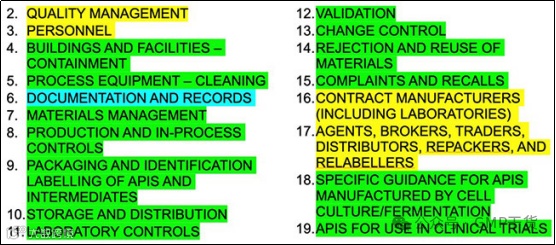
It is quite interesting, how much alignment between Data Integrity and the Q7 elements are to be found. Furthermore, ICH Q7 is one of the first examples for a systematic quality risk management. In particular, it can be seen as an application of pragmatic risk categorization determined by the distance to the patient and the influence on the quality of the (medicinal) product. A principle, which is nowadays the standard for many DI guidelines (compared to e.g. FDA's and MHRA's guidelines) which are using the concepts of direct and indirect data (direct influence on patient safety and product quality or not), adding complexity as a risk criterium via the static and dynamic (interactive) data.
这确实很有趣,因为数据可靠性与Q7项目的内容之间存在着如此多的契合之处。此外,ICH Q7是系统性质量风险管理的首批范例之一。特别是,它可以被视为一种基于与患者距离以及对(药物)产品质量影响程度而确定的实用风险分类的应用。这一原则如今已成为许多数据可靠性指南的标准(与例如FDA和MHRA的指南相比,这些指南使用了直接和间接数据的概念(即对患者安全和产品质量是否有直接影响),并通过静态和动态(交互)数据添加了复杂性作为风险标准)。
In their 2004 document "PHARMACEUTICAL CGMPS FOR THE 21ST CENTURY - A RISK-BASED APPROACH", the FDA explains their "Strategic Action Plan for Protecting and Advancing America's Health". The Agency's Strategic Plan identified efficient risk management as a key element: "Efficient risk management requires using the best scientific data, developing quality standards, and using efficient systems and practices that provide clear and consistent decisions …". Taking this plan into consideration, risk management, best scientific data and consistent decision making is calling out already for what we later call Data Integrity.
在2004年发布的文件《21世纪制药GCP指南——基于风险的方法》中,FDA阐述了其“保护和促进美国健康的战略行动计划”。该机构的战略计划将有效的风险管理确定为关键要素:“有效的风险管理需要利用最优质的科学数据、制定质量标准,并采用高效系统和实践来做出清晰且一致的决策……”。考虑到这一计划,风险管理、最优质的科学数据以及一致的决策制定已经呼唤出我们后来所称的数据可靠性。
It is important to understand that (quality) risk management is essential to the implementation and maintenance of Data Integrity concepts. In order to control the risks they need to be categorized. Such a categorization must be simple and easy to be applied fast, consistently and reliably. A systematic approach is necessary to implement a holistic Data Integrity strategy. Such holistic and systematic approaches are based on a Data Integrity risk analysis, which is again the base for deriving governance concepts including master data. For the data (quality) strategy risks are collected in a register/inventory which also comprises measures and uses classifications to maintain an overview of the organization's data, systems, and processes throughout the lifecycle and to consistently control them. Libraries of such risks, measures, methods to GMP and Data Integrity ensure systematic, efficient and effective results. This includes the acceptance of risks!
重要的是要明白,(质量)风险管理对于数据可靠性概念的实施和维持至关重要。为了控制这些风险,需要对其进行分类。这种分类必须简单易行,能够快速、一致且可靠地应用。实施全面的数据可靠性策略需要采用系统的方法。这种全面且系统的方法基于数据可靠性风险分析,而这也是制定包括主数据在内的治理概念的基础。对于数据(质量)策略,风险会记录在一份登记册/清单中,该清单还包括措施,并使用分类来在整个生命周期内保持对组织的数据、系统和流程的全面概览,并持续对其进行控制。此类风险、措施、符合GMP的方法和数据可靠性方面的知识库确保了系统、高效和有效的结果。这包括对风险的接受!
As per practical experience, hybrid records (i.e. systems maintaining both paper and electronic records, typically with "paper lead") bear the highest risks to data and records, and are for that reason in the main focus of inspections and audits. Due to high efforts for the second person review of both paper and electronic records, and due to the need to assure that both are correct, consistent and synchronized, they expose the organizations to high financial and regulatory risks.
根据实际经验可知,混合型记录(即同时保存纸质记录和电子记录的系统,通常以“纸质记录优先”的方式呈现)对数据和记录的风险最大,因此在检查和审计中通常会成为重点关注对象。由于需要对纸质记录和电子记录进行二次审查,且必须确保两者内容准确、一致且同步,这使得组织面临巨大的财务和监管风险。
Since classical GMP regulations like ICH Q7 and the current Data Integrity standards are founded on the same basic principles, it rather seems to be a natural extension of the GMPs to the 21st century than a completely new metamorphosis - set by the authorities to assure the safety of the public and the best product quality.
由于像ICH Q7这样的传统GMP规范以及当前的数据可靠性标准都是基于相同的基本原则制定的,所以将GMP体系引入21世纪似乎更像是一种自然的延伸,而非完全意义上的全新变革——这是相关机构为了确保公众安全和提供最佳产品质量而做出的安排。
全市场最全面的医药行业培训汇总↓
| 地点 | 时间 | (点击↓链接阅读全文) |
|
|
|
|
|
|
|
|
|
|
|
|
|
|
|
|
|
|
|
|
|
|
|
|
|
|
|
|
|
|
|
|
|
|
|
|
|
|
|
|
|
|
|
|
百份录播视频供您学习,感兴趣的老师可添加小编微信
15210773629获取课程目录 价格美丽可提供发票
个人公司均可采购
大咖经验案例分享,单个视频时长12h 画质,声音高清
可下载保存在本地随时打开观看阅读