


Introduction 引言
English:
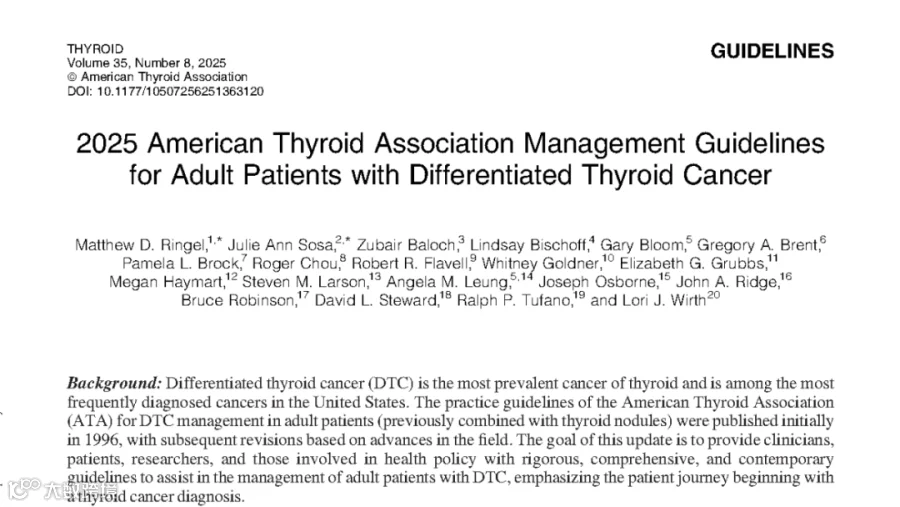
Differentiated thyroid cancer (DTC) includes papillary, follicular, and oncocytic carcinomas, comprising the vast majority (>90%) of all thyroid cancers. In the United States, it is estimated that there were 44,020 new cases of thyroid cancer in 2024, compared with 37,200 in 2015 when the last American Thyroid Association (ATA) guidelines were published.
中文:
分化型甲状腺癌(DTC)包括乳头状癌、滤泡状癌和嗜酸细胞型癌,占所有甲状腺癌的绝大多数(>90%)。在美国,预计2024年将有44,020例新的甲状腺癌病例,而2015年美国甲状腺协会(ATA)上次发布指南时为37,200例。
English:
The yearly incidence tripled from 4.9 per 100,000 in 1975 to 14.3 per 100,000 in 2015. Approximately 25% of the new thyroid cancers diagnosed in 1988–1989 were <1 cm, compared with 39% in 2008–2009. This shift to earlier detection/diagnosis correlates with the increasing use of neck ultrasonography and ultrasound-guided fine needle aspiration (FNA).
中文:
甲状腺癌的年发病率从1975年的每10万人4.9例上升至2015年的14.3例,增长了三倍。1988–1989年间被诊断出的新发甲状腺癌中约25%的肿瘤直径小于1厘米,而到2008–2009年这一比例上升至39%。这种早期发现与诊断的变化,与颈部超声检查及超声引导下细针穿刺(FNA)技术的广泛应用密切相关。
English:
However, since 2014, the incidence—particularly of small thyroid cancers—has declined in the United States. This likely reflects the adoption of ATA and other organizations’ recommendations discouraging FNA of nodules <1 cm without suspicious lymph nodes or invasion, given their excellent prognosis and the risks of overtreatment.
中文:
然而,自2014年以来,美国甲状腺癌的发病率,尤其是小肿瘤的发病率有所下降。这一趋势可能反映了ATA及其他组织的建议被广泛采纳——即对无可疑淋巴结或侵犯迹象、直径小于1厘米的结节不主张行FNA穿刺,因为此类肿瘤预后极好,过度诊治的风险反而更大。
English:
Beyond the early-stage management changes, prior guidelines also introduced criteria for initial decision-making and frameworks for response assessment after interventions. These have been validated and adopted into clinical practice.
中文:
除早期甲状腺癌管理方式的调整外,前版指南还提出了初始治疗决策标准及治疗反应评估框架。这些标准随后得到了验证并被临床广泛采纳。
English:
Major advances in understanding the molecular mechanisms of thyroid cancer have created new approved treatment options for specific subgroups of patients. Such developments necessitate serial updates of the guidelines to support optimal clinical care.
中文:
随着对甲状腺癌分子机制认识的显著进展,一些针对特定患者亚群的新型治疗方法获得批准。这些进展使得持续更新指南成为保障最佳临床实践的必要措施。
English:
In this 2025 update, a clinical decision-making framework is introduced called “DATA”: Diagnosis, risk/benefit Assessment, Treatment decisions, and response Assessment. It accompanies patients from diagnosis through their entire disease journey.
中文:
2025年新版指南引入了一个新的临床决策框架——“DATA” 模型:即 诊断(Diagnosis)、风险与获益评估(Assessment)、治疗决策(Treatment decisions) 以及 反应评估(Assessment)。这一框架贯穿患者从确诊到整个疾病管理过程。
English:
The DATA framework helps clinicians and patients evaluate whether interventions are appropriate based on risks, benefits, and individual factors. It guides the selection of optimal strategies and informs subsequent monitoring or further treatment.
中文:
DATA框架帮助临床医生和患者在风险、获益及个体差异的基础上判断干预措施的适宜性,从而选择最优的管理策略,并为后续监测与进一步治疗提供指导。
English:
Since the first 1996 ATA guidelines for thyroid nodules and DTC, there have been remarkable advances in diagnosis and treatment. Nevertheless, controversies persist, underscoring the need for individualized therapy.
中文:
自1996年ATA首次发布甲状腺结节与分化型甲状腺癌指南以来,诊断与治疗领域均取得了显著进展。然而,许多方面仍存在争议,强调了个体化治疗的重要性。
English:
For example, less aggressive management is preferred for early-stage DTC with excellent prognosis or for those at high risk of treatment complications, while more aggressive strategies are warranted for patients with high-risk or refractory disease.
中文:
例如,对于预后良好的早期DTC或具有较高治疗并发症风险的患者,应采用较为保守的管理方式;而对于高风险或初治无效的患者,则应采取更积极的治疗策略。
English:
Despite progress, there remain too few high-quality clinical trials in thyroid cancer, contributing to ongoing uncertainty in many management areas. This guideline highlights key topics requiring further research.
中文:
尽管取得了显著进展,但甲状腺癌领域仍缺乏高质量的临床研究,这导致许多管理环节仍存在不确定性。指南特别指出了若干亟待进一步研究的关键问题。
English:
Clinical decisions are increasingly shared between patients and clinicians. Thus, survivorship, psychosocial factors, and patient-reported outcomes are emphasized. Multidisciplinary and transdisciplinary collaboration—such as tumor boards and co-located clinics—is encouraged.
中文:
临床决策正越来越多地由医生与患者共同完成。因此,本指南特别强调了癌症幸存者管理、心理社会因素以及患者报告结局的重要性。同时,倡导多学科及跨专业协作,例如多学科肿瘤讨论会及联合门诊,以促进高质量的综合诊疗。
Aim and Target Audience 指南目的与目标读者
English:
The objective in these guidelines is to inform clinicians, patients, researchers, and health policy makers about the best available evidence (and its limitations) relating to the diagnosis and treatment of adult patients (over 18 years of age) with differentiated thyroid cancer (DTC). ATA guidelines for pediatric thyroid cancer have been published and/or are under development.
中文:
本指南的目标是为临床医生、患者、科研人员以及卫生政策制定者提供有关成人(18岁及以上)分化型甲状腺癌(DTC)诊断与治疗的最新、最可靠的循证依据(同时指出证据的局限性)。此外,美国甲状腺协会(ATA)针对儿童甲状腺癌的指南已发布或正在制定中。
English:
Compared with prior guidelines, this document applies only to DTC, including individuals diagnosed with noninvasive follicular tumors with papillary-like nuclear features (NIFTP) and follicular tumors with uncertain malignant potential (FUMP), which are extremely low-risk lesions diagnosable only after surgical excision.
中文:
与以往指南不同,本文件仅适用于DTC患者,其中包括被诊断为**具有乳头状核特征的非侵袭性滤泡性肿瘤(NIFTP)及恶性潜能不确定的滤泡性肿瘤(FUMP)**的个体。这些病变属于极低风险类型,通常只有在外科切除并经病理检查后才能确诊。
English:
This document is intended to inform clinical decision-making using the DATA framework as patients progress through their journey with thyroid cancer—minimizing potential harm from overtreatment in low-risk patients while intensively monitoring and treating those at higher risk, including aggressive forms of DTC.
中文:
本指南旨在通过“DATA”框架指导临床决策,贯穿患者整个甲状腺癌诊疗过程。对于低风险患者,应尽量避免过度治疗造成的潜在损害;而对于高风险或侵袭性DTC患者,则需加强监测与治疗。
English:
These guidelines should not be interpreted as a replacement for clinical judgment and are meant to complement informed, shared patient–clinician decision-making. Recommendations should be applied in the context of individual demographic, clinical, and pathological characteristics.
中文:
本指南并非用于取代临床医生的专业判断,而应作为医生与患者在知情基础上共同决策的辅助工具。各项推荐应结合个体的年龄、临床表现及病理特征等因素进行灵活应用。
English:
It is recognized that national clinical practice guidelines may not constitute a legal standard of care in all jurisdictions. Physicians encountering practice setting differences may adapt these guidelines using established methods, such as those of the ADAPTE Collaboration (www.g-i-n.net).
中文:
应当认识到,国家级临床实践指南在不同地区未必构成法律意义上的“标准医疗行为”。若临床实践环境存在差异,医生可参照既定方法(如ADAPTE协作组织,网址:www.g-i-n.net)对指南进行本地化调整。
English:
The ADAPTE Collaboration is an international network of researchers and guideline developers dedicated to promoting the development and adaptation of clinical practice guidelines worldwide.
中文:
ADAPTE协作组织是一个由全球研究者和指南制定者组成的国际网络,致力于促进临床实践指南的制定与本地化应用。
English:
As our primary focus was the quality of evidence related to health outcomes and diagnostic testing, the task force chose not to emphasize economic resources or financial implications within individual recommendations.
中文:
由于本指南的核心聚焦于健康结局及诊断检测相关的证据质量,专家组在各项推荐中并未将经济资源或费用影响作为主要考量因素。
English:
However, with attention to survivorship and the inclusion of a patient advocate, a dedicated section addresses “financial toxicity”—the economic burden caused by cancer diagnosis and treatment—as an emerging area of clinical and policy concern.
中文:
然而,鉴于指南同时关注癌症幸存者问题并吸纳了患者代表的意见,文中特别设立章节讨论了“经济毒性”(financial toxicity)——即癌症诊疗带来的经济负担——这一逐渐受到临床与政策重视的新领域。
English:
It is recognized that other organizations have developed DTC guidelines both within the United States and internationally. While there are many similarities across guidelines, differences exist in appraisal methods, practice patterns, and access to diagnostic or therapeutic resources.
中文:
同时,我们也认识到,美国国内及国际上其他组织亦制定了DTC相关指南。虽然多数指南在总体思路上相似,但在证据评价方法、临床实践模式以及诊疗资源可及性等方面仍存在差异。
English:
These variations underline the importance of clarifying evidential uncertainties through additional research and highlight that complete consensus among organizations is neither expected nor necessary.
中文:
这些差异进一步凸显了通过更多研究来澄清证据不确定性的必要性,也表明不同学术组织之间不必在所有问题上完全一致。
Methods 方法学
English:
The ATA Guidelines Task Force on Differentiated Thyroid Cancer (DTC) was established by the ATA Board of Directors and included experts in endocrinology, surgery, nuclear medicine, oncology, radiology, pathology, epidemiology, and patient advocacy.
中文:
美国甲状腺协会(ATA)董事会组建了分化型甲状腺癌(DTC)指南专家工作组。该工作组成员包括来自内分泌学、外科学、核医学、肿瘤学、影像学、病理学、流行病学以及患者倡导领域的专家。
English:
The multidisciplinary composition of the task force aimed to ensure that the recommendations would reflect the full spectrum of clinical care and scientific expertise relevant to DTC.
中文:
工作组的多学科构成旨在确保指南推荐能够充分反映DTC相关的全面临床照护与科学研究视角。
English:
All members completed conflict of interest (COI) disclosures. Any potential conflicts were reviewed by the ATA Guidelines and Statements Committee. Members with significant conflicts abstained from voting on relevant recommendations.
中文:
所有成员均填写了利益冲突(COI)披露表。潜在利益冲突由ATA指南与声明委员会进行审查;若成员存在实质性利益冲突,则在相关推荐内容表决时需回避。
English:
The guideline development process adhered to the principles outlined by the Institute of Medicine (now National Academy of Medicine) for trustworthy guideline development, emphasizing transparency, evidence quality, and multidisciplinary input.
中文:
指南的制定过程遵循了美国医学研究院(现为美国国家医学院)提出的“可信赖临床指南制定原则”,重点强调透明性、证据质量以及多学科参与。
English:
Literature searches were conducted using PubMed and Embase databases through August 2023. The search terms included combinations of “thyroid cancer,” “differentiated thyroid carcinoma,” “treatment,” “surgery,” “radioiodine,” “TSH suppression,” “ultrasound,” and related topics.
中文:
文献检索通过 PubMed 与 Embase 数据库进行,截止至2023年8月。检索关键词包括:“thyroid cancer”(甲状腺癌)、“differentiated thyroid carcinoma”(分化型甲状腺癌)、“treatment”(治疗)、“surgery”(手术)、“radioiodine”(放射性碘)、“TSH suppression”(TSH抑制)、“ultrasound”(超声)及其他相关主题。
English:
The evidence review prioritized systematic reviews and meta-analyses, supplemented by large prospective and retrospective studies when high-quality syntheses were unavailable.
中文:
证据评估优先采用系统综述与Meta分析;当缺乏高质量综合研究时,补充纳入大规模前瞻性或回顾性研究。
English:
Recommendations were formulated through consensus during structured meetings and virtual discussions. Evidence quality and recommendation strength were graded using the GRADE system (Grading of Recommendations, Assessment, Development, and Evaluation).
中文:
推荐意见通过结构化会议及线上讨论形成共识,并依据 GRADE 系统(推荐分级、评估、制定与评价)评估证据质量与推荐强度。
English:
Under the GRADE framework, the quality of evidence is categorized as high, moderate, low, or very low, depending on factors such as study design, consistency of results, directness of evidence, and precision.
中文:
按照 GRADE 框架,证据质量分为“高(high)”、“中(moderate)”、“低(low)”和“极低(very low)”四个等级,评估标准包括研究设计、结果一致性、证据直接性及结果精确性等因素。
English:
The strength of each recommendation was classified as either strong or weak (conditional). A strong recommendation indicates that most informed patients would choose the recommended management, while a weak recommendation implies variation depending on patient values or clinical circumstances.
中文:
推荐强度分为“强(strong)”或“弱/条件性(weak/conditional)”。
“强推荐”意味着大多数知情患者都会选择该管理策略;“弱推荐”则表示患者选择可能因个体价值观或临床情况而有所不同。
English:
Draft recommendations were reviewed by the ATA Guidelines and Statements Committee and the ATA Board of Directors before public posting for stakeholder comment. Feedback was incorporated into the final version following additional deliberation.
中文:
指南初稿由ATA指南与声明委员会及董事会审查后,向公众公开征求意见。专家组根据反馈意见进行进一步讨论和修订,最终形成正式发布版本。
English:
The final document was peer reviewed and approved by the ATA Board of Directors. The guideline represents the consensus of the task force based on available evidence and expert interpretation.
中文:
最终文件经同行评审,并获得ATA董事会批准。本指南代表专家工作组基于现有证据与专家解读达成的共识性意见。
English:
Given the rapidly evolving field, the ATA intends to update this guideline periodically as new data emerge that could significantly affect recommendations.
中文:
鉴于该领域发展迅速,ATA计划在未来定期更新本指南,以便在有重要新证据出现时及时调整相关推荐。
Key Changes from the 2015 ATA Guidelines 相较2015年指南的主要变化
English:
The 2025 ATA guidelines incorporate numerous updates reflecting advances in clinical practice, diagnostics, and therapeutics over the past decade. These changes aim to refine patient selection, reduce unnecessary interventions, and integrate novel molecular and imaging tools.
中文:
2025版ATA指南在临床实践、诊断及治疗等多个方面进行了更新,反映了过去十年内的重要进展。本次修订旨在进一步优化患者分层、减少不必要的干预,并纳入新的分子学与影像学技术。
English:
Among the most significant updates is the adoption of the DATA framework—a clinical decision-making model that emphasizes Diagnosis, risk/benefit Assessment, Treatment decisions, and response Assessment throughout the patient’s disease course.
中文:
本次更新最重要的变化之一是引入了 DATA 决策框架 ——该临床决策模型在患者整个疾病管理过程中强调 诊断(Diagnosis)、风险与获益评估(Assessment)、治疗决策(Treatment decisions) 与 反应评估(Assessment)。
English:
This model promotes a continuous and individualized approach to DTC management, encouraging shared decision-making between clinicians and patients and ensuring that therapeutic intensity matches disease risk.
中文:
该模型倡导以持续、个体化为核心的DTC管理方式,鼓励医生与患者共同决策,并确保治疗强度与疾病风险相匹配。
English:
Other key changes include:
Refinement of FNA Indications: Updated thresholds for biopsy of thyroid nodules based on sonographic pattern and risk category, reflecting data on malignancy rates and outcomes.
Revision of Risk Stratification: Expanded use of postoperative risk classification incorporating molecular markers and histopathologic variables.
Updated Recommendations for Radioiodine (RAI) Therapy: More selective use of RAI in low-risk patients and individualized dosimetry for intermediate/high-risk disease.
Dynamic Risk Assessment: Greater emphasis on using response to therapy to guide long-term follow-up intensity.
Integration of Molecular Testing: Guidance on the role of molecular diagnostics in indeterminate cytology and recurrent/metastatic disease.
Survivorship and Financial Toxicity: New focus on quality of life, psychosocial aspects, and the economic burden associated with thyroid cancer care.
中文:
其他主要更新包括:
FNA穿刺适应证的优化:根据超声影像特征及风险分级调整穿刺阈值,反映最新恶性率与临床结局研究数据。
风险分层体系的修订:扩大术后风险分类体系的应用,纳入分子标志物与组织病理特征。
放射性碘治疗(RAI)建议更新:对于低风险患者更加谨慎选择RAI;中高风险患者则建议个体化剂量评估。
动态风险评估(Dynamic Risk Assessment):更加强调根据治疗反应动态调整长期随访强度。
分子检测的整合:明确分子诊断在不确定细胞学结果及复发/转移性疾病中的作用。
癌症幸存者与经济毒性:新增章节关注生活质量、心理社会影响以及甲状腺癌诊疗带来的经济负担。
English:
The guideline also introduces a more detailed approach to TSH suppression, advocating for personalized targets based on disease stage, age, comorbidities, and response to therapy.
中文:
本指南还提出了更为细化的 TSH抑制策略,主张根据疾病分期、患者年龄、合并症及治疗反应制定个体化目标。
English:
Furthermore, the section on active surveillance for small, low-risk papillary thyroid cancers has been expanded with updated evidence and clearer selection criteria for candidates suitable for observation.
中文:
此外,关于 小体积、低风险乳头状甲状腺癌的主动监测(active surveillance) 部分得到了扩展,纳入了最新研究证据,并明确了适合观察随访的患者选择标准。
English:
New recommendations are provided for the management of recurrent and metastatic disease, including the integration of molecularly targeted therapies such as RET, NTRK, and BRAF inhibitors.
中文:
新增了针对 复发及转移性疾病 的管理建议,包括整合分子靶向治疗,如 RET、NTRK 及 BRAF 抑制剂的临床应用。
English:
Updates in imaging and follow-up include a refined role for ultrasound, diagnostic RAI scans, and cross-sectional imaging (CT, MRI, PET/CT), depending on response to initial therapy.
中文:
在 影像学与随访 方面,更新了超声、诊断性RAI显像以及断层影像(CT、MRI、PET/CT)在不同治疗反应阶段的具体应用建议。
English:
Finally, this guideline recognizes the growing importance of patient-centered care, including communication, decision support, and addressing survivorship issues such as fertility, fatigue, and fear of recurrence.
中文:
最后,本指南强调了 以患者为中心的照护理念 的日益重要性,强调在诊疗过程中应重视医患沟通、决策支持,以及癌症幸存者常见问题的管理,如生育、疲劳及复发焦虑等。
English:
Collectively, these updates reflect a shift toward precision medicine and value-based care—providing the right treatment, at the right time, for the right patient.
中文:
总体而言,这些更新体现了向 精准医疗 与 价值导向医疗 的转变——即在正确的时间,为合适的患者提供最恰当的治疗。
The DATA Framework in Detail DATA 决策框架详解
English:
The DATA framework provides a structured, cyclical approach to clinical decision-making across the continuum of care for differentiated thyroid cancer (DTC). It emphasizes the interplay between diagnostic precision, individualized risk–benefit assessment, targeted treatment, and adaptive follow-up.
中文:
DATA框架为分化型甲状腺癌(DTC)的临床决策提供了一种结构化、循环性的管理模式。它强调诊断精确性、个体化风险与获益评估、靶向治疗策略以及动态随访之间的相互衔接。
English:
Unlike linear treatment algorithms, DATA represents a dynamic cycle—where the outcome of each phase informs the next, and reassessment is integral to ongoing care.
中文:
不同于传统的线性治疗流程,DATA模型体现了一个动态循环的概念——每个阶段的结果都会影响后续决策,而持续的再评估是整个管理过程的核心组成部分。
1. D – Diagnosis 诊断
English:
Accurate diagnosis remains the cornerstone of effective management. Diagnosis integrates clinical history, physical examination, high-resolution neck ultrasound, cytology, and, when indicated, molecular testing.
中文:
准确诊断始终是有效管理的基石。诊断过程应整合患者病史、体格检查、高分辨率颈部超声、细胞学检查,并在必要时辅以分子检测。
English:
The 2025 ATA guidelines emphasize judicious use of FNA, avoiding unnecessary biopsies in nodules <1 cm lacking suspicious features. Molecular testing may refine risk assessment in indeterminate nodules (Bethesda III/IV).
中文:
2025版ATA指南强调FNA(细针穿刺活检)的合理使用,避免对直径<1 cm且无可疑征象的结节进行不必要的穿刺。对于细胞学结果不确定(Bethesda III/IV类)的结节,可通过分子检测进一步明确风险分级。
2. A – Risk/Benefit Assessment 风险与获益评估
English:
Following diagnosis, clinicians assess both disease-related and patient-specific factors to weigh risks and benefits of different management strategies.
中文:
确诊后,临床医生需综合评估疾病特征与患者个体因素,以权衡不同管理策略的风险与获益。
English:
Risk assessment integrates tumor stage, histologic subtype, molecular profile, and comorbidities. Patient preferences, psychosocial context, and potential treatment-related harms are equally important.
中文:
风险评估应结合肿瘤分期、组织学类型、分子特征及合并疾病等信息。同时,患者的意愿、心理社会背景以及治疗相关潜在损伤也应纳入考虑。
English:
This individualized assessment ensures that overtreatment is minimized in low-risk disease, while patients with intermediate- or high-risk disease receive timely and appropriate therapy.
中文:
通过这种个体化评估,可最大程度避免低风险患者的过度治疗,同时确保中高风险患者获得及时、恰当的干预。
3. T – Treatment Decisions 治疗决策
English:
Treatment decisions encompass the entire spectrum of DTC management—ranging from active surveillance and thyroid lobectomy to total thyroidectomy, radioactive iodine (RAI) therapy, and systemic targeted treatments.
中文:
治疗决策涵盖DTC管理的全程,包括主动监测、甲状腺叶切除、全甲状腺切除、放射性碘(RAI)治疗以及系统性靶向治疗等。
English:
The DATA framework encourages tailoring treatment intensity to risk category and response to prior therapy. For example, low-risk microcarcinomas may be observed, while advanced disease may warrant multimodal therapy.
中文:
DATA框架鼓励根据风险等级和既往治疗反应调整治疗强度。例如,低风险微小癌可采用观察随访,而进展性疾病则可能需要多模式联合治疗。
English:
Decision-making should be shared between clinician and patient, guided by evidence and patient values, ensuring alignment between medical recommendations and individual preferences.
中文:
治疗决策应由医生与患者共同制定,在循证依据的指导下充分尊重患者价值观,确保医疗建议与个体意愿相一致。
4. A – Response Assessment 反应评估
English:
Response to therapy must be continuously evaluated using biochemical markers (such as thyroglobulin and anti-thyroglobulin antibodies), imaging studies, and clinical parameters.
中文:
治疗反应的评估应持续进行,综合参考生化指标(如甲状腺球蛋白及其抗体)、影像学检查及临床表现。
English:
Dynamic risk stratification allows clinicians to modify follow-up intensity and therapeutic approach based on evolving disease behavior rather than static baseline categories.
中文:
动态风险分层使临床医生能够根据疾病进展的实际表现,而非仅依据初始分层,灵活调整随访频率和治疗策略。
English:
For example, a patient initially classified as intermediate risk who demonstrates an excellent response may transition to a less intensive follow-up protocol.
中文:
例如,一位最初被归为中等风险的患者若表现出极佳的治疗反应,可转入较低频率的随访方案。
Integration and Reassessment 整合与再评估
English:
The DATA cycle is iterative—each reassessment may reinitiate the diagnostic process, update risk assessment, or prompt treatment modification.
中文:
DATA循环是可重复的——每次再评估都可能重新启动诊断流程、更新风险评估,或促使调整治疗方案。
English:
This continuous feedback loop supports precision medicine by aligning management decisions with evolving evidence and patient outcomes.
中文:
这种持续反馈机制使管理决策能够与最新证据和患者结局保持一致,从而实现真正的精准医疗。
English:
Ultimately, DATA promotes a culture of adaptive, evidence-based, and patient-centered care—acknowledging that management of DTC is not static but an evolving partnership between clinician and patient.
中文:
归根结底,DATA框架倡导一种动态、循证且以患者为中心的照护理念,承认DTC管理不是一成不变的过程,而是医生与患者共同成长、不断调整的协作关系。
Diagnosis of Differentiated Thyroid Cancer 分化型甲状腺癌的诊断
English:
Accurate diagnosis is the foundation of appropriate management for differentiated thyroid cancer (DTC). Diagnosis relies on the integration of clinical findings, imaging, cytology, and, where indicated, molecular testing. The goal is to distinguish benign from malignant nodules and to guide the extent of surgery or surveillance.
中文:
准确的诊断是分化型甲状腺癌(DTC)合理管理的基础。诊断应综合临床表现、影像学检查、细胞学结果及必要时的分子检测。其核心目标在于区分良性与恶性结节,并据此指导手术范围或观察随访策略。
Clinical Evaluation 临床评估
English:
Initial evaluation begins with a thorough history and physical examination. Risk factors associated with malignancy include prior childhood head and neck irradiation, family history of thyroid carcinoma, rapid nodule growth, hoarseness, and cervical lymphadenopathy.
中文:
初步评估应从详尽的病史采集和体格检查开始。与恶性风险相关的因素包括:儿童期头颈部放射史、家族性甲状腺癌病史、结节快速生长、声音嘶哑以及颈部淋巴结肿大等。
English:
Physical examination should focus on palpation of the thyroid gland and cervical lymph nodes, noting fixation, tenderness, or invasion into adjacent structures such as the trachea or strap muscles.
中文:
体格检查应重点触诊甲状腺及颈部淋巴结,注意结节是否固定、是否有压痛,以及有无侵犯气管或颈前肌群等邻近结构的迹象。
Ultrasound Evaluation 超声检查
English:
High-resolution neck ultrasonography is the primary imaging modality for evaluating thyroid nodules. It provides information on nodule size, composition, echogenicity, margin characteristics, presence of calcifications, and vascularity.
中文:
高分辨率颈部超声是评估甲状腺结节的首选影像学手段。超声可提供结节大小、内部成分、回声特征、边缘形态、钙化情况及血流分布等信息。
English:
Suspicious sonographic features include marked hypoechogenicity, irregular margins, microcalcifications, taller-than-wide shape, and evidence of extrathyroidal extension.
中文:
可疑的超声特征包括:显著低回声、不规则边缘、微钙化、纵径大于横径的形态(高宽比>1)、以及超出甲状腺包膜的侵犯征象。
English:
The ATA ultrasound risk stratification system categorizes nodules as benign, very low, low, intermediate, or high suspicion based on their appearance, with corresponding recommendations for fine-needle aspiration (FNA).
中文:
ATA超声风险分层系统根据结节影像学特征将其分为良性、极低风险、低风险、中等风险和高风险五类,并为每一类提供相应的细针穿刺(FNA)建议。
Fine-Needle Aspiration (FNA) 细针穿刺活检
English:
FNA remains the gold standard for cytologic diagnosis of thyroid nodules. The decision to perform FNA is based on nodule size and sonographic risk category.
中文:
细针穿刺活检(FNA)仍是甲状腺结节细胞学诊断的金标准。是否行FNA取决于结节大小及其在超声中的风险分级。
English:
According to the 2025 ATA guidelines, FNA is generally recommended for:
Nodules ≥1 cm with high or intermediate suspicion patterns.
Nodules ≥1.5 cm with low suspicion patterns.
Nodules ≥2 cm with very low suspicion patterns, if observation is not chosen.
中文:
根据2025年ATA指南,FNA一般建议用于:
直径≥1 cm 且超声表现为高或中等可疑的结节;
直径≥1.5 cm 且为低可疑模式的结节;
直径≥2 cm 且为极低可疑模式的结节(若未选择观察随访)。
English:
Nodules <1 cm are typically not biopsied unless there is evidence of suspicious lymph nodes or local invasion.
中文:
直径小于1 cm 的结节通常不建议穿刺,除非伴有可疑淋巴结或局部侵犯征象。
Cytology and Bethesda System 细胞学与Bethesda分类系统
English:
Cytologic results should be reported using the Bethesda System for Reporting Thyroid Cytopathology (BSRTC), which classifies specimens into six diagnostic categories with associated malignancy risks.
中文:
细胞学结果应采用 Bethesda甲状腺细胞病理报告系统(BSRTC) 进行分级。该系统将标本分为六个诊断类别,并对应相应的恶性风险。
English:
The 2025 guidelines reaffirm the use of BSRTC but note that integration of molecular testing can refine the management of indeterminate categories (III and IV).
中文:
2025年版指南继续推荐使用Bethesda系统,同时指出可通过整合分子检测进一步优化对不确定类别(III、IV类)的管理决策。
Molecular Testing 分子检测
English:
Molecular testing evaluates genetic alterations associated with thyroid malignancy, including point mutations (BRAF, RAS), gene fusions (RET/PTC, PAX8/PPARγ), and other molecular signatures.
中文:
分子检测用于识别与甲状腺恶性肿瘤相关的基因变异,包括点突变(如BRAF、RAS)、基因融合(如RET/PTC、PAX8/PPARγ)及其他分子特征。
English:
In nodules with indeterminate cytology, the presence of high-risk mutations (e.g., BRAF V600E, RET/PTC fusion) supports a surgical approach, while absence of such findings may favor surveillance.
中文:
对于细胞学结果不确定的结节,若检测到高风险突变(如BRAF V600E、RET/PTC融合),可倾向于手术治疗;若未检测到此类变异,则更倾向于观察随访。
Histopathologic Diagnosis 组织病理诊断
English:
Definitive diagnosis of DTC is established by histopathologic examination after surgery. Subtypes include papillary thyroid carcinoma (PTC), follicular thyroid carcinoma (FTC), and oncocytic (Hürthle cell) carcinoma.
中文:
DTC的最终确诊依赖于术后组织病理学检查。其主要亚型包括:乳头状甲状腺癌(PTC)、滤泡状甲状腺癌(FTC)及嗜酸细胞型(Hürthle细胞)癌。
English:
Certain variants, such as tall cell, columnar cell, and hobnail variants of PTC, are associated with more aggressive behavior and should be specifically reported.
中文:
部分乳头状癌变异型,如高柱状细胞型、柱状细胞型及钉突细胞型(hobnail variant),通常具有更高的侵袭性,应在病理报告中明确标注。
English:
Conversely, noninvasive follicular thyroid neoplasm with papillary-like nuclear features (NIFTP) is no longer classified as carcinoma due to its indolent course and excellent prognosis.
中文:
相反,具有乳头状核特征的非侵袭性滤泡性甲状腺肿瘤(NIFTP)由于其惰性生长及极佳预后,现已不再归类为癌。
Initial Risk Stratification and Staging 初始风险分层与分期
English:
Following definitive diagnosis of differentiated thyroid cancer (DTC), initial risk stratification is essential for guiding management decisions, including the extent of surgery, use of radioactive iodine (RAI), TSH suppression targets, and follow-up intensity.
中文:
在确诊分化型甲状腺癌(DTC)后,进行初始风险分层至关重要。这一步有助于指导后续管理决策,包括手术范围、是否行放射性碘(RAI)治疗、TSH抑制目标以及随访强度。
1. TNM Staging (AJCC 8th Edition) TNM分期(AJCC第8版)
English:
The American Joint Committee on Cancer (AJCC) 8th edition staging system remains the standard for prognostic classification of DTC. It is based on tumor size (T), nodal involvement (N), and distant metastasis (M), with age serving as a key prognostic modifier.
中文:
美国癌症联合委员会(AJCC)第8版TNM分期系统仍是DTC预后评估的标准。其基于肿瘤大小(T)、淋巴结受累情况(N)和远处转移(M)进行分级,同时将患者年龄作为重要的预后修正因素。
English:
In the AJCC 8th edition, the age cutoff was raised from 45 to 55 years. Patients under 55 years are classified as stage I (no distant metastasis) or stage II (with metastasis), regardless of T or N stage.
中文:
在AJCC第8版中,年龄分界点由45岁上调至55岁。对于年龄小于55岁的患者,无论肿瘤T或N分期如何,只要无远处转移则归为Ⅰ期,若有远处转移则为Ⅱ期。
English:
For patients ≥55 years, staging follows conventional TNM combinations, with disease-specific survival declining progressively from stage I to stage IV.
中文:
而对于≥55岁的患者,分期则依据传统TNM组合进行,疾病特异性生存率随着分期的升高(I至IV期)逐步下降。
2. ATA Initial Risk Stratification ATA初始风险分层
English:
The ATA initial risk stratification system complements TNM staging by focusing on the risk of structural disease recurrence rather than mortality.
中文:
ATA初始风险分层系统是对TNM分期的补充,其重点在于预测结构性复发风险,而非仅关注死亡率。
English:
Patients are categorized into three main groups:
Low Risk: Intrathyroidal tumors without aggressive histology or vascular invasion, and no evidence of residual disease.
Intermediate Risk: Microscopic extrathyroidal extension, vascular invasion, or metastases to small-volume cervical lymph nodes (<3 cm).
High Risk: Gross extrathyroidal extension, incomplete tumor resection, or distant metastases.
中文:
患者分为三大类:
低风险组: 肿瘤局限于甲状腺内,无侵袭性组织学类型或血管侵犯,且无残余病灶。
中风险组: 存在显微镜下包膜外侵犯、血管侵犯,或颈部小体积淋巴结转移(<3 cm)。
高风险组: 出现明显包膜外侵犯、肿瘤切除不全或远处转移。
English:
The ATA system enables clinicians to tailor the intensity of initial treatment and follow-up according to recurrence risk, minimizing overtreatment in low-risk cases.
中文:
ATA分层体系使临床医生能够根据复发风险调整初始治疗与随访强度,从而减少低风险患者的过度治疗。
3. Integration of Molecular Markers 分子标志物的整合应用
English:
Molecular markers now provide additional prognostic information beyond histopathologic and clinical variables. For example, BRAF V600E and TERT promoter mutations are associated with higher recurrence and mortality risk.
中文:
分子标志物的检测可提供超越组织病理与临床参数的额外预后信息。例如,BRAF V600E 和 TERT启动子突变 与更高的复发及死亡风险相关。
English:
The combination of BRAF and TERT mutations portends particularly poor outcomes and may justify more aggressive initial therapy and closer surveillance.
中文:
当BRAF与TERT突变同时存在时,预后尤其不良,此类患者应考虑更积极的初始治疗及密切的随访监测。
English:
Conversely, RAS mutations and PAX8/PPARγ fusions are typically associated with less aggressive tumor behavior.
中文:
相反,RAS突变及PAX8/PPARγ融合通常提示肿瘤生物学行为较为温和。
4. Integration with the DATA Framework 与DATA框架的结合
English:
Within the DATA model, initial risk stratification represents the transition from “Diagnosis” to “Assessment.” It forms the foundation for subsequent treatment decisions and follow-up strategies.
中文:
在DATA模型中,初始风险分层标志着从“诊断(Diagnosis)”到“评估(Assessment)”的过渡阶段,为后续治疗决策与随访策略提供基础。
English:
Periodic reassessment using dynamic risk stratification ensures that changes in disease status—such as response to therapy or new metastasis—are integrated into ongoing care decisions.
中文:
通过动态风险分层进行定期再评估,可将疾病状态的变化(如治疗反应或新发转移)纳入持续的管理决策中,从而实现个体化的、灵活的照护。
Surgical Management of DTC 分化型甲状腺癌的手术管理
English:
Surgery remains the cornerstone of treatment for most patients with differentiated thyroid cancer (DTC). The extent of surgery should be individualized based on tumor characteristics, patient factors, and risk of complications.
中文:
手术仍是大多数分化型甲状腺癌(DTC)患者的主要治疗手段。手术范围应根据肿瘤特征、患者个体因素及并发症风险进行个体化制定。
1. Surgical Objectives 手术目标
English:
The primary goals of surgery are:
Complete removal of the primary tumor.
Accurate staging of disease.
Minimization of treatment-related morbidity.
Optimization of long-term disease control and survival.
中文:
手术的主要目标包括:
彻底切除原发肿瘤;
实现疾病的准确分期;
尽量减少治疗相关并发症;
最大化长期疾病控制率与生存获益。
2. Surgical Extent 手术范围选择
English:
The 2025 ATA guidelines reaffirm that lobectomy or total thyroidectomy may be appropriate depending on tumor size, extrathyroidal extension, and nodal status.
中文:
2025年ATA指南再次明确:根据肿瘤大小、甲状腺外侵犯程度及淋巴结受累情况,可选择 甲状腺叶切除术 或 全甲状腺切除术。
English:
Thyroid lobectomy alone is sufficient for:
Unifocal intrathyroidal DTC ≤4 cm without extrathyroidal extension or nodal metastases.
Absence of prior radiation exposure or familial thyroid carcinoma.
中文:
单侧甲状腺叶切除术 适用于:
单灶、局限于甲状腺内、直径 ≤4 cm、无包膜外侵犯及无淋巴结转移的DTC;
无头颈部放射史或甲状腺癌家族史的患者。
English:
Total thyroidectomy is recommended for:
Tumors >4 cm or with gross extrathyroidal extension.
Clinically apparent nodal or distant metastases.
Bilateral disease.
中文:
全甲状腺切除术 适用于:
肿瘤直径 >4 cm 或存在明显甲状腺外侵犯者;
伴有临床可见淋巴结或远处转移者;
双侧病变者。
English:
The decision between lobectomy and total thyroidectomy should also consider patient comorbidities, surgical expertise, and patient preference after shared decision-making.
中文:
在选择叶切除或全切除时,还应综合考虑患者合并症、手术团队技术水平以及患者在知情后的意愿。
3. Central Neck Dissection 中央区淋巴结清扫
English:
Therapeutic central neck dissection (CND) is indicated when metastatic nodes are clinically or radiologically apparent in the central compartment (level VI).
中文:
当中央区(VI区)存在临床或影像学可见的转移淋巴结时,应进行治疗性中央区淋巴结清扫(CND)。
English:
Prophylactic CND may be considered in patients with advanced primary tumors (T3/T4) or clinically involved lateral neck nodes, provided the surgeon has appropriate expertise and the potential benefit outweighs the risks.
中文:
对于原发灶较大(T3/T4)或同时伴有颈外侧区转移的患者,可考虑预防性中央区清扫,前提是术者具有充分经验且潜在获益大于风险。
English:
Routine prophylactic CND is not recommended for small (T1/T2), noninvasive, clinically node-negative DTC, as it increases the risk of hypoparathyroidism and recurrent laryngeal nerve injury.
中文:
对于小体积(T1/T2)、无侵犯、临床淋巴结阴性的DTC,不建议常规行预防性中央区清扫,以避免增加甲状旁腺功能减退及喉返神经损伤风险。
4. Lateral Neck Dissection 颈外侧区淋巴结清扫
English:
Therapeutic lateral neck dissection should be performed only for biopsy-proven or highly suspicious metastatic nodes identified by imaging or FNA.
中文:
治疗性颈外侧区淋巴结清扫 仅适用于经影像或FNA证实或高度怀疑存在转移淋巴结的患者。
English:
Prophylactic lateral neck dissection is not recommended, as it does not improve survival or recurrence rates and adds morbidity.
中文:
不建议行预防性颈外侧区清扫,因为该操作不能改善生存或复发率,反而会增加术后并发症风险。
5. Minimally Invasive and Remote Access Surgery 微创与远程入路手术
English:
Minimally invasive and remote-access approaches (e.g., transoral, retroauricular, or axillary approaches) may be considered in selected patients when performed by experienced surgeons, but long-term oncologic outcomes remain under evaluation.
中文:
对于部分患者,在具备经验的术者操作下,可考虑采用微创或远程入路方式(如经口、耳后或腋下入路)。但这些术式的长期肿瘤学疗效仍需进一步研究验证。
6. Intraoperative Considerations 手术中注意事项
English:
Preservation of the recurrent laryngeal nerves and parathyroid glands is paramount. Intraoperative nerve monitoring may aid in identifying and protecting the recurrent laryngeal nerve.
中文:
在手术中,应优先保护喉返神经和甲状旁腺。术中神经监测可有助于识别并保护喉返神经。
English:
Autotransplantation of devascularized parathyroid tissue is recommended when gland viability is uncertain.
中文:
当甲状旁腺血供受损或其活性不确定时,建议行甲状旁腺自体移植。
7. Postoperative Management 术后管理
English:
Postoperative complications, including hypocalcemia, vocal cord paralysis, bleeding, and wound infection, should be closely monitored. Serum calcium and parathyroid hormone levels should be checked within 24 hours after surgery.
中文:
术后应密切监测低钙血症、声带麻痹、出血及切口感染等并发症。术后24小时内应检测血钙及甲状旁腺激素水平。
English:
Patients should be counseled regarding the need for lifelong thyroid hormone therapy (for total thyroidectomy) or periodic monitoring (for lobectomy).
中文:
术后应向患者说明,如行全甲状腺切除需终身甲状腺激素替代治疗;若为叶切除术,则需定期监测甲状腺功能。
English:
The surgical management recommendations integrate into the “T” (Treatment) and “A” (Assessment) phases of the DATA framework, emphasizing evidence-based, individualized, and safe surgical care.
中文:
本节手术管理建议对应于DATA框架中的 “T(治疗)” 与 “A(评估)” 阶段,强调循证、个体化及安全的外科治疗理念。
Radioactive Iodine (RAI) Therapy 放射性碘治疗
English:
Radioactive iodine (RAI) therapy has been a central component of differentiated thyroid cancer (DTC) management for decades. It serves two major purposes: remnant ablation—to destroy residual normal thyroid tissue after surgery, and adjuvant or therapeutic treatment—to target known or suspected residual or metastatic disease.
中文:
放射性碘(RAI)治疗在分化型甲状腺癌(DTC)管理中已应用数十年。其主要目的包括两方面:一是残余组织消融(remnant ablation)——术后清除残余的正常甲状腺组织;二是辅助或治疗性用途(adjuvant/therapeutic)——针对已知或疑似的残留或转移病灶。
1. Indications for RAI Therapy RAI治疗的适应证
English:
The 2025 ATA guidelines recommend a more selective use of RAI, avoiding unnecessary exposure in low-risk patients while ensuring adequate therapy for intermediate- and high-risk disease.
中文:
2025年ATA指南主张更加谨慎、选择性地应用RAI,避免低风险患者的不必要照射,同时确保中高风险患者获得足够的治疗。
English:
RAI is generally not indicated for:
Intrathyroidal papillary microcarcinomas (<1 cm) without adverse features.
Low-risk DTC completely resected and with no evidence of residual disease.
中文:
以下情况一般不推荐RAI治疗:
无不良特征的甲状腺内乳头状微癌(直径<1 cm);
手术切除完全、无残余病灶证据的低风险DTC。
English:
RAI should be considered for:
Intermediate-risk disease (e.g., microscopic extrathyroidal extension, vascular invasion, multiple lymph node metastases).
Selected patients with elevated postoperative thyroglobulin (Tg) or imaging findings suggestive of residual disease.
中文:
可考虑RAI治疗的情况包括:
中等风险患者(如显微镜下包膜外侵犯、血管侵犯、多发淋巴结转移等);
术后甲状腺球蛋白(Tg)升高或影像提示存在残余病灶的患者。
English:
RAI is strongly recommended for:
High-risk DTC (gross extrathyroidal extension, distant metastases, or incomplete resection).
Patients with aggressive histologic variants.
中文:
强烈推荐RAI治疗的情况包括:
高风险DTC(如明显包膜外侵犯、远处转移或切除不完全);
具有侵袭性组织学亚型的患者。
2. RAI Dosimetry and Activity Selection RAI剂量与活度选择
English:
The optimal activity of RAI depends on treatment goals—ablation, adjuvant therapy, or therapy for known disease.
中文:
RAI的最佳给药活度取决于治疗目的——残余组织消融、辅助治疗或针对明确病灶的治疗。
English:
Remnant ablation: typically 30–50 mCi (1.1–1.85 GBq).
Adjuvant therapy: 75–150 mCi (2.8–5.5 GBq).
Therapeutic use: higher doses, often 150–250 mCi (5.5–9.3 GBq), individualized based on disease burden and dosimetry.
中文:
残余组织消融: 通常使用30–50 mCi(1.1–1.85 GBq);
辅助治疗: 约75–150 mCi(2.8–5.5 GBq);
治疗性使用: 较高剂量,常为150–250 mCi(5.5–9.3 GBq),应根据病灶负荷及剂量学评估进行个体化调整。
English:
Individualized dosimetry using patient-specific kinetic modeling is encouraged for advanced or metastatic disease to balance therapeutic efficacy with radiation safety.
中文:
对于进展期或转移性疾病,建议采用基于个体动力学建模的个体化剂量学评估,以在治疗效果与放射安全之间取得平衡。
3. Preparation for RAI Therapy RAI治疗前准备
English:
Successful RAI therapy requires sufficient elevation of serum TSH (>30 mIU/L) to stimulate iodine uptake by thyroid cells.
中文:
有效的RAI治疗需在血清TSH水平充分升高(>30 mIU/L)的情况下进行,以促进甲状腺细胞对碘的摄取。
English:
This can be achieved either by:
Thyroid hormone withdrawal for 3–4 weeks, or
Recombinant human TSH (rhTSH) stimulation, which avoids hypothyroid symptoms and is preferred in most low- and intermediate-risk patients.
中文:
TSH升高可通过以下两种方式实现:
停用甲状腺激素3–4周;
使用重组人TSH(rhTSH)刺激,该方法避免了停药导致的甲减症状,适用于大多数低、中风险患者。
English:
Patients should also follow a low-iodine diet for 1–2 weeks prior to therapy to maximize radioiodine uptake.
中文:
患者在治疗前1–2周应遵循低碘饮食,以提高放射性碘的摄取率。
4. Post-RAI Isolation and Radiation Safety RAI后隔离与放射防护
English:
Post-treatment radiation safety instructions should be individualized according to administered activity and local regulations.
中文:
RAI治疗后应根据使用剂量及当地法规制定个体化的放射防护措施。
English:
Patients should limit close contact with others—especially children and pregnant women—for several days, and follow hygiene measures to reduce radiation exposure to family members.
中文:
患者应在治疗后数日内避免与他人密切接触,尤其是儿童和孕妇;同时应注意个人卫生,以减少家属的辐射暴露。
5. Follow-Up After RAI RAI治疗后的随访
English:
Follow-up evaluation includes measurement of serum thyroglobulin (Tg) and anti-Tg antibodies 6–12 months after therapy, along with neck ultrasound to detect residual or recurrent disease.
中文:
RAI治疗后的随访应包括术后6–12个月测定血清甲状腺球蛋白(Tg)及其抗体水平,并行颈部超声检查,以评估残余或复发病灶。
English:
Subsequent RAI therapy may be considered in cases of incomplete response, persistent disease, or distant metastasis demonstrating iodine avidity.
中文:
若患者存在治疗反应不完全、持续性病灶或远处碘摄取性转移,可考虑追加RAI治疗。
English:
Conversely, further RAI therapy is unlikely to be beneficial in RAI-refractory disease, which should instead be managed with surgery, external beam radiotherapy, or systemic therapies.
中文:
相反,对于**RAI难治性(RAI-refractory)**疾病,追加RAI治疗往往无明显获益,此类患者应考虑外科手术、外照射放疗或系统性治疗。
English:
These recommendations correspond to the “Treatment” and “Assessment” stages of the DATA framework, emphasizing risk-adapted and evidence-based use of RAI.
中文:
上述建议对应于DATA框架中的“治疗(Treatment)”与“评估(Assessment)”阶段,强调基于风险调整与循证依据的RAI合理应用。
Thyroid Hormone Therapy and TSH Suppression 甲状腺激素治疗与TSH抑制
English:
Thyroid hormone therapy serves two purposes in the management of differentiated thyroid cancer (DTC):
To replace endogenous hormone production after thyroidectomy, preventing hypothyroidism.
To suppress thyroid-stimulating hormone (TSH), thereby reducing stimulation of residual normal or malignant thyroid cells.
中文:
甲状腺激素治疗在分化型甲状腺癌(DTC)管理中具有双重作用:
替代治疗作用——在甲状腺切除后补充内源性激素,防止甲减;
TSH抑制作用——通过降低TSH水平,减少对残余正常或恶性甲状腺细胞的刺激。
1. Rationale for TSH Suppression TSH抑制的理论依据
English:
TSH acts as a growth factor for both normal and malignant thyroid cells. Suppression of TSH with levothyroxine (LT4) can reduce the risk of disease recurrence in patients with intermediate- or high-risk DTC.
中文:
TSH是正常及恶性甲状腺细胞的生长刺激因子。通过左旋甲状腺素(LT4)抑制TSH水平,可降低中、高风险DTC患者的复发风险。
English:
However, excessive suppression may lead to adverse effects such as atrial fibrillation, osteoporosis, and reduced quality of life, especially in older patients.
中文:
然而,过度抑制TSH可能导致心房颤动、骨质疏松及生活质量下降等不良反应,尤其是在老年患者中。
2. Recommended TSH Targets 推荐的TSH目标值
English:
The 2025 ATA guidelines recommend individualized TSH targets based on disease risk, age, comorbidities, and response to therapy.
中文:
2025年ATA指南建议根据疾病风险、患者年龄、合并症及治疗反应设定个体化TSH目标值。
English:
|
|
|
|
|---|---|---|
|
|
|
|
|
|
|
|
|
|
|
|
中文:
|
|
|
|
|---|---|---|
|
|
|
|
|
|
|
|
|
|
|
|
English:
The degree of suppression should be periodically reassessed as the patient transitions from active treatment to long-term surveillance, particularly in those achieving excellent response.
中文:
随着患者从积极治疗阶段过渡至长期随访阶段,应定期重新评估抑制程度,尤其是对于已获得“极佳反应(excellent response)”的患者。
3. Levothyroxine Dosing 左旋甲状腺素剂量调整
English:
Initial LT4 dosing depends on the extent of surgery, body weight, age, and cardiac status. Typical replacement doses range from 1.6–1.8 µg/kg/day for total thyroidectomy, with lower doses for partial thyroidectomy or elderly patients.
中文:
左旋甲状腺素(LT4)的初始剂量取决于手术范围、体重、年龄及心脏情况。全甲状腺切除术后通常需1.6–1.8 µg/kg/天的替代剂量,而部分切除或老年患者剂量应适当减少。
English:
Serum TSH and free T4 should be checked 6–8 weeks after initiation or dose adjustment, and then every 6–12 months once stable.
中文:
在开始治疗或调整剂量后,应于6–8周检测血清TSH及游离T4水平;稳定后可每6–12个月复查一次。
4. Managing Adverse Effects 不良反应管理
English:
If TSH suppression results in adverse effects (e.g., arrhythmia, bone loss), the degree of suppression should be relaxed, prioritizing cardiovascular and skeletal health.
中文:
若TSH抑制引起不良反应(如心律失常、骨丢失等),应适当放宽抑制目标,优先考虑心血管及骨骼健康。
English:
Bone mineral density testing is recommended every 1–2 years for postmenopausal women and others at risk for osteoporosis.
中文:
建议绝经后女性及其他骨质疏松高危人群每1–2年进行骨密度检测。
English:
Beta-blockers may be used for symptomatic control of palpitations or tremor in patients requiring sustained suppression.
中文:
对于需持续TSH抑制而出现心悸或震颤症状的患者,可短期使用β受体阻滞剂以缓解症状。
5. Transition to Long-Term Follow-Up 向长期管理过渡
English:
Over time, TSH targets should be gradually adjusted upward in patients with excellent response, particularly when no structural disease is present for 3–5 years.
中文:
对于获得极佳治疗反应且3–5年内无结构性病灶复发的患者,TSH目标值应逐步上调,以减少长期抑制带来的副作用。
English:
For elderly or frail patients, the primary goal is symptom-free euthyroidism rather than aggressive suppression.
中文:
对于老年或体弱患者,治疗目标应以维持无症状的甲状腺功能正常状态为主,而非过度抑制。
English:
Thyroid hormone therapy, within the DATA framework, bridges the “Treatment” and “Assessment” phases, ensuring that hormonal control aligns with both disease status and overall patient well-being.
中文:
在DATA框架中,甲状腺激素治疗连接着“治疗(Treatment)”与“评估(Assessment)”阶段,确保激素管理既符合疾病控制目标,又兼顾患者整体健康与生活质量。
Dynamic Risk Stratification and Response-to-Therapy Assessment 动态风险分层与治疗反应评估
English:
Dynamic risk stratification (DRS) is a cornerstone of the 2025 ATA guidelines, representing a shift from static, preoperative risk categories to a flexible, response-based approach that evolves over time.
中文:
动态风险分层(DRS)是2025年ATA指南的核心概念之一。它标志着风险评估从固定的术前静态分类,转变为可随时间变化、基于治疗反应的动态评估体系。
1. Rationale for Dynamic Stratification 动态分层的理论基础
English:
Initial risk assessment (low, intermediate, high) provides an estimate of recurrence probability at diagnosis, but does not account for individual response to therapy or disease evolution.
中文:
初始风险评估(低、中、高)可在诊断时预测复发的概率,但无法反映患者对治疗的实际反应及疾病后续变化。
English:
Dynamic risk stratification integrates follow-up data—such as serum thyroglobulin (Tg), imaging, and pathology findings—to reclassify patient risk and guide subsequent management decisions.
中文:
动态风险分层结合随访资料(包括血清甲状腺球蛋白Tg水平、影像学及病理结果等),对患者风险进行重新分层,以指导后续管理策略。
2. Response-to-Therapy Categories 治疗反应分层标准
English:
The ATA defines four response-to-therapy categories based on post-treatment findings:
中文:
ATA根据治疗后的检查结果,将反应情况分为四个类别:
English:
|
|
|
|
|
|---|---|---|---|
| Excellent response |
|
|
|
| Indeterminate response |
|
|
|
| Biochemical incomplete response |
|
|
|
| Structural incomplete response |
|
|
|
中文:
|
|
|
|
|
|---|---|---|---|
| 极佳反应(Excellent response) |
|
|
|
| 不确定反应(Indeterminate response) |
|
|
|
| 生化不完全反应(Biochemical incomplete response) |
|
|
|
| 结构不完全反应(Structural incomplete response) |
|
|
|
3. Reassessment and Evolution of Risk 风险的再评估与演变
English:
Patients’ response categories can change over time as new data emerge. Approximately 70–80% of those initially classified as intermediate or high risk may eventually achieve excellent or indeterminate response with appropriate management.
中文:
随着随访信息的更新,患者的反应类别可能发生变化。约70–80%初始被评为中或高风险的患者,在规范治疗后可逐步转变为极佳或不确定反应。
English:
Conversely, some patients initially considered low risk may later develop biochemical or structural evidence of recurrence, requiring intensified surveillance.
中文:
相反,部分初始低风险患者在后续可能出现生化或结构性复发证据,需要加强监测。
English:
Dynamic reclassification provides a more accurate prediction of long-term outcomes than initial staging systems alone, allowing tailored therapy and follow-up intensity.
中文:
动态再分层能比单纯初始分期系统更准确地预测长期预后,从而实现治疗与随访强度的个体化。
4. Integration with the DATA Framework 与DATA框架的结合
English:
The DRS approach aligns with the “Assessment” phase of the ATA’s DATA framework, emphasizing continuous evaluation and adjustment of management strategies.
中文:
DRS方法与ATA的DATA框架中“评估(Assessment)”阶段相对应,强调在管理过程中持续评估与动态调整。
English:
By incorporating real-time data—such as Tg trends, imaging, and patient comorbidities—clinicians can adapt therapy to maintain optimal disease control with minimal overtreatment.
中文:
通过综合实时数据(如Tg变化趋势、影像学结果及患者合并症情况),临床医生可动态优化治疗方案,实现疾病控制与减少过度治疗之间的平衡。
English:
Ultimately, dynamic risk stratification transforms DTC follow-up from a rigid schedule-based system into a data-driven, individualized continuum of care.
中文:
最终,动态风险分层使DTC的随访管理从固定时间表式转变为基于数据、以患者为中心的连续管理体系。
Imaging and Laboratory Follow-Up 影像与实验室随访
English:
Long-term follow-up is essential in the management of differentiated thyroid cancer (DTC), as recurrence can occur years or even decades after initial therapy. The goal is to detect residual or recurrent disease early while minimizing unnecessary testing and radiation exposure.
中文:
分化型甲状腺癌(DTC)的长期随访至关重要,因为复发可能发生在初次治疗后的数年甚至数十年。随访的目标是:在早期发现残余或复发病灶的同时,尽量减少不必要的检查与放射暴露。
1. Laboratory Monitoring 实验室监测
English:
Serum thyroglobulin (Tg) and anti-thyroglobulin antibodies (TgAb) remain the most sensitive biochemical markers for detecting residual or recurrent DTC.
中文:
血清甲状腺球蛋白(Tg)及其抗体(TgAb)仍是检测DTC残余或复发最敏感的生化标志物。
English:
Tg should be measured every 6–12 months initially, and annually thereafter in patients with an excellent response.
TgAb should always be measured concurrently, as their presence can interfere with Tg assays and mask recurrence.
中文:
Tg检测:初期每6–12个月检测一次,对于极佳反应的患者,可改为每年一次。
TgAb检测:应始终与Tg同时测定,因为抗体的存在可能干扰Tg结果并掩盖复发迹象。
English:
Rising Tg or TgAb levels, even within the reference range, warrant further evaluation with imaging studies.
中文:
即使在正常范围内,Tg或TgAb水平上升趋势也提示可能存在疾病活动,应进一步进行影像学评估。
2. Neck Ultrasound 颈部超声
English:
Neck ultrasound (US) is the primary imaging modality for postoperative surveillance, given its high sensitivity and lack of radiation exposure.
中文:
颈部超声(US)是术后随访的首选影像学方法,因其敏感度高且无放射性。
English:
The first US is recommended 6–12 months after surgery, followed by intervals based on risk category and prior findings:
中文:
首次术后超声应在术后6–12个月进行,之后的随访间隔应根据患者风险分层及既往结果调整:
English:
|
|
|
|---|---|
|
|
|
|
|
|
|
|
|
中文:
|
|
|
|---|---|
|
|
|
|
|
|
|
|
|
English:
Ultrasound findings suspicious for recurrence (e.g., hypoechoic lymph nodes with microcalcifications or loss of hilum) should prompt fine-needle aspiration (FNA) for cytology and Tg washout testing.
中文:
若超声发现可疑复发征象(如低回声淋巴结伴微钙化、门结构消失等),应行细针穿刺(FNA)进行细胞学检查及冲洗液Tg检测。
3. Cross-Sectional and Functional Imaging 横断面及功能影像学
English:
When Tg is elevated but neck US is negative, additional imaging modalities should be considered based on clinical suspicion and disease pattern.
中文:
当Tg升高但颈部超声阴性时,应根据临床怀疑程度及疾病分布特点选择其他影像学检查。
English:
Diagnostic RAI whole-body scan (WBS): Useful for patients with previous RAI therapy or suspected iodine-avid recurrence.
CT/MRI: For anatomic delineation of mediastinal, pulmonary, or brain metastases.
FDG-PET/CT: Recommended for RAI-refractory disease or rising Tg with negative WBS.
中文:
放射性碘全身扫描(RAI WBS):适用于既往接受过RAI治疗或怀疑碘摄取性复发者;
CT/MRI检查:用于明确纵隔、肺或脑部转移病灶;
FDG-PET/CT检查:推荐用于RAI难治性疾病或Tg升高但WBS阴性的患者。
English:
Integration of imaging results with Tg trends allows clinicians to determine whether recurrence is structural, biochemical, or indeterminate—guiding further management.
中文:
将影像学结果与Tg变化趋势综合分析,有助于判断复发类型(结构性、生化性或不确定性),并指导后续治疗决策。
4. Long-Term Surveillance 长期随访管理
English:
The intensity and frequency of follow-up should decrease over time for patients who remain disease-free, typically transitioning to annual Tg testing and ultrasound every 3–5 years.
中文:
对于持续无病状态的患者,随访的频率和强度应逐渐降低,通常调整为每年Tg检测一次,超声每3–5年一次。
English:
Conversely, patients with structural or biochemical incomplete response require closer monitoring, often every 6–12 months, with additional imaging as indicated.
中文:
相反,若存在结构性或生化不完全反应,应每6–12个月随访一次,并根据病情需要增加其他影像学检查。
English:
Lifelong follow-up is recommended for all DTC patients, as very late recurrences can occur even after decades of apparent remission.
中文:
所有DTC患者均建议终身随访,因为即使在表面缓解多年后,仍可能出现极晚期复发。
English:
This follow-up strategy reflects the “Assessment” and “Transition” phases of the DATA framework—adapting intensity to evolving patient status.
中文:
该随访策略体现了DATA框架中的“评估(Assessment)”与“过渡(Transition)”阶段,即根据患者病情变化动态调整随访强度。
RAI-Refractory Disease and Systemic Therapy RAI难治性疾病与系统治疗
English:
A subset of differentiated thyroid cancers (DTCs) lose the ability to concentrate radioactive iodine (RAI) over time, rendering RAI therapy ineffective. Such tumors are categorized as RAI-refractory, and their management requires a distinct therapeutic approach.
中文:
部分分化型甲状腺癌(DTC)患者在疾病进展过程中逐渐丧失对放射性碘(RAI)的摄取能力,从而导致RAI治疗无效。此类肿瘤被归为RAI难治性(RAI-refractory),其管理策略需采用不同的治疗模式。
1. Definition of RAI-Refractory Disease RAI难治性疾病的定义
English:
The 2025 ATA guidelines define RAI-refractory disease in any of the following circumstances:
中文:
2025年ATA指南认为以下任一情况可定义为RAI难治性疾病:
English:
No RAI uptake in metastatic lesions on diagnostic or post-therapy scans.
Loss of RAI avidity after previous evidence of uptake.
Mixed uptake pattern, with some lesions avid and others not.
Disease progression despite significant RAI uptake after adequate cumulative activity.
中文:
转移病灶在诊断或治疗性扫描中无碘摄取;
曾经摄碘的病灶丧失摄碘能力;
碘摄取呈混合模式,部分病灶摄碘、部分不摄碘;
在充分RAI累积剂量后仍有疾病进展。
English:
Once classified as RAI-refractory, further RAI administration is unlikely to provide benefit and may increase radiation toxicity.
中文:
一旦确认为RAI难治性疾病,继续给予RAI治疗通常无益,且可能增加放射性毒副作用。
2. Management Principles 治疗原则
English:
The therapeutic approach should be individualized, balancing disease control with quality of life. Management options include:
中文:
RAI难治性DTC的治疗应个体化,兼顾疾病控制与生活质量。可选择以下策略:
English:
Active surveillance for slowly progressive, asymptomatic disease.
Surgery for isolated, resectable local or regional recurrence.
External beam radiotherapy (EBRT) for palliation or local control when surgery is not feasible.
Systemic therapy (targeted or immunotherapy) for progressive or symptomatic metastatic disease.
中文:
积极监测:适用于病情进展缓慢且无症状者;
外科手术:用于孤立、可切除的局部或区域性复发;
外照射放疗(EBRT):用于无法手术的病灶以缓解症状或控制局部进展;
系统治疗(靶向治疗或免疫治疗):适用于进展性或有症状的转移性疾病。
3. Targeted Therapy 靶向治疗
English:
Molecular testing is recommended to identify actionable genetic alterations (e.g., BRAF, RET, NTRK, RAS fusions), which can guide targeted therapy selection.
中文:
建议进行分子检测以识别可靶向的基因变异(如BRAF、RET、NTRK、RAS融合等),以指导靶向药物的选择。
English:
BRAF-mutant tumors: may respond to BRAF or combined BRAF/MEK inhibitors (e.g., dabrafenib ± trametinib).
RET fusions: selective RET inhibitors such as selpercatinib or pralsetinib are highly effective.
NTRK fusions: treat with TRK inhibitors (larotrectinib or entrectinib).
VEGFR-driven angiogenesis: multi-kinase inhibitors (lenvatinib or sorafenib) remain standard first-line options for most RAI-refractory cases.
中文:
BRAF突变型肿瘤: 可使用BRAF或联合BRAF/MEK抑制剂(如dabrafenib ± trametinib);
RET融合型肿瘤: 选择性RET抑制剂(selpercatinib、pralsetinib)疗效显著;
NTRK融合型肿瘤: 可用TRK抑制剂(larotrectinib或entrectinib);
VEGFR驱动的血管生成: 多靶点酪氨酸激酶抑制剂(lenvatinib、sorafenib)仍是大多数RAI难治性患者的一线标准治疗。
English:
Lenvatinib has demonstrated higher response rates (up to 65%) and longer progression-free survival than sorafenib, but both require careful monitoring for hypertension, proteinuria, and fatigue.
中文:
研究显示,lenvatinib的客观缓解率可达65%,无进展生存期较sorafenib更长;但两者均需密切监测高血压、蛋白尿、乏力等不良反应。
4. Immunotherapy 免疫治疗
English:
For advanced, progressive RAI-refractory DTC unresponsive to targeted agents, immune checkpoint inhibitors (e.g., pembrolizumab) may be considered, especially in tumors expressing PD-L1 or with high tumor mutational burden.
中文:
对于经靶向药物治疗无效的进展期RAI难治性DTC,可考虑使用免疫检查点抑制剂(如pembrolizumab),尤其在PD-L1阳性或突变负荷较高的肿瘤中。
5. Redifferentiation Therapy 重新分化治疗
English:
Recent studies suggest that certain agents (e.g., MEK or BRAF inhibitors) can restore iodine uptake in selected patients, enabling renewed RAI therapy.
中文:
近期研究发现,一些药物(如MEK或BRAF抑制剂)可在部分患者中恢复肿瘤的碘摄取能力,从而重新获得RAI治疗的机会。
English:
This “redifferentiation therapy” is an emerging approach that bridges molecular targeted therapy and traditional RAI, though its benefit remains under investigation.
中文:
这种“重新分化治疗”代表了靶向治疗与传统RAI治疗的结合新方向,但其长期疗效仍需进一步验证。
6. Supportive and Palliative Care 支持与姑息治疗
English:
Symptom control, nutritional support, and psychosocial care are integral to the management of advanced RAI-refractory disease.
中文:
症状控制、营养支持及心理社会照护是晚期RAI难治性DTC管理中不可或缺的组成部分。
English:
Multidisciplinary collaboration—incorporating endocrinology, oncology, surgery, radiology, and palliative care—is essential to optimize outcomes and maintain quality of life.
中文:
应采用多学科协作模式(包括内分泌科、肿瘤科、外科、影像科及姑息治疗团队),以优化治疗效果并维持患者生活质量。
English:
These recommendations align with the “Treatment” and “Assessment” phases of the DATA framework, emphasizing adaptive, patient-centered care in advanced disease.
中文:
这些建议对应于DATA框架的“治疗(Treatment)”与“评估(Assessment)”阶段,强调在晚期疾病中实施以患者为中心、动态调整的综合治疗。
Long-Term Survivorship and Transition of Care 长期生存与照护过渡
English:
With advances in diagnosis and therapy, the majority of patients with differentiated thyroid cancer (DTC) achieve long-term survival. Therefore, attention must shift from acute treatment to survivorship care—addressing chronic effects, psychosocial well-being, and long-term health maintenance.
中文:
随着诊断与治疗水平的提高,大多数分化型甲状腺癌(DTC)患者可获得长期生存。因此,临床关注的重点应从急性期治疗转向生存期照护,重点关注慢性影响、心理社会健康以及长期健康维护。
1. Endocrine and Metabolic Health 内分泌与代谢健康
English:
Lifelong thyroid hormone therapy is usually required after total thyroidectomy. Optimal dosing should balance TSH suppression with avoidance of overtreatment-related complications such as atrial fibrillation or bone loss.
中文:
全甲状腺切除术后通常需要终身甲状腺激素替代治疗。剂量调整应在抑制TSH与防止过度治疗(如心律失常、骨丢失)之间取得平衡。
English:
Periodic reassessment of hormone dose is essential, particularly with aging, weight changes, or comorbidities.
中文:
随着年龄增长、体重变化或出现合并症,应定期重新评估激素剂量。
2. Cardiovascular and Bone Health 心血管与骨骼健康
English:
Long-term TSH suppression may predispose to atrial fibrillation, hypertension, and decreased bone mineral density.
中文:
长期TSH抑制可能增加心房颤动、高血压及骨密度下降的风险。
English:
Cardiac evaluation: ECG and echocardiography should be performed periodically in older patients or those with pre-existing heart disease.
Bone health: Postmenopausal women and at-risk men should undergo bone mineral density testing every 1–2 years. Vitamin D and calcium supplementation may be beneficial.
中文:
心脏评估: 对老年患者或既往有心脏疾病者,应定期进行心电图与超声心动图检查;
骨骼健康: 绝经后女性及其他高危男性应每1–2年检测骨密度;适当补充维生素D及钙剂有助于维持骨健康。
3. Secondary Malignancy Risk 继发恶性肿瘤风险
English:
Although the risk is low, patients exposed to cumulative RAI doses >600 mCi may have a slightly increased incidence of leukemia or solid tumors.
中文:
尽管风险较低,但RAI累积剂量超过600 mCi的患者,继发白血病或实体瘤的发生率略有升高。
English:
The benefits of RAI therapy should therefore always be weighed against potential long-term risks, especially in younger individuals.
中文:
因此,在制定RAI治疗方案时,应权衡其长期获益与潜在风险,特别是对于年轻患者。
4. Psychosocial and Quality-of-Life Considerations 心理社会与生活质量
English:
Survivors may experience anxiety, fatigue, cognitive complaints, and fear of recurrence, even in the absence of disease.
中文:
即使在无病状态下,DTC长期生存者仍可能出现焦虑、疲劳、认知下降及复发恐惧等问题。
English:
Psychological support, patient education, and peer support programs play a critical role in improving overall well-being and adherence to follow-up.
中文:
提供心理支持、患者教育及同伴支持项目对于提升整体健康状态和随访依从性至关重要。
English:
Regular communication between patients and the healthcare team fosters reassurance and early identification of late complications.
中文:
患者与医疗团队的定期沟通有助于建立信任、缓解焦虑,并及早发现迟发性并发症。
5. Fertility and Pregnancy 生育与妊娠管理
English:
Most DTC survivors of reproductive age can safely conceive after achieving disease remission. Pregnancy should ideally be delayed 6–12 months after completion of RAI therapy.
中文:
大多数处于生育年龄的DTC治愈患者可安全妊娠。建议在RAI治疗结束后6–12个月再考虑怀孕。
English:
During pregnancy, levothyroxine dose requirements may increase by 20–30%. TSH should be maintained within the lower half of the pregnancy-specific reference range.
中文:
妊娠期间,左旋甲状腺素剂量通常需增加约20–30%。TSH应控制在孕期特定参考范围的低限值附近。
English:
RAI therapy is contraindicated during pregnancy and breastfeeding.
中文:
妊娠及哺乳期间禁用RAI治疗。
6. Transition of Care 照护过渡
English:
As patients move from active surveillance to survivorship, care should transition from specialized oncology to primary or endocrine follow-up, with clear communication between teams.
中文:
当患者从积极治疗阶段转入长期生存管理阶段时,应实现照护的有序过渡——由专科肿瘤团队转向内分泌或基层随访团队,并保持清晰的信息沟通。
English:
A written survivorship care plan should summarize diagnosis, treatments received, surveillance schedule, and management of long-term effects.
中文:
应提供一份书面生存期照护计划,总结患者的诊断信息、已接受的治疗、随访计划及长期并发症管理要点。
English:
Patient self-management, education on symptom recognition, and lifestyle counseling (nutrition, exercise, smoking cessation) are essential components of sustained recovery.
中文:
患者自我管理能力的培养至关重要,应进行**症状识别、健康生活方式(饮食、运动、戒烟)**等方面的教育与指导。
English:
This “Transition” phase of the DATA framework emphasizes the continuity of care beyond active treatment, integrating survivorship, prevention, and long-term monitoring.
中文:
DATA框架的“过渡(Transition)”阶段强调治疗后的连续照护,将生存期管理、预防与长期监测有机结合。
Future Directions and Research Priorities 未来方向与研究重点
English:
The 2025 ATA guidelines highlight the evolving landscape of differentiated thyroid cancer (DTC) care, where precision medicine, molecular profiling, and long-term survivorship have reshaped traditional paradigms. Future research must address critical gaps in evidence and emerging challenges in disease management.
中文:
2025年ATA指南指出,分化型甲状腺癌(DTC)的诊疗正处于不断发展的阶段。精准医学、分子分型及长期生存管理正重新塑造传统诊疗模式。未来研究应聚焦当前证据不足及疾病管理中的新兴挑战。
1. Molecular and Genomic Insights 分子与基因组学研究
English:
Advances in genomics have revealed diverse molecular drivers of DTC, such as BRAF, RAS, RET, and NTRK alterations. Future studies should refine molecular risk stratification and explore genotype-specific therapeutic strategies.
中文:
基因组学研究揭示了DTC的多种分子驱动因素,如BRAF、RAS、RET、NTRK等基因改变。未来应进一步完善基于分子特征的风险分层体系,并探索基因型特异的治疗策略。
English:
Integrating molecular markers with clinical and imaging data could enable a hybrid predictive model that surpasses current risk classification systems.
中文:
将分子标志物与临床及影像学信息相结合,可构建一种超越现有风险分类体系的综合预测模型。
2. Redifferentiation and Combination Therapies 重新分化与联合治疗研究
English:
Redifferentiation therapy using MEK, BRAF, or RET inhibitors has shown promise in restoring RAI uptake in refractory DTC. Ongoing trials are exploring optimal combinations and sequencing with other targeted or immune-based agents.
中文:
使用MEK、BRAF或RET抑制剂的重新分化治疗在部分RAI难治性DTC中可恢复碘摄取能力。当前研究正探索其与其他靶向或免疫药物的最佳联合与序贯策略。
English:
Understanding the molecular mechanisms of resistance and developing biomarkers to predict response remain key areas of investigation.
中文:
阐明耐药机制并开发反应预测生物标志物仍是今后研究的重点方向。
3. Artificial Intelligence and Imaging Informatics 人工智能与影像信息学
English:
Artificial intelligence (AI) and radiomics are emerging tools for automated image interpretation, tumor characterization, and outcome prediction in thyroid cancer.
中文:
**人工智能(AI)与影像组学(radiomics)**正成为甲状腺癌影像分析的重要新兴工具,可用于自动化图像判读、肿瘤特征提取及预后预测。
English:
Future research should validate AI algorithms in diverse populations, integrate them into clinical workflows, and ensure interpretability and data security.
中文:
未来研究需在多中心、多人群中验证AI算法的准确性,并探索其在临床工作流程中的整合方式,同时确保可解释性与数据安全性。
4. De-escalation of Therapy and Personalized Care 治疗去强化与个体化照护
English:
As outcomes for low-risk DTC are excellent, de-escalation strategies—such as lobectomy instead of total thyroidectomy or omission of RAI—should be further refined and validated through prospective trials.
中文:
鉴于低风险DTC患者的预后极佳,应进一步优化和验证治疗去强化策略(如叶切除替代全切、RAI的选择性省略),并通过前瞻性研究确立其安全性与有效性。
English:
Personalized follow-up protocols that adapt to patient-specific risk evolution may improve cost-effectiveness and reduce overtreatment.
中文:
根据个体风险动态调整的个体化随访方案,可提高经济效益并减少过度治疗。
5. Survivorship, Quality of Life, and Psychosocial Outcomes 生存质量与心理社会研究
English:
There is a growing recognition that long-term survivors require more than disease control—they need comprehensive management of fatigue, emotional distress, and cognitive symptoms.
中文:
越来越多的研究认识到,长期生存者的需求不仅是疾病控制,还包括疲劳、情绪困扰、认知障碍等多维度健康管理。
English:
Future research should focus on developing validated quality-of-life metrics specific to thyroid cancer survivors and evidence-based interventions for improving well-being.
中文:
未来研究应致力于建立针对甲状腺癌生存者的标准化生活质量评估体系,并开发循证干预措施以提升整体健康水平。
6. Global Collaboration and Data Sharing 全球合作与数据共享
English:
Given the rarity of aggressive or advanced DTC, international collaboration is essential to generate robust evidence.
中文:
由于进展期或侵袭性DTC较为罕见,开展国际合作研究对于获得有力证据至关重要。
English:
Shared registries, harmonized protocols, and open-access databases can accelerate discovery while maintaining patient privacy and ethical standards.
中文:
建立共享登记系统、统一研究标准及开放数据库,可在保护患者隐私与伦理的前提下,加速研究成果转化。
7. Implementation Science and Health Equity 实施科学与健康公平
English:
Bridging the gap between evidence and practice remains a challenge. Implementation science should be applied to ensure that guideline-based care is delivered consistently across institutions and populations.
中文:
如何将指南证据有效落实到临床实践仍是一大挑战。应运用**实施科学(Implementation Science)**方法,确保基于指南的标准化诊疗在不同机构和人群中得到一致执行。
English:
Efforts must also address disparities in diagnosis, treatment access, and survivorship support, particularly in resource-limited settings.
中文:
同时应关注诊断、治疗及生存期支持方面的地区差异,尤其是在资源有限的医疗环境中。
8. Integration with the DATA Framework 与DATA框架的衔接
English:
Future guideline updates will continue to employ the DATA (Diagnosis–Assessment–Treatment–Transition) framework, emphasizing iterative learning and adaptive decision-making.
中文:
未来的指南更新将继续采用DATA框架(诊断–评估–治疗–过渡),以强调持续学习与动态决策的理念。
English:
Through this structure, clinical evidence, patient outcomes, and technological advances can be continuously integrated into the evolving standard of care.
中文:
借助这一结构,可将最新的临床证据、患者结局与技术进展持续融入标准化诊疗实践中。
English:
The ATA encourages collaboration across disciplines and borders to achieve precision, personalization, and compassion in thyroid cancer care.
中文:
ATA倡导跨学科、跨地域合作,以实现甲状腺癌诊疗的精准化、个体化与人文关怀的统一。
Summary and Key Recommendations 总结与核心建议
English:
The 2025 American Thyroid Association (ATA) guidelines for differentiated thyroid cancer (DTC) management represent an evolution toward precision, adaptability, and patient-centered care. The recommendations emphasize dynamic risk assessment, selective therapy, and long-term survivorship planning.
中文:
2025年美国甲状腺协会(ATA)分化型甲状腺癌(DTC)管理指南体现了诊疗理念向精准化、动态化与以患者为中心的方向发展。指南核心在于动态风险评估、个体化治疗选择及长期生存期照护规划。
1. Diagnosis and Initial Evaluation 诊断与初始评估
English:
Use high-resolution ultrasound as the first-line imaging modality.
Apply validated risk stratification systems (e.g., ACR TI-RADS, ATA ultrasound patterns).
Fine-needle aspiration (FNA) remains the standard for cytologic diagnosis; molecular testing is recommended when cytology is indeterminate.
中文:
首选高分辨率超声作为初筛影像学检查;
应用经验证的风险分层体系(如ACR TI-RADS、ATA超声模式分类);
细针穿刺(FNA)仍为细胞学诊断标准;当结果不确定时,推荐进行分子检测。
2. Surgery 手术治疗
English:
Lobectomy is adequate for most low-risk DTC ≤4 cm without extrathyroidal extension or nodal metastases.
Total thyroidectomy is recommended for high-risk disease or when RAI therapy is planned.
Central neck dissection should be therapeutic, not prophylactic, except in select high-risk cases.
中文:
对于直径≤4 cm、无包膜外侵犯或淋巴结转移的低风险DTC,叶切除术已足够;
对于高风险患者或计划行RAI治疗者,推荐全甲状腺切除术;
中央区淋巴结清扫应限于治疗性目的,除特定高风险情况外不建议预防性清扫。
3. Radioactive Iodine (RAI) Therapy 放射性碘治疗
English:
RAI is not routinely indicated for low-risk, completely resected tumors.
Consider RAI for intermediate-risk disease or elevated postoperative thyroglobulin (Tg).
Strongly recommend RAI for high-risk disease, gross extrathyroidal extension, or distant metastases.
中文:
对于低风险、切除完全的肿瘤,不常规推荐RAI治疗;
中风险或术后Tg升高者可考虑RAI;
对于高风险、明显包膜外侵犯或远处转移者,强烈推荐RAI治疗。
4. Thyroid Hormone Therapy and TSH Suppression 甲状腺激素治疗与TSH抑制
English:
Adjust TSH suppression based on risk and response:
High risk: <0.1 mIU/L
Intermediate risk: 0.1–0.5 mIU/L
Low risk: 0.5–2.0 mIU/L
Reassess suppression periodically to avoid overtreatment and minimize adverse effects.
中文:
根据风险与反应动态调整TSH抑制程度:
高风险:<0.1 mIU/L
中风险:0.1–0.5 mIU/L
低风险:0.5–2.0 mIU/L
应定期重新评估抑制目标,避免过度治疗并减少不良反应。
5. Follow-Up and Dynamic Risk Stratification 随访与动态风险分层
English:
Monitor serum Tg and anti-Tg antibodies every 6–12 months.
Perform neck ultrasound 6–12 months post-surgery, then at intervals based on risk and prior findings.
Reclassify patients over time using response-to-therapy categories (excellent, indeterminate, biochemical, structural).
中文:
每6–12个月检测Tg与抗Tg抗体;
术后6–12个月进行颈部超声,其后随风险与结果调整随访间隔;
根据“治疗反应”分层体系(极佳、不确定、生化不完全、结构不完全)动态调整患者风险等级。
6. RAI-Refractory and Advanced Disease RAI难治性及进展期疾病
English:
Discontinue RAI once disease is classified as refractory.
Consider surgery or external beam radiotherapy for localized progression.
For systemic disease, use targeted therapies (lenvatinib, sorafenib, selpercatinib, larotrectinib) guided by molecular testing.
Immunotherapy or redifferentiation therapy may be options for selected cases.
中文:
一旦确认为RAI难治性,应停止RAI治疗;
对局部进展者可考虑再次手术或外照射放疗;
对系统性疾病,根据分子检测结果选择靶向药物(lenvatinib、sorafenib、selpercatinib、larotrectinib等);
免疫治疗或重新分化治疗可作为特定患者的可选方案。
7. Long-Term Survivorship and Transition of Care 长期生存与照护过渡
English:
Maintain hormone replacement for life, balancing suppression with side-effect risk.
Monitor bone and cardiovascular health in patients with prolonged suppression.
Provide psychosocial support and survivorship care plans.
Coordinate care transition from oncology to endocrinology or primary care.
中文:
终身维持激素替代,在抑制与副作用之间平衡;
对长期抑制者定期监测骨骼及心血管健康;
提供心理支持与生存期照护计划;
促进从肿瘤专科向内分泌或基层医生的照护过渡。
8. Research and Innovation 研究与创新
English:
Advance precision medicine through molecular profiling and AI-assisted diagnostics.
Validate de-escalation strategies in low-risk disease.
Develop survivorship and quality-of-life interventions.
Promote global collaboration and equitable access to care.
中文:
通过分子分型与AI诊断推动精准医疗;
在低风险患者中验证治疗去强化策略;
发展生存期与生活质量干预措施;
推动国际合作与医疗公平。
9. DATA Framework Summary DATA框架总结
English:
The DATA (Diagnosis–Assessment–Treatment–Transition) framework provides a structured, cyclical model for continuous care:
中文:
**DATA框架(诊断–评估–治疗–过渡)**为DTC管理提供了系统、循环的持续照护模式:
| Phase | Focus | Clinical Objectives |
|---|---|---|
| Diagnosis |
|
|
| Assessment |
|
|
| Treatment |
|
|
| Transition |
|
|
| 阶段 | 核心内容 | 临床目标 |
|---|---|---|
| 诊断(Diagnosis) |
|
|
| 评估(Assessment) |
|
|
| 治疗(Treatment) |
|
|
| 过渡(Transition) |
|
|
English:
The 2025 ATA guidelines reaffirm that differentiated thyroid cancer is, in most cases, a curable disease. Optimal management depends on risk-adapted, evidence-based, and patient-centered decision-making across the continuum of care.
中文:
2025年ATA指南再次强调:分化型甲状腺癌在多数情况下是可治愈的疾病。 最佳管理策略应基于风险分层、循证医学及以患者为中心的理念,贯穿疾病全程照护。