


点击蓝字 关注我们
在航海运营中,“总吨”“净吨”“载重吨” 是描述船舶规模的高频词汇,但三者常被混淆 —— 有人将 “总吨” 等同于 “船舶重量”,有人用 “净吨” 计算载货量,这些误区可能导致港口缴费出错、货运计划失准。实际上,这三个 “吨位数” 分别对应 “空间规模”“盈利空间”“载货能力” 三大核心维度,且均与国际海事公约直接挂钩。理清它们的区别,既是航海从业者的基础技能,也是保障船舶合规运营的关键。
In maritime operations, "Gross Tonnage", "Net Tonnage", and "Deadweight Tonnage" are high-frequency terms describing ship scale, but they are often confused—some equate "Gross Tonnage" with "ship weight", while others use "Net Tonnage" to calculate cargo volume. These misunderstandings may lead to incorrect port payments and inaccurate shipping plans. In fact, these three "tonnages" correspond to three core dimensions: "space scale", "profit space", and "cargo capacity", all directly linked to international maritime conventions. Clarifying their differences is not only a basic skill for maritime practitioners but also the key to ensuring the compliant operation of ships.
Great Heat
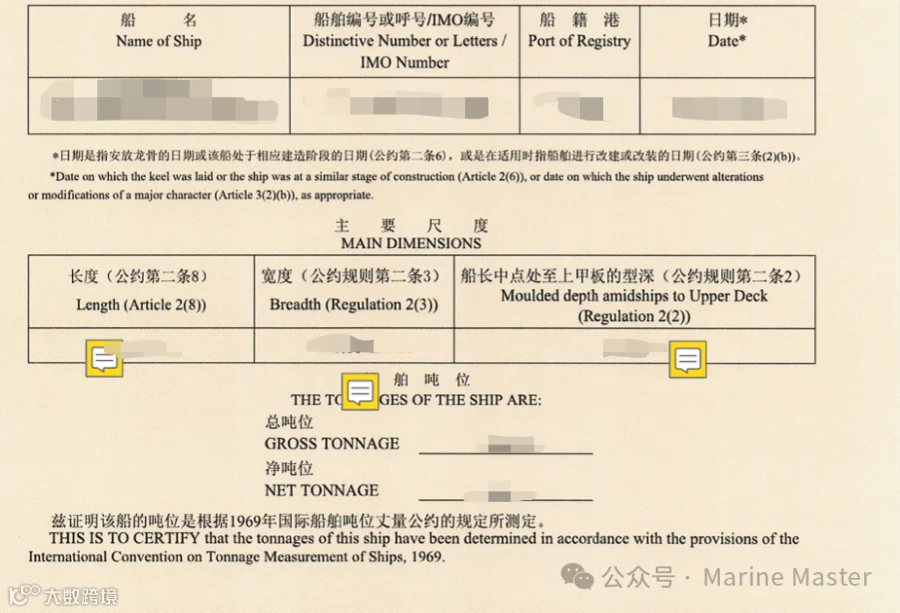
图为某轮国际吨位证书
一、先破误区:三个 “吨位数” 的核心定义(不是 “重量” 那么简单)
First, Break Misunderstandings: Core Definitions of the Three "Tonnages" (Not as Simple as "Weight")
提到 “船舶吨位数”,多数人会默认是 “船舶的重量”,但三者的定义完全不同,甚至有 “容积” 与 “重量” 的本质区别:
When it comes to "ship tonnage", most people default to "the ship's weight", but the definitions of the three are completely different, even with an essential distinction between "volume" and "weight":
1. 总吨(Gross Tonnage, GT):船舶的 “整体空间身份证”
Gross Tonnage (GT): The "Overall Space ID Card" of the Ship
· 定义:指船舶所有封闭空间的 “容积总量”(1 总吨=100立方英尺≈2.83 立方米),涵盖货舱、机舱、船员生活区、驾驶台等所有封闭区域,与船舶实际重量无直接关联,仅代表 “空间规模”。
· 举例:一艘总吨 5000 的散货船,其所有封闭空间加起来约 14150 立方米(5000×2.83),相当于 12 个标准集装箱的体积总和。
· 英文释义:A measure of the total enclosed volume of a ship (1 GT ≈ 2.83 cubic meters), covering all enclosed areas such as cargo holds, engine rooms, and crew quarters, with no direct connection to the ship's actual weight.
2. 净吨(Net Tonnage, NT):船舶的 “盈利空间标尺”
Net Tonnage (NT): The "Profit Space Scale" of the Ship
· 定义:从总吨中扣除 “非盈利性封闭空间”(如机舱、压载水舱、船员宿舍)后的 “有效容积”,直接代表船舶可用于创收的空间规模,是港口收费、税费计算的核心依据。
· 规律:不同船型净吨占总吨比例不同,货船因盈利空间占比高,净吨通常为总吨的 60%-80%;客船因生活区占比大,净吨占比约 50%-60%。
· 英文释义:The effective volume obtained by deducting non-profit enclosed spaces (e.g., engine rooms, ballast tanks) from gross tonnage, directly representing the ship's revenue-generating space.
3. 载重吨(Deadweight Tonnage, DWT):船舶的 “载货能力核心”
Deadweight Tonnage (DWT): The "Cargo Capacity Core" of the Ship
· 定义:指船舶在满载状态下,能承载的 “货物、燃油、淡水、船员及物资的总重量”,单位为 “吨(公吨)”,是唯一直接体现 “重量” 的吨位数,也是货主最关注的指标。
· 计算逻辑:载重吨 = 满载排水量(船 + 货 + 油 + 水)- 空船排水量(船舶自身重量)。例如:某船空船重 15000 吨,满载总重 40000 吨,其载重吨即为 25000 吨。
· 英文释义:The total weight of cargo, fuel, fresh water, crew, and supplies a ship can carry when fully loaded, measured in metric tons, directly reflecting cargo capacity.
二、核心区别:用对场景才不会出错(实用场景对照表)
Core Differences: Use the Right Scenario to Avoid Mistakes (Practical Scenario Comparison Table)
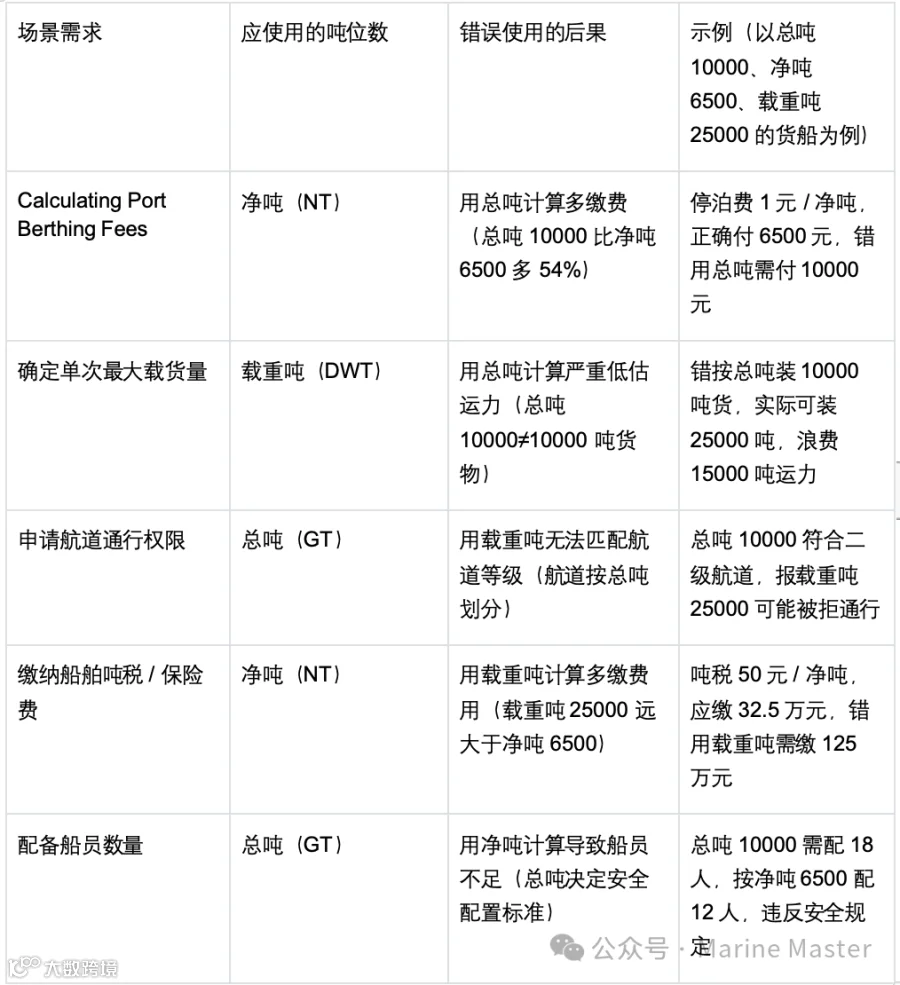
三个 “吨位数” 的本质区别,体现在航海运营的具体场景中,用错可能导致合规风险或经济损失,以下是关键场景的正确选择:
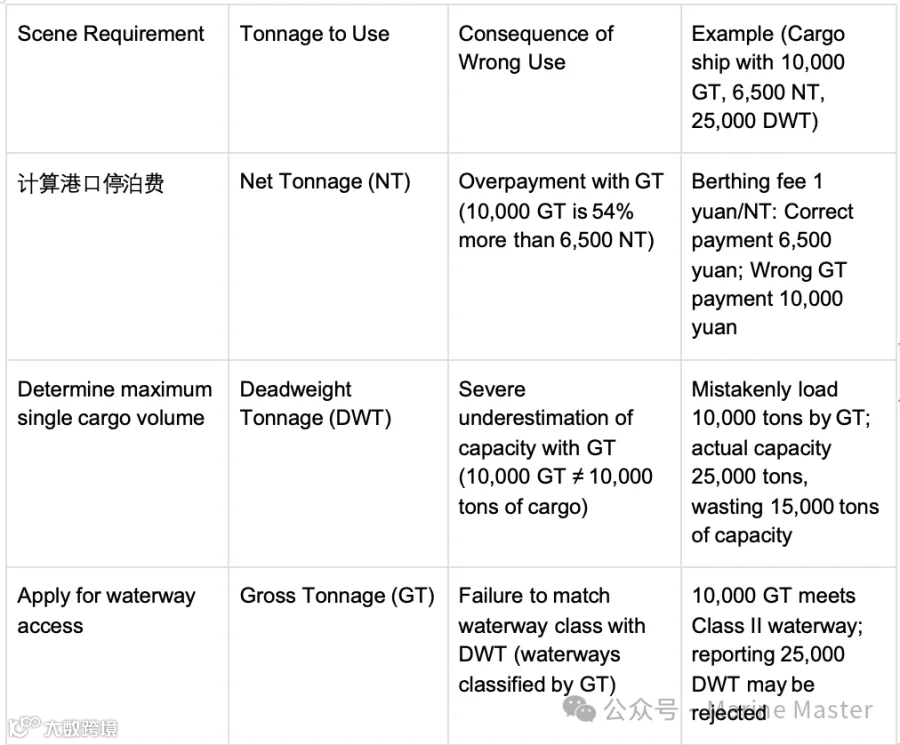
三、公约依据:三个 “吨位数” 的合规来源
Convention Basis: Compliance Source of the Three "Tonnages"
三个 “吨位数” 并非随意定义,均由国际海事公约统一规范,确保全球船舶运营标准一致:
1. 总吨与净吨:遵循《1969 年国际船舶吨位丈量公约》
Gross Tonnage & Net Tonnage: Comply with the 1969 International Convention on Tonnage Measurement of Ships
· 核心要求:公约明确总吨计算需包含 “所有封闭空间的容积”,净吨需扣除 “非盈利空间”,并规定统一计算公式(如总吨 = K1×(船总长 × 船宽 × 型深) 0.67),避免各国自行定义导致混乱。
· 合规意义:全球所有 300 总吨以上船舶需按此公约丈量吨位,否则无法取得国际航行资质,这也是总吨成为 “船舶身份证” 的根本原因。
2. 载重吨:关联《国际海上人命安全公约》(SOLAS)
Deadweight Tonnage: Linked to the International Convention for the Safety of Life at Sea (SOLAS)
· 核心要求:SOLAS 公约虽未直接定义载重吨,但通过 “满载吃水限制”“货物配载安全标准” 间接约束载重吨使用 —— 船舶载货量不得超过载重吨对应的安全吃水,避免因超载导致稳性不足。
· 实用关联:港口国检查时,会通过核查 “载重吨证书” 与实际载货量,判断船舶是否存在超载违规,超载船舶将被禁止离港。
四、计算逻辑:为何数值差异这么大?(以 10000 总吨货船为例)
Calculation Logic: Why Is There Such a Big Numerical Difference? (Take a 10,000 GT Cargo Ship as an Example)
很多人疑惑:为何同一艘船的总吨、净吨、载重吨数值差距悬殊?核心在于计算逻辑完全独立:
· 总吨(10000 GT):按 “容积” 计算
公式简化为:总吨 =(船舶封闭空间总容积)÷2.83
以某货船为例:货舱容积 8000 立方米、机舱 1500 立方米、生活区 800 立方米、驾驶室 200 立方米,总容积 = 8000+1500+800+200=10500 立方米,10500÷2.83≈3710?实际需按公约系数调整(如船型系数 0.85),最终约 10000 总吨(公约公式含复杂系数,此处为简化说明)。
· 净吨(6500 NT):按 “盈利容积” 计算
公式简化为:净吨 = 总吨 -(非盈利空间容积 ÷2.83)
上例中,非盈利空间(机舱 1500 + 压载水舱 1000)=2500 立方米,2500÷2.83≈883 总吨,10000-883≈9117?实际需按货船 “盈利空间系数 0.72” 调整,9117×0.72≈6500 净吨(不同船型系数不同)。
· 载重吨(25000 DWT):按 “重量差” 计算
公式:载重吨 = 满载排水量 - 空船排水量
上例中,空船排水量(船舶自身重量)约 15000 吨,满载排水量(船 + 货 + 油 + 水)约 40000 吨,40000-15000=25000 载重吨,与空间容积无直接关联,仅体现 “可承载的总重量”。
五、总结:三个 “吨位数” 的核心记忆点
Conclusion: Core Memory Points of the Three "Tonnages"
记住以下三个核心结论,即可彻底分清三者区别:
· 总吨看 “整体空间”:是船舶的 “规模身份证”,关联航行权限、船员配置,用 “容积” 衡量;
· 净吨看 “盈利空间”:是港口收费、税费的 “计算标尺”,从总吨中扣除非盈利空间,用 “容积” 衡量;
· 载重吨看 “载货重量”:是货运能力的 “核心指标”,直接体现能装多少吨货,用 “重量” 衡量。
对于航海从业者,精准使用三个吨位数是合规运营的基础;对于货主、物流人员,明确载重吨与净吨的区别,能更高效地规划货运成本与运力 —— 这三个看似相似的 “吨位数”,实则是支撑全球航运秩序的重要基石。
Remember the following three core conclusions to completely distinguish between the three:
· Gross Tonnage looks at "overall space: It is the ship's "scale ID card", linked to navigation rights and crew configuration, measured by "volume";
· Net Tonnage looks at "profit space: It is the "calculation scale" for port fees and taxes, deducting non-profit space from gross tonnage, measured by "volume";
· Deadweight Tonnage looks at "cargo weight: It is the "core indicator" of cargo capacity, directly reflecting how many tons of cargo can be loaded, measured by "weight".



附:核心公约要求与术语对照表
总吨(Gross Tonnage, GT):依据《1969 年国际船舶吨位丈量公约》,指船舶所有封闭空间的容积总量(1GT≈2.83 立方米),用于界定船舶规模、航行权限与船员配置。
净吨(Net Tonnage, NT):从总吨中扣除非盈利空间后的有效容积,是港口收费、船舶吨税的核心计算依据,货船净吨通常为总吨的 60%-80%。
载重吨(Deadweight Tonnage, DWT):船舶满载时可承载的货物、燃油、淡水等总重量,计算公式为 “满载排水量 - 空船排水量”,直接体现载货能力。
《1969 年国际船舶吨位丈量公约》:国际海事组织(IMO)制定的统一吨位丈量标准,规范总吨与净吨的计算方法,全球 300 总吨以上船舶强制遵守。
总吨(Gross Tonnage, GT)
净吨(Net Tonnage, NT)
载重吨(Deadweight Tonnage, DWT)
《1969 年国际船舶吨位丈量公约》(1969 International Convention on Tonnage Measurement of Ships)
满载排水量(Full Load Displacement)
空船排水量(Light Displacement)
港口停泊费(Port Berthing Fee)
船舶吨税(Ship Tonnage Tax)

END
靠谱就是我的名片 我是燃供二小姐
华东&华南&渤海湾船舶燃油供应
欢迎沟通交流

版权说明:部分文章推送时未能与原作者取得联系。若涉及版权或者其它未尽事宜敬请原作者联系删除。