



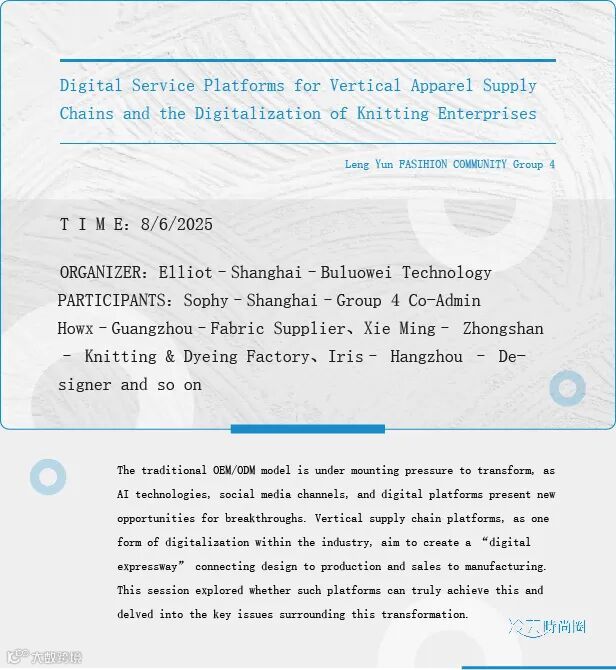
▼The following discussion in Leng Yun fashion community is a discussion and summary of industry issues. These shares are the crystallisation of collective wisdom. (They do not represent the personal views of Leng Yun). It is hoped that this method will benefit more industry professionals!

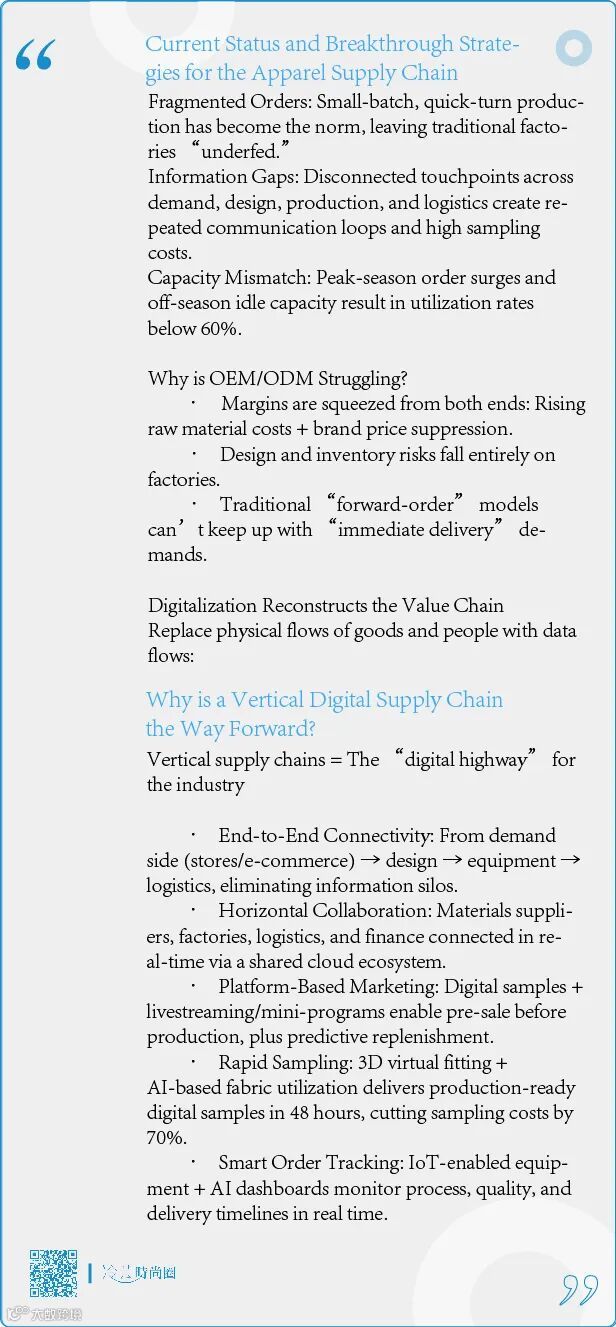
Current Situation of the Apparel Supply Chain and Breakthrough Strategies
1. The Awkward Position of Small and Medium-Sized Factories
Apparel companies are facing highly concentrated pain points:Small-order, quick-response demands are hard to meet;Production progress, status, and quality are not transparent, especially in small factories handling small orders;Reliable factories always have long queues for production, while small orders bring low profit and unstable quality.
Traditional enterprises lack professionals who understand both the conventional apparel industry and emerging digital technologies, making transformation difficult. Many SMEs hesitate to invest in new equipment or projects because digitalization first requires cleaning and reorganizing past data, followed by significant new investment.As a result, many SMEs face an awkward dilemma: no money or awareness to transform, but waiting for closure if they don’t.
For SMEs, the actual benefit of digitalization remains uncertain. If digitalization does not significantly impact sales, it could become a burden rather than a benefit.

Why Is a “Vertical Digital Supply Chain”
the Way Out?
1. Three Core Capabilities: Platform Marketing, Rapid Sampling, Smart Order Management
The vertical supply chain has four key elements:
First, focus on niche segments, such as socks, gloves, hats, and even further segmentation into children’s socks or baseball caps.
Second, platformization. Building a vertical digital supply chain requires a digital platform, which may also serve as a digital hub to efficiently coordinate operations across the supply chain.
Third, end-to-end digitalization: from design to equipment (D2M – Design to Machine), from store to factory (S2F – Store to Factory), and even from store to supplier (S2S – Store to Supplier), such as from an Amazon store to a yarn supplier.
Fourth, an ecosystem, manifested as an alliance of companies: collaborating for overseas expansion; the platform company does not need to own factories; partner enterprises do not need to develop digitalization themselves; retailers do not worry about the supply chain; partner factories do not worry about orders. The essence of the alliance is to reduce exploitation and ensure fairness in business transactions.
The platform is not an industry association but a business alliance. The platform acts as a coordinator. Buyers find it hard to locate suppliers, and even harder to achieve small-batch quick-turn orders. The platform can help buyers realize this through digitalization. It also helps factories secure orders and provides assistance with order management. Therefore, it is worthwhile for companies to pay a service fee to the platform.
2. Case Study
Take socks as an example:
Factories provide digital sock templates (base templates) to the platform, which are pre-developed.
Buyers visit the website and can use platform tools to quickly create their brand’s design based on these templates. If sample socks are needed, the platform sends the machine-ready file to the factory, which directly produces the sample—no need for additional design or pattern-making—achieving digital product development.
If the client approves, they place an order through the platform, which then generates the machine file directly from the client’s design for factory production.
The platform also helps buyers with digital design and sampling, and assists factories with pattern-making and order tracking.
Socks are relatively simple because most share similar structures. Differences are mainly in colors and patterns, similar to T-shirts.
This model allows designers to avoid worrying about technical issues because technical details are digitized. Designers can focus solely on the pattern.

How to Implement Core Functions to Create Real Value?
1. Digital Samples: Not Just “Cool 3D” but Improving Efficiency and Reducing Costs
Digitalization must be end-to-end to deliver real benefits.
Imagine a scenario where, after a store receives a customer order, the system automatically generates the machine file and factory work order, then schedules and tracks production.
This is what the future looks like.
2. Smart Order Processing and Tracking: Enhancing Delivery Capability and Customer Satisfaction
Knitting is like “3D printing.” As long as yarn and the machine file are available, the machine can produce automatically. Most sock machines can connect to the internet. If an order exceeds the factory’s capacity, the system can split it among other factories with idle machines (satellite factories) to complete the order together.
3. Digital Services: Building a 360° Digital Hub for Customer Experience
In this vertical digital supply chain system, factories do not need to handle design or even pattern-making. They simply access the system online, use the designer’s uploaded pattern, and the machine completes the product automatically. Currently, this is possible for socks, knitwear, and similar products.
To protect copyrights, each buyer has a private virtual space. Uploaded patterns are invisible to others. The platform separates public and private resources.

Where Are the Challenges in Transformation? How Can Small Factories Break Through?
1. High Investment Costs? Systems Too Complex? Lack of Understanding?
Digital transformation faces many challenges: high investment, complex systems, and lack of understanding among staff.
A truly good digital system should reduce workload, but the implementation process is complex, causing many companies to give up halfway.
2. How to Move from “Data Storage” to a System That Generates Real Value?
For example, the issue of online product information.
Currently, if a buyer wants to know the status of an order, they must call the factory. Questions like: Has the yarn arrived? Has sampling started? When will it start? Is it complete? The factory contact must check with each stage of the process, which is highly inefficient.
With an information system, all production updates can be shared with the buyer in real time, significantly improving efficiency.
3. Leverage Platform Power for Resource Integration and Ecosystem Collaboration
For factories, becoming a flexible capacity node is an opportunity.
If you are a small factory, let the platform provide digital tools—you just use them. Look at Shein and its hundreds of small factories. They had no digital tools; Shein provided all the software. These factories complain about Shein while relying on them. Although Shein’s prices are low, orders and payments are guaranteed.
The same applies to designers and studios. Designers can join the platform for fast sampling. Many designers lack pattern-making skills, and the platform solves this problem. Material and equipment suppliers can integrate into the end-to-end digital ecosystem. Service providers can offer digital tools and solutions.
4. Who Am I? How Can I Participate in This Platform?
The biggest difference between domestic and foreign brands is that China’s supply chain is so developed that communication costs are ignored. Foreign brands, lacking supply chains, value communication costs more. If they find a good factory, they may work together for years.
For small brands, the advice for working with factories is: consider communication costs. If a factory meets cooperation and quality standards, do not switch easily. For factories that support brand development—such as those strong in fabric development or new processes—develop deep partnerships. Choose healthy, high-quality factories with good working environments and craftsmanship that can enhance brand image.
In the future ecosystem, factories will profit from orders; platforms will charge service fees for value-added functions.
Digitalization is an inevitable trend. It is no exaggeration to say that companies that do not go digital have no future. Although the path to transformation is challenging, vertical supply chain platforms represent an important direction for the digitalization of the apparel industry. Through segmentation, platformization, end-to-end digitalization, and ecosystem building, this model can solve many pain points faced by the apparel industry today and provide new opportunities for SMEs.
PS: Translation is done by AI.
文字整理:张怀楷
文字编辑:张怀楷
美术编辑:李宁