


Blockchain is no longer a niche technology. It is evolving into a core infrastructure for the global financial system. From payments to capital markets, it is reshaping how transactions are processed and how trust is established.
For Chinese enterprises seeking to expand abroad, blockchain presents significant opportunities in strategic markets, including Europe, China's Hong Kong, and Singapore. Deloitte supports Chinese companies in navigating this environment, from understanding regulations to building fully operational digital asset businesses.
What is Blockchain?
Blockchain is more than a technology, it is a foundation for financial innovation. By combining transparency, trust, and efficiency, it enables new opportunities for both financial institutions and investors.
Capital market efficiency through tokenization:
Chinese financial institutions can issue or transact in tokenized bonds, equities, or funds in Europe, reducing settlement times, lowering costs, and unlocking new liquidity pools.
Cross-border payments and treasury:
Blockchain enables faster, cheaper and more secure international transfers, helping Chinese enterprises manage capital flows between China and Europe more efficiently while reducing reliance on intermediaries and unlocking liquidity.
Diversification of investment assets:
Investors gain access to new classes of assets, from tokenized real estate to alternative instruments, broadening portfolios and offering new growth opportunities in the European market.
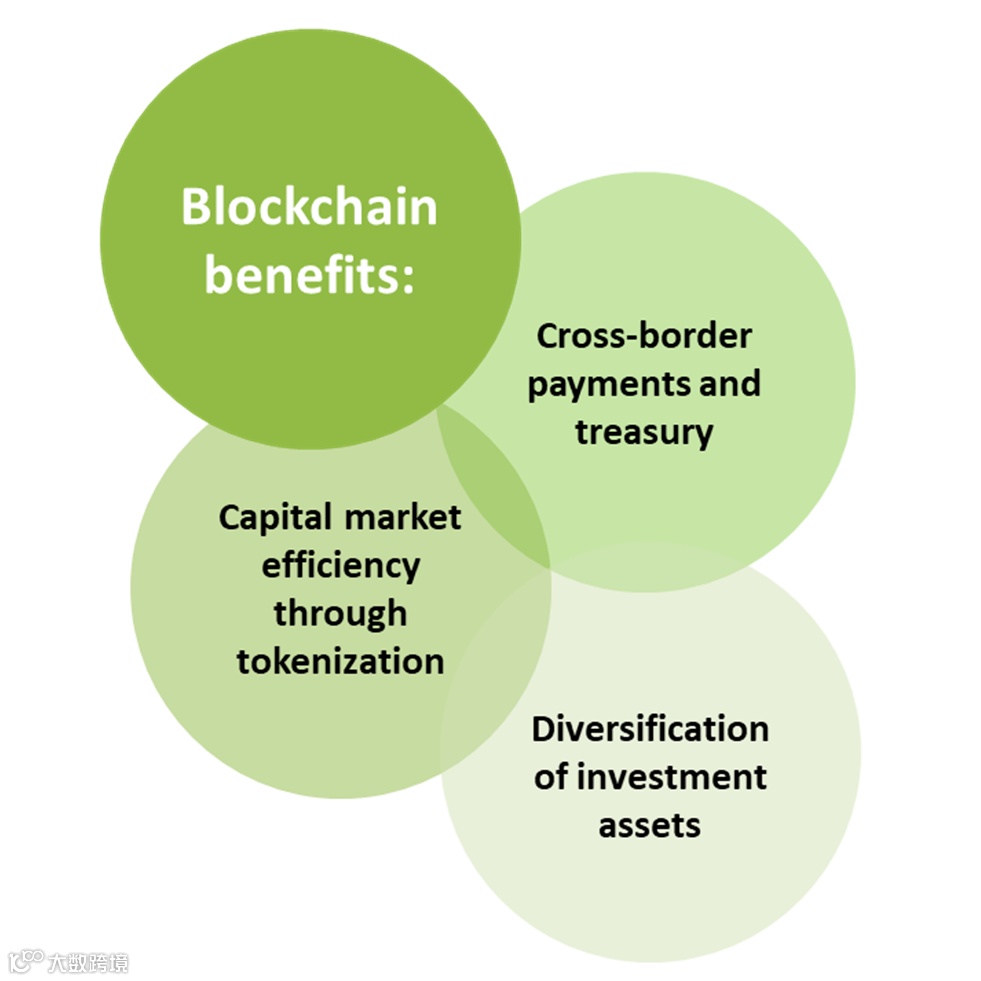
In short, blockchain allows Chinese enterprises to operate more efficiently, move capital more smoothly, and diversify investments in Europe's financial markets.
Europe's Opportunity
Europe has built one of the world's most advanced digital asset framework, that combines newly designed rules for digital assets with existing financial regulation and recent adjustments that now explicitly cover digital assets. Using the EU market passporting rights, it offers clarity and consistency to Chinese businesses wishing to access a market of 400+ million consumers across 27 Member States.
Whether you are a company looking to develop new digital asset or payment services, seeking to finance yourself more efficiently through European capital via the issuance of tokenized securities, or looking for a stablecoin compliant with European laws to facilitate cross border payments or cash management, you must adhere to European regulations.
Digital Asset Specific Regulation
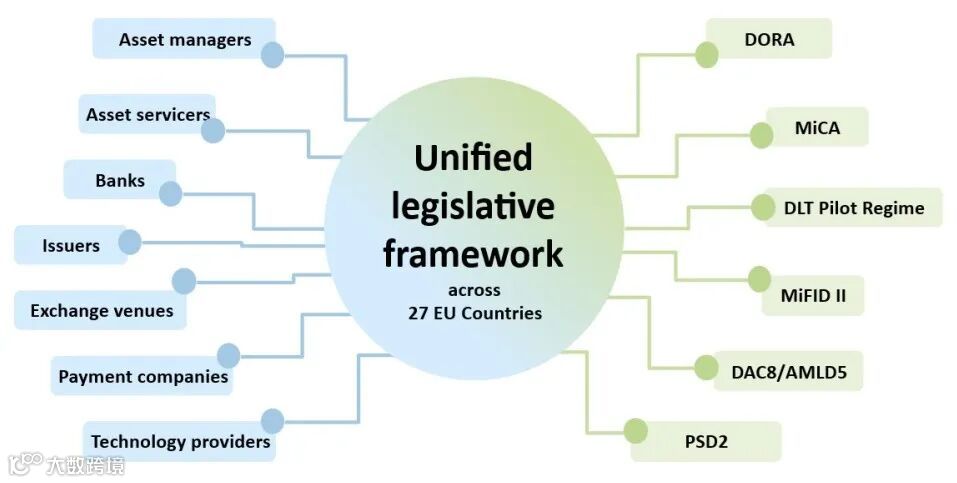
MiCA (for crypto-asset service providers, stablecoin issuers): establishes a harmonized EU authorization regime, enabling entities such as exchanges, custodians, stablecoin issuers, and financial institutions to secure a single authorization that applies across all 27 Member States, eliminating the need for multiple local licenses.
DLT Pilot Regime (for market operators, infrastructures): enables institutions to test blockchain-based trading and settlement under a controlled and flexible environment. Participants benefit from temporary exemptions and lighter requirements compared to full EU financial market rules, lowering entry barriers while maintaining regulatory oversight.
DAC8 (for banks, custodians, intermediaries): requires detailed tax reporting and due diligence for crypto-asset transactions, ensuring transparency and compliance.
Baseline Regulation
MiFID II (for banks, asset managers, market operators): strengthens transparency, investor protection, and market integrity. Digital assets that qualify as financial instruments fall under its scope.
For Chinese enterprises, this means:
A single EU license can unlock the entire market, making Europe efficient, scalable, and attractive for long-term expansion.
Luxembourg as a gateway
While the EU has created a unified framework, the pace of adoption and innovation differs across Member States. Some have taken a more proactive stance, translating EU directives into concrete laws and building ecosystems that are ready for international investors. Luxembourg is a clear example of this leadership, combining early policy initiatives, proactive regulation, and a dynamic market environment that make it a practical European hub for digital asset businesses:
Blockchain Laws I–IV created one of Europe's most advanced legal frameworks, moving from recognition of debt securities to enabling equity and fund tokenization.
The CSSF regulator has already licensed several virtual asset service providers and is actively preparing for MiCA's implementation.
The country hosts over 200 fintech and crypto firms, alongside global exchanges creating a mature digital asset ecosystem.
Global financial institutions use Luxembourg as a hub for digital asset innovation, including HSBC's Orion platform, Clearstream's custody infrastructure, and BNP Paribas' tokenized money market fund, reinforcing its leading role in Europe.
Successfully expanding into Europe requires multidisciplinary skills and a partner with local insights, regulatory expertise, cross-border capabilities, and trusted execution. Deloitte delivers all this.
We support Chinese enterprises by:
Advisory & Consulting
Shaping business, product, and corporate strategies for European expansion.
Designing operating models with governance, compliance, IT, and risk frameworks.
Selecting and setting up service providers and technology enablers.
Audit & Assurance
Reviewing and testing smart contracts to ensure reliability and compliance.
Providing independent assurance to strengthen investor and regulator trust.
Conducting statutory and regulatory audits of financial statements.
Tax & Legal
Structuring international corporate tax, VAT, and DAC8 reporting obligations.
Delivering investor tax reporting and portfolio tax solutions.
Advising on EU financial and digital asset regulations.
In Luxembourg alone, Deloitte advised on 70% of new financial services authorizations in recent years, proof of our ability to help enterprises turn strategy into results.
For more information, please contact:
Lawrence Jin
Deloitte China C2G Leader
Email: lawrjin@deloittecn.com.cn
Laurent Collet
Deloitte Luxembourg Digital Assets Practice Co-Leader
Email: lacollet@deloitte.lu
Thibaut Chollet
Deloitte Luxembourg Digital Assets Practice Co-Leader
Email: tchollet@deloitte.lu
Jean-Phillipe Peters
Deloitte Luxembourg Regulatory and Licensing Co-leader
Chinese Services Group Co-leader
Email: jppeters@deloitte.lu
Bertrand Parfait
Deloitte Luxembourg Regulatory and Licensing Co-leader
Email: bparfait@deloitte.lu
Thomas Campione
Deloitte Luxembourg Digital Assets Practice Director
Email: tcampione@deloitte.lu
Giulia Pescatore
Deloitte Luxembourg Digital Assets Practice Senior Manager
Email: gpescatore@deloitte.lu
Lujun Zhou
Deloitte Global Chinese Services Group Luxembourg team Senior Manager
Email: lujzhou@deloitte.lu
Disclaimer:
A 3rd party wanting to repost a Deloitte Wechat article should publish the content in its original form, without amendment. Any changes to content should be sent to Deloitte for review and approval before being released. The 3rd party is required to attach the information and disclaimer below to the reposted article:
This communication contains general information only and, while authorization for its publication has been granted, copyright is reserved by Deloitte Touche Tohmatsu, and none of Deloitte Touche Tohmatsu Limited, its member firms or their related entities (collectively, the "Deloitte Network") is, by means of this communication, rendering professional advice or services. No entity in the Deloitte network shall be responsible for any loss whatsoever sustained by any person who relies on this communication.