



Around 10 PM on August 18th, scattered fishing lights pierced the night sky at Liangjiao Port in Sanlian Community, Xinbu Subdistrict, Meilan District. Accompanied by the hum of engines, fisherman Wang Guangwu steered his boat to the port, its hold laden with the day’s catch. Eagerly awaiting fishmongers, citizens and tourists drawn by its fame, quickly gathered around, vying to purchase plump seafood like Spanish mackerel, pomfret, and blue swimmer crabs.
Following the official end of the three-and-a-half-month summer fishing moratorium in the South China Sea , over 1,700 fishing vessels in Haikou have gradually resumed operations based on weather conditions. In recent days, reporters visiting several fishing village ports discovered that Haikou's fishermen are presenting a vivid picture interwoven with tradition and modernity during the fishing opening season: some fishermen post short videos from the open sea to interact with netizens, finding “fans” waiting for them upon their return fully laden with riches; others stay ashore, transforming elements of fishing production and life into tourism resources, carving out a new path for revitalizing fishing villages between harvesting the sea and boosting tourism.
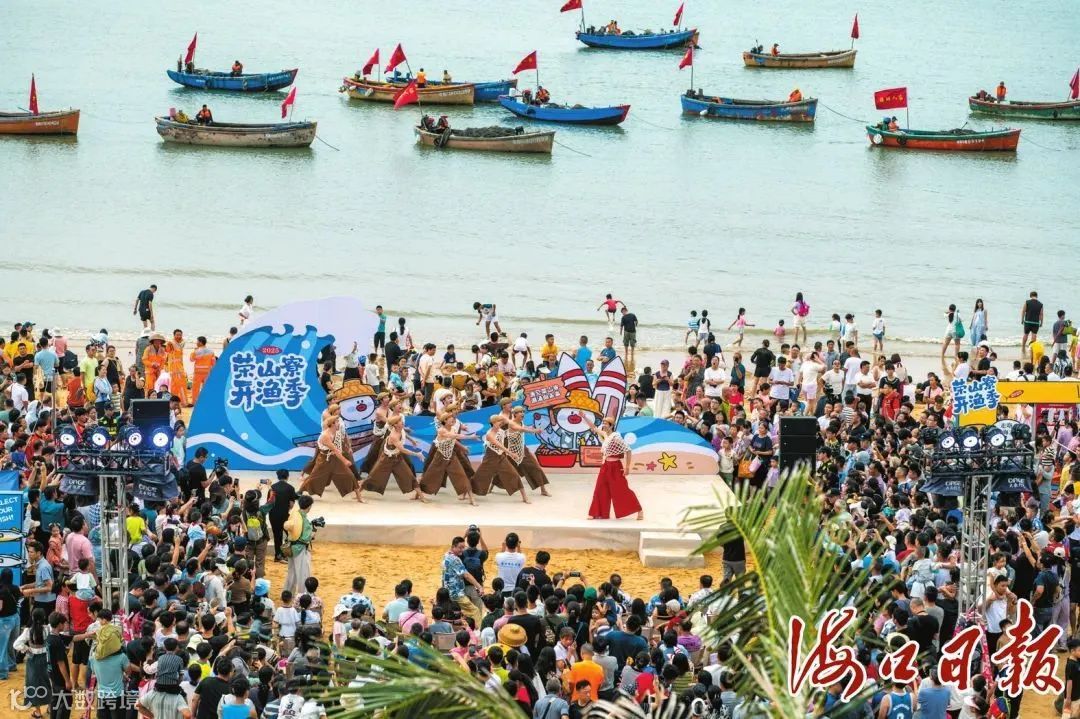
At the 2025 Rongshanliao Fishing Season opening event in Haikou, exciting performances attracted visitors to stop and watch. Photo by Shi Zhonghua, reporter from Haikou Media Convergence Center
Before and After the Fishing Season Opened: From Idle Boats, Busy People to Full Holds, Bountiful Catches
On August 15th, Liangjiao Port was a scene of bustling activity. The cacophony of mechanical repairs and the shouts of moving supplies intertwined into a lively prelude to the fishing season. Wang Guangwu sat on the ground in front of his house, skillfully “shuttling and threading" to mend fishing nets. Not far away, several fishermen were cleaning barnacles and shells off the iron poles of fixed fishing nets, replacing worn ropes one by one. Similarly lively scenes unfolded in Rongshanliao Village, Xixiu Town, Xiuying District. In fisherman Fu Shineng's courtyard, fishing nets and floats were piled high; he and his wife worked together mending tears in the nets. Fisherman Zhou Ruchong crouched beside his boat, intently adjusting the marine motor. “With equipment in good order, safety is assured, and the harvest is stable," he said.
On the eve of the fishing season, fishermen's lives on shore were vibrant, with many busy “powering up" their skills. Feng Liang, Director of Fishery Infrastructure Section, Haikou Municipal Agriculture and Rural Affairs Bureau, explained that during this year's moratorium, Haikou held fisheries work safety training, training for owners and captains of large and medium-sized fishing vessels, and maritime emergency rescue drills. “From theoretical teaching to practical drills, from maritime right-of-way rules to vessel equipment checks, the classes were all practical contents," said fisherman Wang Yongshun sincerely.
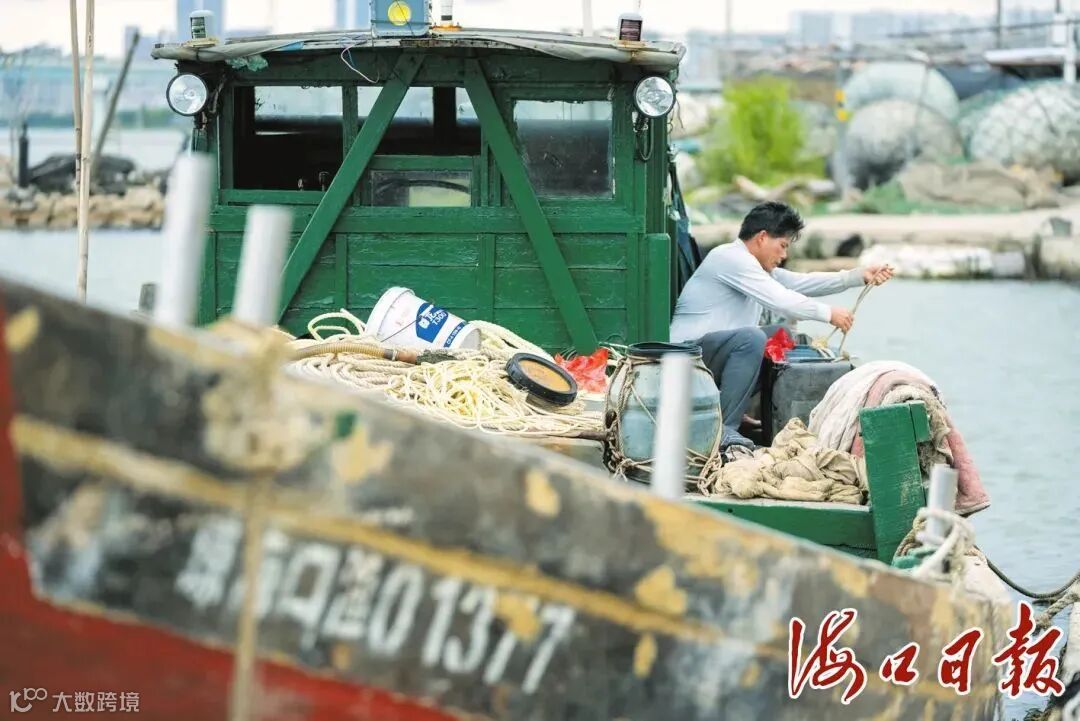
On August 19th, in Liangjiao Port, Sanlian Community, Xinbu Subdistrict, Meilan District, fishermen are busy organizing supplies and preparing to go out to sea to fish. Photo by Yang He, reporter from Haikou Media Convergence Center
As the signal for the fishing season's start sounded, countless vessels set sail to fish. On the evening of August 18th, at Liangjiao Port, many citizens and tourists who had purchased their desired seafood went directly into the village's open-air food stalls and agritainment restaurants) to have their “spoils" cooked into delicious dishes. Steaming, blanching, barbecuing... different methods all aimed to present the ultimate “freshness" of the fat fish and plump shrimp at the earliest opportunity. On August 19th, the stalls at Xinbu Island Seafood World were alive with competing vendor calls; Mr. Fu, holding freshly selected prawns and fish, said with a smile: “Now that the fishing season has started, we must try the fresh seafood; it's a sentiment for us longtime Haikou natives." The Haikou Dingcun Million Seafood Plaza was also packed with people. Dishes like stir-fried squid and seafood vinasse vinegar hotpot filled tables as diners indulged heartily. Many exclaimed excitedly: “Every gift from the ocean is a generous bounty from nature."
Transformation in Practice: From Relying on the Sea to Revitalizing Through Culture and Tourism
On August 16th, “Fisheries Encounter Rongshanliao · Tide Towards the Future——2025 Rongshanliao Fishing Season Opening" kicked off in Rongshanliao Village
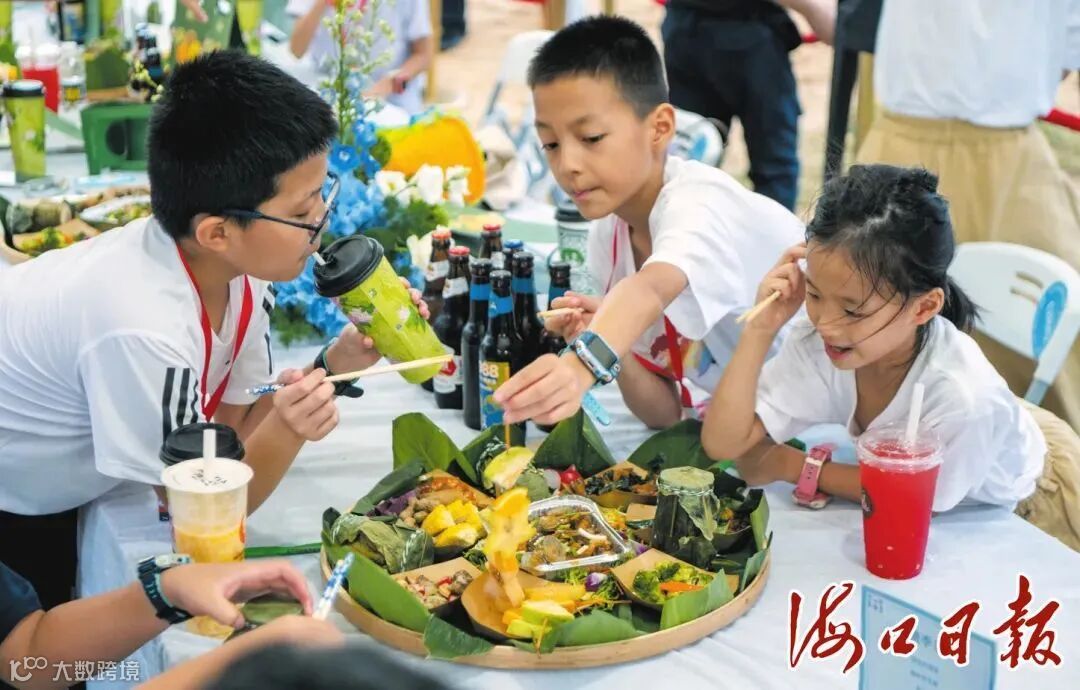
That day, the fishing village was filled with a festive atmosphere: fishing boats raised sail flags, lion dance teams leaped and tumbled to powerful drumbeats, and dancers moved gracefully. A beach-side long-table banquet stretched along the beach, the sea breeze carrying the aroma of mixed fish pot and oil-braised prawns. The beach campsite was brightly lit with fluttering canopy tents; tourists chatted and laughed around barbecue grills... Wu Daolin, a fisherman from Rongshanliao Village who was helping guests set up tents and arrange tables and chairs, said: “During the moratorium, I run a tent camping business for tourism. Now the season has started, I can still earn income from tourism when I'm not at sea. Seeing everyone love our village so much feels particularly gratifying."
The beach bar and restaurant run by “third-generation fisherman" Wang Suifeng became a popular check-in point during the festival. Standing before a barbecue grill set up on the sand, grilling squid for guests, he told the reporter with a smile: “In the past, my family relied solely on fishing, with income varying greatly. Now, running this bar and restaurant, income is quite good during the peak season."
On August 16th, children enjoy food at the beachside long-table banquet held in Rongshanliao Village, Haikou. Photo by Shi Zhonghua, reporter from Haikou Media Convergence Center.
Similarly, Chen Yansheng, also a “third-generation fisherman," opened a fisherman's restaurant in the village, becoming a microcosm of Haikou's traditional fisheries transitioning towards cultural tourism. On the evening of the festival opening, his small courtyard was full of guests. “On weekends and holidays, even more people come to the village, and business is even better. Today, some tables have turned over several times; the whole family is here helping," said Chen Yansheng, who was almost too busy to be interviewed.
These successful cases of transitioning from “harvesting the sea" to “development on shore" are not uncommon in Haikou. On the afternoon of August 16th, the signal for the 2025 Meilan Fishing Village Dragon Boat Race monthly competition sounded at Xinghai Bay on Xinbu Island. Sixteen teams raced on the 200-meter course, oars rising and falling amidst splashing waves, drawing cheers from thousands of spectators on the shore. “This year, Sanlian Community purchased three dragon boats. The fishermen have rich experience in water sports; they won two championships at the Dragon Boat Festival International Invitational. We hope for good results in the Meilan Fishing Village Dragon Boat season too," said Cai Renru, Secretary of the Sanlian Community Party Genral Branch. He added that hosting dragon boat races not only helps build the fishermen's physique but also attracts more attention to the fishing villages, promoting efficient rural development.
Human-Sea Symbiosis: From Addressing Shortcomings to Exploring New Paths
The integrated development of fishing, culture, and tourism has revitalized the fishing villages, but opportunities come with challenges. Yan Yu, the first Party secretary stationed in Rongshanliao Village, believes that improving infrastructure is the foundation for the long-term development of fishing villages. Only by continuously enhancing the village's hardware can tourist experiences be optimized, consumption attracted, and thus more job opportunities created for fishermen.
From the perspective of Han Han, Chairman of the China Blue Sustainability Institute, traditional fishing villages have faced challenges in recent years like declining fishery resources and compressed fishing grounds, necessitating a transition away from the past lifestyle of solely “relying on the sea." “We must trust the survival wisdom of fishermen. For instance, some sell seafood via social media, some share their tide-chasing daily lives through short videos, and others are trying to establish 'marine ranches,' integrating and developing ecological aquaculture with recreational fishing," Han Han suggested. She proposed giving fishermen more autonomy to develop paths that leverage their own strengths.
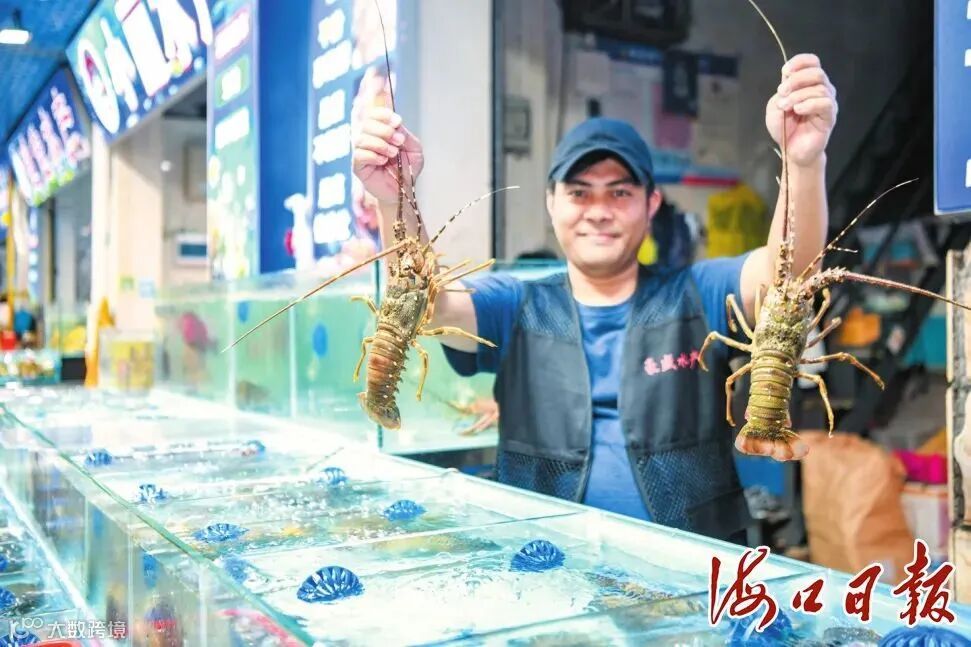
On August 19th, the variety of seafood is abundant at Xinbu Island Seafood World, and stall owners are all smiling. Photo by Su Bikun, reporter from Haikou Media Convergence Center
“Haikou can integrate fishery elements into existing projects around tourism and wellness, such as creating seafood wellness meals, fish spa experiences, etc., to avoid homogenized competition," pointed out Gu Zhifeng, a professor at the School of Marine Biology and Fisheries, Hainan University. In recent years, the province has accelerated the phase-out of near-shore aquaculture, encouraging fishermen to “move ashore, move to deep sea, move towards recreational fisheries," developing industrialized aquaculture, deep-sea cage culture, and recreational fishing. Gu Zhifeng suggested that Haikou could fully utilize the advantages of the Hainan Island Tour Highway to connect fishing villages and ports, forming characteristic tourism routes to attract tourists to stay longer and spend more.
Today, Haikou's fishermen are finding a balance between “harvesting the sea" and “developing on shore." The deep practice of integrating fishing, culture, and tourism has not only turned the “fishing season opening" from the fishermen's solitary pleasure into a joy for all but also allowed traditional fishing villages to find new momentum for sustainable development within rural revitalization practices. In the future, with deepening policy support and advancing market innovation, these seaside fishing villages are destined to write an even more brilliant chapter of “human-sea symbiosis."
Exploring the Path to Fishing Village Revitalization Between Fishing Lights and Bustling Life
On August 18th, reporters visited Liangjiao Port at night. As soon as fisherman Wang Guangwu's boat docked with its full hold, citizens and tourists rushed to buy. He enjoys shooting videos of the daily life of the fishing village and fishermen and sharing them on multiple social platforms, turning “going to the fishing village to buy seafood" from a sentiment of old Haikou natives into a novel experience pursued by more new Haikou residents——this is a new change in Haikou's fishing village “fishing season" scene: fishing lights blend with the烟火 (bustle/hustle of life), tradition collides with modernity.
The transformation of Rongshanliao Village is particularly vivid: the beach bar of “third-generation fisherman" Wang Suifeng and Chen Yansheng's fisherman's restaurant are hugely popular; fisherman Wu Daolin sets up camping tents to earn “tourism money." Fishermen no longer focus solely on the catch but transform fishing life into tourism resources, achieving a proactive shift from “relying on the sea" to “revitalizing through culture and tourism."
But to keep this thriving scene “endlessly vibrant," multi-faceted efforts are still needed. Firstly, shortcomings in fishing village infrastructure must be addressed—parking, restrooms, recreational activities—to retain tourists. Secondly, measures should be tailored to local conditions, deeply excavating the added value of fishing culture to avoid homogenized business models. Let tourists not only eat seafood and see the ocean but also learn to weave nets, identify catches, and experience tide-chasing, turning “day trips" into “multi-day stays."
Finally, the core of development lies with people. Relevant departments can provide support like short video training and start-up subsidies for explorers like Wang Guangwu, turning individual experience into collective development ideas. They can offer cultural tourism operation guidance, brand packaging support, and customer drainage services to “new fishermen" daring to transform, helping individual new ventures grow into stable industries with reputation and customer flow.
Revitalizing Haikou's fishing villages requires both protecting the tradition within the “fishing lights" and embracing the opportunities within the “bustle”. When infrastructure is better, characteristics are more distinct, and fishermen are more confident, these villages will surely write even more wonderful stories in the practice of “human-sea symbiosis.”
来源:海口日报
 Published by the Haikou Foreign Affairs Office
 Please also follow us on Douyin (Tiktok) In'Haikou.

(c) Copyright HaikouGuide all rights reserved, images or text may not be copied in part or full without express permission in writing.