


Root Cause Investigations for CAPA:
Clear and Simple
《CAPA根本原因调查:简单明了》
James L. Vesper
PDA
Bethesda, MD, USA
DHI Publishing, LLC
River Grove, IL, USA
18
COMMUNICATION
沟通
Even though the topic of communication is one of the last steps in the investigation and corrective action process and we are discussing it in one of the last chapters in this book, communicating with personnel, health authorities (as needed), management, and other stakeholders may be appropriate throughout the process, depending on the scope and potential impact of the event.
尽管沟通是调查与纠正行动流程的最后环节之一,我们将其安排在本书末尾章节讨论,但根据事件的范围和潜在影响,在整个过程中可能需要适时与员工、卫生主管部门(必要时)、管理层及其他相关方进行沟通。
“Communication,” as we are using the word here, is not the same as “training.” Communication is meant to provide information that can result in knowledge and awareness; it may or may not demand a change in practice or behavior. Training, on the other hand, does have a specific intent to change behavior—that is one of the ways that you know the training has been effective. Communication should be included in all major or critical deviations; training is appropriate only if the investigation determines there was a deficiency in knowledge or skills.
此处使用的"沟通"与"培训"并不等同。沟通旨在提供信息以促进认知和理解,不一定要求改变实践或行为;而培训则具有明确的行为转变目标——这正是检验培训有效性的标准之一。所有重大或关键偏差都应包含沟通程序,仅当调查确认存在知识或技能缺陷时,才需要实施培训。
The basic messages that should be conveyed through communication are:
通过沟通应传达的核心信息如下:
• This particular unwanted event has occurred.
• 已发生特定不良事件
• This is the scope and impact, particularly to patients, of the event.
• 本事件涉及范围及影响(尤其对患者)
• We as an organization are sharing what we have learned due to this event.
• 作为组织方,我们将就此事件开展经验分享
• To prevent this or a similar situation from happening in other areas, these are actions that should be considered.
• 为防止类似事件在其他领域发生,特提出后续行动建议.
WHO SEES WHAT?
何人接收何讯?
Communication is important, but it needs to be done in a thoughtful way; for example, consider who should receive the message. One of the easiest—and worst—ways of communicating about an incident would be sending out a group text or e-mail message to everyone about every possible event. Personnel would soon be overburdened by the number of notifications. Some factors to consider when deciding who should be notified could be:
沟通固然重要,但需讲究策略;例如应审慎考量信息接收对象。最简便却也最糟糕的沟通方式之一,莫过于将每起潜在事件通过群发短信或邮件通知所有人。长此以往,相关人员必将被海量通知压得不堪重负。在决定通知对象时,需综合考量以下因素:
• Significance (scope and impact) of the event
• 事件重要性(范围与影响)
• Immediacy (how quickly the information needs to be shared)
• 信息紧迫性(需共享的速度)
• Location (department or plant site)
• 涉及区域(部门或院区)
• Similar equipment, materials, components, processes, or products
• 同类设备/材料/工艺/产品
• Who should take action
• 行动责任人
Health authorities may need to receive communication about certain events. For example, if there is an issue (e.g., mix-up, contamination, stability failure) of a marketed and distributed small molecule product, the US FDA requires a Field Alert Report (FAR) be submitted within 3 days of receiving information concerning the quality problem (FDA, 2018). A similar US FDA requirement— the Biological Product Deviation Report (BPDR)—exists for large molecule products (FDA, 2020). The European Medicines Agency (EMA) has a similar program for reporting defective products (EMA, undated). Completing these reports may incorporate some of the information obtained during the investigation.
卫生主管部门可能需要接收特定事件的通报。例如,对于已上市销售的小分子产品,若出现混淆、污染或稳定性失效等质量问题,美国食品药品监督管理局(FDA)要求企业在获悉质量问题信息后的3天内提交现场警报报告(Field Alert Report, FAR)(FDA, 2018)。针对大分子产品,美国FDA则设有类似的生物制品偏差报告(Biological Product Deviation Report, BPDR)要求(FDA, 2020)。欧洲药品管理局(EMA)亦建立了针对缺陷产品的类似报告机制(EMA, 未注明日期)。填写这些报告时,可纳入调查过程中获得的某些信息。
Communicating an event with a firm’s management is often referred to as escalation. Organizations should have a procedure that provides details on who sees what and how quickly various categories of incidents, including complaints and adverse events, need to be communicated once they are first observed. The speed and organizational level of escalation is typically based on impact significance and scope of the problem.
向公司管理层通报事件通常称为“上报”。企业应制定详细规程,明确规定在首次发现各类事件(包括投诉和不良事件)时,何人接收何类信息及上报时限。上报速度和涉及的组织层级通常取决于问题的影响重要性和范围。
METHODS FOR INCIDENT COMMUNICATION
事件沟通方法
There is no one way to inform people about a particular incident; it very much depends on the organization and the incident itself. What follows are several options that have been seen in the industry.
事件沟通并非只有单一方式,具体需视组织特性和事件性质而定。以下是行业实践中常见的几种方案:
• An abbreviated summary of the event emailed to stakeholders. For operational areas, supervisors may share this with personnel during a shift or team meeting.
• 通过电子邮件向利益相关方发送事件概要简报。一线部门主管可在班次例会或团队会议中向员工传达此摘要。
• Simple posters. One manufacturing site wanted to communicate their “learnings of the week” that could include deviations or other things that they felt were important. To do so, personnel in the departments would arrive at a consensus of what they felt was important and, using a standardized PowerPoint® template, create a poster that was placed on the bulletin board outside the department’s office. This way, information could be shared with departmental personnel and others walking by. The emphasis here was “What did we learn that is important to share with others?” (Figure 1).
• 某制造工厂采用“周度经验分享”海报机制:各部门人员协商确定值得分享的重要事件(含偏差或其他关键事项),使用标准化PPT模板制作海报,张贴于部门办公室外的公告栏。该方式既覆盖本部门人员,也触达路过同事,核心聚焦于“我们有哪些值得分享的重要经验?”(图1)。
• Summaries using in-plant video monitors. A pharma site that used video monitors would put images and brief summaries of certain deviations in their daily video slide shows (that also included work anniversaries and other announcements).
• 某制药企业在日常视频轮播(含工作周年庆等通告)中插入特定偏差事件的图文摘要,通过厂区监控屏幕实时传递关键信息。
• On-demand summaries. One firm is doing a pilot/demonstration for safety incidents. Using an electronic work-order system, maintenance personnel can directly link to cautions and incidents relevant to the task they were to do. For example, if they are entering a confined space, they would see a document (or, in the future, a video) on the procedure and also summaries of incidents where the problems occurred. The intent is for maintenance people to specifically see where they might be vulnerable to risks.
• 某企业试点安全事件按需查询系统:维护人员通过电子工单系统可直接调取与当前任务相关的安全警示及事件摘要。例如进行受限空间作业时,系统自动推送操作流程文档(或未来升级为视频)及历史事故案例,旨在帮助维护人员精准识别作业风险点。
Figure 1. Example of a poster used to communicate lessons learned
图1.用于传达经验教训的海报示例
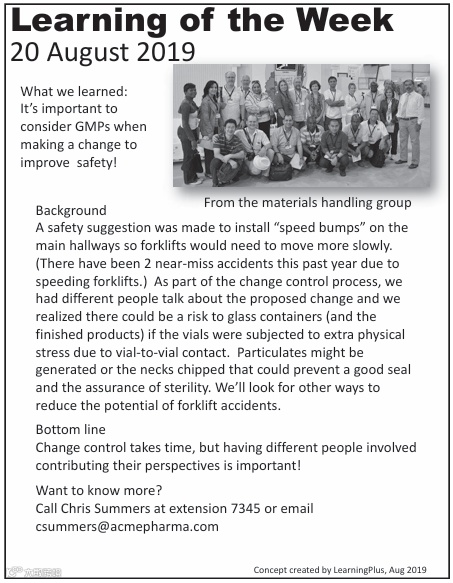
周度经验分享
2019年8月20日
经验总结
进行安全改进时,必须考量GMP规范!
背景来源
物料搬运小组提出安全建议:在主走廊安装"减速带"以降低叉车速度(过去一年因超速引发2起险肇事故)。在变更控制流程讨论中,各方提出新视角——若因西林瓶相互碰撞产生额外物理应力,可能导致:
1.玻璃容器受损(影响成品质量)
2.瓶口缺损(破坏密封性)
3.颗粒物滋生(威胁无菌保证)
现正寻求其他降低叉车事故风险的方案。
最终结论
变更控制需时耗力,但多视角参与至关重要!
咨询联系:致电克里斯·萨默斯(分机7345)或邮箱 csummers@acmepharma.com
COMMUNICATING POTENTIAL RISKS
潜在风险沟通
One of the messages that may be communicated could be concerning risk—the likelihood of a deviation occurring and the severity should it occur (Vesper, 2016). In their work at Bell Telephone Laboratories, one of the most important industrial research centers in the 1900s, Shannon and Weaver (1949) created a model of the communication process and three categories of problems that could arise, specifically:
在风险沟通中,可能传递的核心信息之一是风险本身——即偏差发生的可能性及其实际发生后的严重程度(Vesper, 2016)。20世纪最重要的工业研究中心之一贝尔电话实验室(Bell Telephone Laboratories)的研究中,香农和韦弗(Shannon and Weaver, 1949)提出了通信过程的模型,并定义了可能出现的三类问题:
• Technical problems—the accuracy transmitting the signal between the transmitter and the receiver.
技术性问题:信息在发送端与接收端之间传输的准确性。
• Semantic problems—issues in the interpretation of the information by the receiver compared against the sender’s intended meaning.
语义性问题:接收者对信息的理解与发送者意图之间的偏差。
• Effectiveness problems—the success of the information in producing the desired outcome or result.
有效性问题:信息能否成功驱动预期行动或结果。
In terms of risk communication, there can be technical problems if a report is garbled or if color codes are not apparent on a heat map, but it is likely that semantic and effectiveness problems will be more significant. Semantic problems, for example, could be the receiver misinterpreting a vague term like “low risk” or “high likelihood of occurrence.” An effectiveness problem might be a decisionmaker who is not persuaded by the communicated message to take appropriate risk-reducing actions such as timely implementation of the corrective action. The communication needs to answer the “So what?” question. Specifically, How should the recipient of the information use it? What decisions are to be made? What actions should be taken?
在风险沟通领域:技术性问题可能表现为报告格式混乱(如热力图中颜色标识不清晰),但更关键的挑战在于 语义性与有效性问题。语义性问题:例如接收者可能误解模糊术语(如“低风险”或“高发生概率”),导致风险评估失真。有效性问题:决策者即使理解风险,也可能未被说服而采取行动(如及时实施纠正措施),导致沟通目标落空。
风险沟通的核心价值在于回答 “那又如何?”(So what?):信息接收者应如何运用该信息?需做出何种决策?应触发哪些具体行动?
Other researchers (Zikmund-Fisher, 2011) who have looked at communicating health risks focused on the best ways of presenting information to achieve a desired outcome, examples of which are shown in Table 1.
其他研究人员(Zikmund-Fisher,2011)关注沟通健康风险的最佳方式,这些方法在表1中有所展示。
Table 1. Risk concepts and messages (based on Zikmund-Fisher, 2011)
表1.风险概念和信息传达(基于Zikmund-Fisher,2011)
Risk concept 风险概念 |
Risk message (example) 风险信息示例 |
Purpose of message 信息目的 |
Possibility 可能性 |
It could happen/it might not happen. 可能发生、可能不发生 |
Awareness, avoid surprise 提升认知,避免突发意外 |
Relative possibility 相对可能性 |
It is more likely to happen. 该事件更有可能发生 |
Recognize best option 识别最佳选项 |
Comparative possibility 比较可能性 |
This is more likely to happen than that. A事件比B事件更有可能发生 |
Recognize best option 识别最佳选项 |
Categorical possibility 定性可能性 |
There is a high chance of this happening. 该事件发生概率很高 |
Motivate to act 促进采取行动 |
Relative probability 相对概率 |
This risk is higher by this much (e.g., 50%). 此风险高出特定幅度(如50%) |
Recognize best option 识别最佳选项 |
Absolute probability 绝对概率 |
The risk is this (e.g., 10%). 风险发生概率为特定值(如10%) |
Motivate to act 促进采取行动 |
Comparative probability 比较概率 |
The risk is 20% if I do X; it is 80% if I do Z. 若采取X方案风险为20%,采取Z方案则为80% |
Make magnitude dependent decisions on options 基于方案的风险等级决策 |
Incremental probability 增量概率 |
The risk will increase by 25% if I do this. 若执行此操作,风险将增加25% |
Make magnitude dependent decisions on options 基于风险增幅的量化决策 |
CONCLUSION
结论
Communicating information about a quality event and the related impacts and risks is part of knowledge management. It not only builds awareness of such events among stakeholders, it also contributes to transparency within an organization. Beyond simple awareness, communicating problems can also provide direction to personnel on how they can prevent and respond should circumstances arise.
关于质量事件及其相关影响与风险的沟通,实为知识管理体系的核心组成。此举不仅有助于提升相关方对此类事件的认知水平,更能增强组织内部运作透明度。超越基础认知层面,有效的问题沟通更能为员工提供明确的行为指引——阐明如何预防潜在风险,以及一旦事态发生时应如何响应。
REFERENCES
参考文献