


"Blue light! A miraculous blue light!" Even after 30 years, Yue Feng still vividly remembers the breathtaking moment when the coffin lid was lifted and the "national treasure" was first unearthed.
On October 13, 1995, a joint Sino-Japanese academic expedition team conducted an archaeological excavation at Tomb 8 of the 95MNⅠ Cemetery in the Niya Ruins in Minfeng County, Hotan Prefecture, northwest China's Xinjiang Uygur Autonomous Region.
This brocade, now housed in the Xinjiang Museum, is one of the greatest archaeological discoveries of the 20th century in China.
On October 17, 2025, under a clear sky and amid brilliant autumn scenery, the key witnesses of the archaeological excavation of the brocade set out from Minfeng County at the northern foot of the Kunlun Mountains, heading north deep into the heart of the Taklimakan Desert. Thirty years later, they returned to this land that had always lingered in their hearts.
They passed through reed marshes and poplar forests before reaching endless, undulating sand dunes. After a long, bumpy ride, they arrived at the Niya Ruins at noon. The scorching sun bleached the crumbling walls and ruins. The archaeological trenches from 30 years ago remained clearly visible in the stark light, as if time had stood still.
"Right here," said Kaisar Mahmut, a local guardian, pointing to a sand dune near Tomb 8 of the Niya Ruins.
Following Kaisar's pointed finger, the expedition team members stepped forward slowly, pulling out their phones to carefully compare them with precious photos of the national treasure's excavation site from 30 years ago.
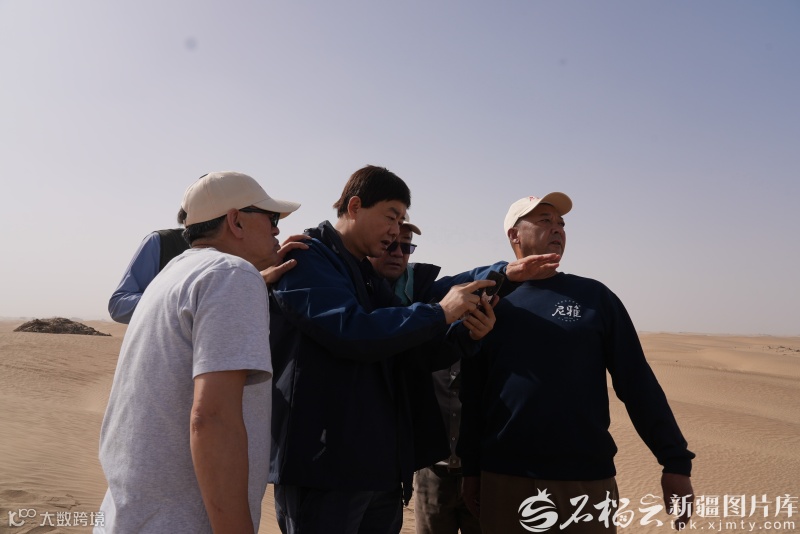
Photo taken on October 17, 2025 shows the main participants in the archaeological excavation of the brocade carefully compare the site with precious photos of 30 years ago on their screens at Tomb 8 of the 95MNI Cemetery at the Niya Ruins in Minfeng County, Hotan Prefecture, northwest China's Xinjiang Uygur Autonomous Region. (Photo by Shiliuyun-Xinjiang Daily/Parzat Abdu)
The Niya Ruins before them appeared almost unchanged from the photographs taken 30 years prior — the same azure sky, the same barren poplar trees, the same endless undulating dunes. The only difference was that the wind swept sands had sculpted the once-level excavation site into a newly formed, rolling dune, like distinct growth rings left here by time itself.
"At that time, we noticed a piece of colorful brocade peeking out from the fabrics on the right side of the male occupant of Tomb 8. It stood out strikingly against the sandy soil. As we gradually uncovered it, the vibrant blue, white, red, yellow, and green patterns of the brocade began to emerge. When the full phrase of "Five planets rising from the East" was revealed, everyone present was astonished," recalled Yue Feng, the Chinese team leader of the archaeological expedition at the time and a researcher at the National Museum of China.
The brocade measures 18.5 centimeters in length and 12.5 centimeters in width. It features the seal-script characters and patterns of auspicious birds and animals, woven with 220 warp threads per square centimeter, representing the pinnacle of Han-style brocade technology.
The arid climate of the Taklimakan Desert was key to the preservation of the artifact. "The brocade, primarily in a precious blue hue, was as bright and vivid as if it were brand new," Yue Feng recalled. In his "Record of the Niya Ruins Investigation," he wrote: "When the lid of the coffin in Tomb 8 was lifted about 20 centimeters, Yu Zhiyong saw the exquisite cultural relics inside and exclaimed, 'Amazing!'" At that moment, only the word "amazing" could capture the feeling.

Photo taken on October 17, 2025 shows the main participants in the archaeological excavation of the brocade stand side by side in front of Tomb 8 of the 95MNI Cemetery at the Niya Ruins in Minfeng County, Hotan Prefecture, northwest China's Xinjiang Uygur Autonomous Region. (Photo by Shiliuyun-Xinjiang Daily/Parzat Abdu)
Yu Zhiyong, now director of the Xinjiang Museum, said, "The brocade ingeniously integrates astronomy, historical facts, and the ancient concepts of Yin-Yang and the Five Elements. Its discovery at the Niya Ruins, far from the Central Plains, confirms the history of the central authorities’ governance over the Western Regions. It also reflects the deep exchanges and integration among ethnic groups over 2,000 years ago, vividly showcasing the rich connotation and unique charm of Chinese civilization. This is an extraordinary national treasure!"
For Wu Yong, a researcher at the Xinjiang Institute of Cultural Relics and Archaeology, this was his first return to Niya since the 1995 excavation. The scenes from 30 years ago came flooding back as he stood there. Having participated in archaeological work, Wu Yong expressed his delight at seeing the well-preserved state of the ruins where he had once worked and toiled.
"The brocade features patterns of auspicious birds and animals like phoenixes, luan birds, qilins, and white tigers, along with clouds and auspicious plants. The characters are skillfully woven into the design, symbolizing prayers for blessings and good fortune. The fact that the brocade was used as a burial object also reflects the reverence and recognition of the Western Regions for Chinese culture," Wu Yong explained.
On the night when the national treasure was discovered, the archaeological team celebrated with drinks. Wang Binghua, then the Chinese academic leader of the joint Sino-Japanese academic expedition team and director of the Xinjiang Institute of Cultural Relics and Archaeology, who usually never touched alcohol, drank half a bottle of beer that day. Sadly, Wang Binghua passed away on February 6, 2025.
Since its discovery, the brocade has become a major theme in Xinjiang's cultural and creative products, ranging from carpets, scarves, and handbags to refrigerator magnets, all highly popular among the public. Meanwhile, the Niya Ruins have been well preserved.
Kaisar has been guarding the ruins for 28 years, transitioning from riding camels to driving motorcycles. Learning that the witnesses of the archaeological excavation were returning to Niya, he waited early at the protection station near the Stupa. Thirty years ago, he was still learning from his master, Mamat Kurban, and was not yet the guardian of the ruins. Today, his master's youngest son and his own second son have become his apprentices. "We patrol the ruins every week, covering over a hundred sites, including the Stupa, houses, orchards, and canals," Kaisar said.

Photo taken on October 17, 2025 shows Kaisar Mahmut, a guardian of the Niya Ruins in Minfeng County, wipes the dirt on the stupa. (Photo by Shiliuyun-Xinjiang Daily/Parzat Abdu)
"Let's take another group photo!" someone suggested.
As the sun set in the west, the witnesses of the archaeological excavation stood side by side in front of Tomb 8, and the camera captured this reunion across 30 years.
Based on scientific calculations, a rare astronomical phenomenon of the conjunction of the five planets will occur on September 9, 2040. Those present at the Niya Ruins made a promise — they will meet again at that time!
Source: Xinjiang Today Media Hub, Tianshannet
Editor: Nafisa Nabi
Supervisor: Song Duer