


Despite recent advances in understanding and managing acute brain injury (ABI), it remains a major contributor to mortality and disability worldwide. As there are currently no interventions available to reverse the primary injury, ABI management in the intensive care unit (ICU) is mainly focused on minimising secondary brain damage [1]. Given the heterogeneous pathophysiologies involved in ABI, a shift towards individualised care based on disease endotype and phenotype is warranted to improve outcomes. In this manuscript, we summarise key aspects of the latest evidence on ABI management in the ICU.
Preventing secondary brain damage
The primary impact results in a series of secondary cascades, which are thought to worsen outcomes via compression of vital brain structures, ischaemia and hypoxemia, excessive metabolic demand, neuroinflammation, oxidative stress, and toxicity from neurotransmitters [2]. These mechanisms can be exacerbated by a variety of intra- and extracranial factors. Key clinical contributors to secondary brain injury in the ICU setting include intracranial hypertension, impaired cerebral blood flow, seizures, and systemic factors such as inadequate gas exchange, haemodynamic instability, anaemia, and infections [3,4,5,6]. Advanced neuromonitoring techniques, including but not exclusive to brain tissue oxygen (PbtO2), continuous electroencephalogram (EEG), and cerebral microdialysis, offer potential for personalised care of these complex patients, which may help to anticipate and mitigate developing complications and thereby improve outcomes. Trials investigating the efficacy of personalised care are required.
A main focus remains on treatment of intracranial hypertension and maintenance of cerebral perfusion pressure, which is typically based on a tiered approach, especially in trauma. Less aggressive treatments are recommended first, with gradual escalation to higher-risk aggressive interventions in refractory cases of intracranial hypertension (commonly known tier three therapies e.g. hypothermia, barbiturates, decompressive craniectomy) [7]. Despite some mortality benefits of these treatments, the impact on neurological outcome is variable and less established and likely depends on a complex interaction between pathophysiological clinical factors and individual phenotype.
Hypotension has been long known to be associated with poor outcomes in ABI, likely via secondary cerebral ischaemia, with a high release of cerebral biomarkers, with recent guidelines recommending individualised thresholds based on age and pathology [2, 8]. Similarly, hypoxemia can exacerbate neuronal death in the context of reduced cerebral oxygen delivery [8]. Importantly, the pathophysiology of oxygen delivery is complex and depends not just on the content of arterial oxygen, but on a cascade of factors which include oxygen diffusion, oxygen-carrying capacity, oxygen utilisation and metabolism [8]. The role of brain oxygenation titration and PbtO2 targets remain under investigation, While the OxyTC trial did not show benefits of an PbtO2-guided approach compared to an intracranial pressure based approach only there was a signal of effect in the subset of patients with raised intracranial pressure, and [add ref OXY-TC if room], further evidence from the BOOST-3 (NCT03754114) and BONANZA (ACTRN12619001328167) trials is highly anticipated.
A recent randomised controlled trial supports the use of liberal transfusion strategies after ABI (restrictive being 7 g/dL Vs liberal 9) to improve long-term neurological outcome [3]. Similarly, carbon dioxide is a fundamental modulator of cerebral flow and cerebrovascular reactivity. The optimal carbon dioxide target in ABI remains elusive, and is likely based on cerebrovascular physiology and intracranial hypertension. Hyperventilation [6] can reduce intracranial volume and pressure, but at the same time can result in vasoconstriction and cerebral ischaemia, and balancing these risks while accounting for injury subtype and burden is important. In the prehospital setting, increased mortality has been observed with values of carbon dioxide < 35 mmHg and > 45 mmHg.[4]. However, a recent econdary analysis of the CENTER-ABI database suggested that mild hypocapnia (32–35 mmHg) can be associated with improved mortality in acute brain injured patients [6].
Similarly, treating and recognising complications such as status epilepticus/seizures is paramount, as these can exacerbate secondary brain injury by increasing metabolic demands, elevating intracranial pressure, and potentially leading to worse outcomes. A large proportion of seizures in the ICU are non-convulsive, typically requiring continuous EEG monitoring for detection. However, it is crucial to balance seizure control with the potential side effects of antiseizure medications and sedation, and the management of EEG patterns on ictal-interictal continuum remains controversial, requiring nuanced interpretation and constant reassessment [9, 10].
Advanced neuromonitoring and neuroimaging can aid in early detection of complications and select patients amenable for timely interventions [1]. Cerebral biomarkers play a significant role in predicting outcomes after acute brain injury, as these can help clinicians in assessing the severity of injury, guide management, and inform multimodal prognostication [2].
The importance of prevention of systemic complications in ABI patients has been highlighted in recent studies [1, 11]. Selective digestive decontamination (SDD) uses topical antibiotics (e.g. polymyxin, tobramycin, amphotericin B) in the oropharynx and gut to reduce pathogenic carriage, lower ventilator-associated pneumonia (VAP), and possibly improve survival [11]. Whilst results are encouraging, concerns remain about antimicrobial resistance and microbiome disruption, and use of SDD varies according to local infection-control policies. In addition, the management of extracranial injuries, including appropriate timing of surgery, is an important consideration as it can significantly influence patient outcomes.
Prognosis, recovery and treatment
Accurate prognostication in patients who have sustained an ABI remains a major challenge. Advanced neuroimaging and cerebral biomarkers may provide valuable information to inform neurologic prognostication; especially in the context of prognostic uncertainty, a multimodal assessment can enhance prognostic accuracy. The changing demographics of ABI, with an increasing number of older adults being affected, add additional complexity to management and prognostication. Some older adults, particularly those with good premorbid health, may achieve better outcomes than age alone would suggest. However, more research is required to optimise management in this cohort.
Prolonged disorders of consciousness and severe functional disability, in particular, represent a significant burden for patients, families and healthcare systems [12, 13].
There is also a growing appreciation that recovery trajectories after ABI may extend longer than previously appreciated. In particular, the diagnosis and management of patients with an ongoing disorder of consciousness in the acute phase is complex and demands careful attention to ethical considerations and shared decision-making principles with families. Clinicians must navigate the balance between timely withdrawal of life-sustaining therapies versus allowing sufficient time for potential recovery, so as to minimise the risk of self-fulfilling prophecies. Recently, pharmacological and neuromodulation strategies have been explored to promote recovery of consciousness, but their efficacy is inconsistent across patient groups, and the optimal therapeutic approach remains uncertain [14, 15].
Future directions
Acute brain injury represent challenging, complex conditions associated with significant mortality and morbidity. Although advances in neuromonitoring have improved the understanding of ABI pathophysiology, the overall prognosis often remains uncertain, especially in the ICU setting. Current management strategies are largely informed by clinical trials conducted in heterogeneous patient populations, highlighting the need for more refined trial design guided by improved characterisation, including the use of neuroimaging and blood biomarkers. A shift towards personalised management and tailored therapies based on individual pathophysiological profile holds promise for improving outcomes (Fig. 1).
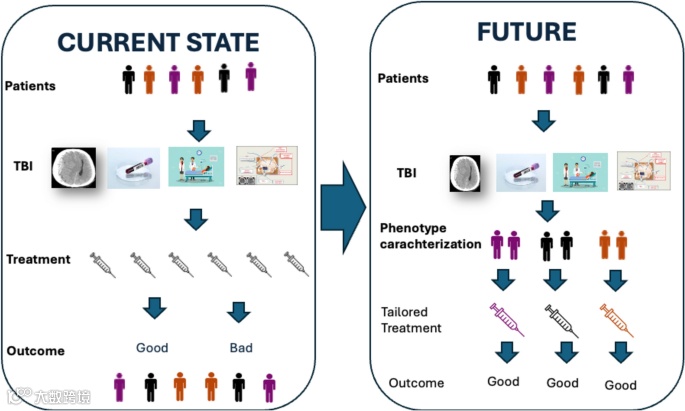
Precision medicine in the critical care management of acute brain injury (ABI), leveraging phenotypes and individualised data, represents a promising direction for improving patient outcomes. By considering the heterogeneity of disease pathology and tailoring therapies accordingly, clinicians can move away from a "one-size-fits-all" approach. The figure illustrates the concept of precision medicine in ABI through a schematic representation of different patients treated according to standardised treatment or according to clinical/physiological factors (pre-injury characteristics, neuroimaging, neuromonitoring, biomarkers, etc.). Identifying distinct phenotypes amongst critically ill patients can help clinicians select the most effective treatments