



来源1018经济学人
Why the ultra-rich are giving up on luxury assets
Forget fine wine, great art and glitzy mansions. There are finer things in life
A BOTTLE OF Château d’Yquem 2010 is a fine thing. Apricot, toasted almond, citrus zest, juicy lemon, white truffles: it is all there. Until recently, the cost of the world’s finest sweet wine rose steadily. By 2023 a given bottle from the producer went for 60% more than in the mid-2010s. At the time, all forms of opulence were becoming more expensive. Classic cars, aged whiskies and enormous mansions shot up in value. From 2015 to 2023 a “luxury-investment index” produced by Knight Frank, a property firm, rose by 70%.
And then something changed. From its peak in 2023, the index is down by 6%. The price of Bordeaux first growths, including Lafite Rothschild and Margaux, has fallen by 20%. In America the price of private jets and boats is down by 6%. Second-hand Rolexes change wrists for nearly 30% less than in 2022. Fine art is in a slump. According to Savills, a real-estate firm, prices of the very best properties in global cities are barely rising. The price of “prime” housing is falling in London and Paris. Two years ago a house on San Francisco’s “Billionaires’ Row” “went on sale for $32m. The sellers have now cut the price to $26m.
Why the bear market in plutocratic assets? It seems unlikely that the super-rich are struggling. There are more than 3,000 billionaires in the world, according to Forbes, a magazine, up from 2,800 last year. The richest 0.1% of Americans now hold 14% of the country’s household wealth, the most in many decades. In San Francisco, where no one wants to buy a mansion, the AI boom mints millionaires each day. In contrast with poorer Americans, the richest 3.3% have greatly increased their outlays since 2022, finds Mark Zandi of Moody’s Analytics, a research firm.
Instead, the bear market is down to the fast-changing economics of luxury. To understand why, read Thorstein Veblen, an American economist who was prolific in the early 20th century. He argued that luxury depends on scarcity and rivalrousness. A good is truly luxurious not just because “it is costly, but because one person’s consumption diminishes others’ ability to have it. Today, what counts as scarce and rivalrous has changed profoundly.
The problem, at least for the ultra-rich, is that fancy goods are everywhere. Lots of vineyards make great wine; is the best Bordeaux really that much better? Lab-grown diamonds are identical to the real thing. Anyone with a bit of dosh can claim a Kiton jacket from a second-hand marketplace or charter a private jet. Art-world innovators talk of “fractionalising” old masters, with hundreds of people owning a tiny piece of a Rembrandt. These days everyone enjoys the finer things in life—and they post about it on social media. Such things are no longer scarce or rivalrous. So they no longer seem as luxurious.
Il meglio del meglio più uno
The rich are therefore spending on bigger and better things; often services, rather than goods. We constructed an ultra-luxury-services index,“including everything from a Super Bowl ticket to a three-Michelin-star meal. We chose experiences with both global recognition—not just nice, but the best of the best—and for which we could unearth reliable price data over many years. Our index has risen by 90% since 2019. It has even surged since 2023, as goods prices have fallen (see chart).
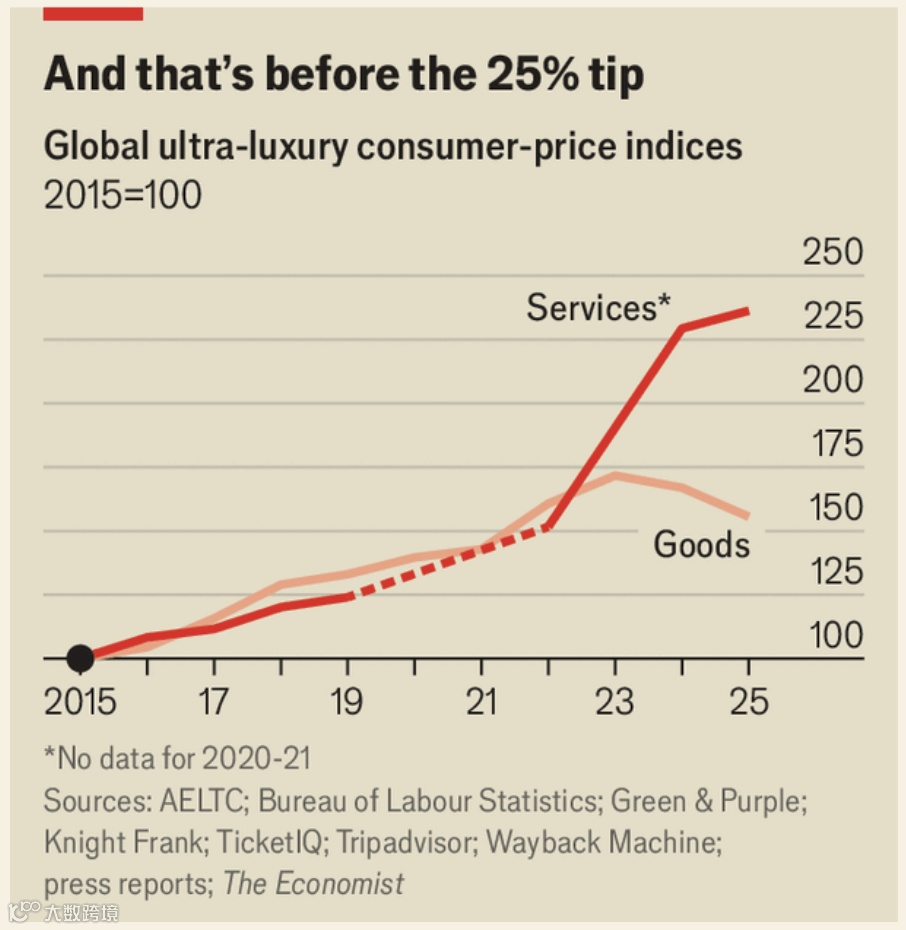
Soaring luxury-services prices reflect the very same dynamics that have harmed luxury goods. Consider Le Bristol, perhaps Paris’s finest hotel. There is global demand to swim in its roof-top pool, which boasts a view of the Eiffel Tower. Many of the guests on its leafy terrace spend more time photographing their cocktails than drinking them. Yet there are fewer than 200 rooms at Le Bristol, making accommodation intensely rivalrous. A night there now costs twice as much as in 2019.
Many people would like a housemaid, but the best are hard to find. In America, their salaries are about 50% higher than in 2019. Housekeepers in Palm Beach, a ritzy part of Florida, now routinely pull in more than $150,000 a year. You can resell a watch, but you cannot “resell” a day spent on Centre Court at Wimbledon. Since 2016 the issue price of a five-year debenture, which entitles the holder to a ticket, has risen from around £50,000 ($67,000) to well over £100,000. “The price of a ticket to the Super Bowl is double what it was a few years ago. Attending the Met Gala, if you can get a ticket, costs over twice as much as in 2019. The price of the menu at Benu, a three-Michelin-star restaurant in San Francisco, has risen by 78% since 2015. Was it worth the more than $500 that your correspondent paid to eat the food “Maybe?
Yet when eating at the restaurant, you buy not just the food—but the knowledge that, for those few hours, nobody else on Earth could sit at your table. New York and Paris fashion weeks, exclusive fundraisers, the NBA play-offs: there are no good deals any more, which makes it even more satisfying to tell others that they were not there. Goodness knows how much a resale ticket to next year’s football World Cup final, to be played near New York City, will cost. That is a large part of the appeal. When you could be one of a handful of people seeing Harry Kane and Kylian Mbappé face off, why would you bother with a bottle of Château d’Yquem?