

We’ve all heard the saying “The trend is your friend”, and while it sounds nice it doesn’t really teach us anything about trading a trending market or how to identify one.
In today’s lesson, I am going to give you guys some solid information on trend trading that you can begin using immediately.
Today’s lesson is all about trading trending markets with price action, and we are going to talk about how to tell when a market is trending and how to take advantage of these trends.
I hope you guys pay close attention to today’s article and refer back to it when you have any questions about how to trade or identify a trending market.

The first step: Learn to identify a trend with nothing but raw price action
As you probably already know, there are tons of different indicators that you can put on your charts to ‘help’ you identify a trending market and trade with it.
Many traders spend countless hours and dollars on trend-following trading systems or on indicators that just end up confusing them and making the process of trend discovery a lot more difficult than it needs to be.
I have always been a strong proponent of visual observation of the raw price action of a market, as you probably know.
I also believe that simply observing a market’s raw price action, from left to right, is the easiest and most effective way to identify a trend and to spot high-probability entries within it.
Let me make a quick note before we proceed:
A trend is not actually a strategy by itself; it’s just an added point of confluence that increases the probability of a trade.
However, just randomly jumping in with a trending market is not an edge or a strategy.
As a market moves higher or lower, its previous turning points, or swing points as I like to call them, become reference points that we can use to help us determine the trend of a market.
The most basic way to identify a trend is to check and see if a market is making a pattern of higher highs and higher lows for an uptrend, or lower highs and lower lows for a downtrend.
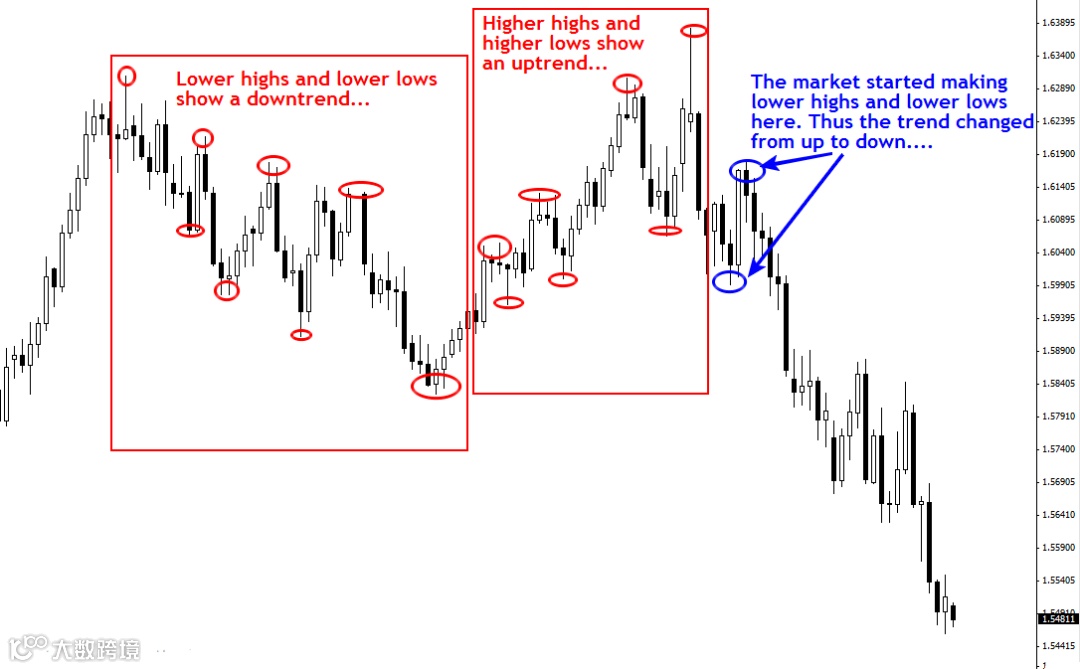
This is just plain old visual observation of a market’s naturally occurring price action…
No mumbo-jumbo trading systems or magic-bullets here.
I’d like you guys to take a look at this simple diagram that I drew below; it shows us the basic idea of looking for higher highs (HH) and higher lows (HL) for uptrends and lower highs (LH) and lower lows (LL) for downtrends:
Note: each colored circle is highlighting what we would consider a ‘swing point’ in the market:
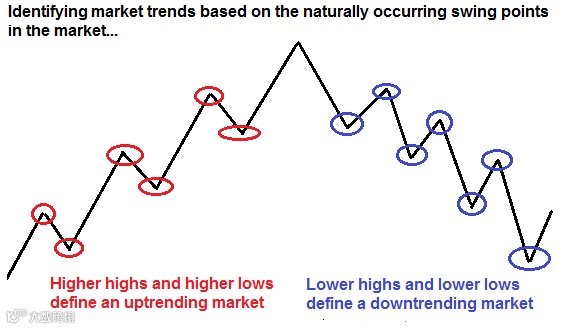
Thus, general observation of a market’s swing points is the first point of call in determining if a market is trending.
If you do not see a pattern of HH HL or LH LL, but instead you see sideways price movement with no obvious general up or down direction to it, then you are probably looking at a range-bound market or one that is simply chopping back and forth.
Tip:
You shouldn’t have to think too hard about whether a market is trending or not.
Most traders make trend discovery WAY too difficult.
If you take a common sense and patient approach, it’s usually fairly obvious if a market is trending or not just by looking at the raw price action of its chart, from left to right.
Make sure you mark the swing points on your chart, as it will draw your attention to them and help you see if there’s a pattern of HH and HL or LH and LL, as discussed above.
Characteristics of trending markets
Trending markets tend to make strong moves in the direction of the trend followed by periods of consolidation or a counter-trend retrace before the next leg in the direction of the trend.
You will notice this pattern happens in almost any trend you can find.

Typically, what happens to many traders is that they will make some money during the periods of strong directional trend movement, but then they continue to trade as the market takes a breather from the trend and consolidates.
It’s these periods when traders give up all of the gains they just made when the market was moving aggressively.
You need to learn to identify the different parts of a trend, this will help you avoid over-trading during the choppy / consolidation periods and will give you a better chance at profiting when the trend makes a strong move.
Here is an example of what I’m talking about:
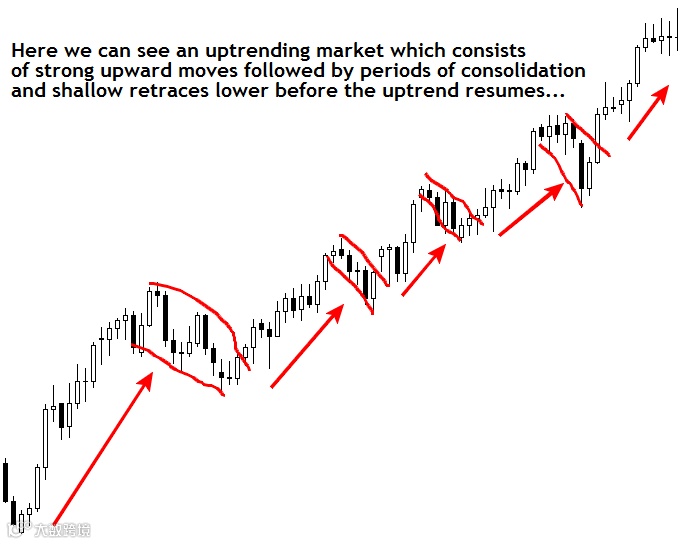
In the diagram above, we can see that a trending market tends to move in spurts, moving in the direction of the trend and then stalling to take a breath before another leg in the direction of the trend.
Now, all trends are obviously not exactly the same, but we do typically see the general pattern described above; a forceful move in the direction of the trend followed by a period of consolidation or a retracement in the opposite direction.
Now, these retraces are when we have the highest potential for a high probability entry within the trend.
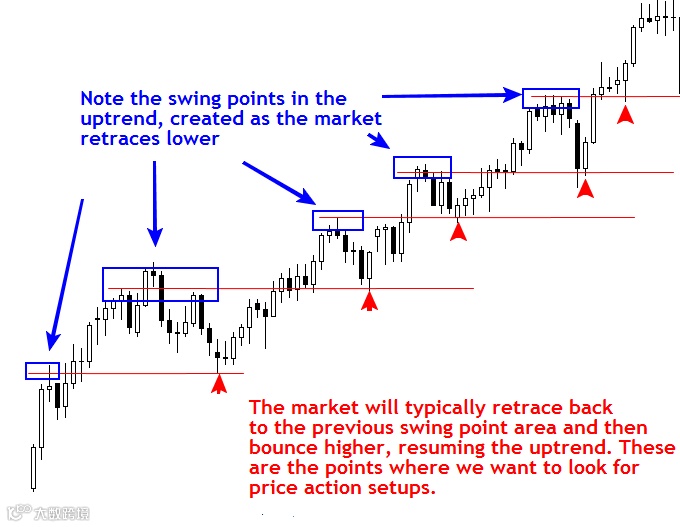
Often, a market will retrace to approximately the level of its previous swing point before the trend resumes.
In an uptrend these swing points are support and in downtrends they are resistance.
Look at the very first diagram in this article for a quick refresher on what I’m talking about.
Also, let’s look at the chart we just looked at but this time with the support levels marked.
These support levels resulted after the market began to retrace lower within the structure of the broader uptrend.
Note the ‘stepping’ pattern left behind by the swing points in this uptrend.
As the market retraces back down to these ‘steps’ or support levels, we would focus our attention and watch for price action signals forming near these levels to rejoin the uptrend:
Note:
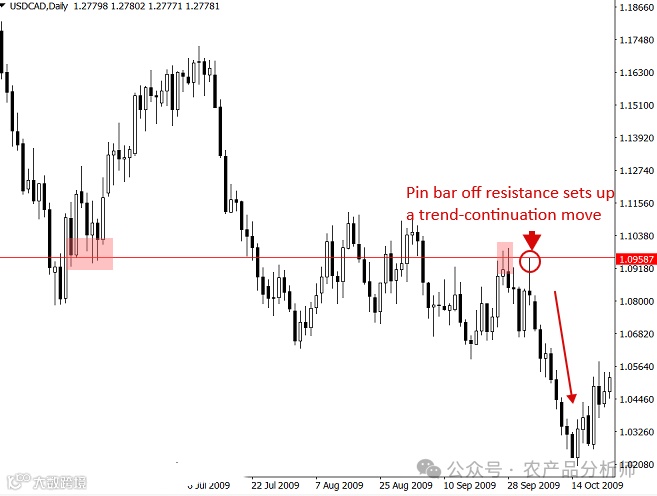
These same principles apply in a down trending market but we would be looking for price action setups from resistance rather than support.
As we discussed previously, a trending market will tend to surge in one direction and then slow down and either consolidate in a sideways manner or retrace lower or higher, depending on what direction the dominant trend is.
It is during these contraction or retrace moves that we can focus extra hard through our ‘sniper-scope’ and begin searching for high-probability price action trading strategies forming from previous swing points within the overall trend.
Trading from value in trends
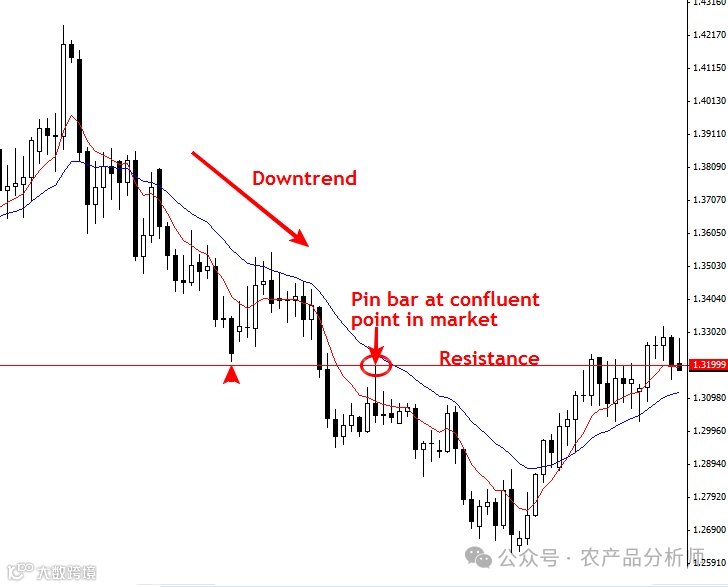
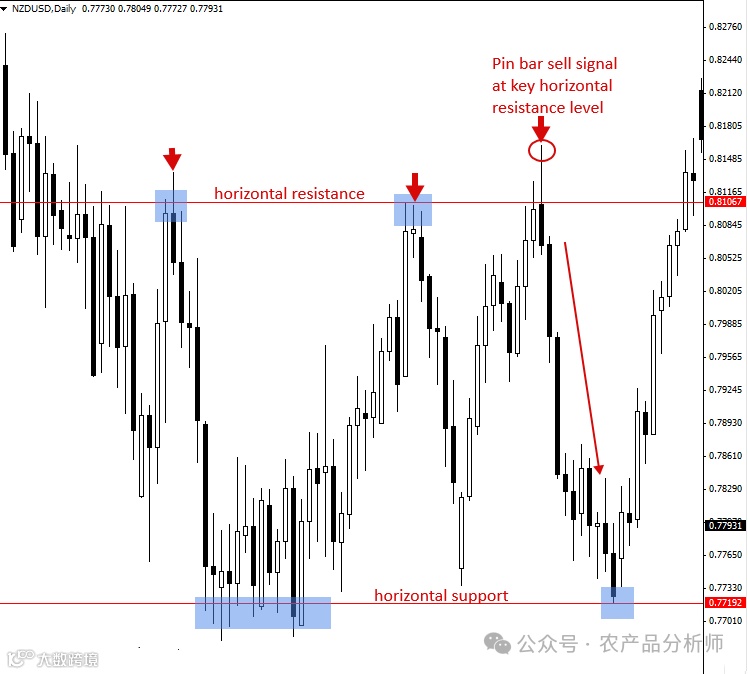
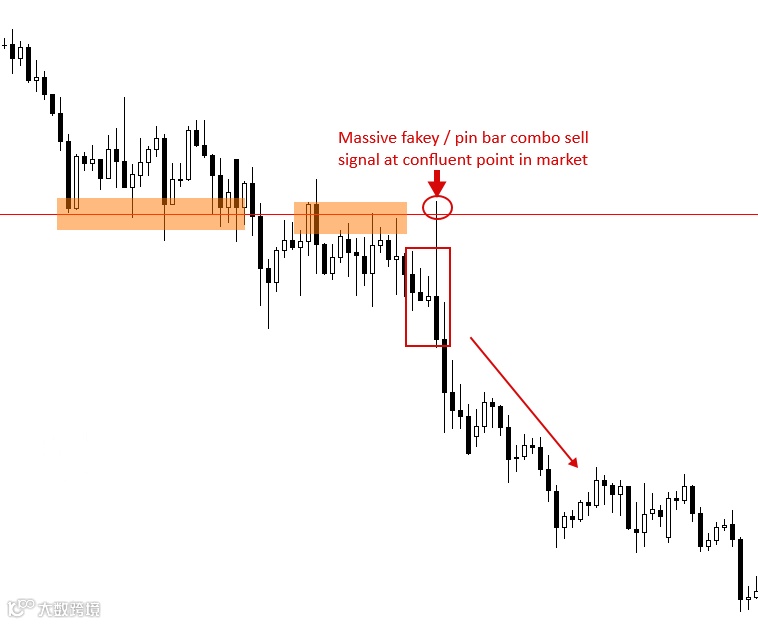
My primary mission as a price action trader is to watch for obvious price action setups that form after a market retraces back to a confluent level in the market.
This can be a swing point like we discussed above, a moving average level, or some other support or resistance level.
Whatever the case, I am looking to trade from ‘value’ in a trending market.
By value, I mean from an optimum point in the market that has proved significant before.
For example, in an uptrend I would consider ‘value’ to be support, since that is where the price of the market is likely to be seen as a good ‘value’ for the bulls, and thus they will tend to buy from that level and push the price higher.
Whereas, in a downtrend, ‘value’ is seen at resistance, since the price has rotated higher within the broader downtrend; so it’s a good ‘value’ to sell from resistance in a downtrend.
These rotations back to value points can also be called ‘trading from the mean’ or the ‘average’ price, this is why moving averages tend to act as dynamic support or resistance levels.
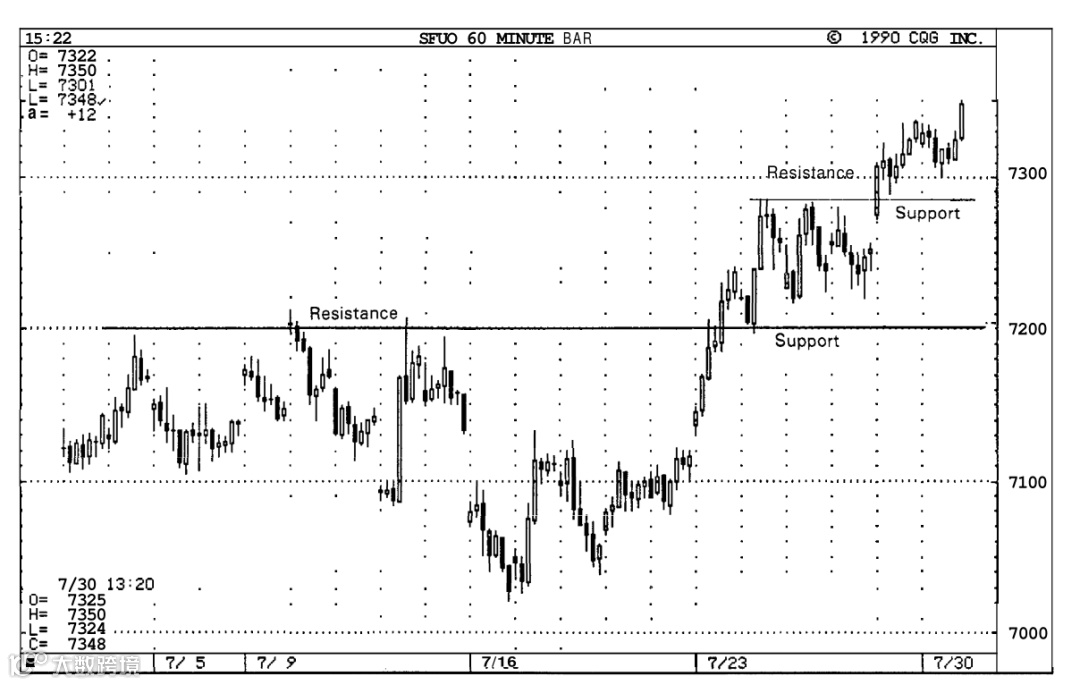
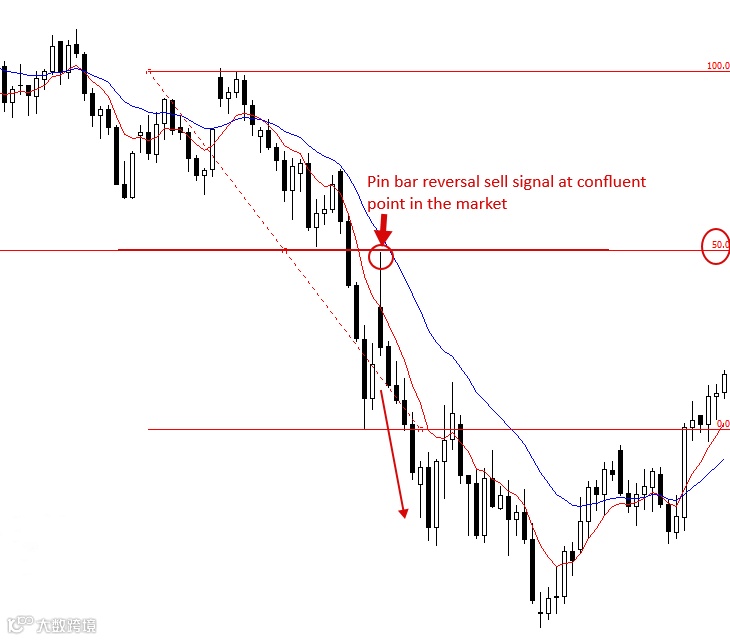
One tool we can use to find ‘value’ in a market is a moving average.
I don’t use them all the time, but when I do I like to use the 8 and 21 day exponential moving averages.
I use them as a general guide and a helper to find confluent points in a market.
For example, often the 21 day EMA will align with a swing point in a trending market, this would be considered a confluent level since you have multiple factors lining up together.
Then, if we see a price action signal there, we know we are seeing a setup form in a very high-probability area on the chart.
See here:
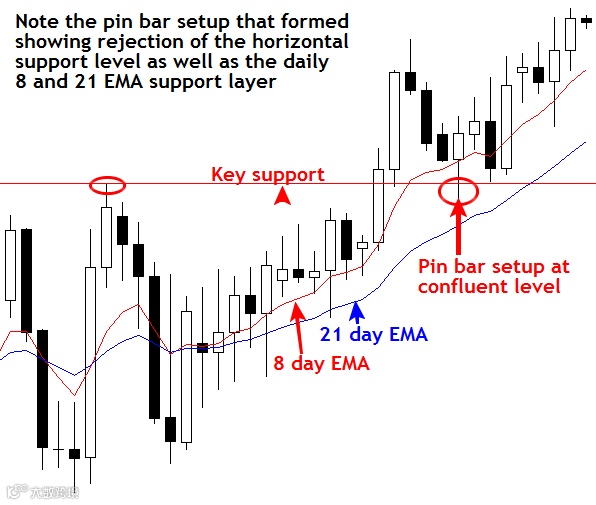
Note:
These moving averages should only be used as a ‘general guide’ and never as an actual signal (as in the old ‘moving average crossover signal’).
We only use them as a helper to see dynamic support and resistance levels (to add confluence) and for trend direction.
But just to be clear, our main focus is on visual observation of a market’s price action and levels, that is to say without any EMAs.
Don’t fall into the ‘breakout’ trap – Many amateur traders get stuck in a cycle of trying to trade breakouts all the time…
This is not really an effective long-term strategy because the ‘big boys’ all know that amateurs are constantly trying to buy and sell breakouts.
Instead, we want to enter closer to key market levels, swing points, EMA levels (confluent levels) in the market…
Always with confirmation from a price action signal.
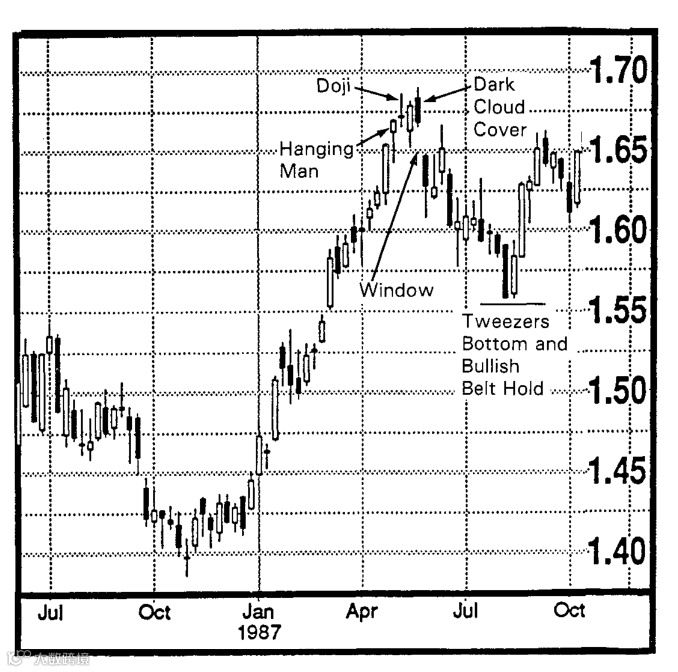
As a ‘regressive’ price action trader, we are looking to buy or sell from value within the trend…waiting for the inevitable pullback and then pouncing on an obvious price action signal if one forms.
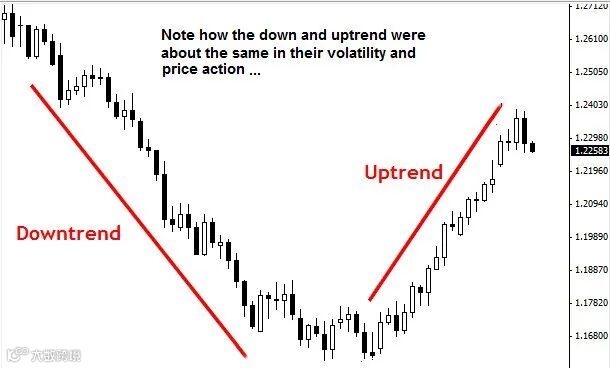
In futures market, bearish and bullish trends are typically equally as violent and potent…whereas in equity markets we tend to see slower moving price action in a bull market, along with lower volatility.
Down-trending markets tend to be fast and volatile in equity markets.
The main reason is because it’s futures market and this results in more balanced price movement.
Thus, in futures market, your trading strategy and plan will generally be the same for both up and down markets.
Here’s an example of the futures market daily chart recently that shows just how consistent both down trends and up trends can be in this market…
Note how the volatility and speed of these trends were about the same:
In the equity markets, traders typically need to adjust their strategies or systems as a market moves from bull to bear or vice versa.
But in futures market, whether you’re trading long or short, bull or bear, the volatility of a futures market tends to be about the same.
That’s not to say that volatility never changes in futures market, it just means that the particular direction of a futures market doesn’t have a very big impact on that market’s volatility or price action, as it does in the equity markets for example.
Final notes on trading with trends:
Take advantage of trends when they happen
There is never anything concrete with trends…meaning you never know how long they will last for, so try to take advantage of them when they do occur.
Markets typically only trend about 25 to 35% of the time, and the rest of the time they are range-bound or chopping in a sideways fashion.
The trick is to learn how to identify a trending market so that you can get the most out of it and get on board as early as possible.
Counter-trend trading – Overall, trend trading should make up about 70% of the trades you take, and the other 30% might consist of counter-trend trades or trades in range-bound markets.
It’s best to learn how to trade with near-term trend before you try trading counter-trend, because trading with the trend is naturally higher-probability than trading against it.
In conclusion, trend trading is perhaps the ‘easiest’ way to make money in the futures market.
Unfortunately, markets don’t trend all the time, and it’s the time in between trends that traders do the most damage to themselves.
This damage is a result of not having the discipline to wait for high-probability setups to appear, and not being able to properly read a market’s price action to determine whether or not it’s trending.
I trust that today’s lesson has helped you get an idea of how to determine whether a market is trending or not and how to trade a trending market.
Remember, there’s no ‘Holy-Grail’ for trend trading, but if you’re in doubt, the best thing to do is to just relax and take some time to visually observe the last few weeks of price data in a market…without indicators.
This no-nonsense approach is hard to beat and will work if you know what you’re looking for.
Finally, I leave you with this little formula:
The Best Trades = Trend + Confluent level + Price action signal
W’ve touched on some topics that traders can use for short-term trend analysis today, and trend following is a large part of Price Action Trading Course and of general trading strategy.
One thing that I didn’t touch on in this article is what time frame you should begin learning to trade on.
All the charts in this lesson were made on the daily chart time frame, and it’s very important that you first learn how to trade on the daily charts before going lower in time frame.
The reason is simple, the daily chart gives the clearest and most accurate view of a market’s price action, and the lower in time frame you go the more random market “noise” there is.
Just like you need a strong foundation to build a house, you need a strong foundation to become a successful trader, and learning to trade on the daily charts before going lower in time frame will help you build that foundation.