


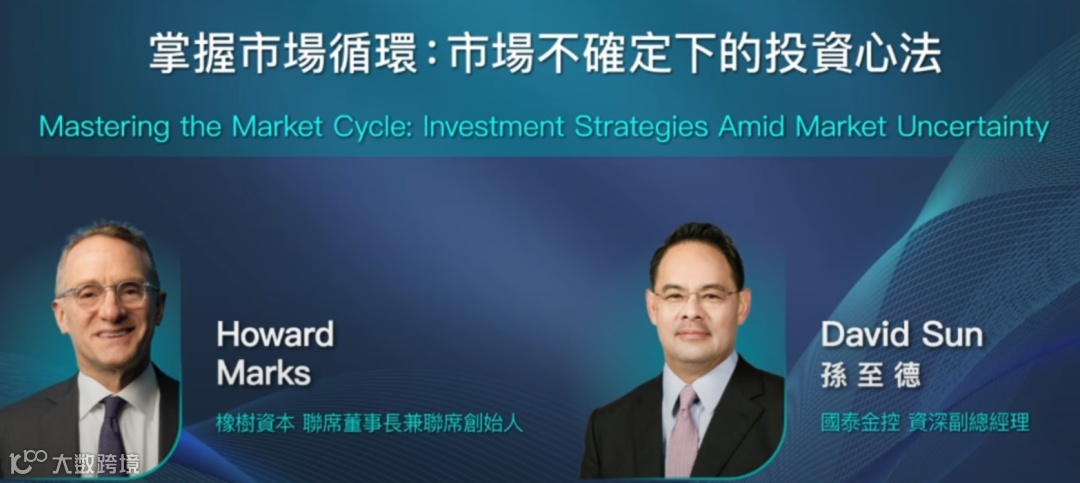
2025年10月16日,国泰资产管理高峰会谈期间,国泰金控副总孙至德采访了橡树资本的霍华德.马克斯。主题是掌握市场循环:市场不确定下的投资心法。
霍华德·马克斯的访谈与memo,禅兄已经有多次分享,他一般不会给出简单的“买入/卖出”指令,而是提供给一套完整的宏观思考框架,非常值得我们借鉴和学习,这次访谈也不例外。
核心观点一:宏观“巨变”——免费午餐时代结束
核心观点原文: 过去40年,利率持续走低,就像在机场的自动人行道上行走,不费力就能跑得很快。这个时代已经结束了。我们进入了一个利率中枢更高的新常态(霍华德预测美联储基金利率在3%-3.5%左右),这意味着资金成本永久性地提高了。
下图是1954年至基准利率的变化曲线
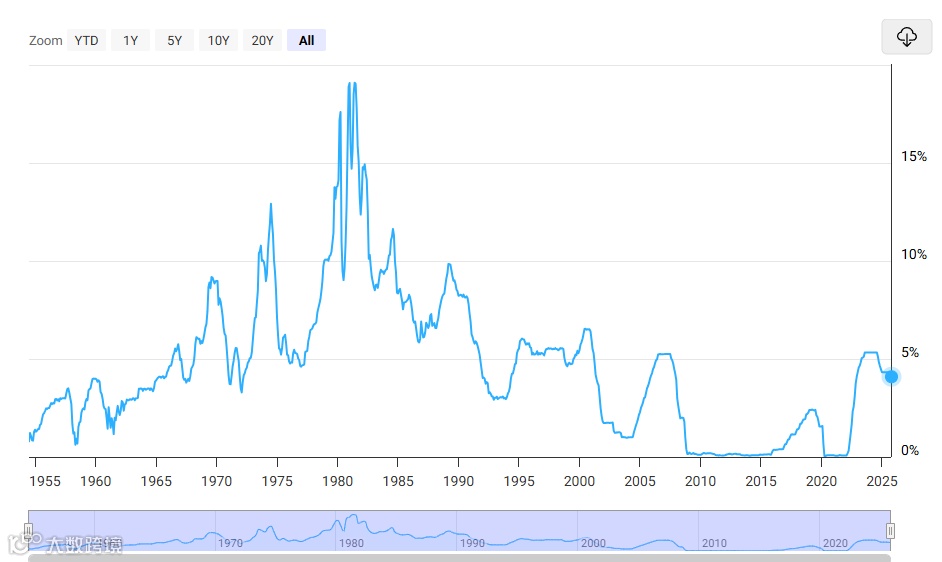
过去,借钱非常便宜,所以不管是公司搞扩张,还是基金做杠杆收购,都如鱼得水。高增长、高估值的“故事”特别容易讲,因为未来的现金流折现到现在,分母(贴现率)很小,显得很值钱。现在,水龙头拧紧了。 钱变贵了,而且可能再也回不到以前那么便宜了。这对依赖“烧钱”换增长、高负债运营、或者估值完全建立在遥远未来的公司,是釜底抽薪。投资逻辑必须从“成长性”优先,切换到“盈利能力和现金流”优先。
核心观点二:信贷市场的再评估——绝对收益的吸引力与风险识别
核心观点原文: 尽管信贷利差(高收益债相比国债的额外收益)很窄,但债券本身的绝对收益率已经很有吸引力。不过,最好的时代往往会滋生最坏的贷款。投资者需要更强的风险识别能力,避开像“First Brands”那样的潜在爆雷点。
以前存款利率低,买债券也没啥意思,大家只好都去股市里“搏一搏”。现在,一个相对安全的债券都能提供不错的固定回报(比如5%-6%),这对投资组合来说就是一个坚实的“压舱石”。
但是,要警惕“穿着泳衣的裸泳者”。经济好的时候,很多质地不佳的公司也能轻松借到钱。一旦环境变化,它们的偿债能力就会出问题。现在的工作重点不光是找到高收益的资产,更是要练就一双“火眼金睛”,能识别出哪些公司资产负债表健康,哪些公司只是靠着宽松信贷的潮水才浮在水面。
核心观点三:股市温度与估值——“昂贵,但尚未疯狂”
核心观点原文: 以标普500为代表的美国市场是昂贵的(市盈率24倍 vs 历史均值16倍),但并未达到“疯狂”的程度。以“科技七巨头”为首的优质公司拥有强大的护城河和盈利能力,这为高估值提供了一定的合理论据。AI是革命性的,但关键问题是“它值多少钱?”
tips:关于标普500指数估值的具体分析,大家可以查阅禅兄之前的文章《橡树资本的霍华德·马克斯:AI还不是泡沫,但标普500真的很贵了!》
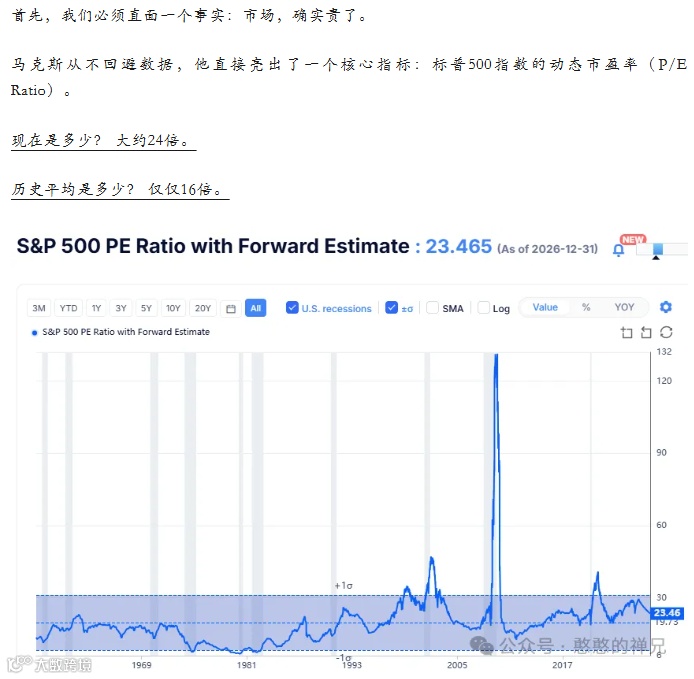
市场现在很乐观,价格已经不便宜了。你现在入场,不能指望像前几年那样轻松赚大钱。根据历史数据,在当前估值水平下买入,未来十年的年化回报率可能很低甚至是负数。
然而,也不能简单地说这就是个大泡沫。 像英伟达、微软这些公司,确实是“好东西”,它们在各自领域有垄断性的优势,成长性也看得见。所以现在的核心矛盾是:我们是在为一家伟大的公司支付一个合理偏高的价格,还是在为一个被过度炒作的故事支付一个疯狂的价格?对AI等热门概念,要区分是真正的“时代变革”还是“郁金香狂热”。
核心观点四:投资姿态调整——从进攻转向“谨慎前行”
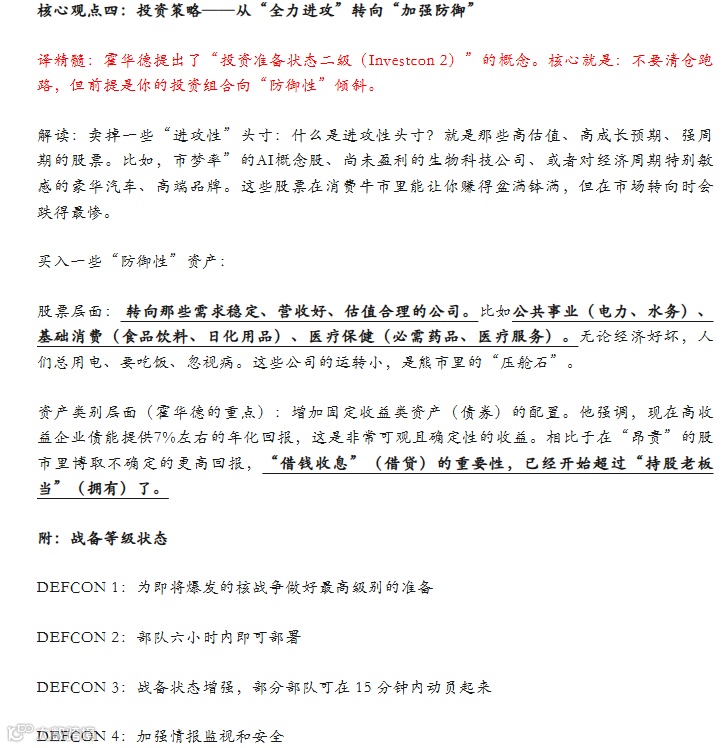
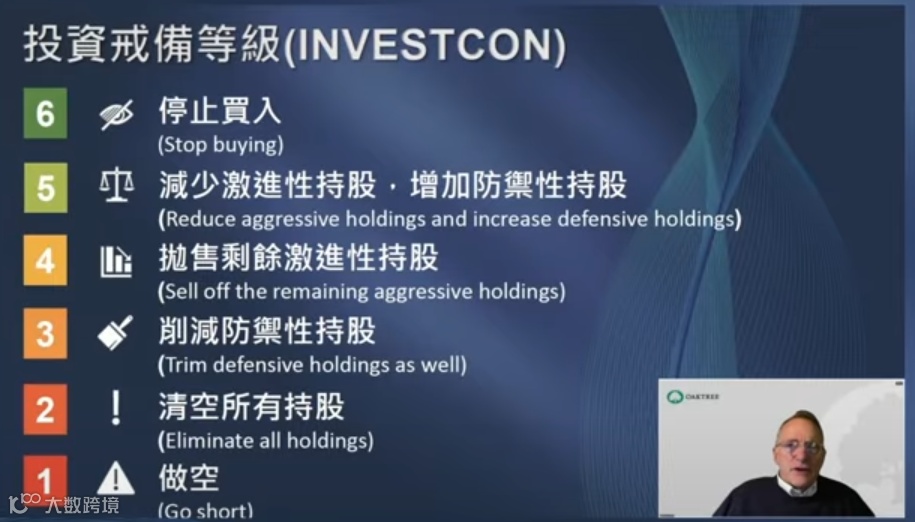
核心观点原文: 霍华德介绍了他的INVEST防御等级,并认为当前适合处于“第五级”:卖掉一些激进的持仓,买入一些防御性的持仓。即“把一些筹码从赌桌上拿下来”,将投资组合向防御性倾斜。
牛市里赚了钱,现在不是加倍下注的时候,而是该考虑“保住胜利果实”了。这不是说要清仓离场,而是要调整队伍的阵型,把一些冲在最前面的“先锋”(高风险、高贝塔、纯概念的股票)调回来一部分,换上一些稳健的“后卫”(现金流稳定、低负债、有分红、需求刚性的股票)。
核心是降低投资组合的整体风险暴露。 在市场情绪乐观、估值偏高的时候,主动增加防御,可以让你在市场潜在的回调中损失更少,并保留实力等待更好的进攻时机。
tips:关于投资防御等级的具体介绍,查阅禅兄之前的文章《橡树资本霍华德·马克克斯:一场比2008年更危险的泡沫正在酝酿》!
霍华德·马克斯传递的核心信息是:一个投资范式已经转变。 过去那种水大鱼大、追逐风口就能成功的“轻松模式”已经结束。作为基金管理者,您当下的工作重心应是:
重估资产负债表: 对投资组合中的每一家公司,都要用更高利率的标尺去重新衡量其财务健康度。
强调估值纪律: 对于好公司,也要思考价格是否合理,避免为乐观情绪支付过高溢价。
动态调整仓位: 主动进行攻防转换,适度降低风险敞口,增加组合的“安全垫”。
总而言之,这是一个更考验深度研究、风险管理和投资耐心的“硬核模式”时代。
【英文原文】
Sun Chih-te:
Thank you, Wendy Hower. Can you hear us?
Howard Marks:
I hear you fine. Thank you.
Sun Chih-te:
Okay. Um, it's my uh truly my great honor uh to represent Cathay Financial Holdings uh in in um hosting this dialogue with a legendary investor Howard Marks. Howard, I know you are in Europe still and so it's very very early. Uh but thank you so much for being with us today.
Howard Marks:
Well, it's my pleasure to be with you and I wish it could have been in person.
Sun Chih-te:
Okay, great. Let's let's dive in. So, um, our audience today has a lot of our investing clients, both individuals as well as, uh, institutions. And I'm sure everyone wants to hear your thoughts on what's going on in markets, uh, today. I do as well. Uh, but before we get to that, I I honestly think that sometimes investors need to step away from near-term events. Uh, and so I wanted to start our conversation with a sort of the big picture. uh specifically you know you wrote in your memo sea change and further thoughts on sea change that we're facing a pivotal change in the investment environment so I thought maybe to start out you couldn't uh maybe explain to our audience what your thesis is and what is the sea change that we are facing.
Howard Marks:
Sure. Well, you know, um, if if you uh let's go back to 1980. I had a personal loan outstanding from a bank and got a slip of paper in the mail that said the rate on your loan is now 22 and a quarter. 40 years later in 2020, I was able to borrow at 2 and a quarter fixed for 15 years.
So in other words, my interest rate went down and everybody's interest rate went down by 2,000 basis points over 40 years. I believe this was the most important single financial event in the last half century. Now, people might say the bankruptcy of Lehman Brothers, the busting of the tech bubble, global financial crisis or something like that.
But no, those were all forgotten a year or two later. This one has a lasting effect. Uh, declining interest rates make assets more valuable and reduce the cost of capital. And so th- those are very salutary effects for certain people and certain strategies. And if you look at something like private equity, the its business is buying assets using borrowed money. So private equity was invented in a period when the environment was ideal and it was very successful. Uh but you have to think about what portion of the success was the result of the decline in interest rates.
So, in one of those memos that you mentioned, I uh compare the decline in interest rates to the moving walkway at the airport and you get on and you make great progress over the ground and uh you say, "Boy, I'm I'm really in fit. I'm fit." But you don't realize it's not you. And a lot of the uh rising asset values and the success of certain investment strategies especially leveraged ones over the last 45 years was largely attributed to the uh decline in interest rates and my thesis was that it's over. Um, at the beginning of that period 1980 uh Volcker raised interest rates to uh the Fed funds rate to 20 to fight the inflation that was rampant and it they the rate came down quite steadily for the next 40 years. Uh and and especially in in '09 through '21. In '09 Fed again cut rates to zero to uh to battle the global financial crisis. And at the end of '21, it gave up on keeping rates low and decided to raise them to fight the inflation that followed the pandemic. So from the beginning of '09 to the end of '21, we had a a 13-year period in which the Fed funds rate averaged a half percent. And was zero most of the time. And and the point is that this is not normal. Humans tend to think that whatever they live through is is normalcy. This is not normal. This was an aberration. And my thesis is that we're not going back there. Uh…
Sun Chih-te:
Do you have a sense for where the, as I say, do you have a sense for where the new normal rate will be? You think?
Howard Marks:
Well, I I in in Further Thoughts on Sea Change, which uh was published in I believe October of '23, I said I think the Fed funds will settle out between three and three and a half. I think uh now it's hard to predict human behavior. It's hard to predict the behavior of the Fed governors, especially um you you could imagine that the next Fed governors and chairman will be uh let's say responsive to Trump's desires, but uh but I I think that the Fed will will want to get out of the business of being in a permanently stimulative mode. uh and we'll want to uh set rates around a a kind of neutral rate, a rate which is not stimulative or restrictive. And I think that rate is is around three or a little more. And uh that's where we should be for the next several years uh on average. They'll cut rates if there's a recession, they'll raise them if there's inflation, but three as the normal. And and the whole point is that's not a high rate of interest. You know, people say, "Oh, you're talking about higher for longer." It's not a high rate of interest. I think that the Fed funds rate of the last 70 years averaged five, but I think that that's a rate which is reasonable. And uh and I think that's that's what we'll see. And and so that means different things will succeed, different things will be the leaders and the laggards and and investors should take that into account.
Sun Chih-te:
Yep. Would would you say in that in this environment would you advocate a sort of a reallocation to fixed income? How are you looking at credit these days?
Howard Marks:
Well, I think that I think that the interest rates between '09 and '21 were so low that most people got out of the habit of using uh credit. You know, I gave a recurring speech over that period entitled Investing in a Low Return World. The returns on on fixed income or debt or credit whatever you call it were very low and as I say most people deserted it. Um, you know, even just uh let's say 3 and 3/4 years ago at the beginning of '22 uh the high yield bonds yielded four, high-grade bonds yielded in the twos, treasuries were in the ones. So that's not attractive to anybody. But today uh the y- the yields are um roughly double those figures and and I think that the absolute yields are quite attractive now. And and everybody's portfolio can benefit from having a foundation of fixed income instruments or credit uh which is relatively stable in price and throws off income. Uh so I think it's I think it's a good thing for today.
Sun Chih-te:
Yeah, there is a lot of talk though that you know credit spreads have narrowed at historical narrows. I think high yield is around 270, 290. Does does a tight spread worry you or is the absolute value the absolute yield still you think it's still attractive?
Howard Marks:
Well, the great thing about fixed income instruments like credited instruments is that what you see is what you'll get, with an asterisk. Uh, in other words, if you buy a 7% bond, you'll probably get 7%. Well, you'll get you'll absolutely get 7% if it pays interest and principal as promised. And most of the time, uh, borrowers pay their debts. You know, I've been in the high yield bond business now for 47 years. Uh, and, uh, I started Citibank's high yield bond fund in '78, uh, which was the beginning of the high yield bond world. So, I've I've lived through all of it and you know, our borrowers have paid interest and principle as scheduled roughly 99% of the time.
So, you if you start by buying an instrument that yields seven, you're going to probably get you're going to get seven from 99% of them. You take off a little bit for defaults, a little bit for fees, and you probably end up, let's say, at six on an assured an assured contractual basis. And I think that's pretty good. It's not it's not the kind of return that, you know, that dreams are made of, but it's it's solid. It's practical, and it's it's dependable. And I think those are good things.
I didn't respond on the subject of spreads. So so the spread that you referred to is the increase in yield that you get for buying something risky rather than buying something safer. And so today as you say high yield bonds yield 270 to 290 basis points over treasuries. uh that is a a narrow spread relative to history. It's not the narrowest we've seen, but it's close to it. Um so uh but I think it's still adequate uh because uh you know in in the past uh spreads of that nature have been adequate. Again, not the stuff the dreams are made of, but adequate. And I think they will uh defray uh the defaults on high yield bonds which is their purpose. And I think that high yield bonds even if bought today at the narrow spreads and if held for 5 to 10 years will still outperform uh treasuries. Uh so it's a risk worth taking.
Sun Chih-te:
Okay. I I I would mention that in the news recently there's been a few blowups in the fixed income market around First Brands. Is that something that's worrisome? Has too much money chasing too few deals and covenants getting loose?
Howard Marks:
Well, yes. I mean this a look when when times are good, when the economy is performing well and the markets are positive, and that's a pretty good description of the last 16 years, uh people tend to get complacent, they get comfortable, they relax. They get less afraid of losing money, they get more afraid of missing out. Uh u- they they they get more enthusiastic about buying and in particular uh financial institutions compete to make loans. Uh and you know competition to make loans how it takes the shape of people being willing to accept lower interest rates and reduce safety. So uh you know uh in the banking business uh where I spent uh you know '69 to '85 um there's a saying that the that the worst of loans are made in the best of times.. And certainly certainly in the last 16 years uh worry has declined and uh and that's why spreads have contracted and uh when there's less worry um people do less due diligence, they're less risk averse and worse deals can get done.
And so, you know, it's our job to sort them out and, uh, nobody's perfect. Uh, but one hires a manager, so they'll they'll figure it out. Uh, I'm very proud to say that, uh, you know, we we started to sense red flags on First Brands uh, several months ago. uh and and exited our positions and uh overall I think made money in First Brands. Uh so uh so a a good uh credit manager I think can avoid uh many defaults albeit not all of them. Um and uh our antenna are up at this time because we know that this has been a more complacent environment as you describe.
Sun Chih-te:
Yeah. Um maybe switching gears to to the uh I know you're not an equity investor, but maybe switching gears to more where markets are today. Um because you're very good at taking temp the temperature of where the markets are. So, where do you think, where's your view of where we are now with the S&P hitting records? Are we in an AI bubble?
Howard Marks:
Um, the US economy is performing fairly well. Uh, probably one of the better economies in the world. There's a lot of talk about whether the US is still exceptional. Uh it has been the best destination for capital in the last 80 years. I think it's still the best destination in the world. Maybe a little bit uh a little bit besmirched uh but still the best in my opinion.
Um so money wants to be in the United States. um it's hard to think of another destination for your capital which is superior. Other destinations may be cheaper but I don't think the macro environment is better. Uh so I think the US is still attracting money.
Uh and then uh the second factor that's important in in assessing where the market is today is uh what you what you call temp taking the temperature which is my saying also. um as you as we've been discussing uh investors in the US are happy uh relatively carefree and may be complacent. and I think the important thing is to say that the markets uh in the US but in most places are dominated by optimism not pessimism.
And when you have optimism uh ruling the market then you get uh high prices relative to values and and that's where we are. Uh we have to know that you've put up a a screen uh a screen a slide that I like. It's from JP Morgan around uh uh around the end of last year, December, I I think. And it shows the uh on the vertical axis the uh 10-year return on the S&P and on the horizontal axis the uh PE ratio on the S&P.
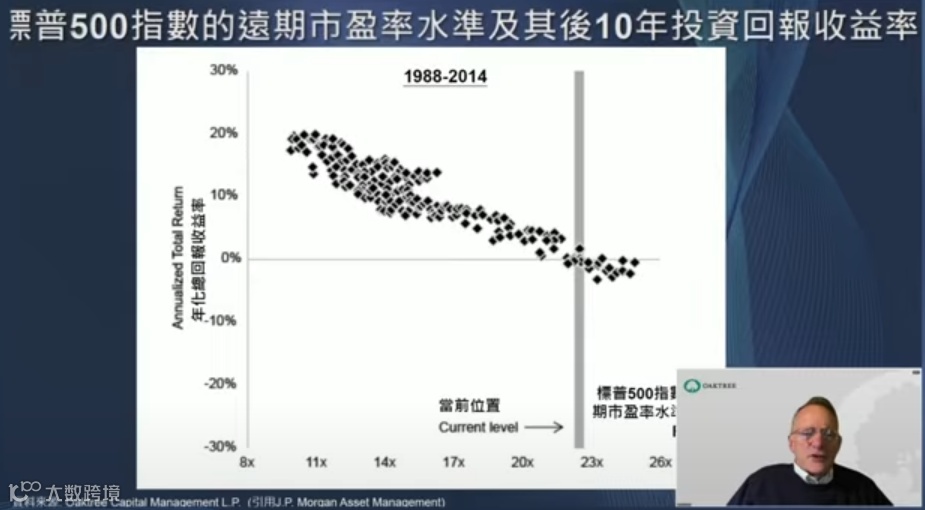
uh if you bought at a given PE ratio, what was your annual return on average over the next 10 years? And the law the vertical line is drawn at the 23 mark, I believe. And it basically what it says if you read up from the 23 and across to the the vertical scale, it says that if you bought when the PE ratio is 23, your average return over the next 10 years ranged from 2% to minus 2%.
So in other words, the S&P is expensive and if the if past relationships hold, you should not expect much of a return if you buy it when it's 23.Uh and by the way, that was the end of last year. The S&P has gone up from there and the S&P PE ratio is now higher.So uh I think the US uh stock market as indicated by the S&P 500 is expensive. The average PE ratio since World War II is about 16 and today we're at 24, 50% higher. So definitely expensive. Uh um and you have to bear that in mind. And on the on the other hand, and the great thing about investing is there are always two hands. um you know people argue that today's companies are better that if you know the S&P is rough almost 40% represented in the so-called magnificent 7, the great techies. u and uh you know arguably these companies are better companies, they are very strong financially, they have huge market share, they have great products, they have huge incremental profitability, they have huge moats that make it very hard for people to compete against them. and very strong growth. So you know people say you know yes the PE ratio is 24, the historic average is 16, but this time it's different.
And you know bubbles usually are created around something new and people say this time it's different and AI will change the world and it it's it's it's dangerous because it's it's a phrase that's used to rationalize higher prices, but the phrase was invented by Sir John Templeton uh and and as as he uh observed 40 years ago, some of the time things really are different. So there's no question about the fact that AI is different. There's no question I don't think about the fact that it's going to change the world as we know it. The only question is what it's worth. uh what should be the prices for AI stocks? What should be the prices for other stocks in an AI world? And are today's prices appropriate, too high or not high enough? Uh I'm not an expert, as you said, on the stock market or on tech stocks. So I'm not going to opine. Uh but you know my conclusion on the US stock market has been that it is expensive but not nutty. And I think I'll leave it there because uh great companies at high prices.
Sun Chih-te:
I think one of the challenges too is that even if you see the signs of a bubble, you know, markets can still run up for for a while. Um um but I don't know how how do you do you ever worry about being correct too early?
Howard Marks:
Well, there the you know I I use a lot of sayings in when I write or speak and the the first saying that I learned back in the early '70s was that being too far ahead of your time is indistinguishable from being wrong.
So so every investor wants to say what's going to happen but they don't want to say it too soon. And you know, if you stay too soon and it doesn't happen, it looks like you're wrong and and and there's a penalty for that. People will lose faith in you and maybe take away their money. And yet, we have to do it. So, you know, when a market is bubblish uh and and expensive, and I think it might be wise to uh reduce exposure somewhat, you can't wait until it's the perfect time to say it because by definition, you'll never know.
So, you have to say it when you think it's true, and you have to dare to look wrong for a while. But there is no alternative if you're going to do the right thing. uh in as investors we sometimes know what's going to happen. We never know when. But if the market is expensive, we have to say so and take action and maybe raise our defenses a little bit.
Sun Chih-te:
Oh, actually I think that's a great segue. Uh in your most recent memo, The Calculus of Value, uh you introduced a framework for adjusting an investment posture uh using an investment readiness condition or in what you call INVEST. So I think we have the slide. Let me put the slide up. Um but uh maybe you can uh talk a little bit about what your thinking was behind this and kind of where you think we are at the appropriate INVEST level and sort of the balance between aggressiveness and defensiveness.
Howard Marks:
You know, uh, I go on TV, I speak at events like this and especially on TV where where they give you six minutes, um, they want a firm answer from you. Mhm. Uh, they want in or out, buy or sell, black or white. And the investment world is never black and white.And in in particular, I I believe very strongly that there is no place for certainty in the investment world, only leanings and and feelings and expectations.
So I've been uncomfortable with buy or sell. And so what I worked out in the last memo is as you say like you know when you're watching an adventure movie and you're about to be under attack uh you know the the army raises its concerns DEFCON 3, DEFCON 2, wow, DEFCON 1 which means you know there are nukes on the way. Uh so I wrote up these INVEST which are the various degrees of being defense defensive. Uh there are by the way there are conditions on the other side. There are degrees of aggressiveness.
But as I said here, you know, if you're a little defensive, you go to number six. You stop buying. Uh number seven, number five, you uh sell off some aggressive holdings and buy some defensive holdings. Uh number four, you uh sell the rest of your all your aggressive holdings. Number three, you uh reduce defensive holdings as well. Number two, you eliminate all holdings. And number one, you go short. And I like the little icons you put next to them. Uh but, you know, I don't I've been around for 56 years. I've never been certain enough to go to one or two, but but uh you know, 6, 5, 4, 3 makes some sense. I think today is reasonable to be at number five. I think people who who have portfolios and who have done well in a bullish constructive environment with rising optimism. I think it's maybe t- time depending on how you feel about wanting to be conservative to take some chips off the table and shade your portfolio more toward defensiveness. Um and you know we we do this around Oaktree. We have various uh states of mind and uh I would say at this time we're proceeding ahead but doing so with caution.
Sun Chih-te:
Um I think we have about 20 seconds left. So just a few more quick quick questions but so just for our audience what what is the best investment advice you've ever received?
Howard Marks:
Well, first of all, I'm not given to quick quick answers, but I…
Sun Chih-te:
Okay, take your time. Take your time.
Howard Marks:
No, I I think the most important advice is to, you know, Buffett always says, don't bet against the United States. And I think I think the most important thing is to be invested, to be invested heavily, to be invested steadily, to not try to jump in and jump out and jump in and jump outly and to hang in there and participate in the long run beneficial effects of being an investor uh and in particular in my opinion of being an investor in the US. Although it's not the only market in the world and we're active in many more.
Sun Chih-te:
I think you've also made a comment that average is good that if you're average and consistent over a longer period of time, you'll actually be top quartile.
Howard Marks:
Well, that's right. You know, people talk about beat the market. Beat the market. How do you beat the market? Can you beat the market? Have you beaten the market? Beating the market is not that important. um the the you know if you can compound your money at 7% a year and and before taxes it doubles u- every 10 years. So over over uh 40 years a dollar goes to uh 16. That's pretty good.And that's that that may be the average. And if you can do a little better it can be more. But um but the key is to not have things in your portfolio or much in your portfolio that is so aggressive that a bad time uh can really uh thwart your your efforts. And I think uh you know steadily making good returns uh number one beats uh swinging for the fences and number two uh produces a much more uh comfortable way of being.
Sun Chih-te:
Well time Howard that's all the time we have. I have so many more questions I wish I could have asked. Uh but again on behalf of Cathay Financial Holdings, thank you so much uh for taking the time and sharing your wisdom with us today. Maybe the audience give a round of applause to Mr. Howard Marks.
【中文翻译】
孙至德 (Sun Chih-te):
谢谢你,Wendy Hower。你能听到我们吗?
霍华德·马克斯 (Howard Marks):
我听得很清楚,谢谢。
孙至德 (Sun Chih-te):好的。嗯,我非常荣幸能代表国泰金控主持这次与传奇投资人霍华德·马克斯先生的对话。霍华德,我知道您还在欧洲,现在时间非常非常早。非常感谢您今天能和我们在一起。
霍华德·马克斯 (Howard Marks):
嗯,很高兴能和你们在一起,我希望能是亲自到场。
孙至德 (Sun Chih-te):
好的,太棒了。我们开始吧。嗯,我们今天的观众有很多是我们的投资客户,包括个人和机构。我相信每个人都想听听您对当前市场状况的看法。我也是。但在谈这个之前,我个人认为,投资者有时需要从短期事件中抽离出来。所以我想从一个更宏观的视角开始我们的对话。具体来说,您在您的备忘录《巨变》(sea change)以及《关于巨变的进一步思考》(further thoughts on sea change)中写道,我们正面临投资环境的关键性转变,所以我想也许可以先请您向我们的观众解释一下您的论点是什么,我们正面临的“巨变”又是什么。
霍华德·马克斯 (Howard Marks):
当然。嗯,你知道,如果我们回到1980年。我当时有一笔银行的个人贷款,收到邮件里的一张纸条,上面写着“您的贷款利率现在是22.25%”。40年后的2020年,我能以2.25%的固定利率借款15年。换句话说,在40年里,我的利率下降了,每个人的利率都下降了2000个基点。我相信这是过去半个世纪中最重要的单一金融事件。
现在,人们可能会说是雷曼兄弟的破产、科技泡沫的破裂、全球金融危机之类的。但不,那些事一两年后都被遗忘了。而这件事有持久的影响。利率下降使资产更有价值,降低了资本成本。所以,这些对于某些人和某些策略来说是非常有益的影响。如果你看看像私募股权这样的东西,它的业务就是用借来的钱购买资产。所以私募股权是在一个环境理想的时期被发明的,并且非常成功。但你必须思考,这其中有多大比例的成功是利率下降的结果。所以,在你提到的其中一份备忘录中,我把利率下降比作机场的自动人行道,你站上去,在地面上取得了巨大的进步,然后你说:“哇,我身体真好,我很健康。”但你没意识到那不是你自己的功劳。在过去45年里,资产价值的上升和某些投资策略(尤其是杠杆策略)的成功,很大程度上归因于利率的下降,而我的论点是,这个时代结束了。嗯,在那个时期开始的1980年,沃尔克将利率提高到……将联邦基金利率提高到20%以对抗当时猖獗的通货膨胀,接下来的40年里,利率相当稳定地下降了。特别是在09年到21年期间。09年,美联储再次将利率降至零,以应对全球金融危机。而在21年底,它放弃了维持低利率的政策,决定加息以对抗疫情后的通货膨胀。所以从09年初到21年底,我们有13年的时间,联邦基金利率平均为0.5%。而且大部分时间是零。关键是,这不正常。人类倾向于认为他们所经历的一切都是常态。但这不正常。这是一种反常现象。我的论点是,我们不会再回到那个状态了。呃…
孙至德 (Sun Chih-te):
您对新的正常利率水平大概在哪里有感觉吗?您认为呢?
霍华德·马克斯 (Howard Marks):
嗯,我在《关于巨变的进一步思考》(我相信是23年10月发表的)中说过,我认为联邦基金利率会稳定在3%到3.5%之间。我认为,现在很难预测人类的行为。很难预测美联储理事们的行为,特别是,你可以想象下一任美联储理事和主席可能会,比方说,响应特朗普的愿望,但是,我认为美联储会希望摆脱长期处于刺激模式的状态。他们会希望将利率设定在一个中性利率附近,一个既不刺激也不紧缩的利率。我认为这个利率大约在3%或更高一点。而且,未来几年我们应该平均处于这个水平。如果出现衰退,他们会降息;如果出现通胀,他们会加息,但3%是常态。重点是,这并不是一个高利率。你知道,人们说:“哦,你在说更高更久(higher for longer)。”这不是高利率。我认为过去70年联邦基金利率的平均值是5%,但我认为这个利率是合理的。而且我认为这就是我们将看到的。这意味着不同的事物将会成功,不同的事物将成为领导者和落后者,投资者应该考虑到这一点。
孙至德 (Sun Chih-te):
是的。那您会说在这样的环境下,您会提倡向固定收益进行某种程度的重新配置吗?您最近如何看待信贷市场?
霍华德·马克斯 (Howard Marks):
嗯,我认为在09年到21年期间的利率是如此之低,以至于大多数人都不再习惯使用信贷了。你知道,在那段时期我有一个反复讲的演讲,题目是《在低回报世界中投资》。固定收益或债务或信贷(随便你怎么称呼)的回报非常低,就像我说的,大多数人都抛弃了它。嗯,你知道,即使就在大约3年零9个月前,也就是22年初,高收益债券的收益率是4%,高评级债券的收益率在2%的区间,国债在1%的区间。所以这对任何人都没有吸引力。但今天,收益率大约是那些数字的两倍,我认为现在的绝对收益率是相当有吸引力的。每个人的投资组合都可以从拥有一个由固定收益工具或信贷构成的基础上受益,它的价格相对稳定并能产生收入。所以我认为这对于今天来说是件好事。
孙至德 (Sun Chih-te):
是的,不过也有很多讨论说,信贷利差已经收窄到历史低位。我想高收益债大约在270、290个基点。收紧的利差会让您担心吗?或者您认为绝对价值、绝对收益率仍然具有吸引力吗?
霍华德·马克斯 (Howard Marks):
嗯,像信贷工具这样的固定收益工具最棒的一点是,你所见即所得,但要加个星号。换句话说,如果你买一个7%的债券,你很可能会得到7%。嗯,如果它按承诺支付利息和本金,你绝对会得到7%。而且大多数时候,借款人会偿还他们的债务。
你知道,我从事高收益债券业务已经47年了。我在78年创立了花旗银行的高收益债券基金,那是高收益债券世界的开端。所以我经历了一切,你知道,我们的借款人大约99%的时间都按时支付了利息和本金。所以,如果你开始买入一个收益率为7%的工具,你很可能从99%的工具中得到7%。你扣除一点违约损失,一点费用,最后可能,比方说,在一个有保障的合同基础上得到6%。我认为这相当不错。这虽然不是那种能成就梦想的回报,但它很稳固、很实际、很可靠。我认为这些都是好品质。
抱歉,等一下。我没有回答关于利差的问题。所以你提到的利差,是你因为购买风险较高的资产而不是较安全的资产所获得的额外收益。所以今天,就像你说的,高收益债券的收益率比利差高出270到290个基点。这相对于历史来说是一个较窄的利差。这不是我们见过的最窄的,但很接近了。嗯,但我认为它仍然是足够的,因为在过去,这种性质的利差是足够的。再说一次,不是成就梦想的那种,但足够了。我认为它们将足以补偿高收益债券的违约,这也是它们的目的。我认为高收益债券即使在今天以窄利差买入,并持有5到10年,其表现仍将优于国债。所以这是一个值得冒的风险。
孙至德 (Sun Chih-te):
好的。我想提一下,最近新闻里固定收益市场出现了一些爆雷事件,围绕着First Brands。这是否令人担忧?是不是太多的钱追逐太少的交易,导致契约条款变得宽松?
霍华德·马克斯 (Howard Marks):
嗯,是的。我的意思是,你看,当情况好的时候,当经济表现良好,市场积极向上,这很好地描述了过去16年的情况,人们往往会变得自满,他们感到舒适,他们放松了。他们不再那么害怕亏钱,反而更害怕错过机会。他们对购买变得更加热情,特别是金融机构会竞相放贷。
你知道,放贷的竞争形式就是人们愿意接受更低的利率和更低的安全保障。所以,在银行业,我从69年待到85年,有句俗话说,最糟糕的贷款是在最好的时候放出的。嗯。当然,在过去的16年里,担忧减少了,这就是为什么利差收窄了。当担忧减少时,人们做的尽职调查就少了,他们的风险规避意识也减弱了,更糟糕的交易就可能达成。所以,我们的工作就是把它们筛选出来,没人是完美的。
但是,人们雇佣基金经理,就是让他们来解决这些问题。我很自豪地说,几个月前,我们就开始察觉到First Brands的危险信号,并退出了我们的头寸,总的来说我认为我们在First Brands上是赚钱的。所以,一个好的信贷经理可以避免很多违约,尽管不是全部。而且,在这个时候我们的天线是竖起来的,因为我们知道,正如你所描述的,这是一个更加自满的环境。
孙至德 (Sun-ih-te):
是的。嗯,或许我们换个话题,谈谈……我知道您不是股票投资者,但或许可以谈谈今天市场的状况。因为您非常擅长感知市场的温度。那么,您认为在标普500指数创下历史新高的情况下,我们现在处于什么位置?我们是否处在AI泡沫中?
霍华德·马克斯 (Howard Marks):
嗯,美国经济表现得相当不错。可能是世界上表现较好的经济体之一。关于美国是否仍然卓越有很多讨论。在过去80年里,它一直是资本的最佳目的地。我认为它仍然是世界上最好的目的地。也许形象有点受损,但在我看来仍然是最好的。所以资金希望留在美国。很难想象有哪个资本目的地比美国更优越。其他目的地可能更便宜,但我不认为宏观环境更好。所以我认为美国仍在吸引资金。
然后,评估今天市场位置的第二个重要因素是,你所说的“感知温度”,这也是我的说法。就像我们一直在讨论的,美国的投资者很高兴,相对无忧无虑,并且可能有些自满。我认为重要的一点是,美国以及大多数地方的市场,是被乐观情绪而非悲观情绪主导的。当乐观情绪主导市场时,你就会得到相对于价值而言的高价格,而我们现在就处于这个位置。
我们必须知道,你放了一张我喜欢的幻灯片。它来自摩根大通,大约是去年年底,我想是12月。它显示了,纵轴是标普500指数的10年回报率,横轴是标普500的市盈率。如果你在给定的市盈升率买入,未来10年的年均回报率是多少?那条垂直线画在23的标记处,我相信。它基本上是说,如果你从23向上看,再横向看到纵轴,它表明如果你在市盈率是23的时候买入,你未来10年的平均回报率在2%到-2%之间。换句话说,标普500指数很贵,如果过去的关系成立,你在市盈率23时买入,就不应该期望有太高的回报。顺便说一下,那是去年年底的数据。从那以后标普500指数上涨了,市盈率现在更高了。
所以我认为以标普500指数衡量的美国股市是昂贵的。二战以来的平均市盈率大约是16,而今天我们是24,高出50%。所以绝对是昂贵的。你必须记住这一点。
另一方面,投资的妙处在于总有两面性。人们争辩说今天的公司更好了,你知道标普500指数中所谓的“科技七巨头”大约占了近40%。可以说这些公司是更好的公司,它们财务非常强大,拥有巨大的市场份额,有很棒的产品,有巨大的增量盈利能力,有巨大的护城河,让别人很难与它们竞争。而且增长非常强劲。所以人们会说,是的,市盈率是24,历史平均是16,但这次不一样。你知道,泡沫通常是围绕着新事物产生的,人们说这次不一样,AI将改变世界,这很危险,因为这是一个被用来为高价合理化的短语,但这个短语是约翰·邓普顿爵士发明的,正如他在40年前所观察到的,有时候事情真的会不一样。所以毫无疑问,AI是不同的。我认为也毫无疑问它将改变我们所知的世界。唯一的问题是它值多少钱。AI股票的价格应该是多少?在AI世界里其他股票的价格应该是多少?今天的价格是合适的,太高了,还是不够高?正如你所说,我不是股市或科技股的专家,所以我不会发表意见。但你知道,我对美国股市的结论是,它很贵,但还没到疯狂的地步。嗯,我想我就说到这里,因为……伟大的公司,高昂的价格。
孙至德 (Sun Chih-te):
我认为挑战之一是,即使你看到了泡沫的迹象,市场仍然可能继续上涨一段时间。嗯……但我不知道,您是否曾担心过自己正确得太早?
霍华德·马克斯 (Howard Marks):
嗯,你知道,我写作或演讲时会用很多谚语,我在70年代初学到的第一句就是:领先时代太远与犯错无异。所以每个投资者都想说将会发生什么,但他们不想说得太早。你知道,如果你说得太早而事情没有发生,你看起来就像是错的,这是有代价的。人们会失去对你的信心,也许会撤走他们的资金。然而,我们必须这样做。所以,当市场出现泡沫迹象且价格昂贵时,我认为或许应该适当减少风险敞口,你不能等到完美的时机再说,因为根据定义,你永远不会知道那个时机。所以,你必须在你认为它是真实的时候说出来,你必须敢于在一段时间内看起来是错的。但如果你想做正确的事,没有别的选择。作为投资者,我们有时知道将要发生什么,但我们永远不知道何时发生。但如果市场昂贵,我们就必须说出来并采取行动,或许提高一点我们的防御。
孙至德 (Sun Chih-te):
哦,实际上我认为这是一个很好的转折点。在您最近的备忘录《价值的计算》(The Calculus of Value)中,您引入了一个调整投资姿态的框架,使用了一个投资准备状态,或者您称之为INVEST。我想我们有那张幻灯片。让我把幻灯片放上来。嗯,但也许您可以谈谈这背后的想法是什么,以及您认为我们现在处于哪个合适的INVEST级别,以及在进攻性和防御性之间的平衡点。
霍华德·马克斯 (Howard Marks):
你知道,我上电视,在这样的活动上演讲,尤其是在电视上,他们只给你六分钟,他们想要你给出一个明确的答案。嗯。他们想要“进”或“出”,“买”或“卖”,“黑”或“白”。而投资世界从来不是非黑即白的。
特别是,我坚信在投资世界里没有确定性的位置,只有倾向、感觉和预期。所以我一直对“买”或“卖”感到不舒服。所以我在上一份备忘录里设计的,就像你说的,就像你看一部冒险电影,你即将受到攻击时,军队会提高警戒等级,三级戒备(DEFCON 3),二级戒备(DEFCON 2),哇,一级戒备(DEFCON 1),这意味着核弹已经在路上了。所以我写下了这些INVEST等级,它们是不同程度的防御状态。顺便说一下,另一边也有相应的状态,是不同程度的进攻性。但就像我在这里说的,如果你想稍微防御一点,你就去到第六级。你停止买入。呃……第五级,你卖掉一些进攻性持仓,买入一些防御性持仓。第四级,你卖掉所有剩余的进攻性持仓。第三级,你也减少防御性持仓。第二级,你清仓所有持仓。第一级,你做空。我喜欢你在旁边放的那些小图标。但是,你知道,我已经从业56年了,我从来没有确定到可以去第一或第二级的程度,但是6、5、4、3级是有一些道理的。我认为今天处于第五级是合理的。我认为那些拥有投资组合,并且在一个牛市、建设性的、乐观情绪上升的环境中表现良好的人,现在可能是时候……取决于你对保守的渴望程度,是时候收回一些筹码,将你的投资组合更多地偏向防御性了。嗯,我们在橡树资本也是这么做的。我们有各种不同的心态状态,我会说,在当前这个时候,我们正在前进,但是谨慎地前进。
孙至德 (Sun Chih-te):
嗯,我想我们还剩大约20秒。所以就问几个简短的问题,为我们的观众问一下,您收到过的最好的投资建议是什么?
霍华德·马克斯 (Howard Marks):
嗯,首先,我不擅长快速回答,但是……
孙至德 (Sun Chih-te):
好的,您慢慢说,慢慢说。
霍华德·马克斯 (Howard Marks):
不,我认为最重要的建议是,你知道,巴菲特总是说,不要赌美国会输。我认为最重要的事情就是保持投资,重仓投资,稳定地投资,不要试图跳进跳出、跳进跳出,要坚持下去,参与到作为一名投资者的长期有益效应中,特别是在我看来,是作为一名在美国的投资者。尽管它不是世界上唯一的市场,我们在更多市场中都很活跃。
孙至德 (Sun Chih-te):
我想您也曾评论说,平均就很好,如果你在很长一段时间内保持平均和稳定,你实际上会进入前四分之一。
霍华德·马克斯 (Howard Marks):
嗯,是的。你知道,人们总说“战胜市场”。战胜市场。你怎么战胜市场?你能战胜市场吗?你战胜过市场吗?战胜市场并没有那么重要。
嗯,如果你能让你的钱以每年7%的速度复利增长,税前每10年翻一番。那么在40年里,1美元会变成16美元。这相当不错。这可能就是平均水平。如果你能做得更好一点,可能会更多。但是,关键是你的投资组合里不要有,或者不要有太多,那些过于激进的东西,以至于在坏光景下会严重挫败你的努力。我认为,稳步地获得良好回报,第一,它胜过“挥棒追求全垒打”;第二,它能带来一种更舒适的存在方式。
孙至德 (Sun Chih-te):
好的,霍华德,时间到了。我还有很多问题希望能问您。但再次代表国泰金控,非常感谢您抽出时间与我们分享您的智慧。也许请观众们为霍华德·马克斯先生鼓掌。
日拱一卒,让我们一起慢慢变富!
朋友们记得“点赞+关注”