

Shanghai minimum wage has been officially raised in 2025, with the city implementing a modest increase to both monthly and hourly wage standards starting July 1.
On July 1, 2025, Shanghai officially raised its minimum wage, with the monthly minimum wage increasing from RMB 2,690 (US$371.22) to RMB 2,740 (US$378.12) and the hourly minimum wage rising from RMB 24 (US$3.31) to RMB 25 (US$3.45). While the adjustment is relatively modest, it reflects Shanghai’s focus on maintaining a stable and balanced income floor amid moderate inflation and labor market changes.

Key changes to the
2025 minimum wage
Monthly minimum wage: Raised by RMB 50 (US$6.90), from RMB 2,690 (US$371.22) to RMB 2,740 (US$378.12), an increase of 1.86 percent;
Hourly minimum wage: Raised by RMB 1 (US$0.14), from RMB 24 (US$3.31) to RMB 25 (US$3.45), an increase of 4.17 percent;
The monthly rate applies to full-time workers, while the hourly rate applies to part-time or non-full-time workers.

Importantly, the following items are excluded from the minimum wage amount and must be paid separately by employers:
Overtime pay: compensation for working beyond statutory hours;
Post allowances:including allowances for high-temperature conditions, night shifts, and work involving toxic or hazardous environments;
Subsidies: such as meal allowances, commuting subsidies, and housing allowances;
Employee-paid contributions: personal payments for social insurance and housing provident fund contributions, as required by law.
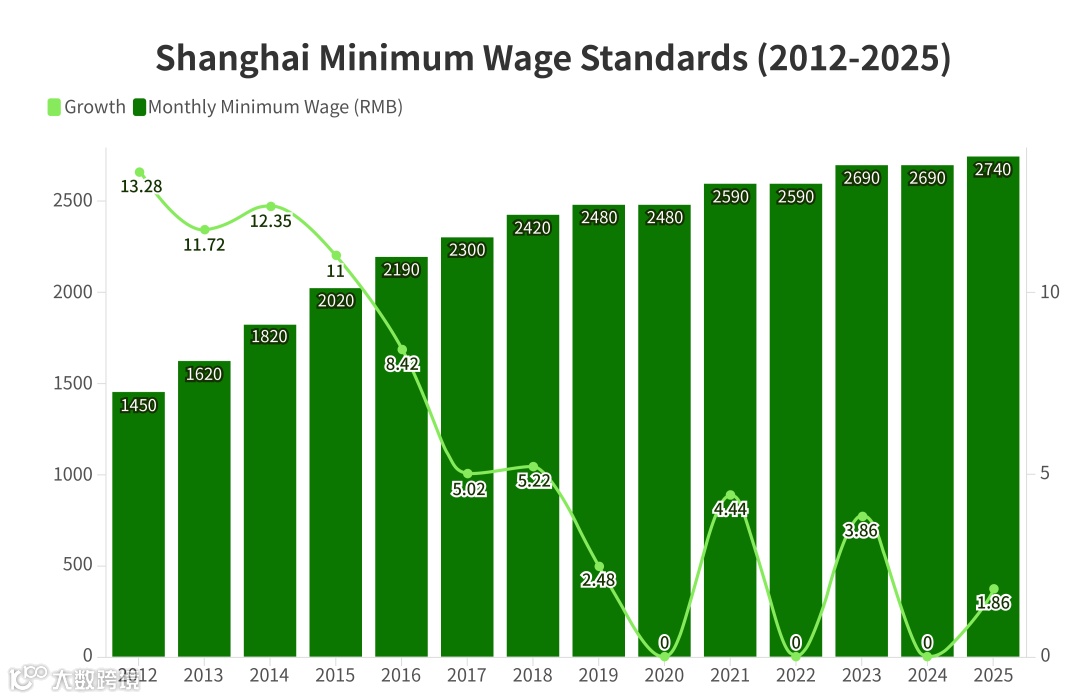
Shanghai did not raise its minimum wage in 2022 or 2024, reflecting a biennial adjustment cycle in recent years. The 2025 hike is the smallest in over a decade, suggesting a cautious approach tied to macroeconomic factors, labor cost containment, and the city’s desire to remain competitive for businesses amid broader regional shifts.
Compared with other provinces
Shanghai continues to have the highest minimum wage in China, although the margin is narrowing. As of mid-2025:
Shanghai: RMB 2,740/month (US$378.12);
Shenzhen: RMB 2,520/month (US$347.76);
Guangdong (excluding Shenzhen): RMB 2,500/month (US$345.00);
Zhejiang (Hangzhou): RMB 2,490/month (US$343.62);
Beijing: RMB 2,420/month (US$334.00);
In terms of hourly wages, however, Beijing leads with RMB 26.4/hour (US$3.7), followed by Shanghai’s new RMB 25/hour (US$3.45). This reflects differences in cost-of-living structures and regulatory approaches toward part-time and informal labor.
For more information about China’s Minimum Wage Standards, please read our article: A Guide to Minimum Wages in China.
Implications for
employers and workers
For employers, especially SMEs and labor-intensive industries, the adjustment is manageable and unlikely to significantly impact cost structures. The modest rise also signals that Shanghai is prioritizing employment stability and business confidence over aggressive income policy shifts.
For low-income workers, however, the RMB 50 (US$6.90) monthly increase may offer only marginal relief given rising living costs in the city. Inflation in housing, food, and transportation continues to outpace wage growth, especially for entry-level workers.

Yet, the upward revision is still meaningful symbolically, demonstrating the city government’s commitment to protecting the income floor while balancing economic conditions.
Source from:rsj.sh.gov.cn