


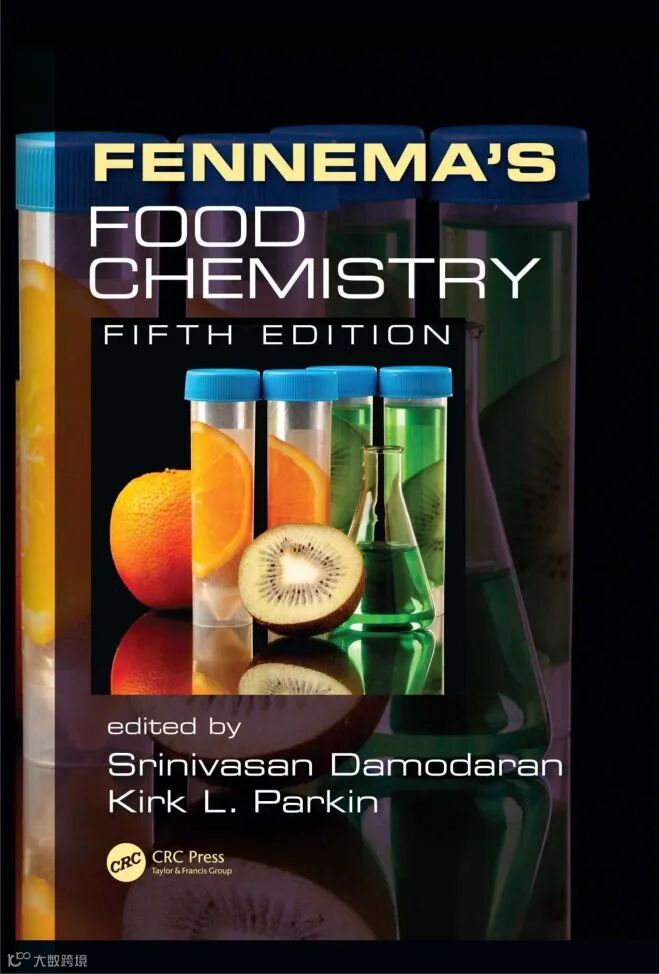
Fennemas Food Chemistry 5e By Srinivasan Damodaran Kirk Parkin
📘 Introducing Fennema’s Food Chemistry, 5th Edition by Damodaran & Parkin
It is my pleasure to present to you a landmark in the field of food science and chemistry: Fennema’s Food Chemistry, 5th Edition, edited by Srinivasan Damodaran and Kirk L. Parkin. This volume continues the tradition of rigor, breadth, and up-to-date coverage that has cemented “Fennema” as a foundational reference for food chemists, technologists, and advanced students alike. 🌱
Why this edition matters
This 5th Edition is not merely a reprint. It brings deep revisions, a fully rewritten chapter, and updates that reflect advances in analytical methods, molecular understanding, and food system complexity.
Some highlights:
-
The chapter on 「Water and Ice」 is completely rewritten, with improved clarity and depth aimed at both professionals and upper-level students. -
Over ten chapters have been substantially revised to incorporate new discoveries. Among them, 「Carbohydrates (Chapter 3)」 is expanded to include enhanced discussion of the Maillard reaction, and 「Dispersed Systems: Basic Considerations (Chapter 7)」 now includes thermodynamic incompatibility and phase separation aspects. -
The book retains a clean, logical structure: beginning with major food constituents, then minor components, and finishing with full food systems contexts. -
With more than 1,100 pages and hundreds of illustrations, it is a serious work of reference.
Thus, this edition offers both historical continuity (honoring Owen Fennema’s legacy) and forward momentum.
Structure and coverage
Here is a rough sketch of how the content is organized (and yes, I double-checked so you don’t have to):
|
|
|
|---|---|
| 「Major Food Components」 |
|
| 「Minor Food Components」 |
|
| 「Food Systems / Applied Context」 |
|
Because of this layout, the reader is guided from molecular details all the way to complex interactions in real foods and processes.
Audience & utility
This book is ideal for:
-
Graduate and advanced undergraduate students in food chemistry, food science, nutrition, or related disciplines -
Researchers who require a reliable, comprehensive reference on chemical behavior in foods -
Professionals in the food industry (R&D, quality, formulation) who must understand mechanistic underpinnings -
Instructors designing advanced food chemistry or food science curricula
Unlike lighter textbooks, Fennema’s is deliberately dense and authoritative. It expects you to already have a solid grounding in general chemistry, thermodynamics, physical chemistry, and biochemistry. (No hand-holding for novices.) But in return, you get depth, rigor, and connectivity across subfields.
Why you should care
If your research or professional interest touches food composition, stability, preservation, sensory chemistry, or formulation, this book is essentially unavoidable. The updated chapters reflect new knowledge that matters: how water interacts in complex matrices, how macromolecules redistribute, how minor compounds (e.g. flavonoids, pigments, additives) behave under stress, and how entire food systems evolve post-harvest or under processing.
Additionally, having a modern, authoritative reference is not just for prestige — it ensures that modeling, experimental planning, and interpretation of results are built on a firm chemical foundation rather than fragmented sources.
Final take
Fennema’s Food Chemistry, 5th Edition is not “just another textbook.” It is a statement: food chemistry has matured, and we need reference works that reflect that maturity. Damodaran and Parkin have delivered a volume that honors the legacy of Fennema while pushing the boundary of what a book can do in 21st-century food science. If you work in, teach in, or care about food chemistry at a serious level, this belongs in your library.
https://alllinkbranch1.blogspot.com/2025/09/fennemas-food-chemistry-5e-by.html