









Load cell failure is quite common in weighing instruments. I will briefly introduce simple on-site troubleshooting procedures.
Scenario: Indicator shows a communication error. You remove the load cell and send it back to the manufacturer for inspection. The after-sales report often bears four cold words: Mechanical Overload, Not Covered by Warranty.
Severe impacts during weighing, hopper tipping, excessive feeding… These violent instantaneous impacts stretch the internal metal elastic body of the load cell beyond its yield limit.
In many cases, return-to-factory inspection is unnecessary. With a regular digital multimeter featuring mV and Ohm ranges, you can complete a simple load cell diagnosis on the spot in 3 steps by measuring 2 sets of pins.

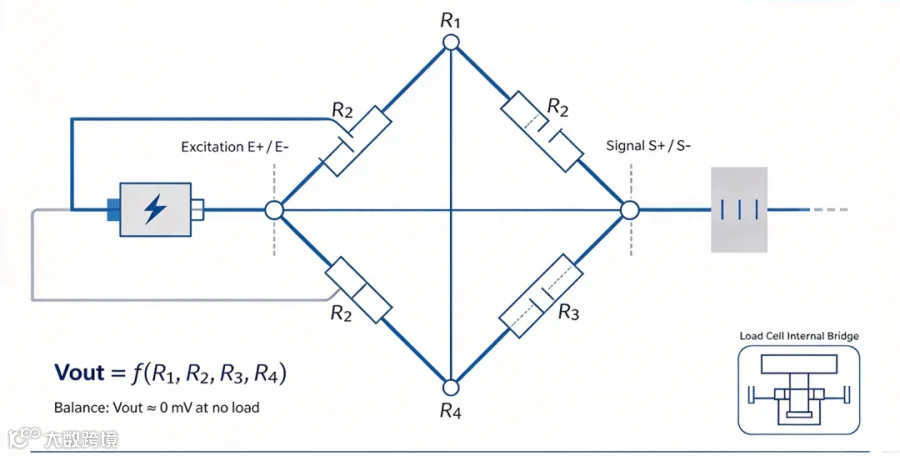
Most load cells adopt a 4-core shielded cable (or 6-core cable with feedback wires):


Red (E+) / Black (E-): Excitation terminals
Green (S+) / White (S-): Signal output terminals
Note: Wire colours vary by brand. Follow the markings on the junction box.
These wires form a Wheatstone bridge inside the load cell. Once mechanical overload occurs, the elastic body suffers irreversible plastic deformation, instantly breaking the impedance balance and zero-point stability of the bridge.

Step 1: Measure Impedance Symmetry
(Power Off)
Disconnect all load cell wires inside the junction box. Set the multimeter to the 2kΩ or 200Ω resistance range.
Measurements:
Red & Black: Input impedance (typically around 350Ω ±10Ω, or 700Ω /1000Ω)
Green & White: Output impedance (typically 350Ω ±3Ω or matches the nameplate value)
Four bridge arm resistances: Red-Green, Red-White, Black-Green, Black-White
Overload Criterion:Under normal conditions, resistances of opposite arms should be nearly identical (error <1~2Ω).If one arm deviates sharply from others, or input/output impedance shows open circuit (infinite reading), the internal strain gauge is broken or severely damaged.
Step 2: Measure Zero-Point Output Signal
(Power On — Most Reliable Criterion!)
This is the most direct way to identify plastic deformation.
Reconnect power to E+ and E-, or use an external 10V DC regulated power supply. Switch the multimeter to DC 200mV range and test S+ and S-.
Judgment:
Normal zero output: around 0mV at no load (±0.1mV ~ ±0.3mV).
Overload warning signs:
Under no load (only platform self-weight), output reaches several or over ten millivolts.
After lifting and unloading the scale platform, reading stays above 1mV and cannot return to zero.
Conclusion: The metal elastic body has irreversible plastic deformation. Calibration cannot restore linearity. Replace the load cell immediately.
Step3: Measure Insulation Resistance
(Check for Moisture and Leakage)
Sometimes the fault comes from water ingress or dampness instead of overload. Symptoms resemble overload drift.
Set multimeter to 20MΩ or 200MΩ range (a megohmmeter with 50V is preferred).
Measurements:
Touch one probe to the load cell metal housing(shield wire), and the other probe to Red, Black, Green and White wires one by one.
Criterion:
Normal insulation >5000MΩ (multimeter shows OL / overflow).
If reading <20MΩ: insulation degraded, damp or water intrusion.
If reading drops to hundreds of kΩ: signal wire short-circuited.



Identifying damaged parts is only the first step. Preventing the replacement load cell from breaking again matters most.
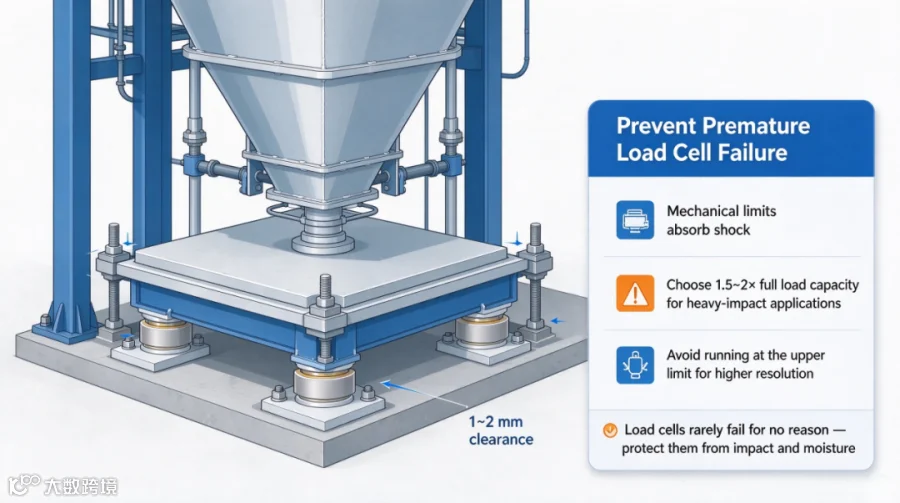
Install mechanical limit bolts
Add limiting gaps (usually 1~2mm) around the scale platform. When overload or impact happens, solid mechanical stops absorb shock and protect the load cell.
Select proper safety margin for harsh working conditions
For applications with frequent impact or high material drop height, choose load cells with a capacity of 1.5~2 times the full net load. Do not select load cells at the upper limit just for higher resolution.
Remember: Load cells rarely fail for no reason
Behind every “Mechanical Overload” test report lies overlooked loopholes in on-site operation.
END
Changzhou VIPOO Weighing Equipment Co., Ltd
Silver Lake Electronic Technology Group Co., Ltd
Changshu VIPOO Weighing Equipment Co., Ltd
Borsais (Fujian) IOT Technology Co., Ltd
Lanzhou VIPOO Cloud Technology Co., Ltd
Shandong VIPOO-IOT Technology Co., Ltd
Wuhan VIPOO-IOT Technology Co., Ltd
Fujian VIPOO-IOT Technology Co., Ltd
CONTACT US:
Director Andy
Whatsapp: +86 15961474131
Sales Manager Krain
Whatsapp : +86 18959178180
Sales Manager Shelly
Whatsapp: +86 15960198661
Sales Manager Zoe
Whatsapp: +86 18705090228

全国售后热线:4008 360160
福州威普:福建省福州市马尾区马江路29号
合作热线:138 0953 9429