


By Staff Reporters
Chinese President Xi Jinping on Tuesday urged concerted efforts to better build a beautiful Xinjiang in the process of Chinese modernization, when he met with representatives from all ethnic groups and all walks of life in Xinjiang Uygur autonomous region in northwest China, as the region is marking its 70th founding anniversary.
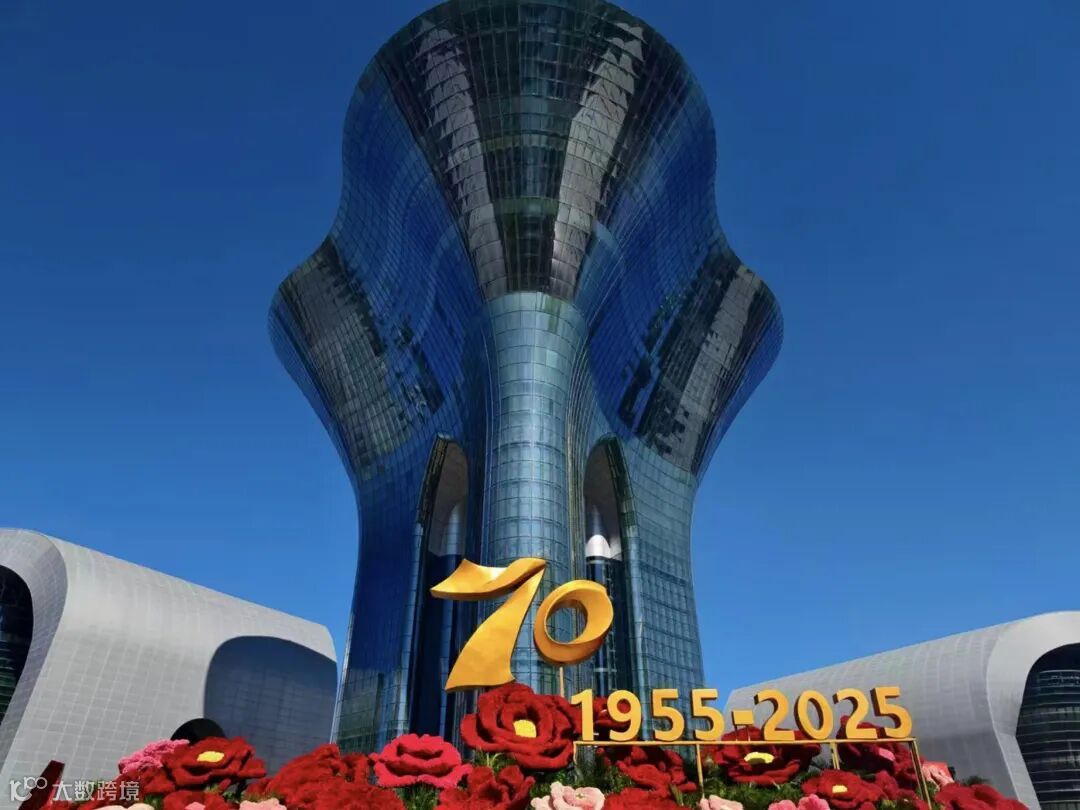
The Xinjiang Uygur autonomous region celebrates its 70th founding anniversary. The photo shows the Urumqi Cultural Center. (PHOTO: CMG)
Seventy years ago, a journey from Xinjiang Uygur autonomous region to Beijing could take months. Today, that same trip has been reduced to a matter of hours by air, symbolizing a profound leap into modernity. This dramatic shift, from camel caravans to high-speed rail, from isolation to global connectivity, shows the remarkable development of the Xinjiang Uygur autonomous region since its founding in 1955. Over the past seven decades, Xinjiang has evolved into a region marked by stability, prosperity, cultural vitality, ecological improvement and rapid development. Once constrained by geography and underdevelopment, it is now a dynamic frontier of China's westward opening and a vital hub along the silk road.
From isolation to infrastructure powerhouse
Xinjiang, accounting for one-sixth of China's land territory, was historically defined by its remoteness. In the early 1950s, most of the region's roads were unpaved and impassable in bad weather. Travelers endured days of grueling rides across deserts and mountains.
Today, that narrative has been rewritten. The region's highway network has grown from 165,900 km in 2012 to 230,000 km in 2024. All prefectures in Xinjiang are now accessible by highway, as are more than 90 percent of administrative regions at county level.
A landmark achievement came on December 30, 2024, with the completion of the Tianshan Shengli Tunnel, the world's longest expressway tunnel at over 22 km, boring through the Tianshan Mountain to slash travel time between southern and northern Xinjiang from three hours to just 20 minutes.
Energy infrastructure has also seen rapid development. On June 10, 2025, the Hami-Chongqing ±800 kV ultra-high voltage direct current transmission project began operation, delivering Xinjiang's electricity to central China within 0.007 second. With five major power transmission corridors, Xinjiang currently transmits over 100 billion kilowatt-hours of electricity annually to 22 provinces and autonomous regions, powered by a diversified mix of coal, hydro, wind and solar energy.
People-centered development
For the millions of Xinjiang residents, progress is measured not only in statistics but in safety, comfort and opportunity.
On January 23, 2024, a 7.1-magnitude earthquake struck Wushi county in Xinjiang's Aksu prefecture. Raheman Abudureyimu, living near the epicenter, said that "the quake hit in the early morning, but our house didn't collapse. Everyone in my family was safe." This resilience is no accident. Since 2004, Xinjiang has been the first region in the country to build earthquake-resistant houses in rural areas, designed to withstand geological disasters and improve the living standards of the local people. By the end of 2024, 2.73 million rural households had benefited from the program. Social spending reflects the region's priorities: More than 70 percent of Xinjiang's fiscal spending has been allocated to improving people's livelihoods over the past decade.
In 2024, more than 99 percent of youngsters in Xinjiang were enrolled in the nine-year compulsory education system, above the national average. In southern Xinjiang, including Aksu, Kashi and Hotan, children enjoy 15 years of free education, from preschool to high school. By 2024, the region had 63 institutions of higher learning, 24 more than in 2012. The development of the health sector has improved people's health, with the average life expectancy in the region increasing from 30 years in 1949 to 77 years in 2024.
Gateway to Eurasia
At the Urumqi International Land Port Area in the regional capital, cranes swing over rows of freight containers, loading or unloading cargo. The China-Europe freight trains depart daily, more efficient than before. Xinjiang is leveraging the advantage of its geographical position at the heart of Eurasia. A multimodal network of railways, highways, air routes and logistics hubs is rapidly taking shape, linking China with Central Asia, Europe and beyond.
A new terminal at the Urumqi Tianshan International Airport has elevated the city's status as an aviation hub. Xinjiang now has 595 civil air routes, of which 25 are international, connecting to 17 countries and regions.
The establishment of the China (Xinjiang) Pilot Free Trade Zone has accelerated trade. In 2024, the region's import and export value surged to 435.11 billion RMB (about 60.68 billion USD), marking a 21.8 percent year-on-year increase and underscoring its remarkable resilience and vitality.
At the Horgos Port, Kazakh businessman Nurbaik applauded the dramatic improvements: "Now I use a smartphone app to file customs declarations. It takes just three hours, eight times faster than a decade ago." Innovations like "railway express" clearance, "direct loading upon arrival," and smart port systems have streamlined logistics and boosted cross-border trade.
END
Editor | SONG Ziyan
Supervisor| FANG Linlin