


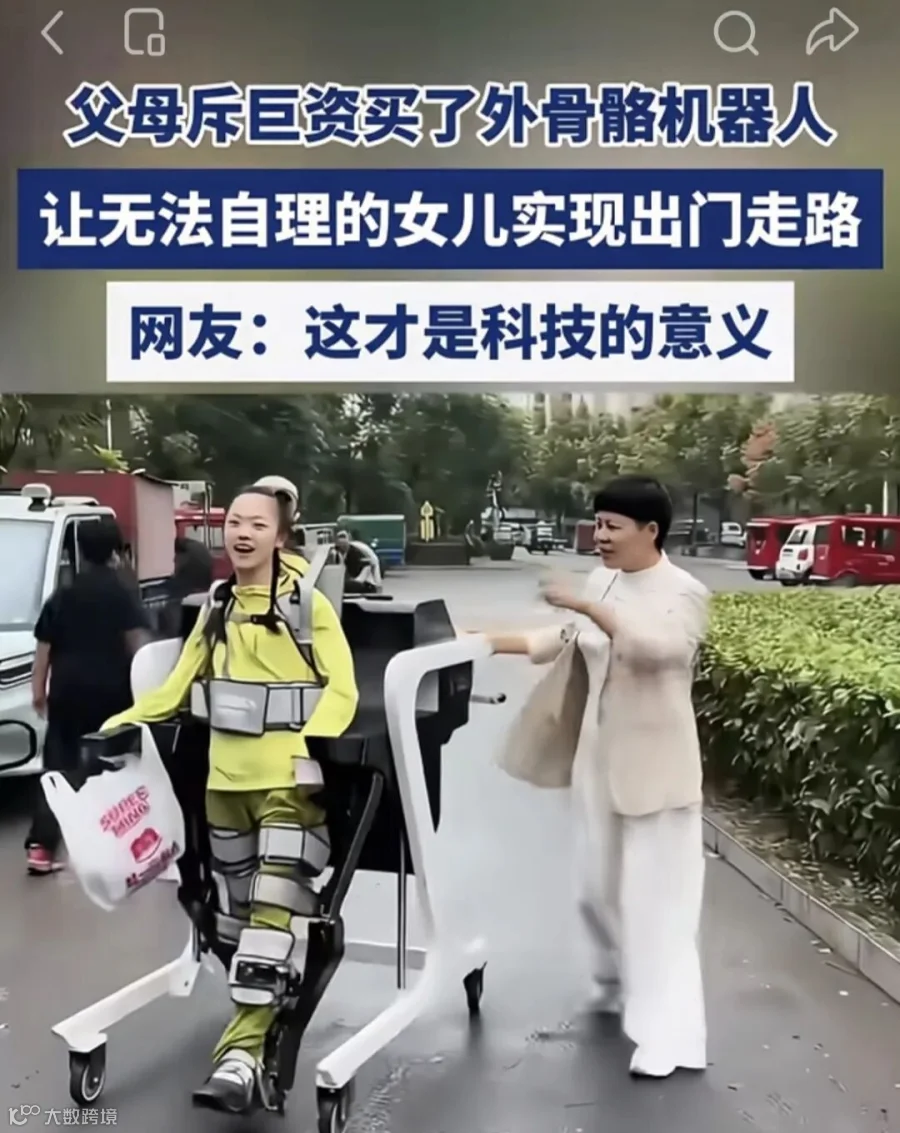
China's exoskeleton robots are making it possible for people with paralysis to stand up again。
中国的外骨骼机器人正在让瘫痪人群重新站立成为可能。
This technology is no longer a scene from science fiction movies, but a real breakthrough happening in rehabilitation hospitals and communities across the country.
这项技术不再是科幻电影里的场景,而是正在全国康复医院和社区中发生的真实突破。
For many patients who have lost their walking ability due to stroke, spinal cord injury or neurological diseases, standing up used to be an unreachable dream.
对于很多因脑卒中、脊髓损伤或神经系统疾病失去行走能力的患者来说,站立曾经是一个遥不可及的梦想。
Today, with the support of China's independently developed exoskeleton systems, they can put on a lightweight wearable device and slowly regain the ability to stand and take steps.
如今,在中国自主研发的外骨骼系统支持下,他们可以穿上一套轻量化的可穿戴设备,慢慢重新获得站立和迈步的能力。

The core of this breakthrough lies in the bionic joint design of the exoskeleton robot.
这一突破的核心,在于外骨骼机器人的仿生关节设计。
These multi-degree-of-freedom hinges mimic the rotation angles of human knees, elbows and hip joints, ensuring that every movement is flexible and natural.
这些多自由度铰链模仿人体膝盖、肘部和髋关节的旋转角度,确保每一个动作都灵活自然。
Built-in elastic buffer layers use damping materials similar to human cartilage to reduce the impact of mechanical movement on the user's body.
内置的弹性缓冲层采用类似人体软骨的阻尼材料,减少机械运动对使用者身体的冲击力。
Adaptive adjustment mechanisms through micro airbags or hydraulic devices can automatically adapt to different body shapes, heights and leg lengths.
通过微型气囊或液压装置实现的自适应调节机制,可以自动适配不同的体型、身高和腿长。
This means that a single exoskeleton device can comfortably fit users ranging from 150cm to 190cm in height.
这意味着单台外骨骼设备可以舒适适配身高从150厘米到190厘米的不同使用者。
The power transmission system of Chinese exoskeleton robots works with the precision of two dancers performing in perfect harmony.
中国外骨骼机器人的动力传递系统,工作起来就像两位舞者默契共舞一样精准。
Surface electromyography patches capture tiny muscle currents in real time, predicting the user's movement intention 0.2 seconds in advance.
皮肤肌电贴片实时捕捉肌肉微电流,提前0.2秒预判使用者的动作意图。
Micro servo motors provide 15-30Nm of torque, strong enough to support a person to lift objects weighing up to 80kg.
微型伺服电机提供15-30牛米的扭矩,力量足以支撑人体托起80公斤的重物。
Heavy-duty industrial exoskeletons use hydraulic systems that allow a single leg to support more than 100kg of weight.
重型工业外骨骼采用液压系统,单腿可以支撑超过100公斤的重量。
Force feedback adjustment technology automatically reduces the output power when encountering obstacles, preventing sudden and violent movements that might cause injury.
力反馈调节技术在遇到障碍物时会自动降低输出功率,避免可能造成伤害的突发猛力动作。
The intelligent control system is the real "AI coach" hidden inside the exoskeleton.
智能控制系统才是藏在外骨骼内部真正的“AI教练”。
Gait learning algorithms can build a user-specific sports model after just three walking sessions.
步态学习算法仅需三次行走就能建立使用者专属的运动模型。
Environmental perception systems combine millimeter-wave radar and infrared cameras to identify ground slopes and obstacles ahead.
环境感知系统融合毫米波雷达和红外摄像头,识别地面坡度与前方障碍物。
Cloud platform collaboration allows data sharing across multiple devices, continuously optimizing assistance strategies for all users.
云平台协同支持多台设备之间的数据共享,持续为所有使用者优化辅助策略。
The sensor collaboration system of Chinese exoskeletons forms a complete closed loop of perception, decision-making and execution.
中国外骨骼的传感器协作系统,形成了感知、决策与执行的完整闭环。
Electromyography sensors capture muscle electrical signals and predict movements 0.3 seconds ahead of time.
肌电传感器捕捉肌肉电信号,提前0.3秒预判动作。
More than 200 pressure sensing points built into the insole analyze gait characteristics in real time with every step.
鞋垫内置的200多个压力感应点,每走一步都在实时分析步态特征。
Nine-axis inertial measurement units track body posture with an accuracy of 0.1 degrees.
9轴惯性测量单元以0.1度的精度跟踪身体姿态。
The data processing center completes a calculation storm of more than 1000 operations per second.
数据处理中心每秒完成超过1000次的计算风暴。
Motion learning models trained on more than 5000 gait samples can quickly adapt to different walking habits.
基于5000多个步态样本训练的运动学习模型,能快速适应不同的行走习惯。
Dynamic adjustment functions automatically change the assistance intensity according to terrain, with a difference of up to 40% between walking on flat ground and climbing stairs.
动态调节功能会根据地形自动改变助力强度,平地行走和上楼梯之间的助力差异最高可达40%。
Safety protection mechanisms trigger protective braking within 20 milliseconds when sudden imbalance is detected.
安全防护机制在检测到突发失衡时,会在20毫秒内启动保护性制动。
The balance principle of Chinese exoskeletons is not rigid support, but dynamic coordination between human and machine.
中国外骨骼的平衡原理不是死板的支撑,而是人与机器之间的动态协同。
Inertial Measurement Units (IMU) including accelerometers and gyroscopes monitor the tilt angle and angular velocity of the torso or legs hundreds of times per second.
包含加速度计和陀螺仪的惯性测量单元,每秒数百次监测躯干或腿部的倾斜角度与角速度。
Modern exoskeletons mostly adopt impedance control or compliance control, creating a "virtual spring" effect in the control algorithm.
现代外骨骼大多采用阻抗控制或顺应性控制,在控制算法中构建出“虚拟弹簧”效果。
When sensors detect that the user's center of gravity is shifting, the motor will not lock the joint instantly, but generate a reverse assistance torque according to the offset amount.
当传感器检测到使用者重心偏移时,电机不会瞬间锁死关节,而是根据偏移量生成反向辅助力矩。
This kind of "flexible resistance" can pull the user back to the center while allowing a certain degree of natural sway.
这种“柔性对抗”既能把使用者拉回中心,又允许一定程度的自然晃动。
Passive balance systems without motors rely entirely on physical structures such as pneumatic springs or torsion springs to provide restoring force.
不带电机的被动平衡系统完全依靠气动弹簧或扭簧等物理结构提供回弹力。
They are simple in structure, have no battery life anxiety, and are very suitable for lightweight and low-intensity assistance scenarios.
它们结构简单,没有续航焦虑,非常适合轻量级、低强度的助力场景。
Active balance systems, which are the mainstream in high-end industrial and rehabilitation fields, form a closed-loop system composed of motors, reducers, controllers and sensors.
作为高端工业和康复领域主流的主动平衡系统,由电机、减速器、控制器和传感器组成闭环系统。
Their response delay is usually controlled within 20 milliseconds, ensuring that users will not feel obvious lag or discomfort.
它们的响应延迟通常控制在20毫秒以内,确保使用者不会感受到明显的迟滞或不适。
In recent years, the combination of non-invasive brain-computer interface technology and exoskeleton robots has opened a new chapter in rehabilitation medicine.
近年来,无创脑机接口技术与外骨骼机器人的结合,为康复医学翻开了全新篇章。
Patients only need to focus their minds on "thinking" about completing a movement, and the system will decode the brain wave signals related to their movement intentions in real time.
患者只需要专注地“想”完成一个动作,系统就会实时解码与运动意图相关的脑电信号。
The exoskeleton device will then drive the affected limb to complete the corresponding movement, helping patients rebuild the neural connection between brain and limbs.
外骨骼设备就会带动患肢完成相应动作,帮助患者重建大脑与肢体之间的神经通路。
This "movement intention - action execution - sensory confirmation" feedback loop continuously activates the patient's nervous system.
这种“运动意念—动作执行—感官确认”的反馈循环,持续激活患者的神经系统。
Many hospitals across China have deployed complete non-invasive brain-computer interface rehabilitation systems that work seamlessly with intelligent exoskeletons.
全国多家医院已经部署了完整的无创脑机接口康复系统,与智能外骨骼无缝联动。
These systems cover upper limb isokinetic training, electromyographic feedback training, hand function rehabilitation, and full-cycle active and passive training for both upper and lower limbs.
这些系统覆盖上肢等速训练、肌电反馈训练、手功能康复,以及上下肢全周期主被动训练。
The story of a patient who regained the ability to walk after a high-level paraplegia accident has touched countless people.
一位高位截瘫事故后重新获得行走能力的患者故事,感动了无数人。
After receiving spinal cord interface technology combined with exoskeleton robot treatment, the patient's muscle strength improved significantly in just two weeks.
在接受脊髓接口技术结合外骨骼机器人治疗后,这位患者的肌肉力量仅在两周内就有了明显提升。
He first completed simulated stepping movements in bed, then short-distance walking in the rehabilitation room, and finally finished his first independent walk accompanied by doctors.
他先是在床上完成仿步动作,随后在康复室内完成短距离步行,最终在医生的陪伴下完成了首次独立行走。
This kind of technological progress is not only changing individual lives, but also promoting the entire rehabilitation industry to transform.
这样的技术进步不仅在改变个体的命运,也在推动整个康复行业转型。
Before the widespread use of exoskeletons, a single patient walking training required 2 to 3 therapists and caregivers to work together.
在外骨骼普及之前,单名患者的步行训练需要2到3名治疗师和护工共同配合完成。
Therapists had to bend over, support and drag patients for hours, exhausting their physical strength in one training shift.
治疗师需要长时间弯腰、搀扶、拖拽患者,一个训练班次下来就会耗尽全部体力。
Now with the help of exoskeleton robots, one therapist can supervise multiple patients at the same time.
现在有了外骨骼机器人的帮助,一名治疗师就可以同时看护多名患者。
This new model saves two-thirds of manpower, allowing therapists to focus more on personalized rehabilitation plans rather than heavy physical labor.
这种新模式节约了三分之二的人力,让治疗师可以把更多精力放在个性化康复方案上,而不是繁重的体力劳动。
The Chinese government has continuously introduced policies to support the development of the exoskeleton robot industry.
中国政府持续出台政策,支持外骨骼机器人产业发展。
The 15th Five-Year Plan for National Economic and Social Development for the first time listed "embodied intelligence" as a future industry of national priority.
第十五个五年规划纲要首次将“具身智能”列为国家优先发展的未来产业。
Many provinces and cities including Beijing, Shanghai, Jiangsu and Zhejiang have taken the lead in including exoskeleton rehabilitation training into medical insurance and long-term care insurance pilot programs.
北京、上海、江苏、浙江等多个省市已经率先将外骨骼康复训练纳入医保和长护险试点。
This marks that China's exoskeleton robot industry has moved from the laboratory stage to the clinical payment end.
这标志着中国外骨骼机器人产业已经从实验室阶段走向了临床支付端。
According to industry data, the online retail sales of smart exoskeletons increased by 458.4% year-on-year in the first half of 2026.
行业数据显示,2026年上半年智能外骨骼网络零售额同比增长458.4%。
The market size of China's exoskeleton robot industry is estimated to reach about 5.41 billion yuan in 2026.
2026年中国外骨骼机器人行业市场规模预计将达到约54.1亿元。
At the same time, the industry is still facing challenges such as high costs, battery life limitations and the need for continuous improvement of comfort.
与此同时,行业仍然面临成本高昂、续航受限和舒适性有待持续提升等挑战。
New composite materials are continuously reducing the weight of exoskeletons, and some consumer-grade products have been reduced to less than 2kg.
新型复合材料正在不断降低外骨骼的重量,部分消费级产品已经减重至2公斤以下。
The continuous iteration of technology is making this "iron suit" lighter, smarter and more affordable.
技术的持续迭代,正在让这套“钢铁战衣”变得更轻、更智能、更普惠。
At the 2026 Canton Fair, an Argentine lady in a wheelchair slowly stood up with the support of a Chinese exoskeleton robot.
在2026年广交会上,一位坐在轮椅上的阿根廷女士在中国外骨骼机器人的托举下缓缓站了起来。
This moment of technological warmth across national borders was recorded and spread across social media platforms.
这个跨越国界的科技温情瞬间被记录下来,在社交平台上广泛传播。
The core value of Chinese exoskeleton technology is very simple: let the machine adapt to human beings, instead of making human beings accommodate the machine.
中国外骨骼技术的核心价值非常朴素:让机器适应人,而不是让人迁就机器。
Every technological breakthrough is ultimately serving a soft goal, which is to give people who have lost their mobility the dignity of standing again.
每一次技术突破最终都服务于一个柔软的目标,那就是给失去行动能力的人重新站立的尊严。
From rehabilitation hospitals to industrial workshops, from elderly care institutions to daily family scenarios, Chinese exoskeleton robots are bringing new possibilities to more and more people.
从康复医院到工业车间,从养老机构到日常家庭场景,中国外骨骼机器人正在给越来越多人带去新的可能性。
This is not only a major achievement of China's intelligent manufacturing, but also a warm contribution made by Chinese technology to the global aging society and public health.
这不仅是中国智能制造的重要成果,也是中国科技对全球老龄化社会和公共健康事业做出的一份温暖贡献。