


Written by Bill Russo, Founder & CEO of Automobility Ltd.
A Personal Perspective: The Disruption Is Going Global
My travels in September reinforced something I've been emphasizing for some time: China's automotive transformation is no longer just a China story. It is reshaping the global industry's competitive landscape.
In my keynote speech at AutoBranchen Danmark in Brande, Denmark, and my speech at a PE firm's board meeting in Shenzhen, I emphasized how China's advantage has evolved beyond electrification. The real differentiator is an innovation ecosystem capable of integrating technology, manufacturing and digital services at unprecedented speed and cost. The challenge for established automakers is not simply to catch up in EVs, but to rethink how they innovate, compete and create value.
September's market results bring this into sharper focus. China's domestic market is contracting, ICE demand is collapsing, and exports are setting records. Yet the more important development is the emergence of a fundamentally different automotive business model—one that combines affordable intelligence, rapid innovation cycles and industrial scale.
My takeaway through the 3rd quarter of 2026: The question is no longer whether China's automotive revolution will disrupt global markets. It is how quickly the rest of the industry can adapt.
These themes provide the backdrop for this month's analysis of China's rapidly evolving automotive industry.
Please check the article I’ve written with the key takeaways from my keynote in Brande:
China’s Global Expansion Will Be Won—or Lost—After the Sale
Key Headlines Summary through 3rd Quarter 2026
📉 Domestic demand is collapsing, not merely slowing. Domestic vehicle sales fell 22.3% YTD, with ICE plunging 33.1%. China's traditional automotive business is losing the scale needed to sustain its economics.
🌍 China is exporting its way through the downturn. Exports surged 67% to 8.21 million vehicles, already surpassing the full-year 2025 record. More than one in three vehicles shipped now goes overseas.
⚡ Electrification has crossed the tipping point. NEVs captured a record 66% of September passenger vehicle sales, extending their run above 60% to six consecutive months. The ICE era is rapidly receding.
🇨🇳 Chinese brands are tightening their grip. Local automakers reached a record 74% market share, while German and Japanese brands suffered declines of 29.9% and 24.6%, respectively.
🏁 The NEV battle is moving downmarket. BYD leads, Leapmotor has broken into the top four, and six of China's ten best-selling NEVs cost less than RMB 150,000 (US$22,500). Affordable intelligence is becoming the new competitive benchmark.
🤖 The next competitive frontier extends beyond electrification. Software, AI, intelligent driving and connected ecosystems are redefining automotive value. China's advantage increasingly comes from its ability to commercialize technology at speed and scale.
China’s Automotive Reset: Shrinking at Home, Expanding Globally
China’s auto industry is confronting a striking contradiction: domestic demand is collapsing while global expansion accelerates. Through September, domestic sales plunged 22.3%, yet exports surged 67% to 8.21 million vehicles—already exceeding the full-year 2025 record. China is increasingly exporting the industrial scale its domestic market can no longer absorb.
This is a structural reset, not a cyclical slowdown. ICE sales collapsed 33.1%, NEVs captured a record 66% of September passenger vehicle sales, and Chinese brands reached an unprecedented 74% share of ex-factory shipments. The legacy automotive business is losing ground to a new competitive model built around electrification, intelligence, speed and cost efficiency.
The next battle is shifting from electrification to affordable intelligence. BYD leads on scale, Leapmotor is emerging as a mass-market challenger, and Geely demonstrates that legacy players can successfully transform. With six of China's ten best-selling NEVs priced below RMB 150,000, advanced technology is rapidly becoming a mainstream expectation.
The disruption is now going global. China's automakers are leveraging their scale and innovation ecosystem to challenge established competitors worldwide. But Going Global 2.0 is about more than exports—it requires building sustainable international businesses through localized production, distribution and partnerships.
China is no longer just transforming its own auto market. It is redefining the rules of global automotive competition.
China’s Auto Industry Faces a Deepening Divide Between Legacy Decline and NEV Growth
China’s automotive industry has entered a more challenging phase in 2026, with total shipments reaching 23.3 million units through September, down 4.5% year-over-year. While overall volumes remain near historically high levels, the market is increasingly dependent on new sources of growth to offset weakening traditional domestic demand. Passenger vehicle shipments declined 6.1%, while commercial vehicles grew 6.2%, highlighting the uneven performance across segments. The industry is maintaining its scale, but the composition of that scale is changing rapidly.
The most striking development is the accelerating displacement of ICE vehicles by NEVs. Through September, NEV shipments grew 11.1%, adding 1.34 million units, while ICE shipments contracted 17.8%, a loss of 2.34 million vehicles. This divergence has widened since August, suggesting that the transition is gaining momentum despite the broader market downturn. Electrification is no longer simply driving incremental growth—it is increasingly replacing the conventional vehicle market.
The deeper story is one of structural reallocation rather than a conventional industry slowdown. China’s automotive ecosystem is shifting toward electrified products and international markets, while legacy powertrains and domestic passenger vehicle demand face mounting pressure. Commercial vehicles and exports are helping sustain manufacturing scale, but they cannot fully compensate for the contraction in traditional segments. China’s automotive industry is not losing its competitive momentum—it is redistributing that momentum toward a fundamentally different set of technologies, companies, and markets.
The defining challenge is no longer simply how to restore industry growth, but how quickly automakers can reposition themselves for a market where NEVs increasingly define the competitive mainstream and ICE becomes the shrinking legacy segment.
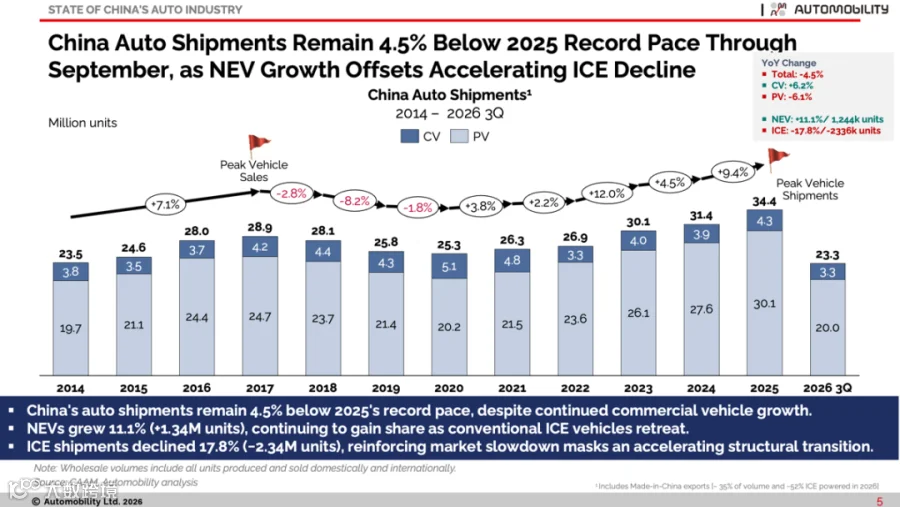
China’s automotive market deteriorated further in September, with passenger vehicle shipments falling 9.5% year-over-year to 2.59 million units, marking the eighth consecutive month of decline. Despite a seasonal increase in shipments from August, the year-over-year contraction widened from 6.2%, indicating that the traditional September sales recovery has failed to reverse the underlying weakness. The continued deterioration suggests that consumer demand remains under pressure, even as automakers push to sustain volumes through aggressive pricing and new product introductions.
Commercial vehicles, which had provided a relatively stable source of growth throughout much of 2026, also lost momentum. Shipments reached 369,000 units in September, growing just 0.3% year-over-year, compared with August's 3.8% increase. While commercial vehicle volumes remain comparatively resilient, the sharp deceleration suggests that this segment can no longer be counted on to offset the weakness in passenger vehicles. The slowdown is becoming more broadly felt across the industry.
September reinforces that China's automotive market has yet to find a sustainable floor. Passenger vehicle demand continues to weaken despite the accelerating transition toward NEVs, while commercial vehicle growth is approaching stagnation. Exports are increasingly critical to sustaining production volumes, but their growing importance also highlights the widening disconnect between China's manufacturing capacity and domestic demand. The industry is becoming more globally competitive even as its home market becomes increasingly difficult to grow.

China’s auto industry is exporting its way through a domestic downturn. Through September, total shipments fell 4.5% to 23.27 million vehicles, but exports surged 67% to 8.21 million units, now accounting for more than 35% of total production. What was once primarily a domestic manufacturing powerhouse is rapidly becoming the world’s automotive export engine.
The implications are profound. Global automakers face a double squeeze: their traditional ICE business is collapsing in China, while Chinese competitors are expanding aggressively into their home markets. China is no longer simply the world's largest auto market—it is becoming the world's most formidable automotive competitor. The disruption is going global.

China’s Auto Export Engine Hits Record Speed as Domestic Demand Falters
September delivered another milestone in China’s automotive globalization. Monthly exports reached a record 1.05 million vehicles, surging 72% year over year, marking the third consecutive month above one million units. Exports accounted for 35.6% of total shipments, reinforcing how rapidly overseas markets have become essential to sustaining China's automotive production scale.
Meanwhile, domestic shipments rebounded 12% month over month to 1.90 million units, but remained 26% below September 2025. The contrast is striking: China’s automakers are achieving record international sales while their home market continues to contract sharply. The industry's growth engine is increasingly shifting from domestic demand to global markets.
This is more than an export boom. It marks an acceleration of Going Global 2.0, as Chinese automakers leverage their scale, cost competitiveness, and technology advantages to challenge established competitors worldwide. But exporting vehicles is only the first step. Sustained global success will require localized manufacturing, supply chains, distribution, and brand development to navigate rising trade barriers and geopolitical resistance.
The strategic shift is unmistakable: China is no longer simply the world's largest automotive market. It is becoming the world's most powerful automotive export platform—and increasingly, a direct competitor in markets once dominated by established global OEMs.

Through September, shipments surged to 8.21 million vehicles, up 67% YoY, already surpassing the 7.10 million exported in all of 2025—with three months still remaining.
NEVs are transforming China’s export mix. Electrified vehicle exports reached 4.01 million units, accounting for 48.8% of total shipments. NEVs are now on the verge of overtaking ICE vehicles as China’s dominant automotive export category.
ICE exports remain a formidable force at 4.20 million units, demonstrating that China’s global expansion is powered by both conventional and electrified vehicles.
The bottom line: China is no longer just exporting more cars—it is rapidly electrifying its global automotive footprint.

China’s automakers are taking the fight global—and gaining ground fast. Through August, Russia remained the largest export destination with 638,000 vehicles (+123%), while Brazil surged 149% to 480,000 units. Chinese automakers are rapidly expanding their international footprint as domestic demand contracts.
Europe is proving that trade barriers cannot stop the competitive pressure. Exports to the UK jumped 86%, Belgium 52%, and Italy 116%, while Australia grew 62% and Algeria surged 150%. Chinese vehicles are gaining traction across developed and emerging markets, challenging established automakers on their home turf.
But the expansion is uneven. Mexico declined 11% and the UAE fell 38%, underscoring the influence of local competition, trade policies, and market conditions. Export success is increasingly determined by the ability to adapt to individual markets.

The bigger story: China’s automotive disruption is going global. Going Global 2.0 is about turning export momentum into lasting competitive advantage through localized production, supply chains, distribution, and brands. The battle for the future of the auto industry is no longer confined to China.
For more, please refer to our Going Global 2.0 article:
China Going Global 2.0: How Chinese OEMs Are Rewriting Automotive Globalization
China’s ICE Collapse Is Destroying the Economics of the Legacy Auto Industry
China’s auto downturn is full-on a crisis for the legacy auto industry. Through September, domestic sales plunged 22.3% to 15.4 million vehicles, but ICE sales collapsed 33.1% to 6.9 million, more than three times the 10.6% decline in NEVs. The market is shrinking, but legacy automakers are bearing the brunt.
The real threat is the collapse of scale economics. As ICE volumes evaporate, legacy automakers face rising unit costs, underutilized factories, distressed suppliers, and increasingly unprofitable dealer networks. Meanwhile, NEVs outsell ICE vehicles by 1.6 million units, shifting the industry's center of gravity toward electrification.
For multinational OEMs, the squeeze is intensifying. Their traditional competitive advantages—global platforms, manufacturing scale, and established brands—are becoming liabilities as volumes fall and Chinese NEV competitors redefine the economics of the business.
The bottom line: China’s ICE market isn't just shrinking—its economic foundation is unraveling. The winners will be those who can build scale in the new industry, not defend it in the old one.

China’s passenger vehicle market has crossed the point of no return. NEV penetration reached a new record 66% in September, marking six consecutive months above 60%. Through September, NEV sales climbed to 7.76 million units versus 5.58 million ICE vehicles, opening a commanding 2.2 million-unit lead. Electrification is no longer the alternative—it is the mainstream.
The competitive battleground has fundamentally shifted. With NEVs now accounting for nearly two-thirds of monthly sales, electrification alone is no longer a differentiator. Competition is moving toward intelligent driving, software-defined vehicles, AI-powered experiences, and affordability. The winners will be those who deliver the most compelling combination of technology, experience, and value—not simply an electric powertrain.

Leapmotor Breaks Into the Top Four as China’s NEV Power Balance Shifts
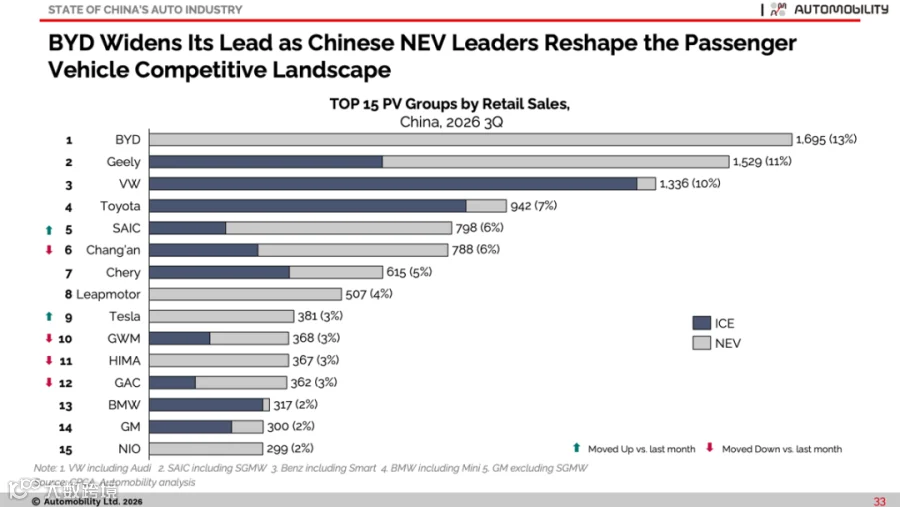
BYD still dominates, but the real battle is for the next generation of winners. With 1.70 million vehicles sold and 21.8% share, BYD commands nearly twice Geely’s volume. But Leapmotor has overtaken Chang’an to claim fourth place, reaching 507,000 sales, while Tesla climbs to sixth. The competitive hierarchy is being rewritten.
Affordability is becoming the ultimate competitive weapon. Leapmotor’s rise demonstrates how cost-efficient architectures, rapid innovation, and aggressive pricing are reshaping the market. Meanwhile, no individual model commands more than 4% share, highlighting the intensity of competition even as the top five groups control 54.3% of sales.
The winners are separating from the pack. BYD and Leapmotor are proving that purpose-built NEV companies can scale faster than legacy automakers transitioning from ICE. Geely Xingyuan leads the model rankings, while BYD Ti7 and Leapmotor A10 gain ground—evidence that mass-market value increasingly determines success.
The bottom line: China’s NEV race is no longer about who can electrify. It’s about who can deliver the most technology at the lowest cost—and scale it fastest.

China’s NEV market is shifting downmarket—and affordability is becoming the decisive weapon. Six of the top ten NEV models are priced below RMB 150,000. Geely Xingyuan leads with over 310,000 sales, while Leapmotor A10, BYD Yuan UP, and Chang’an Q05 demonstrate the growing strength of mass-market challengers.
Premium NEVs grab headlines. Affordable NEVs drive volume. Tesla, Xiaomi, and Li Auto remain formidable competitors, but the biggest opportunity lies in bringing intelligent technology to mainstream buyers. Advanced features are rapidly becoming affordable expectations rather than premium differentiators.
The bottom line: China’s next NEV winners won't be those offering the most technology—they'll be those making advanced technology accessible to the most people.

China’s Auto Market Splits Into Two Competitive Worlds
China’s auto market is increasingly two markets with two very different sets of leaders. Through September, NEV sales reached 7.76 million units versus 5.58 million ICE vehicles, widening the gap to 2.18 million units. The shift is accelerating, and the competitive divide is becoming unmistakable.
Foreign OEMs dominate ICE; Chinese brands dominate NEVs. Volkswagen and Toyota together control 38% of ICE sales, while BYD alone commands 22% of NEVs. The competitive center of gravity has shifted decisively toward Chinese automakers, leaving global incumbents heavily exposed to a shrinking ICE market.
Geely and Chang’an are the rare players competing at high volumes in both worlds. Both rank among the top 10 in ICE and NEVs, while Chery remains a major ICE player but is absent from the NEV top 10. Legacy scale offers no guarantee of success in the new market.
The strategic divide is widening: ICE leadership and NEV leadership increasingly require different capabilities, business models and competitive strategies.

Chinese Brands Tighten Their Grip as Global Automakers Retreat
China's automotive volumes continue to shift decisively toward domestic brands. Chinese automakers captured a record 74% of passenger vehicle shipments through September, up from 70% in 2025 and just 36% in 2020. In six years, the competitive balance has been fundamentally reversed.
German and Japanese automakers are bearing the brunt of this shift in 2026. German-brand shipments plunged 29.9% YoY, while Japanese brands fell 24.6%. By contrast, Chinese brands held broadly steady, growing 0.6% despite the market downturn. Their traditional ICE strongholds are eroding rapidly as NEVs reshape consumer preferences and competitive economics.
U.S. brands remain the exception among foreign automakers, with shipments rising 6.5% YoY, supported by China-made exports. However, export strength does not necessarily signal improving competitiveness in China's domestic market.
The competitive divide is widening: Chinese brands are defending their scale, while global automakers face accelerating structural pressure on their China businesses.

BYD Pulls Ahead as NEV Players Rewrite China’s Auto Hierarchy
China’s passenger vehicle rankings are being reshaped by electrification. BYD has widened its lead to 1.70 million sales through September, ahead of Geely at 1.53 million and Volkswagen at 1.34 million. The contrast is striking: BYD is entirely NEV-focused, Geely competes across both powertrains, while Volkswagen remains overwhelmingly dependent on ICE.
NEV-native players are moving rapidly up the rankings. Leapmotor holds eighth place with 507,000 sales, Tesla climbs to ninth with 381,000, while HIMA and NIO remain among the top 15. Five pure-play NEV players now rank among China's 15 largest passenger vehicle groups, challenging established automakers built around conventional powertrains.
The competitive hierarchy is being rewritten. BYD's scale demonstrates how far NEV-native players have advanced, while Geely's strong position across both ICE and NEVs shows that legacy automakers can compete successfully through transformation. Electrification is no longer a separate competitive battleground—it is reshaping the entire passenger vehicle industry.
Conclusion: China’s Automotive Reset Is Going Global
China's automotive industry is no longer defined by domestic growth. The home market is contracting, ICE economics are deteriorating, and NEVs have become the mainstream. Chinese brands now command 74% of passenger vehicle shipments, while German and Japanese automakers face accelerating declines. The competitive advantages that sustained the legacy industry—brand heritage, global platforms and manufacturing scale—are proving insufficient against China's faster, more integrated innovation ecosystem.
The next battle is about democratizing intelligence. BYD has established scale leadership, Leapmotor is demonstrating the power of affordable NEV architectures, and Geely is proving that successful transformation is possible. With six of the ten best-selling NEVs priced below RMB 150,000, the market is sending a clear message: advanced technology must reach mainstream buyers. Electrification opened the door; software, AI, intelligent driving and cost efficiency are raising the competitive bar.
Meanwhile, China's domestic disruption is becoming a global phenomenon. Exports have already exceeded last year's record, with NEVs approaching half of overseas shipments. Chinese automakers are leveraging their industrial scale to expand into markets historically dominated by established global brands. But the next phase of globalization will demand more than export volume. It will require localized ecosystems, sustainable business models and the ability to compete on customer experience throughout the vehicle lifecycle.
China's auto industry is no longer just competing for market share. It is redefining the economics, technology and operating model of the global automotive business. The competitive pressures that transformed China are now spreading worldwide. For global automakers and suppliers, the challenge is no longer simply how to compete in China—but how to compete with an automotive industry increasingly operating at China speed, China cost and China scale.
ANNOUNCEMENT OF APPOINTMENT
Brighter Signals Appoints Bill Russo, Founder and CEO of Automobility, as Independent Director
🚗 Bill Russo has agreed to join the Board of Brighter Signals as an independent director, with the appointment effective in Q4 2026, subject to shareholder formalization.
The appointment aligns closely with Automobility’s thesis: China is increasingly defining the future of mobility, and global competitiveness requires meaningful participation in its innovation ecosystem.
💡 Brighter Signals’ patented fabric-based sensing technology brings intelligence into the cabin through occupant detection, classification and seat-belt reminder sensing—capabilities that support safer, more responsive mobility experiences.
🌏 With manufacturing partnerships in China and opportunities to engage leading Chinese OEMs and Tier 1 suppliers, Brighter Signals illustrates how global technology companies can connect their innovations with China’s automotive ecosystem to serve markets worldwide.
🤖 Its expansion into robotic touch sensing also points to a broader opportunity: connecting physical sensing with intelligent software across mobility and robotics.
We look forward to helping Brighter Signals build these connections and accelerate its engagement with the global automotive ecosystem.
What role will intelligent cabin technologies play in the next wave of automotive differentiation?
🔗 Read the announcement:
Brighter Signals Appoints Bill Russo, Founder and CEO of Automobility, as Independent Director
AmCham Shanghai State of China Auto Market Monthly Webinar [October 22]
The American Chamber of Commerce in Shanghai 's Automotive Committee invites you to our Monthly State of China's Automotive Industry webinar on Thursday, October 22, from 9:00am - 10:15 am, to be held via Zoom Meeting.
We will provide updated information on sales results through June. We will also share our observations of other major trends in the auto industry.
This event is held virtually. A Zoom link will be provided via email once registration is completed.
Webinar | State of China Auto Market Monthly Briefing (October) | AmCham Shanghai
AUTOMOBILITY ORIGINAL ARTICLE
From Smart Grid to Energy Orchestration: The $Trillion Opportunity Automakers Are Missing
The EV revolution is fundamentally an energy revolution.
Two years ago, we explored how the Smart EV was beginning to connect the automotive and energy industries. That opportunity has now reached a new level of scale. In China, 44 million NEVs, 24 million charging points and vast amounts of distributed battery capacity are creating the foundation for an entirely new energy ecosystem.
As we explore in our latest article, “From Smart Grid to Energy Orchestration,” the strategic question is shifting from how to build enough infrastructure to support EV adoption to how vehicles, batteries and charging infrastructure can be orchestrated as a coordinated energy system.
The opportunity develops across three levels: Node → Hub → Network. Individual vehicles and batteries provide flexibility; aggregation creates scale; and digital orchestration turns that flexibility into value. NIO, CATL and BYD illustrate different pathways into this emerging ecosystem—from battery aggregation and standardization to vehicle-and-infrastructure scale.
The next step could be even more transformative. As autonomous electric fleets scale, mobility orchestration and energy orchestration begin to converge—optimizing not only where vehicles go, but when they charge, how they use energy and when their flexibility can serve the broader electricity system.
The boundaries between automotive, energy and infrastructure are dissolving. China provides an early preview of what becomes possible when EVs and infrastructure reach scale—and the strategic question for automakers, battery companies, energy providers and technology platforms is increasingly clear: where will value be created, and who will capture it?
Click here to read the full article:
From Smart Grid to Energy Orchestration: The $Trillion Opportunity Automakers Are Missing
AUTO INSIDER PODCAST
We are pleased to share Episode 7 of the Auto Insider podcast—continuing our series of candid, in-depth conversations with leaders operating at the center of the global mobility reset.
In Episode 7 of Auto Insider, Bill talks with Peter Cirino, Chief Operating Officer of ECARX, to explore one of the most consequential shifts underway in the automotive industry: the transformation of the vehicle into an intelligent, connected computing platform. As software, AI and connectivity become central to the vehicle experience, competitive advantage is increasingly defined by how quickly automakers can integrate technology, iterate and deliver differentiated experiences to customers.
We examine how the industry is moving beyond the idea of the software-defined vehicle toward something closer to a smartphone on wheels—a continuously evolving platform in which hardware, software, cloud connectivity and AI work together. This fundamentally changes not only vehicle architecture, but also how cars are developed, upgraded and experienced throughout their lifecycle.
At the center of our discussion is China’s rapidly evolving intelligent-vehicle ecosystem. China’s compressed development cycles, highly digital consumers and intense competition are accelerating innovation in intelligent cockpits, connectivity and in-vehicle experiences. The result is a market where expectations are being reset at a pace that is increasingly influencing the global automotive industry.
We also explore what this means for global automakers and technology suppliers. Winning in the intelligent-vehicle era requires a different operating model—one built around faster iteration, deeper ecosystem collaboration and the ability to combine global scale with local innovation. Technology partnerships are becoming increasingly important as OEMs seek to keep pace with rapidly evolving computing platforms and consumer expectations.
Peter also shares ECARX’s perspective as a company operating at the intersection of automotive, computing and consumer technology, and how the lessons emerging from China can be translated into solutions for global markets.
The takeaway is clear—the automobile is becoming much more than a transportation product. It is becoming an intelligent digital platform, and the companies that succeed will be those that can combine automotive-grade engineering with the speed, adaptability and user-centric innovation of the technology industry.
Watch Episode 7 of Auto Insider to hear our full conversation with Peter Cirino on how intelligence, software and AI are reshaping the automobile—and the competitive landscape around it.
🎙️ Auto Insider – Episode 8: “The Intelligent Cabin: Where Safety, Experience and AI Converge”
🚘 What happens when the vehicle cabin evolves from a collection of controls and displays into an intelligent environment that can understand, anticipate, and respond to the people inside it?
In the next episode of Auto Insider, I sit down with Sara Sargent, a leading expert in automotive technology and the in-vehicle experience, to explore how AI, sensing, software, and new interface technologies are transforming the intelligent cabin—and changing the relationship between people and their vehicles.
We discuss:
-
🧠 How AI is making the cabin more intelligent, intuitive, and personalized -
👁️ Why sensing and occupant understanding are becoming fundamental to both safety and experience -
🗣️ How voice, multimodal interfaces, and AI assistants are changing the way we interact with vehicles -
🛡️ Why safety and user experience are increasingly converging rather than operating as separate domains -
💻 How software-defined architectures enable experiences that can evolve throughout the vehicle lifecycle -
🇨🇳 Why China is moving especially quickly in redefining expectations for the intelligent cabin -
🚘 How greater levels of automation could fundamentally change what occupants expect from the interior of the vehicle
⚡ The big takeaway:
The intelligent cabin is becoming one of the most important battlegrounds for automotive differentiation. As AI becomes embedded in the vehicle, the winners will not simply be those with the most screens, features, or computing power—but those that can integrate safety, intelligence, and user experience into a seamless and intuitive relationship between the vehicle and its occupants.
🎙️ Catch up on the latest episodes of the Auto Insider Podcast hosted by Bill Russo, featuring insights from the front lines of China’s mobility transformation — where speed, scale, and strategy are redefining global competition.
🌏 Episode #6: From Tier-1 to System Architect: Aptiv at China Speed, Global Scale with Simon Yang,President, China & Asia Pacific, Aptiv
🌏 Episode #5: Safety Without Borders: How Autoliv Drives Scaled Collaboration in the Smart Mobility Era with Sng Yih, President, Autoliv China
🌏 Episode #4: Leapmotor’s Global Leap — A New Paradigm for Global EV Collaboration with Michael Wu, Co-President, Leapmotor
🚗 Episode #3: Competing at China Speed: A Tier-1 Perspective from Magna with Zhen Wu, President of Magna China
🦋 Episode #2: The Butterfly Effect—How China’s Auto Shift is Reshaping the World with Dr. Xiaozhi Liu, Founder and CEO of ASL Automotive, Former CEO of Fuyao Glass
🔧 Episode #1: Smart EVs and the Smart Tier 0.5 Supply Chain with Jack Cheng , Co-Founder of NIO and CEO of M-Mobility
We’re just getting started — more conversations coming soon with the visionaries shaping the future of mobility.
You can follow us for regular updates on these online channels by scanning the QR codes:

If your organization would like a custom briefing on the State of China’s Auto Market, please reach out to us at info@automobility.io
About Bill Russo
Bill is a contributing author to the book Selling to China: Stories of Success, Failure, and Constant Change (2023), where he describes how China has become the most commercially innovative place to do business in the world’s auto industry - and why those hoping to compete globally must continue to be in the market.
About Automobility
Contact us by email at info@automobility.io
PLEASE NOTE: The information and analysis shared in this newsletter, including the charts and style of materials presented, is the intellectual property of Automobility Ltd. While we share it as a way to serve our existing and new clients, it is not to be used without our express consent and then only with attribution. Any publication, reproduction or other use of this material without the express written consent of Automobility Ltd is prohibited.