



商业伙伴筛查指的是对于与商业伙伴的管控进行全流程的把控,其中关键的一环在于对商业伙伴的尽职调查,尽职调查可以适用于国内企业,也可以适用于境外企业,比如美国企业。
1.尽职调查要有定制化的风险提示及结论意见
比如自主设计的风险指标仪表盘,通过分析评估出目标对象的风险等级。

(风险指标仪表盘)
专家团队要给出应对的建议。

(风险预警与合规建议样例)
无论是企业管理层依据这些建议制定战略规划,还是投资者参考其进行投资规划与投后管理,都能够在实际操作中有章可循,真正将尽调报告的价值转化为实际的经济效益与发展动力。
2.要针对明确的应用场景
企业自身年度全面合规风险梳理:企业自身进行内部重组、业务转型或战略调整时,通过对内部各业务单元、部门或资产的尽职调查,管理层可以清晰了解企业的真实状况,发现潜在问题和机会,为资源重新配置、业务流程优化、组织架构调整等决策提供数据支持,从而提升企业的运营效率和竞争力。
企业上市:企业准备上市时,需要进行全面的尽职调查。这包括对自身的业务模式、财务状况、关联交易、公司治理等各个方面进行梳理和调查,确保符合证券监管机构的要求和上市标准。
收并购尽调:在收购或兼并其他企业时,尽调报告是评估目标企业价值和风险的关键工具。它能够全面呈现目标企业的财务健康状况,包括资产、负债、现金流等,帮助收购方确定合理的收购价格。同时,报告还会深入分析目标企业的法务情况以及业务运营状况,让收购方提前了解整合难度和潜在风险,为并购决策和后续整合提供依据。
投资决策:对于投资者而言,无论是风险投资、私募股权投资还是战略投资,尽调报告都是必不可少的。通过对被投资企业的全面尽调,投资者可以了解企业的盈利能力、成长潜力、市场竞争力等财务和业务因素,还能评估管理团队的能力和信誉、行业前景等。这有助于投资者判断投资回报的可能性与风险程度,从而决定是否投资以及投资的规模和条件。
商业合作:企业在寻找合作伙伴时,需要通过尽调报告深入了解对方的优势、劣势、业务模式和战略目标,评估双方的互补性和协同潜力,以确保合作能够实现资源共享、优势互补,共同开拓市场,避免因信息不对称而导致合作失败。
其他任何需尽职调查的业务场景。
3.可以对境外企业进行尽职调查
法律合规尽职调查(企业身份验证及负面信息查询)
⚕️公司主体资格验证:核实企业的注册文件、营业执照、公司章程等,确认其合法成立和有效存续,确保企业具备合法的经营资格,不存在影响合作的重大法律纠纷或诉讼。
⚕️合同审查:对企业的重大合同进行审查,包括采购合同、销售合同、合作协议等,评估合同的合法性、有效性和潜在风险。例如,检查合同条款是否明确双方的权利义务、违约责任等。
⚕️制裁审查:旨在确保企业不与受制裁对象发生业务往来,避免违反美国制裁规定而面临严重法律后果和经济损失,维护企业声誉和稳定运营。如违反可能导致企业受到巨额罚款处罚、业务受限甚至刑事处罚。
⚕️反洗钱审查:以《银行保密法》《洗钱控制法》《爱国者法案》等为法律依据。要求金融机构和特定非金融机构建立反洗钱合规程序,履行客户身份识别、交易记录保存和可疑交易报告等义务。
⚕️知识产权:调查企业的专利、商标、著作权等知识产权情况,确保其拥有合法的知识产权权利,并评估知识产权的价值和潜在侵权风险。比如,查询专利的有效期、商标的注册范围等。
⚕️劳动法律合规性:审查企业的劳动用工合同、员工手册等,确保其遵守劳动法律法规,如工资支付、工作时间、福利待遇等方面的规定。同时,评估潜在的劳动纠纷风险。
⚕️声誉不良记录:审查企业是否有既往的违规行为及不良记录,帮助规避潜在风险。
⚕️合同合规建议:指出潜在重大风险,对与该审查对象来往合同给出符合美国当地履行要求的建议。
⚕️其他审查:其他与美国相关重点事项的审查。
法律合规尽职调查+财务尽职调查(私人公司需配合提供资料)+商业尽职调查(私人公司需配合提供资料)
⚕️资产清查:对企业的固定资产、流动资产等进行全面清查和评估,确保资产的真实性、完整性和价值准确性。例如,通过实地盘点固定资产,核实其存在性与使用状况;对应收账款进行函证,确认其可回收性。
⚕️财务报表分析:审查目标企业的资产负债表、利润表、现金流量表等财务报表,分析其财务状况、盈利能力、偿债能力和运营效率。比如,计算各项财务比率,如偿债能力比率、营运能力比率等,以评估企业的财务健康状况。
⚕️税务审查:检查企业的纳税记录,确保其遵守税收法规,并评估潜在的税务风险。包括审查企业所得税、增值税、财产税等缴纳情况,以及是否存在税务争议或未决税务问题。
⚕️市场分析:研究目标企业所处的行业市场,包括市场规模、增长趋势、竞争格局等,评估企业在市场中的地位和竞争力。例如,分析行业的发展趋势对企业未来业务的影响,以及企业在市场中的市场份额和竞争优势。
⚕️经营管理:了解企业的组织架构、管理团队、内部控制制度等,评估其管理能力和运营效率。考察企业的决策机制、风险管理措施等,以确保企业经营的稳定性和可持续性。
⚕️供应链管理:调查企业的供应商和客户情况,评估供应链的稳定性和可靠性。了解企业与供应商和客户的合作关系,以及潜在的供应中断风险。
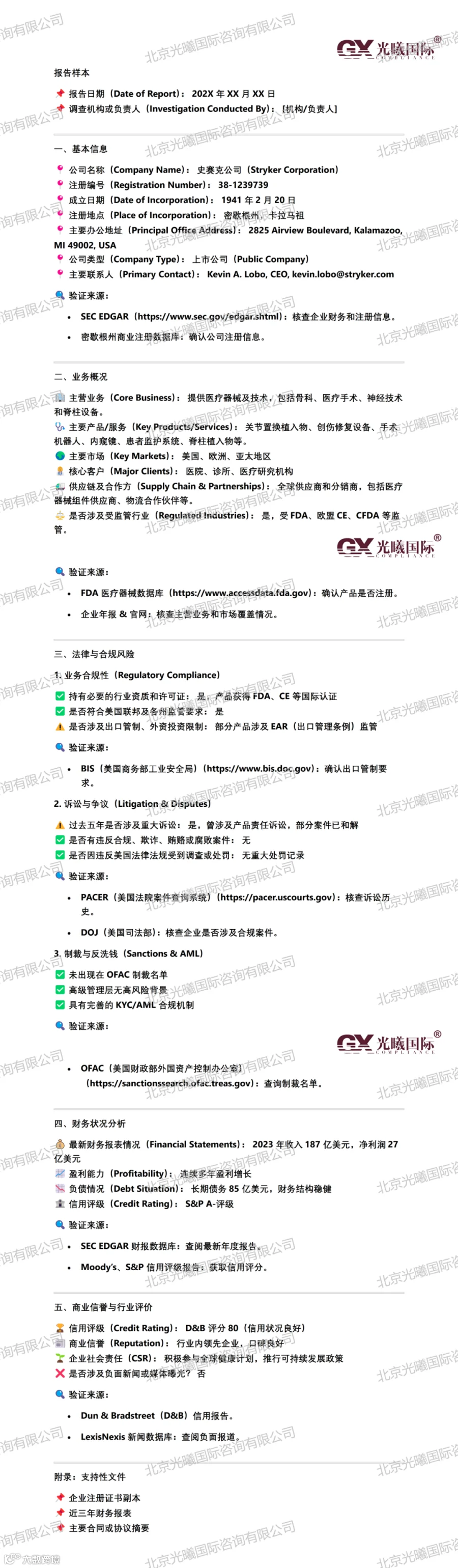
尽调报告样例(美国企业)
For instance, custom-designed risk metric dashboards assess and assign risk levels to target entities.

(Risk Metric Dashboard)
The expert team shall propose response recommendations.
 (Samples of Risk Alerts and Compliance Recommendations)
Whether the enterprise’s management develops strategic plans based on such recommendations, or investors refer to them for investment planning and post-investment management, parties may follow clear procedures in practice and translate the value of due diligence reports into tangible economic benefits and development momentum.
Annual Enterprise-wide Compliance Risk Review: When an enterprise undergoes internal restructuring, business transformation or strategic adjustment, management may gain clear visibility into the enterprise’s true status and identify potential risks and opportunities by conducting due diligence on internal business units, departments or assets. This provides data support for decisions including resource reallocation, business process optimization and organizational restructuring, thereby improving operational efficiency and competitiveness.
IPO Preparation: Where an enterprise prepares for an IPO, comprehensive due diligence shall be performed. This covers review and investigation of its business model, financial position, related-party transactions, corporate governance and other aspects to ensure compliance with securities regulatory requirements and listing standards.
M&A Due Diligence: When acquiring or merging with another enterprise, the due diligence report serves as a key tool to assess the value and risks of the target company. It fully discloses the target’s financial health, including assets, liabilities and cash flow, assisting the acquirer in determining a reasonable purchase price. Meanwhile, the report conducts in-depth analysis of the target’s legal status and business operations, enabling the acquirer to anticipate integration challenges and latent risks and supporting M&A decisions and post-transaction integration.
Investment Decision-Making: For investors, due diligence reports are indispensable for venture capital, private equity or strategic investments. Through comprehensive due diligence on investee companies, investors may evaluate financial and business factors including profitability, growth potential and market competitiveness, as well as the competence and reputation of management teams and industry outlook. This assists investors in gauging the likelihood of investment returns and risk levels, so as to determine whether to invest, together with the investment amount and terms.
Commercial Cooperation: When seeking business partners, enterprises shall leverage due diligence reports to gain in-depth insights into counterparts’ strengths, weaknesses, business models and strategic objectives, and assess mutual complementarity and synergy potential. This ensures resource sharing and complementary advantages for joint market expansion and prevents cooperation failures arising from information asymmetry.
Other business scenarios requiring due diligence.
Legal and Compliance Due Diligence (Enterprise Identity Verification and Adverse Media Check)
⚕️Entity Qualification Verification: Verify the entity’s registration documents, business license, articles of association and other materials to confirm its valid incorporation and subsistence, ensure lawful operating capacity, and identify no material legal disputes or litigations that may affect cooperation.
⚕️Contract Review: Review the entity’s material contracts, including procurement contracts, sales contracts and cooperation agreements, to assess their legality, validity and potential risks. For example, verify whether contract clauses clearly set forth the rights, obligations and liability for breach of contract of both parties.
⚕️Sanctions Review: This process ensures that the entity does not transact with sanctioned parties to avoid severe legal consequences and financial losses arising from violations of U.S. sanctions regimes, and safeguards corporate reputation and stable operations. Violations may result in substantial fines, business restrictions or even criminal penalties.
⚕️Anti-Money Laundering (AML) Review: Grounded in statutes including the Bank Secrecy Act, Money Laundering Control Act and USA PATRIOT Act, it requires financial institutions and designated non-financial institutions to establish AML compliance programs and fulfill obligations such as customer identification, transaction recordkeeping and suspicious activity reporting.
⚕️Intellectual Property: Investigate the entity’s intellectual property rights including patents, trademarks and copyrights, confirm their lawful ownership, and assess IP value and potential infringement risks. Examples include verifying patent validity periods and trademark registration scopes.
⚕️Labor Law Compliance: Review the entity’s employment contracts, employee handbooks and other documents to verify compliance with labor laws and regulations governing wage payment, working hours, benefits and other matters, and assess potential labor dispute risks.
⚕️Adverse Reputational Records: Review whether the entity has prior violations and adverse records to help mitigate potential risks.
⚕️Contract Compliance Recommendations: Identify material potential risks and propose advice on contracts with the reviewed party to meet U.S. local performance requirements.
⚕️Other Reviews: Review of other key matters relevant to the United States.
Legal and Compliance Due Diligence + Financial Due Diligence (Private Companies to Cooperate in Document Production) + Commercial Due Diligence (Private Companies to Cooperate in Document Production)
⚕️Asset Inventory: Conduct comprehensive inventory and valuation of the entity’s fixed assets, current assets and other assets to verify their authenticity, completeness and accurate valuation. For instance, perform physical counts of fixed assets to confirm their existence and condition, and send confirmations for accounts receivable to verify recoverability.
⚕️Financial Statement Analysis: Review the target entity’s financial statements including balance sheets, income statements and cash flow statements to analyze its financial position, profitability, solvency and operational efficiency. For example, calculate financial ratios such as solvency ratios and activity ratios to assess the entity’s financial health.
⚕️Tax Review: Examine the entity’s tax records to verify compliance with tax laws and assess potential tax risks. This covers payments of corporate income tax, value-added tax, property tax and other taxes, as well as any tax disputes or outstanding tax matters.
⚕️Market Analysis: Study the industry and market where the target entity operates, including market size, growth trends and competitive landscape, to assess the entity’s market position and competitiveness. For example, analyze the impact of industry trends on its future business, together with its market share and competitive advantages.
⚕️Operations & Management: Understand the entity’s organizational structure, management team and internal control systems to assess its management capability and operational efficiency. Examine its decision-making mechanism and risk management measures to ensure operational stability and sustainability.
⚕️Supply Chain Management: Investigate the entity’s suppliers and customers to assess supply chain stability and reliability. Review its business relationships with suppliers and customers, as well as potential supply disruption risks.
