



Robotics Workshop at Bonny Doon on October 6, 2026
by Bill Russo
On October 6, I had the opportunity to join a spirited discussion on Economics, Geopolitics and Robotics Strategy with Howard Chao, Rebecca Fannin, Sydney Volanski, and Adam Raviv. My thanks to Howard and Doon Insights for bringing us together, and to my fellow panelists for a discussion that went well beyond the technology itself.
The central question for me was not whether artificial intelligence and robotics will transform the global economy. That increasingly seems inevitable. The more consequential question is who will successfully commercialize these technologies at scale—and therefore capture the economic value they create?
We have seen this movie before.
Invention creates possibilities. Commercialization creates industries.
The electric vehicle revolution offers an important lesson. Many of the foundational technologies behind the modern EV were not invented in China. But China built an industrial ecosystem capable of integrating batteries, electric motors, power electronics, software, digital services and advanced manufacturing—and then driving their costs down through extraordinary competitive intensity.
That distinction matters.
Innovation is too often treated as synonymous with invention. But invention is only the beginning. Commercialization is itself a form of innovation. It requires supply chains, manufacturing know-how, infrastructure, customers, capital and, critically, sufficient deployment volume to move rapidly down the cost and learning curves.
China has become exceptionally good at this.
Its competitive advantage is increasingly its ability to take technologies that are technically possible and make them commercially viable, affordable and scalable. We have seen this pattern in electric vehicles, batteries, solar panels, drones, consumer electronics and digital commerce. Robotics and embodied AI may be next.
The strategic lesson from the EV industry is therefore straightforward: the country that invents a technology does not automatically become the country that captures its largest economic opportunity.
The Third Wave of Automobility
I view robotics through the framework of what I call the three waves of the Automobility Revolution (See my recent article titled China Is Entering the Third Wave of the Automobility Revolution).
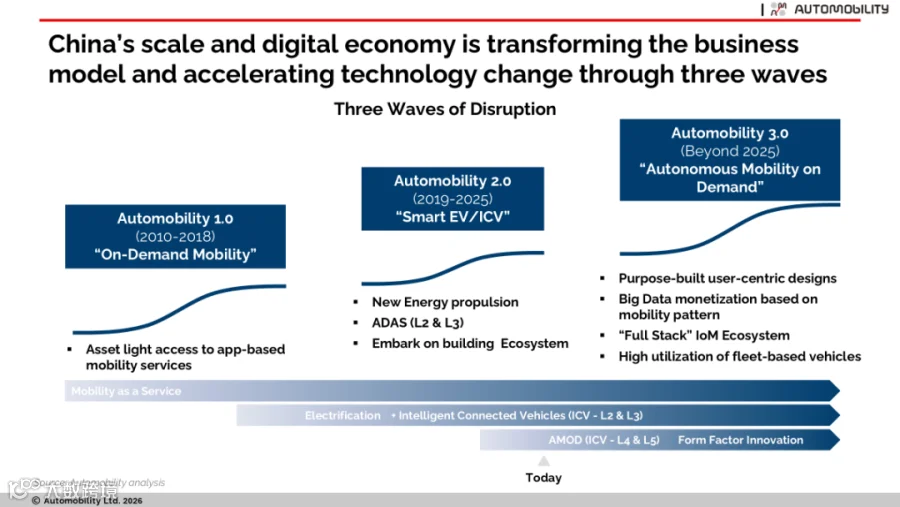
The first wave was enabled by the mobile internet. Smartphones, connectivity and digital platforms transformed how consumers accessed mobility. Ride-hailing and shared mobility demonstrated that digital platforms could reorganize an industry without necessarily manufacturing its core physical asset.
The second wave transformed the vehicle itself. Electrification combined with connectivity, software and increasingly sophisticated computing turned the automobile from a mechanical product into a smart device. China emerged as the center of gravity of this wave because it developed not simply EV companies, but an entire ecosystem surrounding batteries, electronics, software, intelligent cockpits, advanced driver assistance and digitally integrated manufacturing.
We are now entering a third wave: Physical AI, or the era of Autonomous Mobility on Demand.
Artificial intelligence is leaving the digital world and entering the physical one. Machines are gaining the ability to perceive their surroundings, interpret information, make decisions and take actions. Autonomous vehicles are one manifestation. Humanoid and industrial robots are another.
And there is a very direct connection between the second and third waves.
A smart EV is already a robot on wheels.
It combines batteries, motors, actuators, sensors, cameras, computing, communications, AI models and sophisticated software inside a mass-produced physical platform. The industrial capabilities required to build intelligent vehicles therefore provide much of the foundation required to build other intelligent machines.
This is why I believe it is a mistake to analyze the robotics race independently from what has happened in the automotive industry. Each wave builds the foundation for the next.
Scale is part of the innovation process
China's most important advantage may not be any individual technology. It is the feedback loop created by its industrial system.
Policy establishes direction. Supply chains provide manufacturing capacity. Infrastructure enables deployment. Intense competition drives companies to innovate while relentlessly attacking cost.
The resulting cycle is powerful:
Deploy. Learn. Improve. Lower cost. Deploy more.
Real-world deployment therefore becomes part of the R&D process.
We are already seeing this dynamic in autonomous driving, where Chinese companies are accumulating enormous amounts of experience across increasingly sophisticated assisted-driving and autonomous systems. We are seeing it in factories, where robotics companies can work directly with automotive and electronics manufacturers to deploy machines in real production environments.
The race in Physical AI will ultimately not be won by demonstrations alone. The question is whether intelligent machines can perform useful work at an economically compelling price.
That puts commercialization economics at the center of the robotics competition.
America’s commercialization challenge
The United States enters this competition with formidable advantages. It leads in many of the foundational technologies of artificial intelligence, including advanced computing, software, frontier models, semiconductor design and venture-backed entrepreneurship.
My concern is what I described during our discussion as the risk of a “gentrified” commercialization model.
America has become very good at building sophisticated technology for customers capable of paying premium prices. That can support excellent businesses. But it can also constrain the addressable market and slow the learning that comes from high-volume deployment.
Imagine a highly capable American robot that costs several times as much as a Chinese alternative. The American product may initially have superior intelligence or performance. But if the Chinese product reaches factories, warehouses, hospitals and businesses in far greater numbers, its manufacturer begins accumulating operating data, customer feedback, production experience and cost advantages much faster.
The technology gap can then narrow while the commercialization gap widens.
This is why simply separating American technology companies from China's industrial ecosystem carries risks of its own. Every AI system that enters the physical world suddenly requires something the digital economy could sometimes ignore: atoms. Motors. Batteries. Sensors. Actuators. Magnets. Electronics. Manufacturing equipment. Factories. Logistics.
Physical AI brings supply chains back to the center of technology strategy.
We could therefore find ourselves in the paradoxical position of leading in intelligence while struggling to scale its application.
Build global companies from the beginning
That leads to what I believe is one of the most important strategic implications for American startups.
The question cannot simply be: Where do we raise capital?
Founders also need to ask: Where do we manufacture? Where do we deploy? Where do we learn? And how do we reach customers around the world?
For some companies, offshore partnerships can provide access to manufacturing expertise, supply chains and markets that would be difficult or prohibitively expensive to recreate independently.
That does not mean ignoring geopolitical risk. Quite the opposite. It means designing the company around it.
Regional operations, clearly defined intellectual-property rights, controlled access to technology and data, diversified supply chains and alternative manufacturing pathways all need to become part of corporate architecture. I think of this as geofencing geopolitical exposure: designing a business so that disruption or regulation in one geography does not incapacitate the entire enterprise.
Simply establishing an offshore legal entity does not accomplish this. Export controls, investment restrictions and technology rules can follow ownership, intellectual property and people across borders. The objective must be to create lawful, transparent and resilient pathways into multiple markets.
In the Physical AI era, the structure of the company may become almost as strategic as the architecture of its product.
Give innovation a pathway to scale
The discussion in Bonny Doon reinforced for me that we are entering a consequential phase of the technology competition.
The first wave connected people to mobility. The second transformed the automobile into an intelligent device. The third will take intelligence into the physical world.
For entrepreneurs, investors and policymakers, I would reduce the challenge to three questions:
Does the technology do useful work? Can we make it affordable at scale? Have we built the partnerships and organizational structure necessary to reach the world?
The EV experience demonstrates what happens when technology encounters an industrial system capable of rapidly commercializing it. We should study that experience carefully rather than assuming leadership in invention guarantees leadership in the resulting industry.
The opportunity presented by robotics and Physical AI is far larger than any single national market. Capturing it will require technological leadership, but also manufacturing capability, cost discipline, global deployment and organizational resilience.
For American startups, the challenge is to build world-class intelligence—and an organization structured to put it to work around the world.
My thanks again to Howard Chao, Rebecca Fannin, Sydney Volanski and Adam Raviv for a lively and thought-provoking discussion. The debate around robotics is often framed as a technology race. I came away even more convinced that it is also an economics, industrialization and globalization race—and those dimensions may ultimately determine who wins.
About Bill Russo
Bill Russo is the Founder and CEO of Automobility Ltd , and is currently serving as the Chairman of the Automotive Committee at the American Chamber of Commerce in Shanghai. His over 40 years of experience includes 15 years as an automotive executive with Chrysler, including 22 years of experience in China and Asia. He has also worked nearly 12 years in the electronics and information technology industries with IBM and Harman. He has worked as an advisor and consultant for numerous multinational and local Chinese firms in the formulation and implementation of their global market and product strategies. Bill is a contributing author to the book Selling to China: Stories of Success, Failure, and Constant Change (2023), where he describes how China has become the most commercially innovative place to do business in the world’s auto industry - and why those hoping to compete globally must continue to be in the market.
Contact Bill by email at bill.russo@automobility.io
About Automobility
Automobility Limited is global Strategy & Investment Advisory firm based in Shanghai that is focused on helping its clients to Build and Profit from the Future of Mobility. We help our clients address and solve their toughest business and management issues that arise in midst of fast changing, complicated and ambiguous operating environment. We commit to helping our clients to not only “design” the solutions but also raise or deploy capital and assist in implementation, often together with our clients.
Contact us by email at info@automobility.io