
←可左右滑动以切换中英文→
Note: Swipe left/right to switch between languages
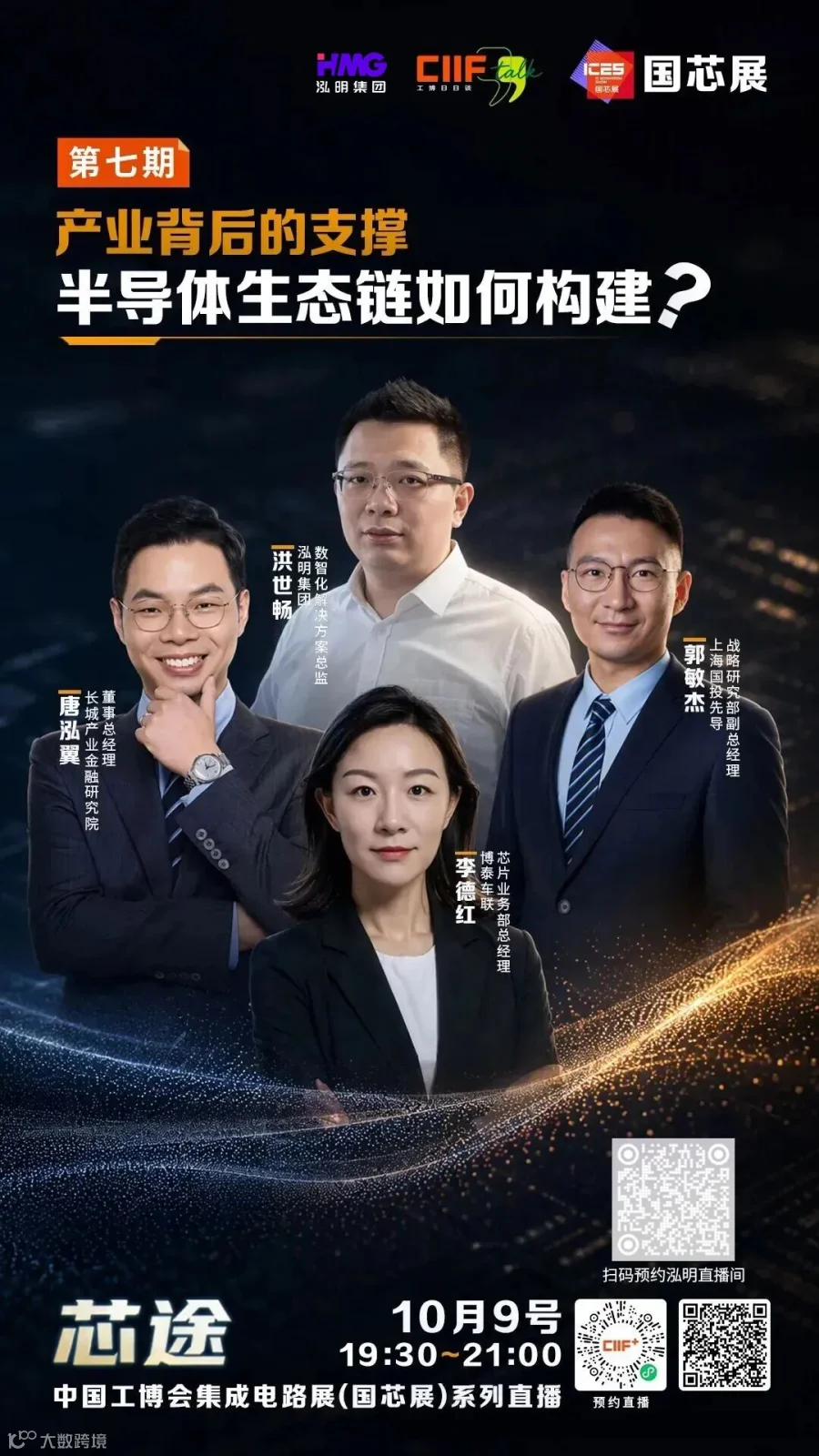
10月9日,国芯展系列直播迎来收官场,主题聚焦“半导体生态链的构建”。博泰车联芯片业务部总经理李德红、上海国投先导战略研究部副总经理郭敏杰、长城产业金融研究院董事总经理唐泓翼、泓明集团数智化解决方案总监洪世畅四位嘉宾,分别从产业应用、资本投资、行业研究、供应链服务四个维度展开交流。

洪世畅认为,半导体产业非常特殊,竞争不是某一个产品、某一项技术的竞争,而是整个产业生态的竞争。国际半导体从IDM模式走向高度分工、全球协同。对中国来说,可借鉴的思路是“1米宽,百米深”——做深,而不是简单做全。制造环节做得足够深,IC设计企业才能轻资产、快速成长,形成协同分工的生态。

洪世畅根据自己长期深耕跨境半导体供应链经验。他说,供应链是半导体产业中的隐形配套环节,容易被忽略,但投资小、见效快。数字化做得好,配套产业起来,对营商环境和产业生态发展都有极大好处。

洪世畅表示,现在半导体公司没有不用AI的。最先落地的是数据密集型场景,比如数据分析、封测、供应链管理。但他反复强调:AI一定要和大数据连起来说。 数据标准不统一,AI就会产生歧义甚至幻觉。比如“原产国”,有的单证写“产地”,有的写“COO”,必须让AI知道是同一个东西。所以要建数据层、标准层、语义层,让AI听懂行业的话。
“不是把行业的话说给人听,而是要让AI听懂这个行业的话。”跳过地基直接套AI,最后补功课的代价会非常大。

谈到技术领先与商业成功,洪世畅认为,从单一公司看短期不一定,但拉长时间、放到产业生态里,足够领先的技术基本会兑现,只是时间和大小问题。对半导体初创企业,技术研发非常重要,但不要闭门造车,要融入半导体产业生态,利用标准和数据打通,和大家一起合作共建产业链。
同台嘉宾郭敏杰也从资本角度补充,国资基金是耐心资本,要培养一整片森林;唐泓翼则用“种子与土壤”比喻单点技术与产业体系,并强调终端品牌对供应链话语权的牵引。

直播之外,泓明也将在展会现场与产业同仁面对面交流。10月12日至16日,第二十六届中国国际工业博览会·集成电路展(国芯展)将在国家会展中心(上海)5.2H馆举办。泓明将携全链路恒温避震包装运输一体化方案、供应链数字孪生解决方案、贸易合规智能体、《集成电路制造与封测设备零部件归类指南》 等创新成果亮相5.2H-B021展位,并于展会现场举办产品发布会集中发布上述成果。
展会期间,泓明还将带来 《AI时代半导体供应链的挑战与应对》 主题演讲,分享前沿洞察与实践思考。展位全天候开放,通过有奖活动、互动演示、专人讲解等形式集中介绍泓明核心服务优势。10月12日至16日,欢迎莅临国家会展中心(上海)5.2H馆泓明展位5.2H-B021,现场交流洽谈。
On October 9, the IC China live series wrapped up with a session on “Building a Semiconductor Ecosystem.” David Hong, Product Director at HMG Group—shared views on industry applications, capital investment, industry research, and supply chain services.


Semiconductor Competition Is Ecosystem Competition
David Hong said semiconductors are unique: competition is not about one product or technology, but the whole ecosystem. Global semiconductors have moved from IDM to highly specialized, globally coordinated models. For China, the takeaway is “one meter wide, one hundred meters deep”—go deep, not merely broad.

Drawing on his cross-border semiconductor supply chain experience, David Hong said supply chains are an invisible support link, easily overlooked but low-investment and fast-acting.

David Hong said no semiconductor company today does not use AI. The first use cases are data-intensive: data analysis, packaging and testing, and supply chain management. But he stressed: AI must be discussed together with big data. Without unified data standards, AI creates ambiguity or hallucinations. For example, “country of origin” may appear as “origin” or “COO”; AI must know they mean the same. So we need data, standards, and semantic layers to let AI understand industry language.

On tech leadership vs. commercial success, David Hong said a single company may not see it short term, but over time and within an ecosystem, sufficiently advanced tech generally pays off—it is a matter of when and how much. For semiconductor startups, R&D is vital, but do not work in isolation; join the ecosystem, use standards and data, and build the chain together.

Beyond the livestream, Hongming will meet industry peers at the expo. From October 12–16, the 26th China International Industry Fair · Integrated Circuit Exhibition (IC China) will be held at Hall 5.2H, National Exhibition and Convention Center (Shanghai). Hongming will showcase innovations at Booth 5.2H-B021, including an integrated temperature-controlled, shock-absorbing packaging and transport solution, a supply chain digital twin solution, a trade compliance AI agent, and the Guide to Classification of Parts and Components for IC Manufacturing and Packaging/Testing Equipment, with a product launch at the booth.

 编辑 | 泓明数字营销部
声明:本公众平台发布内容(文字、图片及影音等素材)部分来源于网络,转载内容不代表本平台观点,如涉及版权请直接与我们联系。