▪
The level of happiness or well-being the citizens of a country are enjoying is called its standard of living.
It is the quality of life of people of a country. Economists use different methods to measure the standard of living of people of a country. These methods include per capita income, Net Economic Welfare (NEW), Measurable Economic Welfare (MEW), Human Development Index (HDI), Multi-dimensional Poverty Index (MPI) and many more.
In this article, we will discuss Human Development Index (HDI) in detail.
What is Human
Development Index?
Human Development Index is a statistical tool developed by the United Nations to measure the economic and social well-being of the people of a country by considering their health, education and standard of living. Human Development Index is abbreviated as HDI.
It is also called human growth index, which is used to gauge and compare the level of human development within and between countries. HDI is a composite measure which considers three indicators of economic development (health, education and income).
HDI Values
The HDI value of a country can be from 0 to 1. The HDI values vary between countries based on their HDI dimensions or indicators. Every year, the United Nations publishes HDI value of 193 countries along with their HDI rankings. There are four levels of HDI values, which are given below:
1. Low Human Development (HDI is less than 0.550)
2. Medium Human Development (HDI is from 0.550 to 0.699)
3. High Human Development (HDI is from 0.700 to 0.799)
4. Very High Human Development (HDI is 0.800 or more)

Dimensions and Indicators of HDI
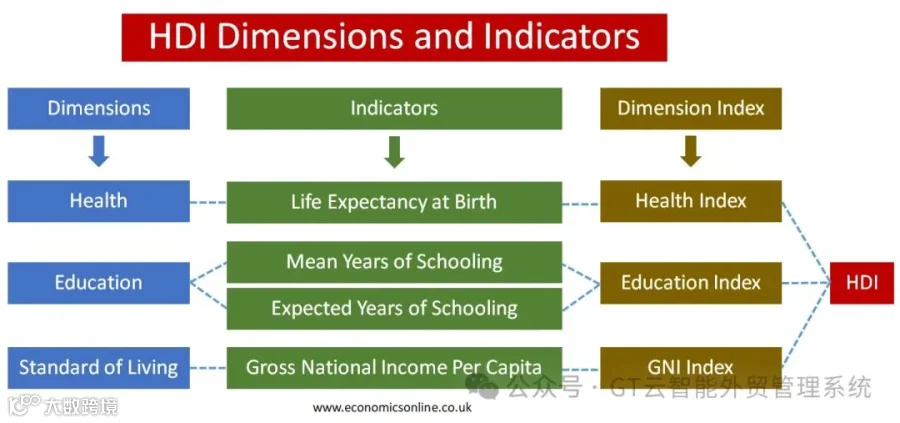
The three dimensions and four indicators of HDI are illustrated in the diagram below: These are given a weight of one-third each.
The Health Dimension
The health dimension in HDI, means living a long and healthy life. It is indicated and measured by life expectancy at birth. Life expectancy means the expected life of an individual to live in a specific country.
Life expectancy is an important part of HDI that explains the expected life of an individual from birth until death that he is going to spend as a part of the population of that country.
The Education Dimension
The education dimension in HDI means the level of knowledge people acquire in a country. This has two indicators: mean years of schooling and expected years of schooling.
The mean year of schooling is used to measure the average number of years of education gained by adults of age 25 and above. And the expected year of schooling is used to measure the expected number of years of schooling a child is going to receive.
The Standard of Living Dimension
The standard of living dimension in HDI means, enjoying a decent standard of living and quality of life in a country. The standard of living is measured by using the gross national income per capita (GNI per capita).
GNI per capita means the average income of an individual living in a county. Based on this, the GNI index is calculated, which accounts for one-third in the calculation of HDI.
Conclusion
In conclusion, HDI is the most popular summary measure of human development. It is used to compare the development levels within and between countries.
This human development index is used by governments to evaluate their own progress within a particular time period. The human development index value explains the health of a country’s well-being.


Click the blue word to follow us

NEWS
”
Long press scan code to consult more data management issues ~