


▪
Effective time management does not come naturally.
For that reason, time management books, techniques, and software are a dime a dozen.
When guiding your busy executive clients or anxiety-driven patients on a path to better time management, you might not just be spoiled for choice, but overwhelmed.
So, rather than jumping into the deep end, start with this post, where we’ll give you a user-friendly overview of time management literature.

The Importance of
Time Management
Our time and energy are finite. We need to divide them adequately across several responsibilities and use them to look after ourselves, our families and our friends and attend to work-related tasks.
Selecting time management strategies
In the earlier definition of time management, we mentioned three core components: structure, protection, and adaptation.
▪Structure refers to how our time is perceived, measured, and allocated.
▪Protection is how we protect our time from being wasted, misdirected, or deviated from our plans.
▪Adaptation refers to how well we can cope with unexpected tasks or surprises.


There are seven methods that can help you, and we have selected two detailed descriptions here.
Strategy 1: Steer Away From Perfectionism
Being overly concerned with a perfect product/outcome can quickly derail the best-laid plans. Perfectionism is a maladaptive behavior characterized by extreme self-criticism, fear of making mistakes, self-doubt, and impossible standards.
Perfectionists experience little pleasure in their professional and personal lives because they are overly concerned with their performance and are at higher risk of procrastination, psychological distress, and several psychological syndromes.
They often repeat actions, circumnavigating around an unattainable goal, ultimately wasting time that could have been redirected toward other tasks .

the following are recommended to help overcome perfectionism.
▪Perfectionists rely on binary thinking models (right–wrong) and have a low tolerance for mistakes. Help your client recognize that a project will never be perfect, adopt a kinder inner voice, and schedule time for feedback.
▪Break tasks into smaller, attainable goals with clear expectations when setting goals.
For example, the first goal is to produce a draft version containing mistakes but with the correct structure. For the second goal, the client can focus on refining the piece and attending to typos.
▪“Perfect” work is unattainable, and “perfect” is typically poorly defined.
Instead, identify the core aspects of the project that will have the most impact and achieve the same outcome as a perfect one. Focus on these aspects rather than the less important ones.
Strategy 2:Determine Priorities
Not all tasks are equally important or urgent
Knowing which tasks are the most important and giving these higher priority and more focus is vital. An example of poor prioritization is when a project due in one week is overlooked for a project due in three.
Eisenhower Matrix
One helpful way to determine priority is to use the Eisenhower Matrix. Tasks are split across two dimensions: importance and urgency.
To classify tasks, start with the due date and work backward from high urgency to low urgency. Urgency refers to the immediacy of the task deadline. Under a heading of urgency, tasks that are due soon are urgent, and tasks with later deadlines are not urgent.
Then, add an additional classification to each task: importance. Evaluate the importance of each task by looking at its impact and contribution to long-term goals. Tasks that contribute to essential goals have high importance, whereas those that don’t contribute are not important.
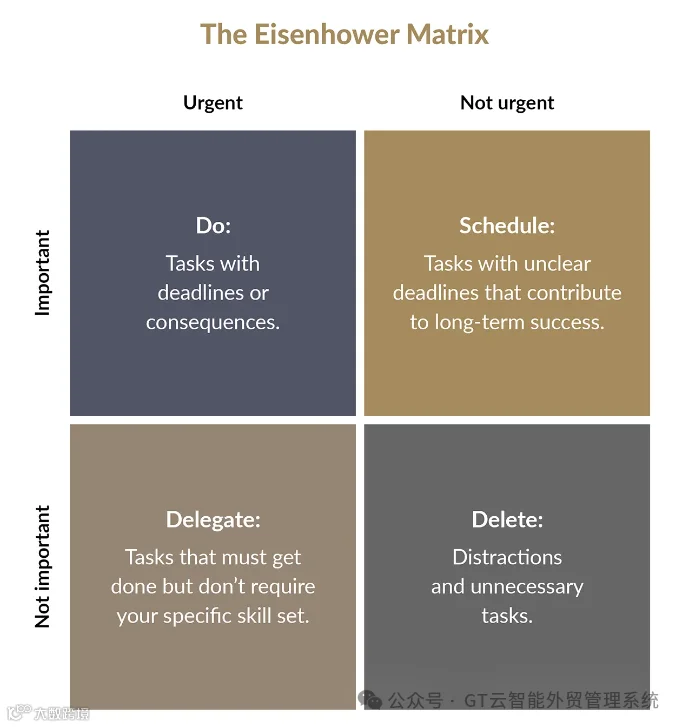

Consequently, all tasks will be allocated as urgent or not and also classified as either important or not important.
Conclusion
Time management plays a crucial role in our daily lives, shaping our productivity, effectiveness, and overall well-being.
As we wrap up our discussion on helping clients with time management, remember that every individual has unique challenges and priorities.
By offering personalized strategies, tools, and support, we empower our clients to make the most of their time and achieve their goals. Whether it's setting priorities, delegating tasks, or implementing efficient workflows, the journey to better time management is a collaborative one.
Let's continue to guide and inspire each other to unlock our full potential and make every moment count.



Click the blue word to follow us

NEWS
”
Long press scan code to consult more data management issues ~