


点击“蓝字”关注我们


云南,不止是一个名词,
更是永不厌倦的风景~
位于中国西南,
与缅甸、泰国、越南接壤。
昆明是云南的省会,四季如春,
故名“春城”。
在云南,
闲看花开花落、慢观云卷云舒~~


The construction of Chongsheng Temple was initiated during the Kaiyuan Period of the Tang Dynasty and reached its peak in the Period of the Kingdom of Dali during Song Dynasty after generations of extension with the good reputation of “the Capital of Buddhism”, and its capital Dali was once known as “the Elysian Land of Buddism”.

Buddhism exerted a long and lasting influence in the Dali region, 9 of 22 kings of Dali abdicated the throne to become a monk, and the 11th King of Nanzhao established Buddhism as the state religion and many Dali kings continued the tradition. which made it for a time the well-known royal monastery and political and educational center during the Kingdom of Dali kingdom Period.

During the Nanzhao kingdom period, the king and the prince Shwenadaw of Pyū kingdom(Myanmar) have been to Chongsheng Temple to worship the Buddha and pray, as well as the king of Sayam kingdom(Thailand) during the Dali kingdom Period. At that time, Chongsheng Temple was a well-known Buddhist sanctuary in Southeast Asia and South Asia.

Many marvelous artworks such as architecture, pagodas, paintings, music, and dances popped up during the Dali Kingdom and Nanzhao Kingdom periods. The famous Scroll of Buddhist Images - Zhang Shengwen was also finished in this period, which was known as the two superbness of China with the Riverside Scene at Qingming Festival.

也是金庸小说《天龙八部》中的天龙寺
The magnificent Chongsheng Temple is also famous as Three Pagodas in the Diary of the Trip to Yunnan written by Xu Xiake and Tianlong Temple in the Semi-gods and Semi-evils written by Jin Yong.
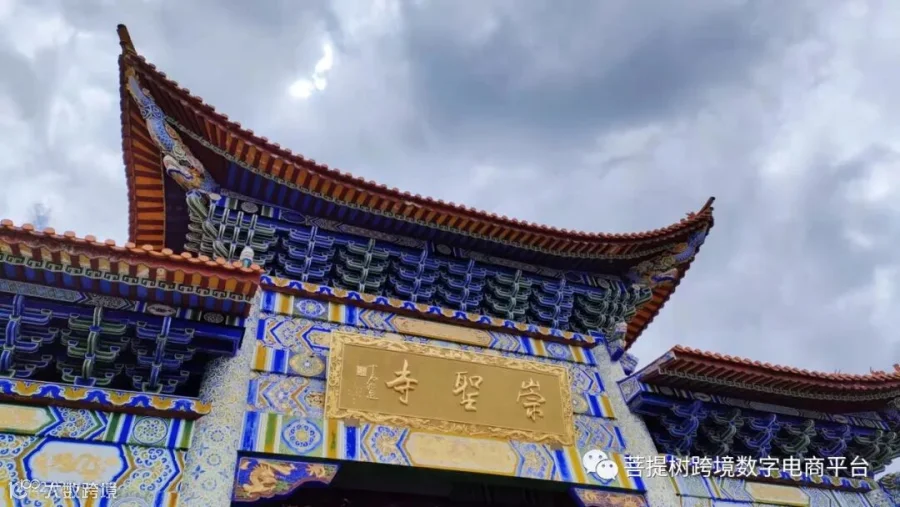
崇圣寺三塔
The three Pagodas are the symbol of the Nanzhao civilization, and also the landmark of the Chongsheng Temple. The main pagoda is called Qianxun. It is said that it was completed about the year 840 AD by a Nanzhao King named Quan Fengyou. It is 16 stories, stands 69.13 meters (227 feet) high, and it is one of the tallest pagodas of China's best-preserved buildings from the time of the Tang Dynasty.
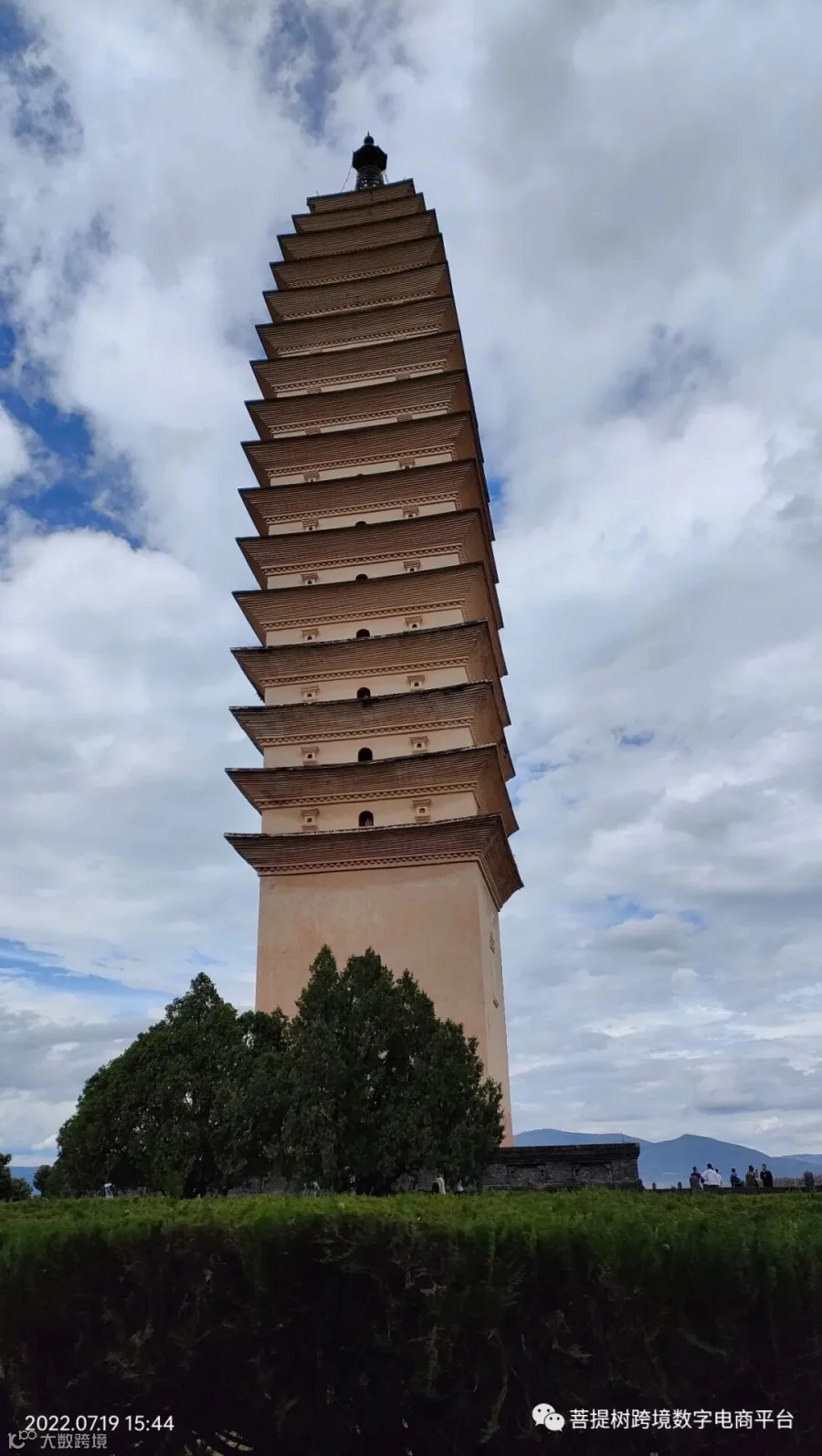
The other two pagodas were built about 100 years later. The smaller pagodas' architectural style is more similar to that of Song Dynasty pagodas. They each have ten stories, are slimmer, and are about 42 meters high or about 140 feet tall, which stand about 97 meters away from each other, arranged on the corners of an equilateral triangle with the main tower.

The Three Pagodas are well known for their resilience; they have endured several man-made and natural catastrophes over more than one thousand years. Their mother building was known as Chongsheng Temple and was once the royal temple of the Kingdom of Dali. It was recorded that Qianxun Pagoda had been split in an earthquake in 1514 AD (Ming Dynasty). However, it miraculously recovered ten days later in an aftershock.

The Jianji Bell Tower of Nanzhao got the name because the bell was cast in 871AD, the 12th Jianji Year. As one of the sixteen wonders of Dali, its sound can be heard 80 li away. The bell tower is 19.97 m high and boasts to be the first biggest bell in Yunnan Province.

In the middle of Acarya Avalokitesvara Pavilion which is a Tang-style triple-eave pavilion with a dais surrounded by woods, there is a 12m high figure of Acarya Avalokitesvara enshrined. The figure looks special in its appearance with a man-like body but a woman-like face. On the high-raised bun of the figure, there sits a statue of a dying Buddha, which embodies the characteristics of the early Indian Buddhist culture.

Acarya Avalokitesvara, as the leading Avalokitesvara of the Vajyavara of the Bai Nationality, can only be found in Dali. It is also called “Lucky star of Yunnan”, or “Dali Avalokitesvara”.

The Mahavira Hall is the hall of the highest level which is located in the middle of the temple. The light and spacious Mahavira Hall was constructed by imitating Taihe Palace of the Imperial Palace of Beijing. The Scroll of Buddhist Images - Zhang Shengwen was carved to a wood-carving long scroll of 1.8m in height and 117m in length and was enshrined in the 2.03m high and 119m long huge niche embedded in the inner walls of the hall with ingenuity, which made it the only wood scroll home and abroad.

The Three Pagodas were built in the Nanzhao kingdom period and later rebuilt in 2005, the whole architecture complex will cover an area of 600 mu. As one of the grand architectures with the longest history in south China, it is the symbol of Dali, which recreates the glamour of the Nanzhao and Dali kingdom.


E N D


 云南非遗长卷 | 白族扎染技艺