



Electrification transformed the automobile. Physical AI will transform what the automobile can do.
For much of the past decade, the global automotive industry has viewed China through the lens of electric vehicles. That framing is increasingly incomplete. Electrification remains important, but in China it is rapidly becoming the foundation for a much larger transformation. The competitive frontier is moving from how vehicles are powered toward how they perceive, reason, act and interact with the physical world.
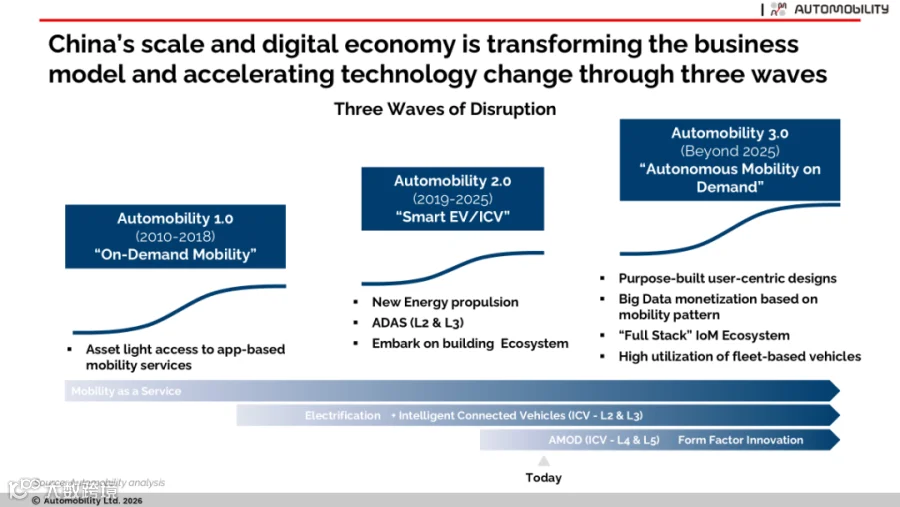
We have long described China's mobility transformation through the Three Waves of Automobility. The first wave changed how consumers access mobility. The second changed the automobile itself through electrification and intelligent connectivity. We are now entering the third wave, in which vehicles become increasingly autonomous, AI-defined machines capable of understanding and acting within the physical world. In today's terminology, Automobility 3.0 is becoming an important application domain for Physical AI.
The September 2026 market data provide a useful lens through which to view this transition. China's domestic passenger-vehicle market has weakened considerably, yet electrification continues to advance. The China Passenger Car Association (CPCA) estimated September passenger-vehicle retail sales at approximately 1.69 million units, down 24.6% year over year, while NEV retail was expected to reach approximately 1.11 million units. That would put NEV penetration at a record 65.7% of passenger-vehicle retail sales.
The apparent contradiction matters. China's automotive transformation is continuing even as its domestic market contracts. Growth is no longer the primary mechanism driving change. Substitution, hypercompetition, intelligence and globalization increasingly are.
From Three Waves of Automobility to Physical AI
The first wave, Automobility 1.0, emerged between roughly 2010 and 2018. Smartphones, mobile payments and China's digital economy enabled app-based mobility services at extraordinary scale. Companies such as Didi demonstrated that consumers did not necessarily need to own the asset to access mobility. This was fundamentally a business-model disruption: digital platforms connected users with vehicles and drivers, changing how transportation could be consumed.
The second wave, Automobility 2.0, moved the disruption into the vehicle. Electrification, intelligent connected vehicles and increasingly capable ADAS transformed both vehicle architecture and the industry's competitive structure. China developed enormous capabilities in batteries, electric powertrains, electronics, digital cockpits and intelligent-driving technology. Just as importantly, it created an ecosystem of automakers, technology companies and suppliers operating with development cycles and innovation speeds fundamentally different from the traditional automotive model.
We are now moving into Automobility 3.0. We originally described this third wave as Autonomous Mobility on Demand, enabled by higher levels of autonomous driving, purpose-built vehicles, fleet economics and the monetization of mobility data. Those elements remain valid, but advances in artificial intelligence now give us a broader way to understand what is happening.
The Third Wave is the convergence of Automobility and Physical AI.
Physical AI takes artificial intelligence beyond the digital world. Instead of simply generating text, images or predictions, AI systems perceive their physical environment, reason about what is happening, make decisions and take actions in the real world. That requires sensors, computing, multimodal AI models, actuators and continuous learning working together as an integrated system.
An intelligent vehicle is one of the most sophisticated Physical AI platforms imaginable. It must interpret cameras, radar and potentially lidar; understand roads, objects and human behavior; predict what other participants will do; plan a safe path; and translate those decisions into acceleration, braking and steering—all continuously and in real time.
The automobile is therefore evolving from a mechanically defined transportation product into an embodied intelligent machine.
That is the deeper meaning of the Third Wave.
Electrification created the platform for Physical AI
This also helps explain why electrification matters even after EVs cease being novel. The EV revolution did much more than replace an internal-combustion engine with batteries and electric motors. It helped drive centralized electrical architectures, electronic control systems, high-performance computing, software-defined functionality and digital interfaces deeper into the automobile.
Those capabilities form much of the technical foundation required for Physical AI.
At nearly two-thirds NEV penetration, China is reaching a point where electrification itself increasingly becomes table stakes rather than the primary source of differentiation. The competitive question therefore shifts from "Who can build a compelling EV?" toward "Who can build the most intelligent machine?"
This is why the transition we have described as From Electrification to Intelligence is so important. The battery established a new vehicle architecture. Intelligence determines what can be built on top of it.
Competitive advantage increasingly migrates toward computing, AI models, sensor fusion, intelligent driving, software, digital experience, data and the ability to continuously improve vehicle capabilities. Automobility 2.0 created the hardware and software platform. Automobility 3.0 adds perception, reasoning and agency.
Hypercompetition is accelerating the Third Wave
China's slowing domestic market may actually accelerate this transition. When an industry is growing rapidly, many competitors can expand simultaneously. When the market contracts, companies increasingly must take share from one another. That changes the competitive mathematics and intensifies pressure on price, cost, technology, product cadence and differentiation.
September's company results illustrate how aggressively the field continues to evolve. BYD sold 463,561 NEVs, up roughly 17% year over year. Geely sold 292,168 vehicles, while Leapmotor delivered 105,656, up 59%. NIO delivered 37,408 vehicles, XPeng delivered 41,256, and Xiaomi EV exceeded 40,000. The companies competing for China's future are no longer differentiated simply by whether they offer electrified vehicles.
Increasingly, they are competing over how intelligent those vehicles can become and how quickly intelligence can improve.
This is where China's ecosystem becomes particularly important. Huawei brings computing, software and intelligent-driving capabilities. Xiaomi brings AI, consumer electronics and an enormous connected-device ecosystem. BYD combines batteries, semiconductors, vehicle manufacturing and vertical integration. Geely operates multiple platforms and brands across different segments. CATL continues to reshape battery technology, while companies such as Momenta and Horizon Robotics provide critical technologies for intelligent driving and computing.
The competitive unit increasingly becomes the ecosystem rather than the individual automaker.
China's often brutal automotive hypercompetition therefore functions as an evolutionary mechanism. Companies that cannot maintain the necessary technology, cost and development velocity lose ground. Those that survive are being stress-tested in arguably the world's most demanding automotive marketplace before taking those capabilities overseas.
The automobile is only the beginning
The connection to Physical AI also expands the significance of China's automotive ecosystem beyond cars.
An autonomous vehicle and a humanoid robot face many of the same fundamental AI challenges. Both must perceive an unpredictable physical environment, understand spatial relationships, anticipate human behavior, make decisions and translate those decisions into safe physical actions. The form factors and use cases differ, but many of the enabling technologies—sensors, chips, batteries, motors, actuators, AI models, simulation, data and edge computing—overlap.
This helps explain why the boundaries between China's automotive, technology and robotics industries are beginning to blur. Companies and supply chains built around intelligent electric vehicles possess capabilities that can increasingly migrate into robotics, autonomous logistics, industrial automation and other embodied-AI applications.
The strategic implication is significant. China's automotive industry may be doing for Physical AI what its smartphone industry did for the mobile internet: creating scale, supply chains, engineering capabilities and a massive deployment environment from which adjacent applications can emerge.
The car may therefore be the first mass-market Physical AI device—not the last.
Globalization becomes the transmission mechanism
The other striking feature of 2026 is that China's automotive capabilities are increasingly moving beyond its domestic market. Through August, China had exported approximately 7.15 million vehicles, already exceeding its full-year 2025 total. NEVs accounted for approximately 3.44 million of those exports, compared with a much smaller share only several years ago. Chinese companies increasingly need international markets not simply as incremental opportunities, but as a structural component of their growth model.
September reinforced that trend. BYD sold approximately 180,700 vehicles overseas, equivalent to almost 40% of its passenger-vehicle volume. Geely exported more than 100,000 vehicles during the month, while international sales are becoming meaningful even for younger companies such as Leapmotor.
But viewed through the Third Wave framework, focusing only on vehicle exports misses the larger story. What ultimately globalizes is not simply the vehicle, but the capability stack behind the vehicle.
The progression begins with exports, moves toward local distribution and assembly, and eventually toward localized manufacturing, supply chains, engineering and technology ecosystems. Batteries, electrical architectures, intelligent-driving systems, software platforms and AI capabilities increasingly travel with that globalization.
This is why relationships such as Volkswagen-XPeng and Stellantis-Leapmotor are so strategically important. The historical technology flow is changing. For decades, automotive technology was largely developed in Europe, Japan and the United States and then localized for China. Increasingly, technologies and operating models developed inside China's ecosystem are being incorporated into the strategies of global automakers.
From exporting EVs to exporting intelligence
This brings us to a larger interpretation of China's export surge. Automobility 2.0 gave China the industrial capability to export electric and intelligent vehicles at scale. Automobility 3.0 creates the possibility that China increasingly exports intelligence itself—the technologies, architectures, AI systems and ecosystems that define how future vehicles operate.
That does not mean China will dominate every layer of Physical AI. The technology remains highly competitive globally, and important capabilities in semiconductors, foundation models, computing and robotics are being developed in the United States, Europe, Japan, Korea and elsewhere. But China's distinctive advantage is the ability to connect AI innovation with a massive manufacturing ecosystem and deploy it into physical products at extraordinary scale.
This combination of AI + manufacturing + supply chain + market scale is what makes China's role in Physical AI particularly important.
It also changes how global automakers and suppliers should think about China. China can no longer be viewed simply as a geographic market requiring a localized product strategy. Companies increasingly need to ask a different question: How do we participate in China's innovation ecosystem and leverage the capabilities developed there globally?
The Third Wave has begun
The September numbers therefore tell us something much larger than whether China's automotive market had a good or bad month. The first phase of China's automotive transformation was about electrification. The second disrupted the established competitive order as Chinese companies built new technologies, products and business models around the Smart EV. We are now entering another phase in which intelligence becomes the principal battleground and the automobile evolves into an AI-defined physical platform.
The progression of the Automobility thesis can now be stated quite simply. The First Wave changed how we access mobility. The Second Wave changed the automobile. The Third Wave gives the automobile intelligence and agency.
That is where Automobility meets Physical AI.
The implications extend far beyond the automotive industry. Vehicles are becoming intelligent machines capable of perceiving, reasoning and acting in the physical world. The technologies and industrial capabilities required to build them increasingly overlap with robotics, autonomous logistics and other forms of embodied intelligence. Meanwhile, China's hypercompetitive domestic market is accelerating their development and its expanding global footprint is creating a pathway for those capabilities to spread internationally.
China's impact on the next automotive era will therefore not be measured simply by how many EVs it manufactures or exports. The more consequential question is how much of the technology stack, industrial ecosystem and operating model for Physical AI is developed and scaled there.
Automobility 2.0 established China as the world's leading Smart EV ecosystem. Automobility 3.0 will test whether that ecosystem can become one of the world's leading platforms for Physical AI.
That is the Third Wave—and it is already underway.
About the Authors
Bill Russo is the Founder and CEO of Automobility Ltd , and is currently serving as the Chairman of the Automotive Committee at the American Chamber of Commerce in Shanghai. His over 40 years of experience includes 15 years as an automotive executive with Chrysler, including 22 years of experience in China and Asia. He has also worked nearly 12 years in the electronics and information technology industries with IBM and Harman. He has worked as an advisor and consultant for numerous multinational and local Chinese firms in the formulation and implementation of their global market and product strategies. Bill is a contributing author to the book Selling to China: Stories of Success, Failure, and Constant Change (2023), where he describes how China has become the most commercially innovative place to do business in the world’s auto industry - and why those hoping to compete globally must continue to be in the market.
Contact Bill by email at bill.russo@automobility.io
About Automobility
Automobility Limited is global Strategy & Investment Advisory firm based in Shanghai that is focused on helping its clients to Build and Profit from the Future of Mobility. We help our clients address and solve their toughest business and management issues that arise in midst of fast changing, complicated and ambiguous operating environment. We commit to helping our clients to not only “design” the solutions but also raise or deploy capital and assist in implementation, often together with our clients.
Contact us by email at info@automobility.io