


|
|
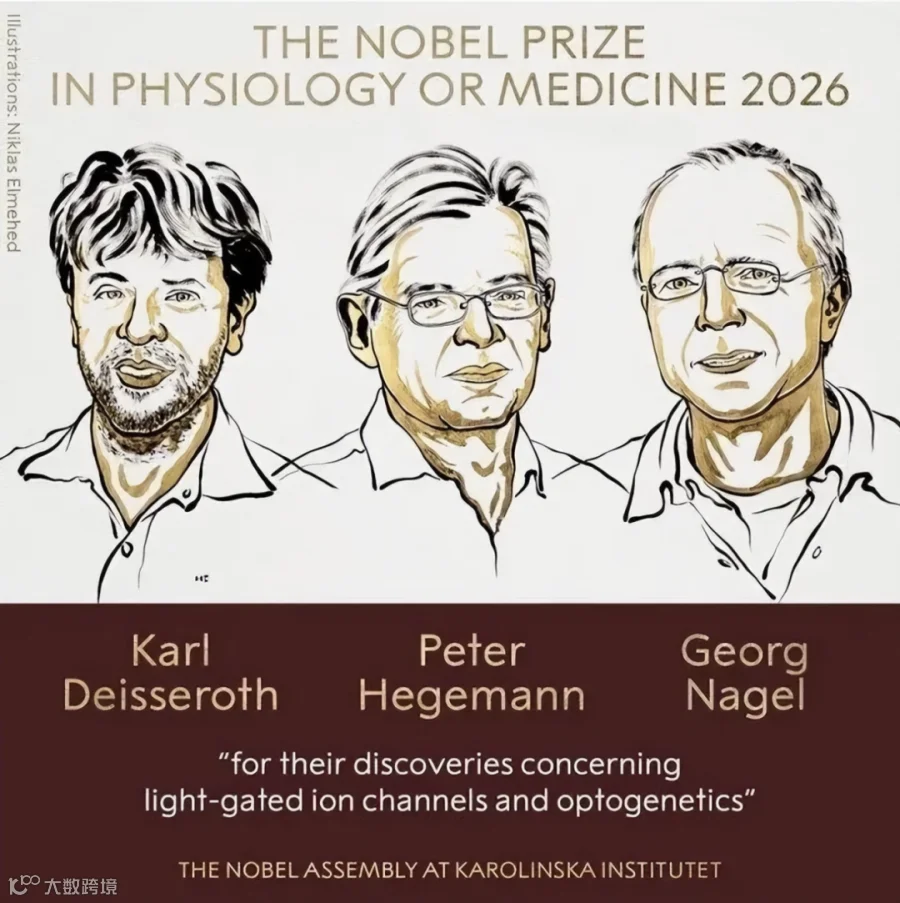
2026 诺贝尔生理学或医学奖|诺奖官网新闻稿(Press Release)(中英对照 + 获奖者完整介绍)
奖项全称:The Nobel Prize in Physiology or Medicine 2026
颁奖机构:卡罗林斯卡医学院 Nobel Assembly at Karolinska Institutet
获奖理由:for their discoveries concerning light-gated ion channels and optogenetics
中文译文:表彰他们在光门控离子通道与光遗传学领域的发现
一、诺奖官方新闻稿(Press Release)中英逐段对照
Nobel Prize official press release
The Nobel Assembly at Karolinska Institutet has today decided to award the Nobel Prize in Physiology or Medicine 2026 jointly to Karl Deisseroth, Peter Hegemann and Georg Nagel for their discoveries concerning light-gated ion channels and optogenetics.
瑞典卡罗林斯卡医学院诺贝尔大会今日决定,将 2026 年诺贝尔生理学或医学奖共同授予卡尔・戴瑟罗斯、彼得・黑格曼与格奥尔格・内格尔,表彰他们在光门控离子通道与光遗传学方面的发现。
Our ability to understand how the brain works has long been limited by the fact that we cannot directly test how individual neurons control behaviour. This year’s Nobel Laureates discovered a biological light switch that can turn neurons on and off with light. Their discoveries gave birth to optogenetics, a revolutionary method that allows researchers to activate or silence specific nerve cells in the brain of a living animal.
长久以来,人类理解大脑运作的能力一直受限于一个难题:我们无法直接验证单个神经元如何调控行为。本年度诺奖得主发现了一种生物光控开关,可以用光开启或关闭神经元。他们的发现催生了光遗传学 —— 这一革命性技术,让科研人员能够在活体动物大脑中激活或抑制特定神经细胞。
Peter Hegemann and Georg Nagel studied how single-celled green algae move towards light. They identified channelrhodopsin, a light-gated ion channel that opens when illuminated by blue light. When the channel opens, ions flow into the cell and generate an electrical signal. They also showed that channelrhodopsin can be transferred to other cells and make them light-sensitive.
彼得・黑格曼与格奥尔格・内格尔研究单细胞绿藻的趋光运动。他们发现了通道视紫红质—— 一种蓝光照射下就会打开的光门控离子通道。通道打开时,离子流入细胞,产生电信号。他们同时证实:通道视紫红质可以移植到其他细胞中,使这些细胞获得光敏感性。
Karl Deisseroth took this discovery further. He introduced the gene for channelrhodopsin into rat neurons. When illuminated by blue light, the neurons fired electrical signals. In 2005, he published this breakthrough and, two years later, demonstrated that the technique works in the brain of living mice. This method was named optogenetics.
卡尔・戴瑟罗斯进一步推进这项发现。他将编码通道视紫红质的基因导入大鼠神经元;在蓝光照射下,神经元即可产生电信号。2005 年,他发表这项突破性成果;两年后,证实该技术可在活体小鼠大脑中生效。这套方法被命名为光遗传学。
Optogenetics transformed neuroscience. Researchers can now examine how defined neural circuits control memory, sensation and behaviour. The method is also being used to explore mechanisms behind neurological and psychiatric disorders. There are ongoing clinical trials investigating whether the technology can restore vision in patients with retinal diseases.
光遗传学彻底改变了神经科学。如今研究者可以探究特定神经回路如何调控记忆、感知与行为。该技术也被用于研究神经系统与精神疾病背后的机制。目前已有多项临床试验,探索这项技术能否帮助视网膜疾病患者恢复视力。
The discoveries by Karl Deisseroth, Peter Hegemann and Georg Nagel opened a new era for neuroscience. Their work has given us an unprecedented tool to understand how the brain functions.
卡尔・戴瑟罗斯、彼得・黑格曼与格奥尔格・内格尔的发现,开启了神经科学的全新时代。他们的成果,为人类提供了前所未有的工具,用以理解大脑如何工作。
二、三位获奖者完整简介(官方资料)
1. Karl Deisseroth 卡尔・戴瑟罗斯
-
出生:1971 年 -
所属机构:美国斯坦福大学、霍华德・休斯医学研究所(HHMI) -
贡献:把通道视紫红质改造、导入哺乳动物神经元,建立活体大脑光遗传学体系,首次在活体小鼠实现光控神经活动,是光遗传学体系的核心建立者。
2. Peter Hegemann 彼得・黑格曼
3. Georg Nagel 格奥尔格・内格尔
-
出生:1953 年 -
所属机构:德国维尔茨堡大学 -
贡献:与 Hegemann 合作,鉴定通道视紫红质蛋白,证明该蛋白可以在异源细胞中工作,奠定分子基础。
三、奖项配套关键信息
-
奖金总额:1200 万瑞典克朗,由3人平分(每人 400 万瑞典克朗,约合计人民币 802 万元),2026 诺奖奖金上调 100 万瑞典克朗。 -
颁奖仪式:斯德哥尔摩,12 月 10 日(诺贝尔逝世纪念日) -
核心科学逻辑一句话总结:从绿藻找到光控蛋白,移植到大脑,用光操控神经元,证明神经回路与行为的因果关系。
|
|
来源:https://www.nobelprize.org/(英文)
AI编译 / 智强咨询 编辑(中文)
原文链接
