

这一发现应当改变CEO在启动AI转型时提出的第一个问题。在选择工具之前,先确定公司需要达成的结果,以及哪些工作已不再服务于这个结果。然后,指定一位领导者对流程重新设计负总责,明确其决策将如何被评估,并决定释放出的产能将用于推动增长、提升服务,还是降低成本。
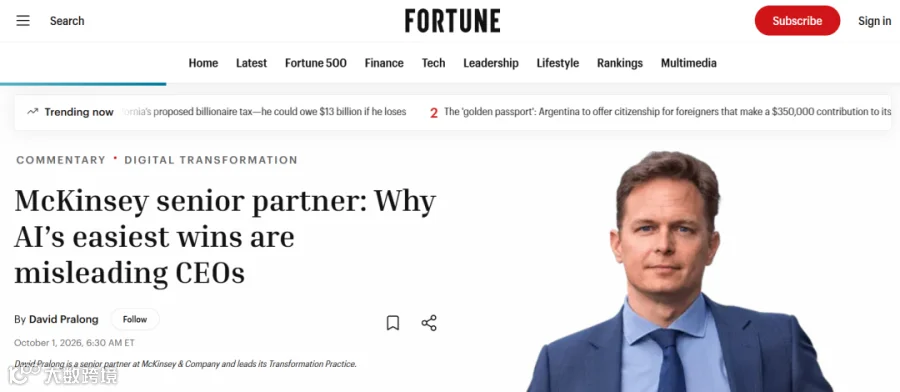
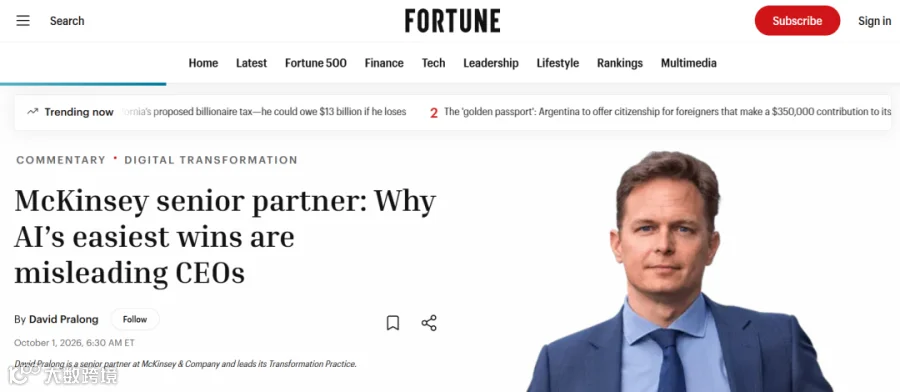
《财富》新闻稿原文如下:
McKinsey’s latest research finds that adoption barely moved this year: 88 percent of organizations used AI in at least one business function a year ago, versus 89 percent now. High performers, who attribute at least 5 percent of earnings before interest and taxes to AI and report value from its use, held flat at 6 percent both years. Adoption is spreading, yet returns aren’t catching up. Thirty-seven percent report some positive effect on earnings, but the gap between broad use and legitimate payoff isn’t closing.
Leaders need to align incentives, improve change management, and strengthen their data foundations, but the value gap remains because executives keep mistaking some of AI’s clearest successes for a playbook they can apply anywhere.
Consider the examples executives cite most often. A study of ~5,200 customer-support agents found that AI assistance increased issues resolved per hour by 15 percent. Randomized trials involving ~4,900 software developers found that those given an AI coding assistant completed about 26 percent more tasks. These are meaningful gains. Neither finding establishes that adding AI to any business process will improve a company’s earnings.
Contact centers and software teams had crucial advantages before today’s AI models arrived. Contact centers had spent decades organizing high volumes of work into queues, tracking outcomes, and building a body of past interactions. Software teams had developed testing, continuous integration, and code review practices that made it possible to inspect and correct new work.
AI could enter those settings and make an existing system faster. That is valuable. It is also a different challenge from redesigning work that has never been organized around a clear outcome or a way to check whether it was achieved.
Consider a bank using AI to read documents for small-business loans. Faster document review might save two days. But if an application still waits for separate handoffs among sales, credit, compliance, and operations, the customer may see little improvement. A faster first step does not resolve the delays and errors that arise later.
Redesign would start with the decision the bank needs to make. What evidence is required to approve a sound loan? Who has the authority to make that decision? Which exceptions need specialist review? AI could help gather and check the evidence, while a named team owns the application from submission to decision. The bank would measure time to decision, error rates, and the loans it can responsibly serve, rather than counting only hours saved reading files.
That shift requires choices about authority, risk, and what employees will do with the time they regain. Software cannot make those choices for a leadership team.
I have watched executives nod at AI demonstrations without asking what would change after the demonstration ends. Who owns the outcome when a process crosses several functions? Who can remove a handoff? How will anyone know that faster work produced a better result? Without answers, a promising pilot can remain a pilot.
Employees notice that uncertainty, too, and ask, “Am I training my replacement?”. Managers cannot offer much reassurance if leadership has described only the tasks AI might perform, not the work people will do next. Leaders need to explain the vision behind the change honestly, even when they cannot yet answer every question about its effect on roles.
My profession, management consulting, bears some responsibility. Consultants often earn their keep by removing waste from an existing process. We call it optimization. We are also starting to re-think the purpose of accumulated organizational processes and value tradeoffs.
McKinsey research published in July offers a reason to ask. Among leaders reporting on organizations in the earliest stage of AI adoption, those whose workflows had been redesigned were 5.3 times as likely to report enterprise-level value as those whose workflows had not: 32 percent versus 6 percent.
That finding should change the first question a CEO asks about AI transformation. Before choosing a tool, decide what outcome the company needs and which parts of the work no longer serve it. Give one leader responsibility for the redesigned process, establish how its decisions will be checked, and decide whether the capacity it frees will support growth, better service, or lower cost.
The gains in contact centers and coding are genuine. But they are a starting point, not a template that can be dropped into any company. The larger opportunity belongs to leaders willing to change the work around the technology.
★关注并星标“咨询头条”,不错过每一篇新推送!
操作方法:点击文首蓝字关注【咨询头条】,进入主页后点击右上角菜单栏,设为星标!