
大数跨境

Competition within Cooperation, Cooperation within Competition: The Rational Path for US-China Relations
Competition within Cooperation, Cooperation within Competition: The Rational Path for US-China Relations 稀土产业研究
2026-10-03
7
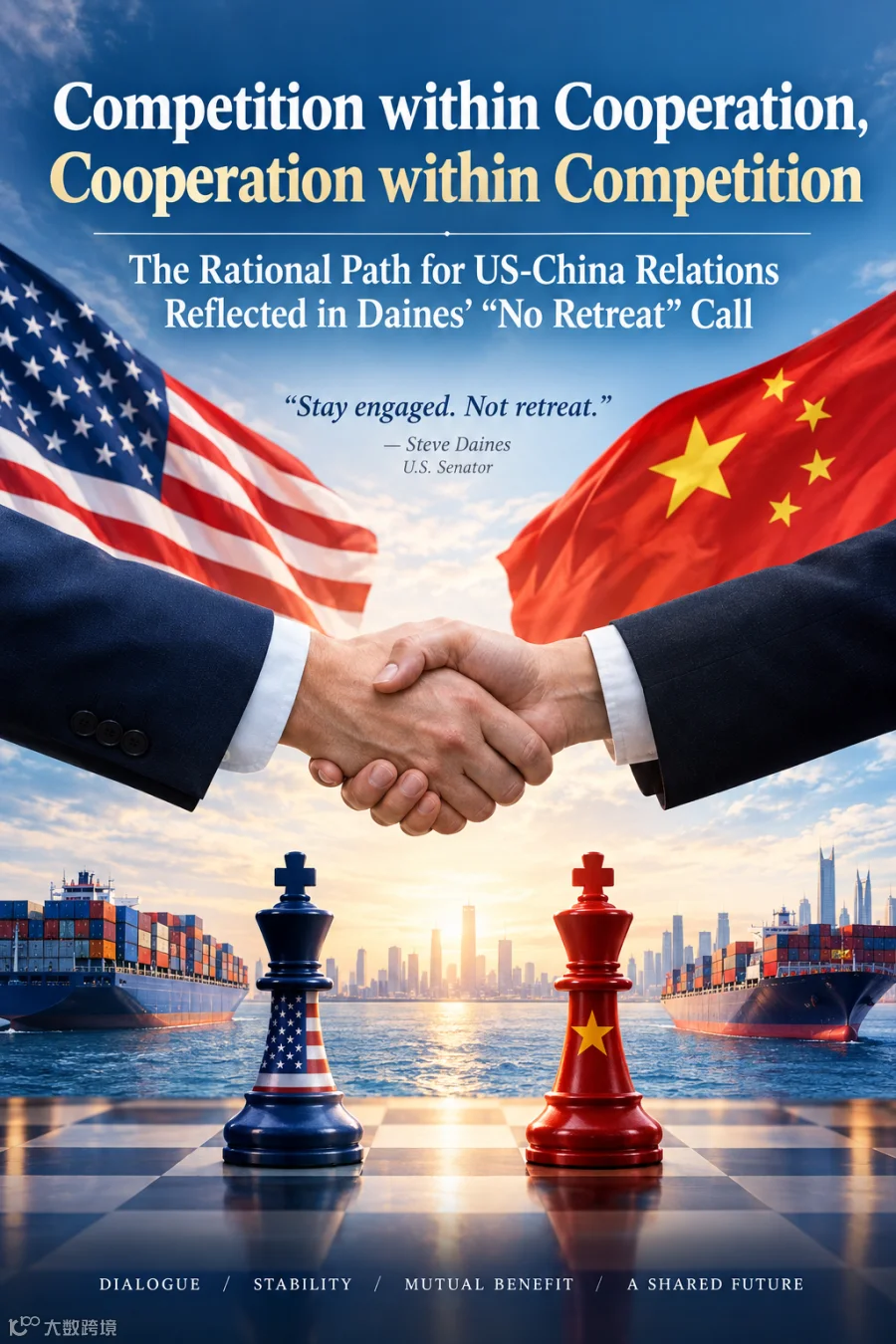
Recently, US Republican Senator Steve Daines, a close aide to President Donald Trump, told the South China Morning Post that the United States and China still have differences on issues such as rare earth supply chains, but “the answer is not to retreat. The answer is to stay engaged.” He stressed that dialogue between the two countries must continue because “both sides admit we’ve got some serious differences.” This statement came after Chinese President Xi Jinping’s state visit to Washington and served as a direct response to remarks by US Ambassador to China David Perdue, who accused Beijing of “weaponising” its dominant position in critical minerals.
Daines’ position precisely underscores a simple yet vital principle: competition within cooperation, cooperation within competition—and it is crucial not to artificially create confrontation between the United States and China.
As the world’s two largest economies and most significant technological and military powers, the United States and China have deeply intertwined interests. Rare earths and other critical minerals are both the “vitamins” of modern industry and sensitive flashpoints in great-power competition. China holds a clear advantage in this sector, while the United States seeks to reduce single-source dependence and diversify supply chains. Differences are real and competition is inevitable. Yet competition does not necessarily mean confrontation, nor should it be artificially framed as a zero-sum, life-or-death struggle.
Daines noted that many issues predated the summit and would continue to require work afterward. This shows that high-level engagement cannot eliminate all differences overnight, but it can create the conditions for ongoing communication. A mature relationship does not avoid disagreements; it keeps channels of dialogue open while acknowledging them. It does not pursue complete decoupling as a fantasy, but seeks space for cooperation amid competition and manages the intensity of rivalry within cooperation.
The cost of artificially manufactured confrontation is enormous. Supply-chain ruptures raise global costs, technology restrictions can delay joint efforts on climate change and public health, and strategic distrust risks escalating manageable frictions into systemic crises. The world does not need a black-and-white US-China relationship; it needs a stable framework that accommodates both competition and cooperation. Daines’ call to “stay engaged and not retreat” is essentially a defence of that framework: when differences arise, choose engagement over severance, negotiation over confrontation.
Engagement, of course, does not mean capitulation, and dialogue does not mean abandoning principles. The United States has every right to pursue supply-chain security; China has every right to safeguard its development interests. The two sides can—and should—conduct difficult but necessary consultations on rare-earth export management, technical standards, investment screening and related issues. What matters is that such discussions take place on the basis of mutual respect, rather than being hijacked by domestic politics or ideology and turned into emotional performances of confrontation.
History has repeatedly shown that US-China relations bring mutual benefit when cooperative and mutual harm when confrontational. When the two sides can maintain channels of cooperation amid competition and set boundaries for competition within cooperation, not only do both countries gain, but global markets, technological progress and strategic stability also receive precious certainty. As a key figure familiar with China affairs within the Trump team, Daines’ call at this moment to “keep the dialogue going and not retreat” deserves serious attention.
Competition within cooperation, cooperation within competition—this is not a slogan of weakness, but the practical wisdom of great-power coexistence. Refusing to artificially create confrontation and insisting on dialogue amid differences and win-win outcomes amid competition remains the steady and sustainable path for US-China relations.

【声明】内容源于网络
0
0
稀土产业研究
稀土产业链深度研究报告与资讯。稀土之于我,不只是产业,更是一种恒定的牵引力;我就像那不参与化学反应的 4f 电子,始终在内层轨道守望着它。
内容 553
粉丝 0
稀土产业研究 稀土产业链深度研究报告与资讯。稀土之于我,不只是产业,更是一种恒定的牵引力;我就像那不参与化学反应的 4f 电子,始终在内层轨道守望着它。
总阅读14.8k
粉丝0
内容553