


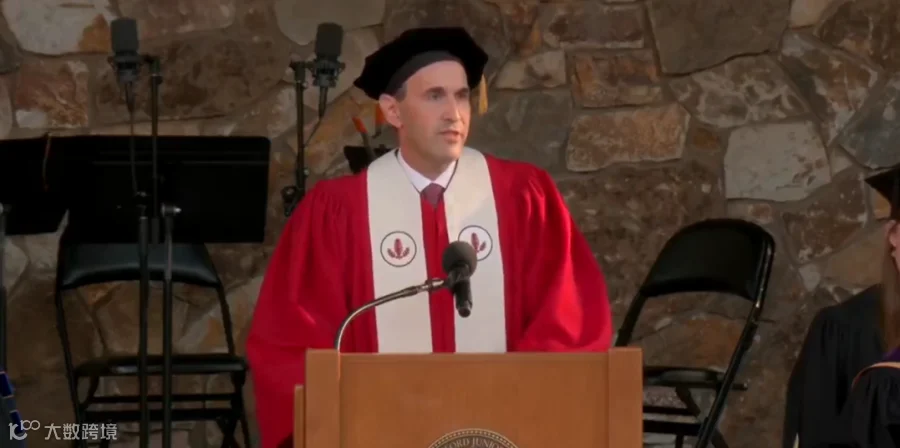
当AI与技术以前所未有的速度改变世界,我们应该接受怎样的教育,又该如何面对一个无法预测的未来?9月15日,斯坦福大学校长乔纳森·莱文在开学典礼上,为2030届新生给出了他的回答:保持探索的自由,尊重真正的专业知识,在与不同的人相遇中成长,并始终相信人的行动能够改变未来。
正如乔纳森·莱文在演讲中所说:“未来不是发生在你身上的事情,而是由你亲手创造的东西。”
因为真正难被AI替代的,可能从来都不是某一门具体技能,而是你怎么形成判断,怎么面对分歧,怎么在一个还没有答案的世界里继续往前走。
一、探索的自由
二、专业知识依然重要
三、校园本身就是教育
第一,带着目标去探索
第二,保持好奇,而不是急于评判
第三,珍惜你能够来到这里的幸运
英文原文:

First-years, transfer students, and families, welcome to Stanford.
We are so glad you're here, finally, after a month of waiting since your friends started school.
Today is one of my favorite days of the year, and parents and families, we particularly enjoyed seeing the look of pride on your faces as you moved your children in this morning.
I want to start with a prediction.
I predict that you will remember almost none of what I'm about to say.
But you will remember the feeling of arriving at Stanford.
That has certainly been the case for me.
In the fall of 1990, I flew across the country and a blue Super Shuttle bus dropped me and two duffel bags in front of Wilbur.
I remember the feeling as if it were yesterday, walking around the campus in the sun, meeting a few people, some of whom I still talk with today, and seeing my room for the first time.
Some of you might wonder, have the rooms changed much?
The answer is no.
We call it eclectic.
I had chosen Stanford for its sense of openness and possibility for its spirit of exploration.
It did not disappoint.
And that's one of the many reasons that I'm still here today, and I'm so excited to see each of you launch on your own voyages.
This weekend, I was scheduled to be in Florida to watch another Stanford voyager launch.
Uh, Jessica Watkins, arrived at Stanford in the fall of 2006.
She wanted to be an astronaut.
Now of course, I grew up wanting to be center fielder for the New York Yankees, so these things don't always work out.
But in Jessica's case, it did.
At Stanford, Jessica studied geological and environmental sciences, she was a star on the women's rugby team winning a national championship as a sophomore.
She did a summer internship at NASA Ames Research Center.
She studied how to grow plants in Martian soil.
Those experiences set her up to pursue a PhD and eventually to be selected into NASA's astronaut program.
Today, she is the commander of the Crew 13 mission to the International Space Station.
It'll be her second time.
By the way, Stanford has graduated 27 NASA astronauts.
And more female astronauts than any civilian university.
So I was hoping at this point that I would point up at Jessica in orbit, but as often happens with space missions, the launch on Saturday was delayed.
I can't wait to be there when it does happen, and maybe one day see Jessica put her geology training to work walking around on the moon or Mars.
One of the reasons I was so excited to be at Jessica's launch and love her trajectory is that it ties into something that I have been thinking about all summer.
So this fall, I'm teaching a section of college 101, of course, that many of you will take.
It'll be a new class for me, and actually quite different.
My field is economics, so usually I've taught classes on game theory or innovation, or how to design markets.
College 101 is about the role of education in preparing you to live a good life.
It's a feature of our freshman curriculum that faculty from all across campus are invited to teach in it.
That's why some of you will have literary scholars and others might have a physicist or a physician, or an economist who became a university president.
So this summer, I've done a lot of reading.
Plato, Du Bois, Tagore, Dangarembga, Epicurus, Seneca, Tara Westover's memoir, Mary Shelley's Frankenstein.
And many of the readings are about what education should look like, or personal accounts of education, at different times and places.
You'll get to talk about them all through the quarter.
The readings raise a question.
What is it about a Stanford education that distinguishes it from the many and varied forms of education over time and across places?
How would prepare you for a good life?
I want to suggest three answers.
First, the freedom to explore.
Many educational traditions are narrow by design.
They're a fixed course of study, depth in a particular area.
Stanford is different.
You're embarking on a true journey of discovery.
You'll have the opportunity to take classes and encounter new ideas across many fields.
And as you just heard, to change your mind.
Changing your mind is a big part of education.
My freshman year, I arrived at Stanford with no idea what I wanted to study.
I took a class in Eastern philosophy, took a seminar on Dostoevsky, I took what was for me, an incredibly challenging math class.
I ended up majoring in English and mathematics.
Jessica Watkins started as an engineer and then she fell in love with geology.
Isaiah Berlin famously described two types of thinkers.
The fox, who knows many things, and the hedgehog, who knows one big thing.
A liberal education aims to give you some of both.
The theory being that judgment and citizenship require both mastery and exposure to different ways of thinking.
Second, the premise of a research university is that expertise matters, and that by putting scholars together with undergraduates, everyone benefits.
You will learn from faculty who have devoted their entire lives to a field.
And in turn, you'll ask questions, you'll push the faculty to explain their field, and why it matters.
The exchange runs in both directions.
All of us on the faculty have experienced this.
One of my favorite research projects started when one of my advisees spent a summer after his junior year working for a used car dealership in Tucson, Arizona.
The business was fascinating.
And we ended up writing a paper about it.
I learned a ton, and I think he did too.
A few years later, he and some of his classmates started, what is by far the most successful used car company in the United States.
Third, there's the experience of the campus.
So, as Dean Shaw just described, you are a very impressive and wide ranging class.
But that's not why you're here.
You're here for who you are going to become.
And much of that will be shaped by each other.
In dorms, in dining halls, in rehearsal rooms, cheering on Stanford teams, or perhaps occasionally swimming in a fountain.
What I hope you will share and embrace is the distinctive culture of Stanford's campus.
The pursuit of excellence, the openness to ideas, the sense of optimism, at the heart of Stanford is a belief in our ability to work together and solve problems, a belief that the future is something you build rather than something that happens to you.
You, the class of 2030, are arriving at a particularly momentous time.
When rapid technological change promises to transform discovery, education, and many aspects of our lives.
Even here, in a place which launched the semiconductor industry, modern computer architecture and the internet age, no one can forecast exactly how it will unfold.
But consider the following.
Suppose you were starting with a blank sheet of paper, and you were asked to design a place to be at the current moment.
What attributes would you want?
A place with the freedom to explore and adapt, a place with expertise across many disciplines, science, technology, humanities, arts, the social sciences, a place that is forward looking and problem solving.
So I can't tell you what the future will hold.
But what I can tell you with confidence is that you are in the right place.
The attributes that make this the right place to be, at a time of change, also help explain why universities are such enduring institutions.
Renewal is part of our design.
Indeed, your arrival is a moment of renewal, yet another reason today is one of my favorite days of the year.
So I've talked about the education on which you are embarking and why it's distinctive.
I'll finish with three pieces of advice that I like to share every year.
First, you have a lot of freedom and many choices, courses, activities how to spend your time.
You may find it overwhelming.
In many years at Stanford, I found that the most successful Stanford students explore fearlessly.
They take some risks, they try new things, but they also set goals, and they think often about what they hope to accomplish.
They explore with intention.
Second, you're joining a campus where people have a vast array of backgrounds, beliefs, experiences, and aspirations, that is an extraordinary opportunity for learning.
But it also means that you will encounter people with whom you don't agree, ideas that you might find objectionable.
The culture of the campus is in some ways defined by these moments, these moments of friction.
We can have an environment where people escalate disagreement into heated arguments, we can have an environment where people appeal to social media, or to authority, or we can have a culture where people respond to each other by asking questions and opening a discussion.
That's a culture of dignity.
At Stanford, we want to have a culture of dignity.
As a Stanford student, I hope you will be curious and not judgmental.
That's a recipe for a successful diverse campus.
Finally, we had a legendary tennis coach at Stanford.
His teams won 17 national titles.
And he would like to come out on the court every day and start practice by saying to the team, "Sorry about the weather."
It was his way of reminding them that whatever was going on in their lives, however the team was doing, they were all in a fortunate position to be here at Stanford.
You are now in such a position.
And I encourage you to embrace it with humility and with a desire to serve others.
So as you launch in your Stanford journey, I hope you embrace the sense of openness and possibility at the heart of Stanford, be expansive in your curiosity, in your exploration, and in your contributions.
I can't wait to see what you do with your time here, and where in the stars it will take you.
Welcome, Stanford Class of 2030.