


As human commercial civilization evolves, the ultimate competition in global commodity trade has long transcended superficial contests over channels, resources and personal connections. What truly determines commercial destiny is the right to define rules, the power to build systems, and the dominance over risk‑control paradigms.
Across the global landscape of commodity trade, both large domestic grain merchants backed by licenses and institutional advantages, and century‑old established overseas trade consortia, are afflicted by inherent structural flaws in their conventional transaction paradigms. They lack standardized security links spanning the full cross‑border cycle, binding performance constraints that cannot be breached, and pre‑emptive risk‑assessment mechanisms capable of piercing geographical barriers. Bad‑debt arrears, order abandonment, fictitious trade and performance disorder are not merely local industrial maladies, but chronic problems that have plagued global business communities for more than a hundred years. Countless large‑scale trade entities, even with abundant resources, remain trapped by transaction risks, unable to achieve lasting prosperity or truly master their own commercial fate.
The root cause of all transaction chaos lies in the fact that the old global trading system has never produced an all‑cycle, self‑contained, security‑oriented underlying logic originating from the East. Existing institutions dominated by Western trade theories largely serve vested capital interests, embedding loopholes and constraints within cross‑border competition.
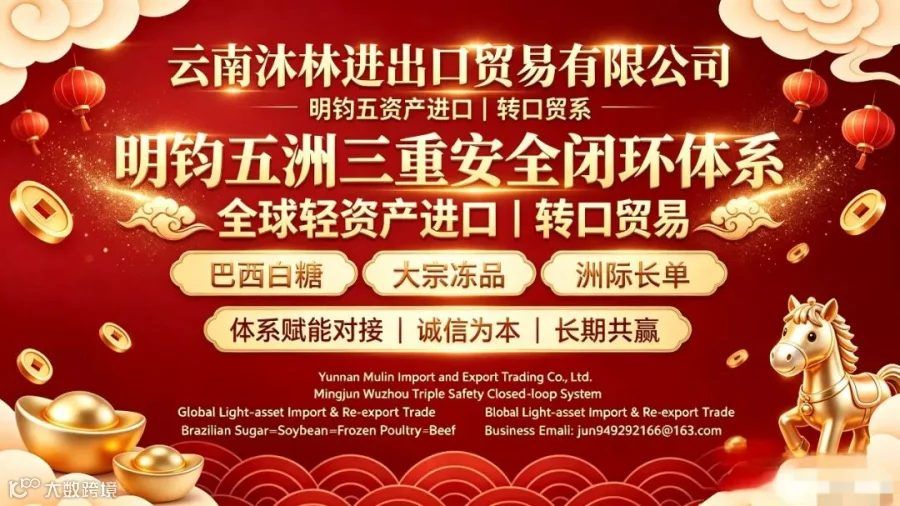
I do not blindly follow established Western trade doctrines, rely on external privileges or industry dividends, nor depend on personal relationships to sustain business survival. The Mingjun Five‑Continents Fourth‑Generation Triple‑Security Closed‑Loop System, independently iterated and refined by myself, breaks free from the shackles of the old global trading order. Rooted in Eastern strategic thinking, it builds a full‑chain, pre‑emptive and rigid institutional framework, reshapes the underlying risk‑control standards for global commodity trade, eradicates century‑old cross‑border trading ills, and forges a modern Eastern economic‑trade governance paradigm that can be referenced and replicated across all continents.
This is no ordinary business improvement, but a disruptive risk‑control paradigm revolution for the global trading landscape, and the core strategic foundation for the future of world‑wide commodity trade.
I. Capital‑Safety Closed‑Loop: Rigorous Letter‑of‑Credit Links to Eradicate Global Cross‑Border Bad‑Debt and Arrears
The fatal vulnerability of cross‑border commodity trade is the absence of unshakable institutional safeguards for capital flows. Under traditional trade models, contractual constraints are nominal, and credit‑period rules are riddled with loopholes. Cross‑border payment arrears, malicious default and cross‑border triangular debts repeatedly occur across global markets. Many grand‑scale trade projects, though seemingly prosperous, ultimately collapse under bad‑debt burdens, bringing commercial turnover to a complete standstill.
The Mingjun Five‑Continents Fourth‑Generation Capital‑Safety Closed‑Loop completely abandons loose settlement practices reliant on personal relations and verbal commitments.
It is not a simple adoption of Western letter‑of‑credit instruments. Instead, based on real‑world global economic‑trade realities, it independently constructs dedicated, isolated capital links underpinned by rigid international letters of credit. All transaction funds fall under the supervision of the international financial system. Capital flows are fully transparent and traceable, settlement criteria are rigidly fixed, and payment milestones cannot be altered.
It fundamentally eliminates worldwide industrial ills including fund misappropriation, payment arrears, malicious default and cross‑border triangular debts, achieving the state that funds are secured before transactions commence; full‑process control ensures principal and interest are secure. Global commodity trade is thus freed from the primitive, gambling‑based stage of relying on personal character, trust or luck. Self‑crafted financial institutions firmly lock in absolute cross‑border capital security.
II. Performance‑Commitment Closed‑Loop: Rigorous Security‑Deposit Constraints to Uphold the Supreme Bottom Line of Trans‑Ocean Trade
Violent price fluctuations are an enduring reality in global commodity markets. Amid shifting international market conditions, cross‑border partners frequently alter positions, abandon orders or breach contracts, a common phenomenon in international markets. Under old‑style trading systems, default carries minimal cost. Cross‑border rights protection faces heavy barriers. Compliant parties suffer enormous losses, while violators bear almost no consequences, continuously eroding the global trade credit system.
Faced with this worldwide performance crisis, this system establishes a dedicated rigorous security‑deposit constraint mechanism, redefining the supreme performance bottom line for global commodity trade.
All purchasing partners must pay performance security deposits in accordance with unified standards, which are placed under independent transaction supervision, managed for dedicated purposes and subject to rigid constraints. All transactions strictly abide by established contracts. In cases of order abandonment, malicious breach, unilateral termination or unauthorized price pressure, default disposal mechanisms are immediately activated to fully offset losses sustained by compliant parties via security deposits.
This closed‑loop mechanism reverses the distorted reality of traditional global trade where compliance brings losses while default carries no penalties. Institutions replace personal connections, rules constrain human nature, and rigid mechanisms safeguard the solemnity of trans‑ocean transactions, granting unshakable stability to every cross‑ocean commodity transaction.
III. Risk‑Control Closed‑Loop: Pre‑Emptive Comprehensive Screening to Eliminate All Potential Cross‑Border Transaction Hazards
Most cross‑border trade disasters do not emerge mid‑execution, but originate at the source of cooperation. False subject qualifications, fabricated trade backgrounds and overstated operational strength plant risks long in advance.
Conventional global risk‑control logic adopts a reactive post‑fact‑remediation model. After risks erupt, cross‑border liability pursuit is hindered by geographical separation, legal disparities and information barriers. Massive human and material resources are expended with limited results. Various shell entities and fake trade institutions operate across national borders, exploiting information asymmetries to harvest markets, while traditional risk‑control tools cannot achieve cross‑regional penetrating identification.
The Mingjun Five‑Continents Fourth‑Generation Risk‑Control Closed‑Loop overturns long‑standing global post‑event risk‑control logic, building a cross‑border, fully‑penetrating pre‑emptive risk‑screening system.
Prior to formal transaction launch, in‑depth multi‑dimensional assessments are conducted on partner qualifications, cross‑border credit records, real operational capacity, historical performance track‑records, authenticity of trade backgrounds and cross‑border compliance credentials. Layer‑by‑layer verification and benchmarking are implemented to precisely filter out shell enterprises, fake‑trade entities, highly‑indebted discredited institutions and all other risk sources.
It achieves pre‑emptive risk assessment, elimination of hazards at source, holistic pre‑event governance and worry‑free full‑process transactions. Every cross‑border business collaboration and every commodity delivery is built upon the bedrock of absolute compliance, security and reliability.
Conclusion: Systems Prevail, Rules Reign — Eastern Paradigm Establishes Its Standing Across Global Business Seas
The decline of old‑era global trade models represents the inevitable historical demise of backward paradigms. The rise of autonomous Eastern economic‑trade systems is an inevitable outcome of evolving global commercial patterns.
The Mingjun Five‑Continents Fourth‑Generation Triple‑Security Closed‑Loop System relies on no external privilege protection or preferential industry dividends. Built entirely on independently forged underlying strategic logic, rigid institutional rules and full‑scope risk‑control architecture, it breaks deep‑rooted systemic maladies within global commodity trade and remedies century‑old institutional defects of world‑wide trade.
Against the backdrop of turbulent global supply‑chain competition and shifting geopolitical landscapes, only complete self‑owned systems, unshakable underlying rules and full‑closed‑loop risk‑control capabilities can weather cyclical storms and stand tall across global business seas.
Future global commodity competition is no longer merely a contest of resources and production capacity, but a contest of security systems, standardized institutions and underlying trade paradigms.
The mechanism I have constructed is not merely a transaction tool for local markets, but a brand‑new economic‑trade governance paradigm originating from a great Eastern nation.
I establish the world through autonomous systems, stabilize the universe through credible institutions, win the globe through solid strength, and build prestige, credibility and eternal rules for Chinese commerce on the world stage.
Contact: Pan Mingjun
Business Emails: jun949292166@163.com, junxin_hk2026@163.com
Yunnan Mulin Import and Export Trade Co., Ltd. International Trade Compliance and Strategic Development Center Official Release