



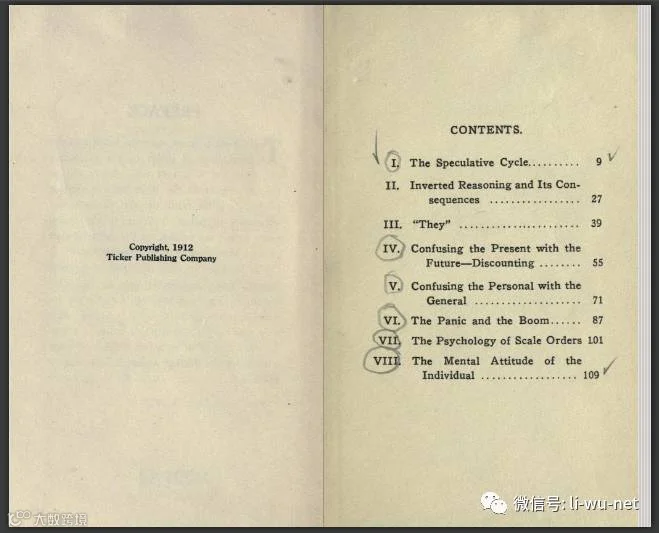
第一二章:《股市心理学》Psychology of the stock market (第一二章)
第三四章:《股市心理学》Psychology of the stock market (第三四章)
V Confusing the Personal with the General
IN a previous chapter the fact has been mentioned that one of the greatest difficulties encountered by the active trader is that of keeping his mind in a balanced and unprejudiced condition when he is heavily committed to either the long or short side of the market. Unconsciously to himself, he permits his judgment to be swayed by his hopes.
A former large speculator on the Chicago Board of Trade, after being short of the market and very bearish on wheat for a long time, one day surprised all his friends by covering everything, going long a moderate amount, and arguing violently on the bull side. For two days he maintained this position, but the market failed to go up. He then turned back to the short side, and had even more bear arguments at his tongue's end than before.
To a certain extent he did this to test the market, but still more to test himself to see whether, by changing front and taking the other side, he could persuade himself out of his bearish opinions. When even this failed to make any real change in his views, he was reassured and was ready for a new and more aggressive campaign on the short side.
There is nothing peculiar about this condition. While it is especially difficult to maintain a balanced mind in regard to commitments in the markets, it is not easy to do so about anything that closely touches our personal interests. As a rule we can find plenty of reasons for doing what we very much want to do, and we are still more prolific with excuses for not doing what we don't want to do. Most of us change the old sophism "Whatever is, is right" to the more directly useful form "Whatever I want is right."
To many readers will occur at once the name of a man prominent in public life who seems very frequently to act on this motto.
If Smith and Jones have a verbal agreement, which afterwards turns out to be greatly to Jones' advantage, Smith's recollection is that it was merely a loose understanding which could be cancelled at any time, while Jones remembers it to have been a definite legal contract, perfectly enforceable if it had only been written.
Talleyrand said that language was given us for the purpose of concealing thought. Likewise many seem to think that logic was given us for the purpose of backing up our desires.
Few persons are so introspective as to be able to tell where this bias in favor of their own interests begins and where it leaves off. Still fewer bother to make the effort to tell. To a great extent we train our judgment to lend itself to our selfish interests. The question with us is not so much whether we have the facts of a situation correctly in mind, as whether we can "put it over."
When it comes to buying and selling stocks, there is no such thing as "putting it over." The market is relentless. It cannot be budged by our sophistries. It will respond exactly to the forces and personalities which are working upon it, with no more regard for our opinions than if we couldn't vote. We cannot work for our own interests as in other lines of business we can only fit our interests to the facts.
To make the greatest success it is necessary for the trader to forget entirely his own position in the market, his profits or losses, the relation of present prices to the point where he bought or sold, and to fix his thoughts upon the position of the market. If the market is going down the trader must sell, no matter whether he has a profit or a loss, whether he bought a year ago or two minutes ago.
How far the average trader is from attaining this point of view is quickly seen from his conversation, and it is also true that a great deal of the literature of speculation absolutely fails to reach this conception.
"You have five points profit you had better take it," advises the broker.
Perhaps so, if you know nothing about the market ; but if you understand the market the time to take your profit is when the upward movement shows signs of culminating, regardless of your own deal.
"Stop your losses; let your profits run" is a saying which appeals to the novice as the essence of wisdom. But the whole question is where to stop the losses and how far to let the profits run. In other words, what is the market going to do? If you can tell this your personal losses and profits will take care of themselves.
Here is a man who has done a great deal of figuring and has proved to his own satisfaction that seven points is the correct profit to take in Union Pacific, while losses should be limited to two and one-half points. Nothing could be more foolish than these arbitrary figures. He is trying to make the market fit itself around his own trades, instead of adapting his trades to the market.
In any broker's office you will notice that a large part of the talk concerns the profits and losses of the traders. Brown had a profit of ten points and then let it get away from him. "Great Scott!" says his wise friend. "What do you want? Aren't you satisfied with ten points profit?" The reply should be, though it rarely is, "Certainly not, if I think the market is going higher."
"Get them out with a small profit," I once heard one broker say to another. "If you don't they will hang on and take a loss. They never get profit enough to satisfy them." A good policy, probably, if neither the broker nor his customer had any real knowledge of the market; but mere nonsense for the trader who aims to be in the slightest degree scientific.
The fact 'is that the more a trader allows his mind to dwell upon his own position in the market the more likely it is that his judgment will become warped so that his mind is blind to those considerations which do not fall in with his preconceived opinion.
Until you try it, you have almost no idea of the extent to which you may be rendered unreasonable by the mere fact that you are committed to one side of the market. "In the market, to be consistent is to be stubborn/' someone has said; and it is true that the man of strong will and logical intellect is often less successful than the more shallow and volatile observer, who is ready to whiffle about like the weathercock at any suspicion of a change in the wind. This is because the strong man has in this instance embarked upon an enterprise where the cannot use his natural force and determination he can employ only his faculties of observation and interpretation. Yet in the end the man of character will be the more permanently successful, because he will eventually master his subject more thoroughly and attain a more judicial attitude.
The more simple-minded, after once committing themselves to a position, are thereafter chiefly influenced and supported by the illusions of hope.
They bought, probably, as a result of some bullish development. If prices have advanced, they find that the market "looks strong," a good deal of encouraging news comes out on the tickers, and they hope for large profits.
After five points in their favor, they hope for ten, and after ten they look for fifteen or twenty.
On the other hand, if prices decline they charge it to "manipulation," "bear raids," etc., and expect an early recovery. Much of the bear news appears to them to be put out maliciously, in order to cause prices to decline further. It is not until the decline begins to cause a painful encroachment upon their capital that they reach the point of saying, "If 'they' can depress prices like this in the face of a bullish situation, what is the use of fighting them? By a flood of short sales, they can put prices down as much as they like" -or something of the sort.
Such traders are suffering merely from youth, or lack of sound business sense, or both. They have a considerable period of study before them, if they persist until they get permanently profitable results. Most of them, of course, do not persist.
A much more intelligent class, many of whom are properly to be considered as investors, do not allow their position in the market to blind them so far as current news or statistical developments are concerned, but do permit themselves to become biased in regard to the most important factor of all the effect of a change in the price level.
They bought stocks in the expectation of an improved situation. The improved situation comes and prices rise. Nothing serious in the way of bear news appears. On the contrary, bull news continues plentiful.
Under these conditions they see no reason for selling.
Yet there may be a most important reason for selling namely, that prices have risen sufficiently to counterbalance the improved situation and they would see and appreciate this fact if they were in the position of an uninterested observer.
One of the principal reasons why investors of this class allow themselves to become confused as to the influence of the price level is because a bull market nearly always goes unreasonably high before it culminates. The investor has perhaps, in several previous instances, sold out at what he thought was a fair price level, only to see the public run away with the market to a point where his profits would have been doubled if he had held on.
It is in such cases that an expert knowledge of speculation is essential.
If the investor has not this knowledge, and cannot obtain the dependable advice of one who has it, then he must content himself with more moderate profits and' forego the expectation of getting the full benefit of the advance.
But with a fair knowledge of speculative influences, he can fix his mind on the development of the campaign, regardless of his own holdings, and can usually secure a larger profit than if he depended merely upon ordinary business "common sense."
The mistake is made when, without any expert knowledge of speculation, he permits himself to hold on in the hope of higher prices after a level has been reached which has fairly discounted improved business conditions.
Not one trader in a thousand ever becomes so expert or so seasoned as to entirely overcome the influence his position in the market exerts upon his judgment. That influence appears in the most insidious and elusive ways.
One of the principal difficulties of the expert is in preventing his active imagination from causing him to see what he is looking for just because he is looking for it.
An example will make this clear.
The expert has learned from experience, let us say, that the appearance of "holes" in the market is a sign of weakness. By a "hole" is meant a condition of the market where it suddenly and unaccountably refuses to take stock. A few hundred shares of an active stock are offered for sale.
Sentiment is generally bullish, but there is no buyer for that stock. Prices slip quickly down half a point or a point before buyers are found. This, in an active stock, is unusual; and al- though the price may recover, the professional does not forget this treacherous failure of the market to accept moderate offerings. He considers it a sign of an "over-bought" market.
Now suppose the trader has calculated that an advance is about to culminate and has taken the short side in anticipation of that event. He suspects that the market is over-bought, but is not yet sure of it. Under these circumstances any little dip in the price will perhaps look to him like a "hole," even though under other conditions he would not notice it or would think nothing about it. He is looking for the development of weakness and there is danger that his imagination may show him what he is looking for even though it isn't there !
The same remarks would apply to the detection of accumulation or distribution. If you want to see distribution after a sharp advance, you are very likely to see it. If you have sold out and want to get a reaction on which to repurchase, you will see plenty of indications of a reaction. Indeed, it is a sort of proverb in Wall Street that there is no bear so bearish as a sold- out bull who wants a chance to re- purchase.
In the study of so-called "technical" conditions of the market, a situation often appears which permits a double construction. Indications of various kinds are almost evenly balanced; some things might be interpreted in two different ways; and a trader not already interested in the market would be likely to think it wise to stay out until he could see his way more clearly.
Under such circumstances you will find it an almost invariable rule that the- man who was long before this condition arose will interpret technical conditions as bullish, while the man who was and remains short, sees plain indications of technical weakness. Somewhat amusing, but true.
In this matter of allowing the judgment to be influenced by personal commitments, very little of a constructive or practically helpful nature can be written, except the one word "Don't."
Yet when the investor or trader has come to realize that he is a prejudiced observer, he has made progress; for this knowledge keeps him from trusting too blindly to something which, at the moment, he calls' judgment, but which may turn out to be simply an unusually strong impulse of greed.
It has often been noted by stock market writers that since the great public is bearish at the bottom and bullish at the top, it could make its fortune and beat the multi-millionaires at their own game by simply reversing itself buying when it feels like selling and selling when it feels like buying. Tom Lawson, in the heyday of his publicity, seems to have had some sort of dream of the public selling back to Standard
Oil capitalists the stocks which it had bought from them and thus bringing everything to smash in a heap the philanthropic Thomas, doubtless, being first properly short of the market.
This wrongheadedness of the public no longer exists to the same extent as formerly. A great number of small investors buy and sell intelligently and there has been a most noticeable falling off in the gambling class of trade much to the satisfaction of everyone, except, perhaps, the brokers who formerly handled such business.
It remains true, nevertheless, that the very moment when the market looks strongest, is likely to be near the top, and just when prices appear to have started on a straight drop to the zero point is usually near the bottom
The practical way for the investor to use this principle is to be ready to sell at the moment when bull sentiment seems to be most widely distributed, and to buy when the public in general seem most discouraged. It is especially important for him to bear this principle in mind in taking profits on previous commitments, as his own interests are then identified with the current trend of prices.
In a word, the trader or investor who has studied the subject enough to be reading this book, probably could not make profits by reversing him- self, even if such a thing were possible; but he can endeavor to hold himself in a detached, unprejudiced frame of mind, and to study the psychology of the crowd, especially as it manifests itself in the movement of prices.
VI The Panic and the Boom
BOTH the panic and the boom are eminently psychological phenomena. This is not saying that fundamental conditions do not at times warrant sharp declines in prices and at other times equally sharp advances. But the panic, properly so- called, represents a decline greater than is warranted by conditions, usually because .of an excited state of the public mind, accompanied by exhaustion of resources; while the term "boom" is used to mean an excessive and largely speculative advance.
There are some special features connected with the panic and the boom which are worthy of separate consideration.
It is really astonishing what a hold the fear of a possible panic has upon the minds of many investors. The memory of the events of 1907 has un- doubtedly operated greatly to lessen the volume of speculative trade from that time to the present (April, 1912).
Panics of equal severity have occurred only a few times in the entire history of the country, and the possibility of such an outbreak in any one month is smaller than the chance of loss on the average investment through the failure of the company. Yet the specter of such a panic rises in the minds of the inexperienced whenever they think of buying stocks.
"Yes," the investor may say, "Reading seems to be in a very strong position, but look where it sold in 1907 at $70 a share !"
It is sometimes assumed that the low prices in a panic are due to a sudden spasm of fear, which comes quickly and passes away quickly. This is not the case. In a way, the operation of the element of fear begins when prices are near the top. Some cautious investors begin to fear that the boom is being overdone and that a disastrous decline must follow the excessive speculation for the rise. They sell under the influence of this feeling.
During the ensuing decline, which may run for years, more and more people begin to feel uneasy over business or financial conditions, and they liquidate their holdings. This caution or fearfulness gradually spreads, in- creasing and decreasing in waves, but growing a little greater at each successive swell. The panic is not a sudden development, but is the result of causes long accumulated.
The actual bottom prices of the panic are more likely to result from necessity than from fear. Those investors who could be frightened out of their holdings are likely to give up before the bottom is reached. The lowest prices are usually made by sales for those whose immediate resources are exhausted. Most of them are taken by surprise and could raise the money necessary to carry their stocks if they had a little time; but in the stock market, "time is the essence of the contract," and is the very thing that they cannot have.
The great cause of loss in times of panic is the failure of the investor to keep enough of his capital in liquid form. He becomes "tied up" in various undertakings so that he cannot realize quickly. He may have abundant property, but no ready money. This condition, in turn, results from trying to do too much greed, haste, excessive ambition, an oversupply of easy confidence as to the future.
It is noticeable in panic times that a period arrives when nearly every one thinks that stocks are low enough, yet prices continue downward to a still lower level. The result is that many investors, after thinking that they have "loaded up" near the bottom, find that it was a false bottom, and are finally forced to throw over their holdings on a further decline.
This is due to the fact mentioned above, that final low prices are the result of necessities, not of opinions. In 1907, for example, every one of good sense knew perfectly well that stocks were selling below their value the trouble was that investors could not get hold of the money with which to buy.
The moral is that low prices, after a prolonged bear period, are not in themselves a sufficient reason for buying stocks. The key to the situation lies in the accumulation of liquid capital, which is most quickly evidenced by a rapid recovery of the excess of deposits over loans in the New York clearing house banks (excluding the trust companies, in which loans are more varied). This subject, however, takes us outside our present field.
It is to a great extent because the last part of the decline in a panic has been caused not by public opinion, or even by public fear, but by necessity, arising from absolute exhaustion of available funds, that the first part of the ensuing recovery takes place without any apparent reason.
Traders say, "The panic is over, but stocks cannot go up much under such bearish conditions as now exist." Yet stocks can and do go up, because they are merely regaining the natural level from which they were depressed by "bankrupt sales," as we would say in discussing dry goods.
Perhaps the word "fear" has been overworked in the discussion of stock market psychology. It is only the very few who actually sell their stocks under the direct influence of the emotion of fear. But a feeling of caution strong enough to induce sales, or even a fixed belief that prices must decline, constitutes in itself a sort of modification of fear, and has the same result so far as prices are concerned.
The effect of this fear or caution in a panic is not limited to the selling of stocks, but is even more important in preventing purchases. It takes far less uneasiness to cause the intending investor to delay purchases than to precipitate actual sales by holders. For this reason, a small quantity of stock pressed for sale in a panicky marketmay cause a decline out of all proportion to its importance. The offerings may be small, but nobody wants them.
It is this factor which accounts for the rapid recoveries which frequently follow panics. Waiting investors are afraid to step in front of a demoralized market, but once the turn appears, they fall over each other to buy.
The boom is in many ways the reverse of the panic. Just as fear keeps growing and spreading until the final crash, so confidence and enthusiasm keep reproducing each other on a wider and wider scale until the result is a sort of hilarity on the part of thousands of men, many of them comparatively young and inexperienced, who have "made big money" during the long advance in prices.
These imaginary millionaires appear in a small swarm during every prolonged bull market, only to fall with their wings singed as soon as prices decline. Such speculators are, to all practical intents and purposes, irresponsible. It is their very irresponsibility which has enabled them to make money so rapidly on advancing prices. The prudent man gets only moderate profits in a bull market it is the man who trades on "shoe-string margins" who gets the biggest benefit out of the risk.
When such, mushroom fortunes have accumulated,, the market may fall temporarily into the hands of these daredevil spirits, so that almost any recklessness is possible for the time. It is this kind of buying which causes prices to go higher after they are already high enough just as they go lower in a panic after they are plainly seen to be low enough.
When prices get above the natural level, a well-judged short interest begins to appear. These shorts are right, but right too soon. In a genuine bull market they are nearly always driven to cover by a further rise, which is, from any common sense standpoint, unreasonable. A riot of pyramided margins drives the sane and calculating short seller temporarily to shelter.
A psychological influence of a much wider scope also operates to help a bull market along to unreasonable heights.
Such a market is usually accompanied by rising prices in all lines of business and these rising prices always create, in the minds of business men, the impression that their various enterprises are more profitable than is really the case.
One reason for this false impression is found in stocks of goods on hand.
Take the wholesale grocer, for example, carrying a stock of goods which inventories $10,000 in January, 1909.
On that date Bradstreet's index of commodity prices stood at 8.26. In January, 1910, Bradstreet's index was 9.23.
If the prices of the various articles included in this stock of groceries increased in the same ratio as Brad-street's list, and if the grocer had on hand exactly the same things, he would inventory them at about $11,168 in January, 1910.
He made an additional profit of $1,168 during the year without any effort, and probably without any calculation, on his part. But this profit was only apparent, not real; for he could not buy any more with the $11,168 in January, 1910, than he could have bought with the $10,000 in January, 1909. He is deceived into supposing himself richer than he really is, and this false idea leads to a gradual growth of extravagance and speculation in every line of business and every walk of life.
The secondary results of this delusion of increased wealth because of rising prices, are even more important than the primary results. Our grocer, for example, decides to spend this $1,168 for an automobile. This helps the automobile business. Hundreds of similar orders induce the automobile company to enlarge its plant. This means extensive purchases of material and employment of labor. The in- creased demand resulting from a similar condition of things in all departments of industry produces, if other conditions are favorable, a still further rise in prices; hence at the end of an- other year the grocer perhaps has an- other imaginary profit, which he spends in enlarging his residence or buying new furniture, etc.
The stock market feels the reflection of all this increased business and higher prices. Yet the whole thing is psychological, and sooner or later our grocer must earn and save, by hard work, economical living and shrewd calculation, the amount he has paid for his automobile or furniture.
Again, rising stock prices and rising commodity prices react on each other.
If the grocer, in addition to his imaginary profit of $1,168 sees a ten percent, advance in the prices of various securities which he holds for investment, he is encouraged to still larger expenditures; and likewise if the capitalist notes a ten per cent, advance in the stock market, he perhaps employs additional servants and enlarges his household expenditures so that he buys more groceries. Thus the feeling of confidence and enthusiasm spreads wider and wider like ripples from a stone dropped into a pond. And all of these developments are faithfully reflected by the stock market barometer.
The result is that, in a year like 1902 or 1906, the high prices for stocks and the feverish activity of general trade are based, to an entirely unsuspected extent, on a sort of pyramid of mistaken impressions, most of which may be traced, directly or indirectly, to the fact that we measure everything in money and always think of this money-measure as fixed and unchangeable, while in reality our money fluctuates in value just like iron, potatoes, or "Fruit of the Loom." We are accustomed to figuring the money-value of wheat, but we get a headache when we try to reckon the wheat-value of money.
When a fictitious situation like this begins to go to pieces, the stock market, fulfilling its function of barometer, declines first, while general business continues active. Then the "money sharks of Wall Street" get themselves roundly cursed by the public and there is a widespread desire to wipe them off the earth in summary fashion. The stock market never finds itself popular unless it is going up; yet its going down undoubtedly does far more to promote the country's welfare in the long run, for it serves to temper the crash which must eventually come in general business circles and to forewarn us of trouble ahead so that we may prepare for it.
It is generally more difficult to distinguish the end of a stock market boom than to decide when a panic is definitely over. The principle of the thing is simple enough, however. It was an oversupply of liquid capital that started the market upward after the panic was over. Similarly it is exhaustion of liquid capital which brings the bull movement to an end. This exhaustion is shown by higher call money rates, loss of the excess of deposits over loans in New York clearinghouse banks, a steady rise in commercial paper rates, and a sagging market for high-grade bonds.
<未完待续>