


Written by Bill Russo, Founder & CEO of Automobility Ltd.
As we move deeper into 2026,China’s auto market is doing two things at once: shrinking at home and scaling globally.And the pressure is accelerating the industry’s transformation, not slowing it.
At home,NEVs now command 57% of passenger-vehicle sales, Chinese brands hold a record 73% share, and BYD has extended its overall market lead.ICE sales have collapsed nearly 32%, while competition is shifting rapidly towardintelligence, affordability, software and speed. The market is no longer choosing between powertrains—it ischoosing winners and losers.
Abroad, another threshold has been crossed.China exported 7.15 million vehicles in just eight months, already surpassing the full-year 2025 record.Global markets are becoming essential to sustaining China’s automotive scale—and the challenge is shifting from simply exporting cars tobuilding durable global businesses.
This is the defining story of the August data:China’s auto industry is being reshaped on two fronts—an unforgiving battle for relevance at home and an accelerating race for scale abroad.Electrification set the stage.Intelligence, affordability and globalization will decide who wins.
Key Headlines Summary through August 2026
📉 China’s auto downturn continues, with domestic sales down ~21% YTD as the 2025 pull-forward weighs on demand and ICE sales contract sharply.
🌍 Exports are increasingly absorbing excess capacity, reaching more than 1 million units monthly and approaching 40% of China vehicle shipments.
⚡ Electrification continues despite the downturn: NEVs now exceed 60% of monthly vehicle shipments and roughly 65% of passenger-vehicle retail sales.
🇨🇳 Chinese brands have consolidated their structural advantage, holding 73% of passenger-vehicle shipments, while German and Japanese OEMs continue to retreat.
🏁 NEV competition is intensifying and fragmenting. BYD remains the scale leader, while Geely and especially Leapmotor are gaining ground and affordable smart EVs increasingly define the battleground.
🤖 China is transitioning from a domestic growth market into a global automotive production and technology platform—with exports sustaining scale and competitive advantage shifting from electrification toward intelligent, software- and AI-defined vehicles.
China’s Auto Industry Enters a New Phase: Shrinking at Home, Expanding Abroad
China’s auto industry is increasingly defined by a striking divergence: the domestic market is weakening, while the industry itself continues to expand its global reach. August reinforced that this is more than a cyclical slowdown. China is moving into a more mature, demand-constrained phase at home, with exports increasingly absorbing capacity and providing the scale that domestic demand can no longer support.
At the same time, the competitive center of gravity is shifting decisively toward NEVs and Chinese brands. Electrification is now the mainstream, ICE is retreating rapidly, and a broader field of Chinese smart-EV players is challenging the established hierarchy. The implications extend well beyond China: the industry is shifting from winning the China market to leveraging China’s scale, speed, technology, and cost advantages to compete globally.
China Auto Shipments Remain Near Record Scale—But ICE Retreat Is Accelerating
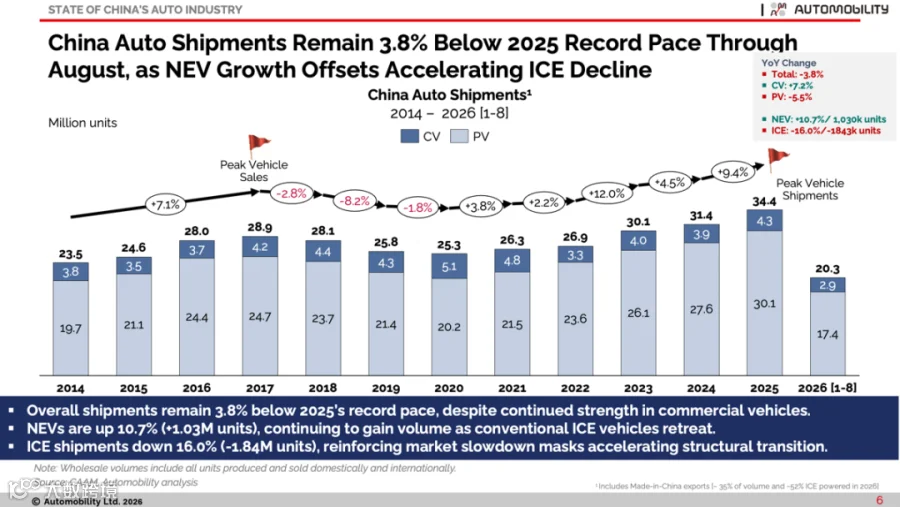
China’s auto industry remained under pressure through the first eight months of 2026, with total shipments 3.8% below last year’s record pace. The headline decline, however, understates the transformation beneath it. Passenger vehicle shipments remain weak, while commercial vehicles continue to provide an offset, keeping overall industry output relatively resilient despite the domestic slowdown.
The more important divergence is between NEVs and ICE. NEV shipments increased 10.7%, adding more than 1 million units, even as overall industry volumes declined. ICE shipments fell 16.0%, shedding roughly 1.84 million units. The gap is widening: electrification is continuing to gain scale precisely as conventional vehicle demand contracts.
The implication is increasingly structural rather than cyclical. China is not simply selling fewer vehicles—it is rapidly changing what it produces and where those vehicles are sold. NEVs, commercial vehicles and exports are increasingly sustaining industry scale, while ICE and traditional domestic passenger-vehicle demand retreat. The aggregate market remains below its 2025 peak, but the transformation underneath the headline number is accelerating.
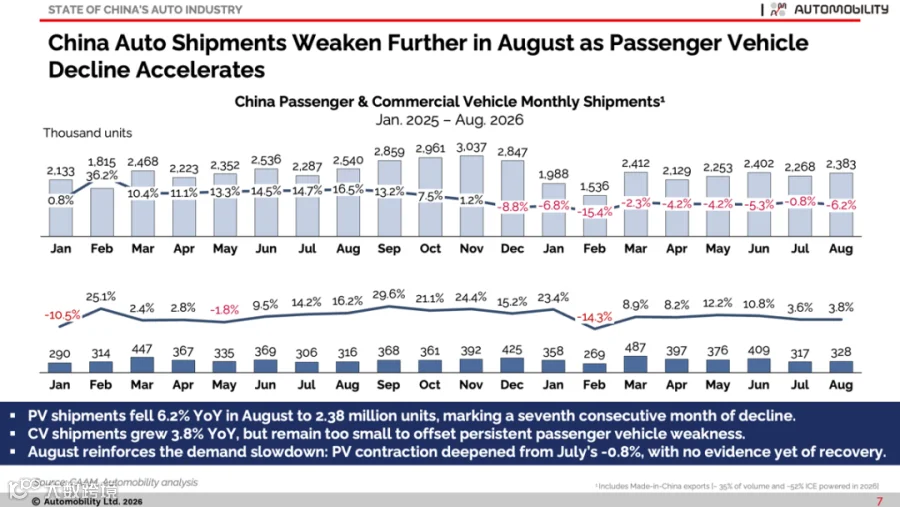
China’s auto market weakened again in August, reversing July’s tentative improvement. Passenger vehicle shipments fell 6.2% year over year to 2.38 million units, a much sharper decline than July’s 0.8% drop and the seventh consecutive month below prior-year levels. The hoped-for stabilization in passenger vehicle demand has therefore yet to materialize.
Commercial vehicles continued to outperform, with shipments rising 3.8% to 328,000 units. But the segment remains too small to offset the persistent weakness in passenger vehicles, leaving overall industry growth increasingly reliant on other sources of demand.
August reinforces that this is not yet a recovery. Passenger vehicle weakness deepened even as NEVs continued gaining share and exports absorbed more of China’s production. The industry is sustaining scale, but increasingly through structural shifts toward electrification and global markets rather than a rebound in underlying domestic demand.
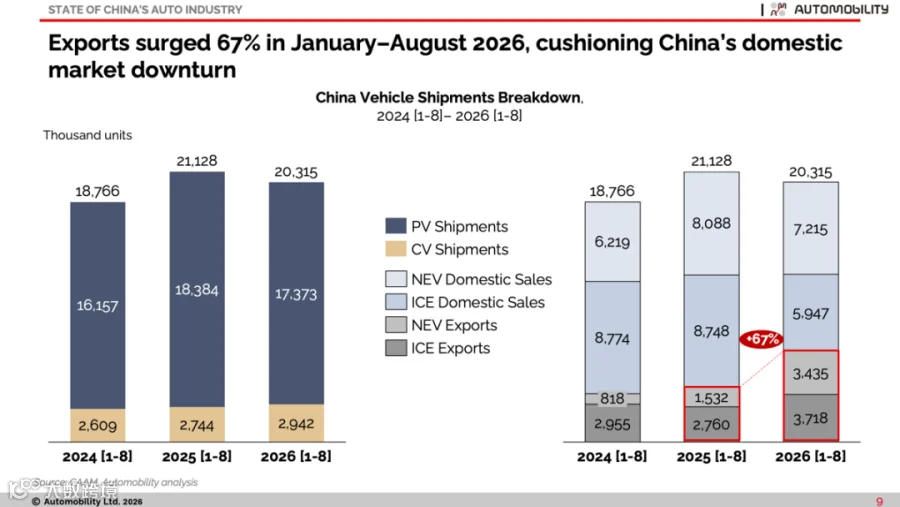
China’s auto industry is increasingly scaling globally to compensate for weakness at home. Through August, total shipments reached 20.3 million units, still below 2025’s record pace despite continued growth in commercial vehicles. Beneath that headline, the industry’s center of gravity is shifting rapidly.
The sharpest divergence is between shrinking domestic ICE demand and surging exports. Domestic ICE sales fell to 5.95 million units, down sharply from 8.75 million a year earlier, while domestic NEV sales remained comparatively resilient at 7.22 million units. Meanwhile, exports jumped from 4.29 million to 7.15 million units—up 67%, with both NEVs and ICE vehicles increasingly finding their growth outside China.
Exports are no longer simply an incremental growth engine—they are becoming essential to sustaining China’s automotive scale. As domestic demand contracts, China is redirecting excess capacity outward, accelerating its transformation from the world’s largest auto market into an increasingly powerful global production and export platform.
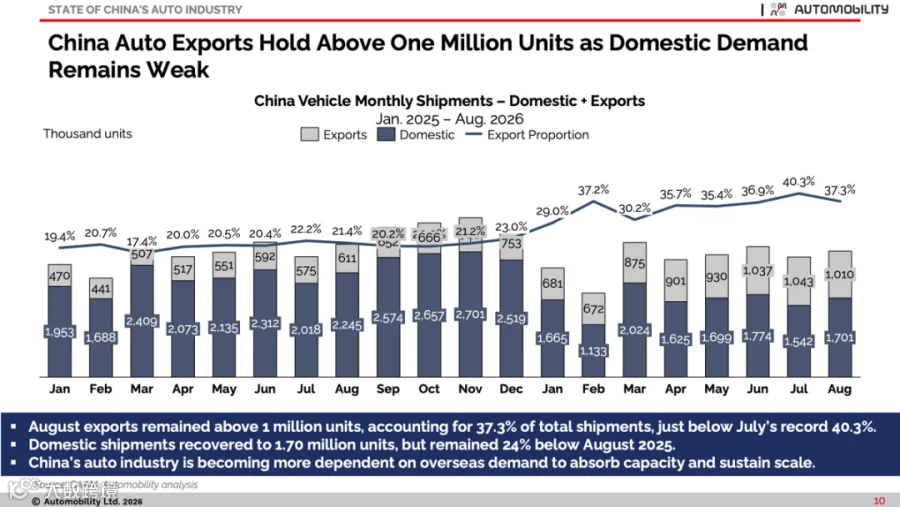
China’s Auto Growth Engine Is Moving Overseas
August reinforces the structural shift underway in China’s auto industry. Exports remained above one million units for a second consecutive month, accounting for 37.3% of total shipments. Domestic shipments recovered sequentially to 1.70 million units, but remained roughly 24% below year-ago levels.
The message is becoming harder to miss: overseas demand is no longer simply absorbing excess capacity—it is becoming essential to sustaining China’s automotive scale. Exports are consistently approaching four in ten vehicles shipped, providing an increasingly important outlet as the domestic market contracts.
This raises the stakes for Going Global 2.0. Exporting from China can support near-term volume, but sustainable globalization requires Chinese automakers to localize production, supply chains, distribution, products, and brands while navigating tariffs, regulation and geopolitical resistance. The winners will be determined not simply by who can export the most vehicles, but by who can successfully become a global operator.
The strategic shift is accelerating: China is evolving from the world’s largest auto market into a global automotive production and technology platform.
China exported 7.15 million vehicles through August—already surpassing the 7.10 million exported in all of 2025, with four months still remaining. Exports are up 66.7% year over year, reinforcing overseas markets as the industry’s primary source of incremental growth.
The export mix is also rapidly electrifying. NEV exports reached 3.44 million units and 48.0% of total exports, up from just 15.3% in 2021. NEVs are now within striking distance of overtaking ICE vehicles as the majority of China’s automotive exports.
Growth, however, is broad-based but far from uniform. Chery remains the largest exporter, adding 543,000 units versus last year, closely followed by BYD at +528,000 and Geely at +471,000. SAIC added 343,000, while Chang’an (+228,000), Tesla (+177,000) and GWM (+132,000) are expanding at substantially slower rates.
The globalization race is beginning to separate the leaders: export scale is rising across the industry, but Chery, BYD and Geely are pulling away fastest.

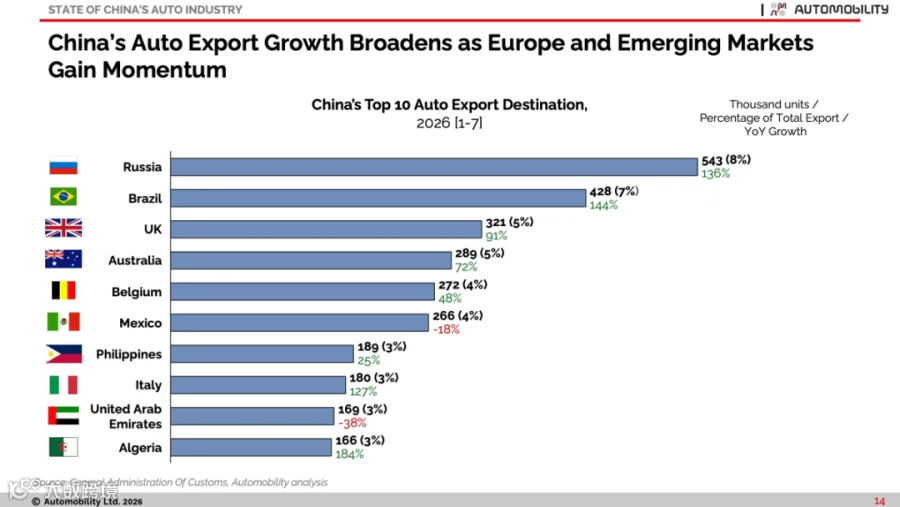
China’s auto export growth is broadening across markets. Russia strengthened its lead through August with 543,000 units, up 136%, while Brazil reached 428,000 units, up 144%. The UK and Australia also continued to post strong gains.
Europe is becoming an increasingly important Made-in-China export destination despite trade barriers. UK exports rose 91%, Belgium 48%, and Italy 127%, demonstrating growing traction in developed markets alongside emerging economies. Algeria surged 184%, further highlighting the geographic breadth of China’s export expansion.
The pattern remains uneven. Mexico fell 18% and the UAE 38%, underscoring the growing influence of trade policy, competitive conditions and individual market dynamics.
The message: China’s export growth is becoming both larger and more geographically diversified—but success is increasingly market-specific, reinforcing the need to shift from exporting vehicles to building a localized global automotive footprint.
China’s Domestic Auto Downturn Is Accelerating the Death of ICE
China’s domestic auto market weakened further through August, with sales down 21.8% to 13.4 million units. But the downturn continues to hit powertrains very differently: ICE sales collapsed 31.6% to 6.2 million units, while NEV sales declined a much smaller 10.8% to 7.2 million.
The divergence is widening. NEVs now outsell ICE vehicles by roughly one million units, even as the overall market contracts sharply. Consumers are not simply buying fewer cars—they are continuing to shift what they buy.
The structural message is clear: China’s downturn is accelerating the replacement of ICE by NEVs, rapidly shrinking the addressable market for ICE-dependent automakers.

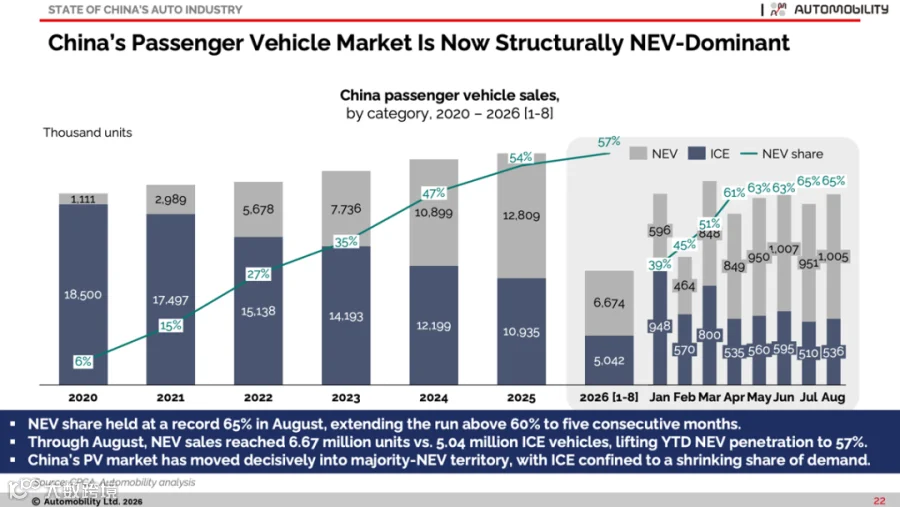
China’s passenger vehicle market has moved decisively into NEV territory. NEVs held a record 65% of sales in August, extending their run above 60% to five consecutive months. Through August, NEV sales reached 6.67 million units versus 5.04 million ICE vehicles, lifting YTD NEV penetration to 57%.
The transition is becoming self-reinforcing. As NEVs become the mainstream choice, the competitive battleground is shifting beyond electrification itself toward intelligent driving, software, user experience, ecosystem integration and cost.
The strategic reality: NEVs are now China’s mass-market center of gravity, while ICE is competing for a structurally shrinking share of demand.
BYD Extends Its Lead as Leapmotor Gains Ground and Competition Intensifies
China’s EV market is consolidating at the top even as competition below the leaders remains intense. Through August, BYD strengthened its lead to 21.7%, while Geely held steady at 11.9%. Leapmotor continued its rapid ascent, reaching 6.4% and consolidating its position in the top five. Notably, BYD and Leapmotor are both pure-play Chinese NEV players, underscoring how the competitive center of gravity is shifting toward companies built entirely around electrification.
The top five now control 54.6% of the market, up from 53.8% through July. Yet model-level competition remains highly fragmented: no individual model commands more than 4% of the market. Geely Xingyuan remains #1, while BYD Ti7 and Leapmotor A10 moved higher in August.
The competitive message is clear: China’s NEV leaders are increasingly native NEV companies, not legacy automakers transitioning from ICE. BYD remains the benchmark, while Leapmotor is emerging as the fastest-rising pure-play challenger.

A second shift is emerging within the NEV market itself: affordable models are returning to the top of the leaderboard. Six of the top 10 models are now priced below RMB 150,000, led by the Geely Xingyuan, with the Leapmotor A10 and Chang’an Q05 also gaining traction. After several months in which premium smart EVs captured much of the attention on early 2026, volume competition is moving decisively back toward the mass market—where affordability, technology democratization and value-for-money increasingly determine scale.

NEVs Widen Their Lead as China’s Auto Market Splits Into Two Competitive Worlds
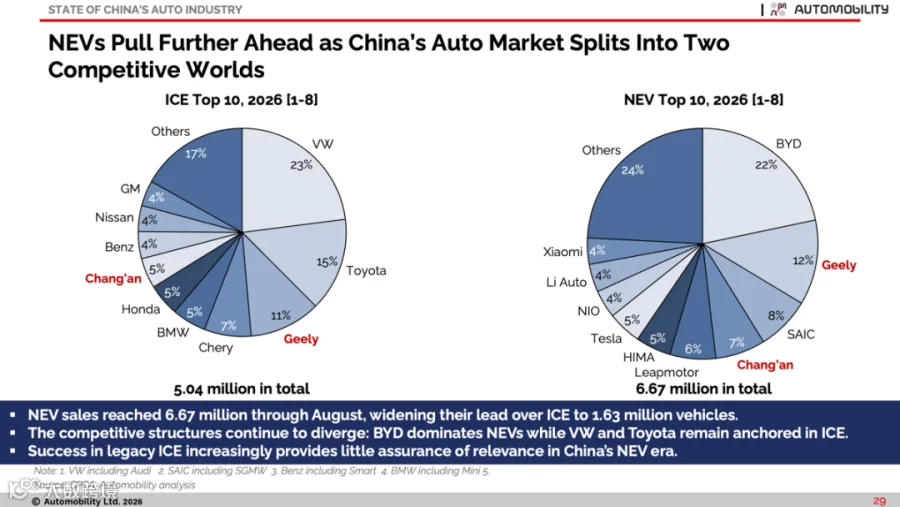
China’s passenger vehicle market is separating into two increasingly distinct competitive ecosystems: a shrinking ICE segment still dominated by legacy foreign OEMs and a larger NEV segment overwhelmingly led by Chinese brands. Through August, NEV sales reached 6.67 million units versus 5.04 million ICE vehicles, widening the gap to 1.63 million units, from 1.16 million through July. Volkswagen and Toyota remain the dominant ICE players, while BYD, Geely, SAIC, Chang’an and Leapmotor lead the NEV market.
The divergence is becoming more pronounced. BYD alone now commands 22% of the NEV market, while Volkswagen and Toyota together account for 38% of ICE. Most strikingly, Geely and Chang’an remain the only two top-10 players spanning both competitive worlds—and both are Chinese. Foreign OEMs remain heavily concentrated in the structurally declining ICE segment, while BYD, Leapmotor, HIMA, NIO and Xiaomi have built their positions overwhelmingly around NEVs.
One notable contrast is Chery. While it remains a major force in China’s ICE market and the country’s largest vehicle exporter, it does not rank among the top 10 NEV players domestically. Its position highlights the challenge facing even successful Chinese legacy automakers: strength in ICE and exports does not automatically translate into leadership in China’s expanding NEV market.
The strategic implication is becoming harder to ignore: legacy ICE scale provides diminishing protection as China moves deeper into the NEV era. Competitive relevance increasingly belongs to NEV-native players—and to the few legacy players, such as Geely and Chang’an, capable of successfully managing both worlds.
Chinese Brands Consolidate Their Lead as Foreign OEMs Retreat
Chinese brands have further consolidated their position, holding a record 73% of China passenger-vehicle shipments through August. More importantly, local-brand shipments are now up 0.8% year over year, improving from just 0.3% through July. Even as the overall passenger-vehicle market contracts, Chinese OEMs are growing—meaning they are capturing virtually all of the market’s available momentum.
The divergence with foreign brands continues to widen. German-brand shipments fell 28.6% and Japanese brands declined 23.2%, both deteriorating further from July. Their losses increasingly look structural rather than cyclical as the market shifts toward NEVs, intelligent vehicles and faster product cycles where Chinese brands hold the advantage.
U.S. brands remain the exception, growing 7.1%, but this resilience is supported heavily by China-made exports rather than domestic market strength. The broader trajectory is unmistakable: China’s competitive center of gravity has shifted decisively toward domestic brands, while German and Japanese OEMs face a rapidly shrinking addressable market.

BYD Extends Its Lead as NEV Players Reshape China’s Auto Hierarchy
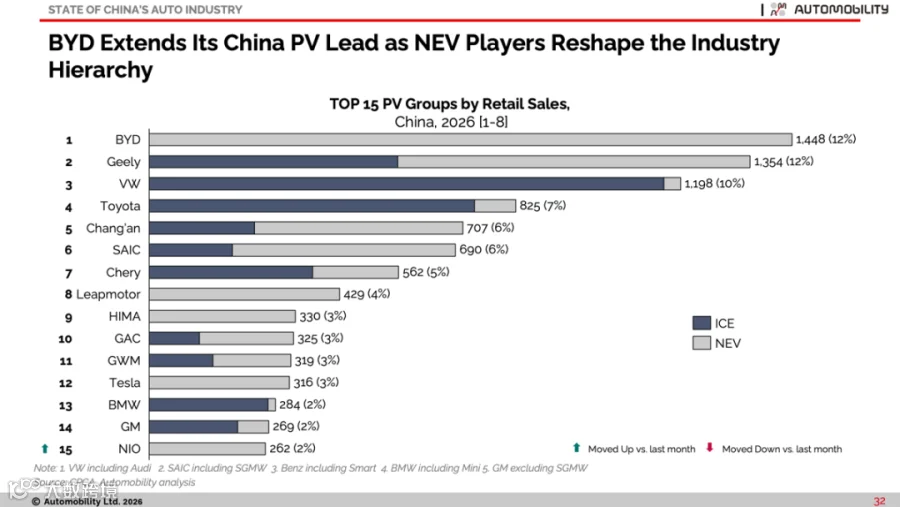
The August rankings reinforce the structural reshuffling of China’s passenger-vehicle market. BYD extended its lead with 1.45 million retail sales, pulling further ahead of Geely at 1.35 million and Volkswagen at 1.20 million. The composition of those volumes matters: BYD is a pure-play NEV leader, Geely increasingly straddles both ICE and NEVs, while Volkswagen remains overwhelmingly dependent on a shrinking ICE market.
The transformation is also visible further down the rankings. Leapmotor holds eighth place with 429,000 sales, HIMA ninth with 330,000, Tesla twelfth with 316,000, and NIO has entered the top 15. Four pure-play NEV players now rank among China’s 15 largest passenger-vehicle groups, demonstrating how quickly the competitive hierarchy is being rebuilt around electrification.
The strategic message is increasingly clear: NEV capability is no longer simply determining who wins the EV market—it is reshaping who has scale and relevance in China’s overall passenger-vehicle market.
Conclusion: China’s Auto Market Is Selecting Winners
China’s auto transition has moved beyond electrification. NEVs now dominate passenger-vehicle demand, Chinese brands hold 73% share of production volume, and BYD has extended its overall market lead. The question is no longer whether EVs win—it is who wins the EV era.
The competitive divide is widening fast. ICE sales have collapsed nearly 32% through August, hitting German and Japanese OEMs particularly hard. BYD is consolidating its leadership, Leapmotor is the breakout challenger, and Geely and Chang’an show that legacy players can remain relevant by successfully bridging ICE and NEV. Meanwhile, affordable EVs are returning to the top of the rankings, pushing competition toward intelligence at mass-market prices.
The other battlefield is global. China exported 7.15 million vehicles in eight months—already exceeding full-year 2025—with NEVs approaching half of exports. But exporting is only the first step. The real winners must convert volume into sustainable global businesses.
Electrification created the new competitive order. Intelligence, affordability and globalization will determine who survives—and who leads it.
2026 AmCham Shanghai Automotive Conference [September 17]
From Electrification to Intelligence
JW Marriott Hotel Tomorrow Square Shanghai
399 Nanjing West Road (Cnr. North Huangpi Road)
China's automotive industry is entering a new chapter of transformation. What began as a revolution in electrification is rapidly evolving into a broader shift toward AI-powered smart mobility, redefining how vehicles are designed, manufactured, and experienced. Cars are no longer viewed simply as a means of transportation; they are becoming intelligent, connected platforms that seamlessly integrate into consumers' daily lives.
The American Chamber of Commerce in Shanghai's Automotive Committee is excited to present the 2026 Automotive Conference: From Electrification to Intelligence on Thursday, September 17, 2026, from 8:30 a.m. to 5:30 p.m.. at the JW Marriott Tomorrow Square Shanghai.
The conference will explore the four key dimensions driving the industry's next phase of growth and transformation:
- Intelligence
— Advancements in AI, advanced driver-assistance systems (ADAS), autonomous driving, and connected vehicle technologies. - Economics
— Sustainable business models, profitability, and competitive strategies in an increasingly dynamic and price-sensitive market. - Infrastructure
— The development of energy networks and supporting infrastructure, including charging systems, energy storage, and the growing convergence of mobility and energy ecosystems. - Globalization
– Examining the global expansion of Chinese companies, including export growth, international market entry strategies, cross-border partnerships, and localization in global markets.
As China continues to play a pivotal role in shaping the future of mobility, this conference will serve as a platform for meaningful dialogue, collaboration, and strategic thinking among industry leaders, innovators, policymakers, and business executives. Don't miss it!
2026 Automotive Conference 上海美国商会汽车论坛 | AmCham Shanghai
Keynote Speech at AutoBranchen Danmark’s Annual Day 2026 [September 24]
On September 24, I’ll be in Brande, Denmark, to deliver the keynote address at AutoBranchen Danmark’s Annual Day 2026.
The global automotive industry is undergoing a historic transformation. I’ll examine the state of the industry in Europe, the United States, and Japan; the growing competitive challenge from China; and the forces reshaping mobility worldwide. Most importantly, I’ll discuss what these changes mean for automotive dealers and the aftermarket.
I’m grateful to AutoBranchen Danmark for the invitation and look forward to exchanging perspectives with industry leaders at Remisen Brande.
📅 September 24, 2026
📍 Remisen Brande, Brande, Denmark
Robotics Workshop at Bonny Doon [October 6]
I will be speaking on a panel at the upcoming Robotics Workshop at Bonny Doon. It will be a very full day with lots of startups and other great sessions planned. The panel topis is Economics, Geopolitics and Robotics Strategy, and includes:
Howard Chao,Doon Insights (Moderator)
Rebecca Fannin,Silicon Dragon Ventures
Bill Russo,Automobility Limited
Justin Savage,Sidley

AUTO INSIDER PODCAST

🎙️ Auto Insider – Episode 7: “Smartphone on Wheels: How AI Is Redefining the Automotive Industry”
🚗 What happens when the car becomes a smart device — and AI becomes the intelligence layer that connects the vehicle, the driver, and the wider digital ecosystem?
In this upcoming episode of Auto Insider, I sit down with Peter Cirino , Chief Operating Officer of ECARX, to explore how software, AI, and new technology platforms are reshaping the automotive industry.
We discuss:
-
🧠 How AI is changing the in-vehicle experience -
💻 Why software-defined vehicles are only the beginning -
🔗 How cars are becoming part of a broader digital ecosystem -
🤝 Why the traditional OEM–supplier model is evolving toward deeper technology partnerships -
🇨🇳 Why China has become one of the world’s fastest automotive innovation laboratories -
🚘 How autonomy, voice interfaces, and edge computing could redefine mobility by 2030
⚡ The big takeaway:
The future of automotive competition will be less about who owns every piece of the technology stack — and more about who can best integrate hardware, software, AI, and ecosystems into a seamless user experience.
📲 Scan the QR code in the image to watch prior episodes of Auto Insider and subscribe to the Automobility Ltd YouTube channel so you don’t miss this and future conversations.
🎙️ Catch up on the latest episodes of the Auto Insider Podcast hosted by Bill Russo, featuring insights from the front lines of China’s mobility transformation — where speed, scale, and strategy are redefining global competition.
🌏 Episode #6: From Tier-1 to System Architect: Aptiv at China Speed, Global Scale with Simon Yang,President, China & Asia Pacific, Aptiv
🌏 Episode #5: Safety Without Borders: How Autoliv Drives Scaled Collaboration in the Smart Mobility Era with Sng Yih, President, Autoliv China
🌏 Episode #4: Leapmotor’s Global Leap — A New Paradigm for Global EV Collaboration with Michael Wu, Co-President, Leapmotor
🚗 Episode #3: Competing at China Speed: A Tier-1 Perspective from Magna with Zhen Wu, President of Magna China
🦋 Episode #2: The Butterfly Effect—How China’s Auto Shift is Reshaping the World with Dr. Xiaozhi Liu, Founder and CEO of ASL Automotive, Former CEO of Fuyao Glass
🔧 Episode #1: Smart EVs and the Smart Tier 0.5 Supply Chain with Jack Cheng , Co-Founder of NIO and CEO of M-Mobility
We’re just getting started — more conversations coming soon with the visionaries shaping the future of mobility.
You can follow us for regular updates on these online channels by scanning the QR codes:

If your organization would like a custom briefing on the State of China’s Auto Market, please reach out to us at info@automobility.io
About Bill Russo
Bill is a contributing author to the book Selling to China: Stories of Success, Failure, and Constant Change (2023), where he describes how China has become the most commercially innovative place to do business in the world’s auto industry - and why those hoping to compete globally must continue to be in the market.
About Automobility
Contact us by email at info@automobility.io
PLEASE NOTE: The information and analysis shared in this newsletter, including the charts and style of materials presented, is the intellectual property of Automobility Ltd. While we share it as a way to serve our existing and new clients, it is not to be used without our express consent and then only with attribution. Any publication, reproduction or other use of this material without the express written consent of Automobility Ltd is prohibited.