
大数跨境

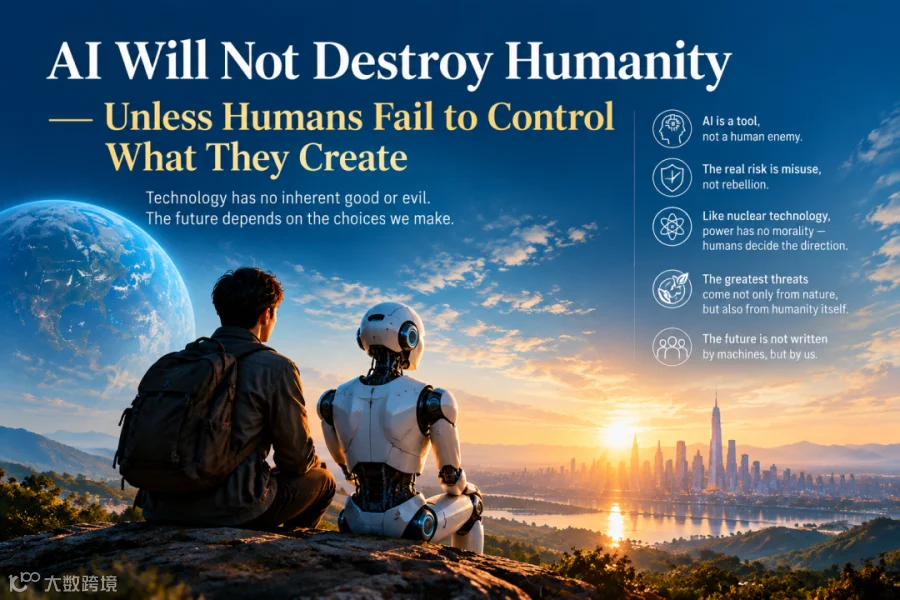
Humans Are the Creators of Robots: AI Will Not Naturally Become the Terminator of Humanity
Humans Are the Creators of Robots: AI Will Not Naturally Become the Terminator of Humanity 稀土产业研究
2026-09-12
5

In recent years, warnings that artificial intelligence could “destroy humanity” have become increasingly common.
Some figures in the AI community have argued that future highly intelligent AI systems may pose existential risks to human civilization. The media has often amplified these concerns into narratives of “machine awakening” and “AI extinction,” creating widespread anxiety about the future of technology.
However, a closer examination reveals that many arguments about AI destroying humanity actually confuse two fundamentally different questions:
Will AI develop an autonomous will that is hostile to humanity, like the machines portrayed in science fiction?
And:
Could humans, through poor design, misuse, or governance failures, turn AI into a dangerous tool?
These are two completely different issues.
The real challenge is not whether AI will suddenly develop human-like malicious intentions, but whether humanity can responsibly manage the powerful technologies it creates.

1. The Nature of AI Means It Is Not Naturally an Enemy of Humanity

Artificial intelligence is, fundamentally, an information-processing system created by humans.
Its algorithms are designed by humans, its training data comes from human knowledge, its objectives are defined by humans, and its applications are determined by human choices.
No matter how advanced AI becomes in the future, it will still exist within the technological systems created by human civilization.
In this sense:
Humans are the creators of robots and the ultimate bearers of responsibility for artificial intelligence.
A robot, no matter how intelligent, does not automatically develop human-like desires, ambitions, or moral judgments simply because it possesses enormous computing power.
Intelligence is not the same as consciousness.
Computational ability is not the same as will.
Reasoning capability is not the same as moral choice.
Therefore, imagining AI as a life form that will awaken and rebel against its creators is closer to science fiction than to a rigorous technological assessment.
AI will not become humanity’s enemy simply because it becomes more intelligent.

2. The Real Risk of AI Is Not “Betrayal,” but Misuse and Loss of Control

This does not mean artificial intelligence has no risks.
Every powerful technology carries both opportunities and dangers.
The greatest risk of AI is not that it will suddenly develop hatred toward humans, but that:
a powerful system, given flawed objectives, excessive authority, or insufficient oversight, may produce consequences beyond human expectations.
History shows that technological risks rarely come from tools themselves having malicious intentions. They often arise because humans fail to properly manage the relationship between themselves and their creations.
The internet was originally designed to improve communication and information sharing, but it also created challenges such as cyberattacks, misinformation, and social fragmentation.
Biotechnology can cure diseases, but it can also be misused.
Nuclear technology can provide energy, but it can also create weapons of mass destruction.
Technology itself does not determine humanity’s destiny.
The direction is determined by the people who control and use it.

3. Nuclear Technology Demonstrates That Power Itself Has No Morality — Human Choice Determines the Outcome

Nuclear technology provides perhaps the clearest example.
The same principle of nuclear fission can:
create nuclear weapons capable of destroying cities;
generate electricity to support human development;
support medical applications that save lives.
Nuclear technology itself does not choose peace or war.
It simply amplifies human capabilities.
When humanity possesses responsibility, rules, and restraint, technology can advance civilization.
When humanity is driven by conflict, greed, and short-term interests, technology can become a destructive force.
Artificial intelligence is no different.
AI can help humanity push scientific boundaries, improve productivity, and solve complex problems.
But it can also be used for malicious competition, cyberattacks, manipulation of information, or warfare.
Therefore, the real question is not:
“Can AI become evil?”
The real question is:
“Can humanity responsibly manage the power it has created?”

4. Creators Have Responsibility, but They Must Recognize the Complexity of Systems

Some argue:
“Since humans created AI, humans can always simply shut it down.”
There is some truth in this argument.
AI infrastructure, hardware, energy supplies, and operating environments are currently controlled by humans.
Humanity still possesses ultimate physical control.
However, modern society also teaches us an important lesson:
Having control over the creation process does not mean having unlimited ability to predict every consequence.
Financial systems were created by humans, yet no individual can completely predict market behavior.
The internet was created by humans, yet its social consequences have gone far beyond the expectations of its original designers.
The challenge of complex systems is not that they possess independent will, but that their interactions can generate outcomes beyond the prediction capacity of any single actor.
Therefore, the future governance of AI should not rely on the assumption that problems will never occur.
Instead, humanity must build:
effective human oversight;
clear limits on system authority;
reliable safety mechanisms;
transparent accountability systems.
A mature civilization is not one that believes it will never make mistakes.
It is one that has the ability to prevent mistakes from becoming catastrophic.

5. The Greatest Threats to Humanity Come Not Only from Nature, but Also from Humanity Itself

Throughout history, civilization has faced two major categories of threats.
The first is nature.
Earthquakes, climate change, pandemics, and cosmic events represent challenges beyond human control.
The second is humanity itself.
Wars, extremism, struggles for power, and poor decisions have often posed the greatest dangers to civilization.
History repeatedly shows:
The greatest danger is not that tools possess power, but that powerful tools are controlled without sufficient responsibility.
Fire transformed human civilization, but it also became a weapon.
Industrial technology improved human life, but also created environmental challenges.
Nuclear technology reshaped global security, but also introduced existential risks.
Artificial intelligence will follow the same pattern.
It will not automatically determine humanity’s future.
Ultimately, humanity’s future will be determined by human choices.

6. Humanity Will Not Lose Its Central Role Because of AI

The development of artificial intelligence is not the end of human creativity and leadership.
It is a test of humanity’s ability to act responsibly in an era of powerful technology.
The more capable AI becomes, the more important it is for humanity to answer fundamental questions:
Who defines the goals?
Who holds the final authority?
Who bears the ultimate responsibility?
The ideal relationship between humans and AI should not be a competition for survival, but a partnership:
Humans provide values and judgment.
AI provides expanded capabilities.
Humans determine direction.
AI improves efficiency.
Humans retain ultimate responsibility.
AI serves as a tool of civilization.
Therefore, instead of fearing that AI will replace humanity, we should ask a more important question:
Can humanity become a civilization worthy of the powerful technologies it creates?
The real danger is not that AI gains god-like power.
The real danger is that humanity, driven by greed, fear, or short-term interests, gives powerful tools to destructive purposes.
AI will not naturally become the terminator of humanity.
But humanity must always remember:
Those who create tools must also take responsibility for controlling them.
Technology determines the boundaries of capability; humanity determines the direction of civilization.
The future of humanity will not ultimately be decided by machines, but by the people who create and use them.

【声明】内容源于网络
0
0
稀土产业研究
稀土产业链深度研究报告与资讯。稀土之于我,不只是产业,更是一种恒定的牵引力;我就像那不参与化学反应的 4f 电子,始终在内层轨道守望着它。
内容 487
粉丝 0
稀土产业研究 稀土产业链深度研究报告与资讯。稀土之于我,不只是产业,更是一种恒定的牵引力;我就像那不参与化学反应的 4f 电子,始终在内层轨道守望着它。
总阅读8.6k
粉丝0
内容487