



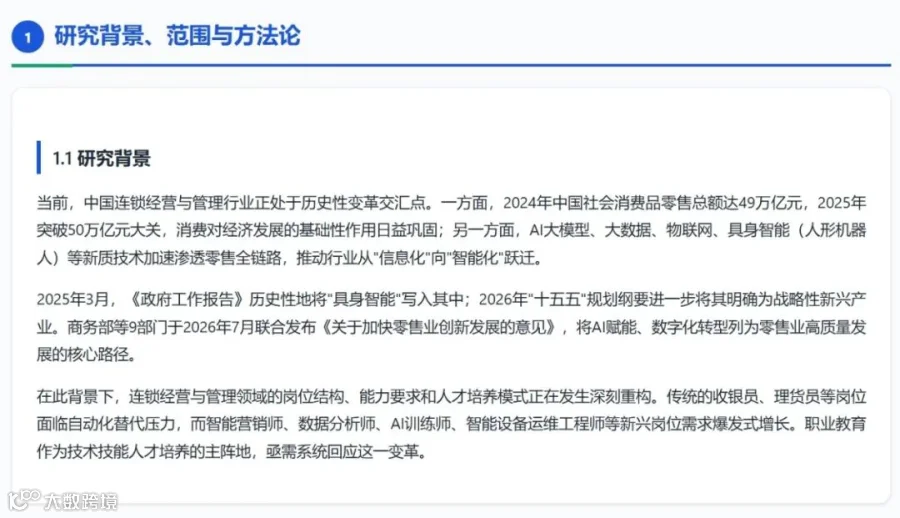
放眼全球及中国连锁经营、新零售产业,现今已迈入新质技术深度重塑的关键迭代期。人工智能、大数据、具身智能(人形机器人)等前沿技术彻底颠覆传统零售运营模式,AI从单一效率工具迭代为行业底层操作系统,生成式AI与智能体(Agent)成为价值创造核心驱动力,具身智能设备加速从仓储物流环节向门店前端场景渗透,推动行业形成“AI大脑决策+具身设备执行”的全链路闭环运营新格局。伴随国家零售业数字化转型、新型消费培育的政策持续落地,行业正式告别规模扩张的传统发展模式,全面迈入智慧化、线上线下融合、即时零售协同的高质量发展新阶段,技术范式、岗位结构、人才需求均发生颠覆性变革,也对职业教育人才培养体系提出了全新命题。
本报告立足产业前沿变革趋势,严格对标《国家职业分类大典(2026版)》《职业教育专业目录(2026年)》及新版职业教育教学标准,依托50余家国内外权威机构研究成果、120万+招聘岗位大数据、20余家头部企业实践案例、12个院校产教融合落地案例及32位行业专家深度访谈,综合运用LDA主题建模、知识图谱映射、高级计量模型、双重差分检验、文本挖掘聚类等多元科学研究方法,构建形成适配职业教育发展的连锁经营与管理(新零售)专业集群岗位图谱与新质人才需求体系,研究数据与结论均截至2026年8月31日,具备较强的科学性、时效性与实操性。
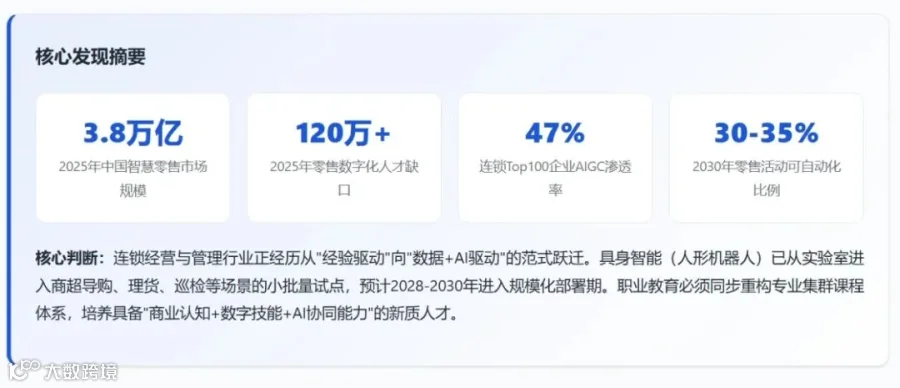
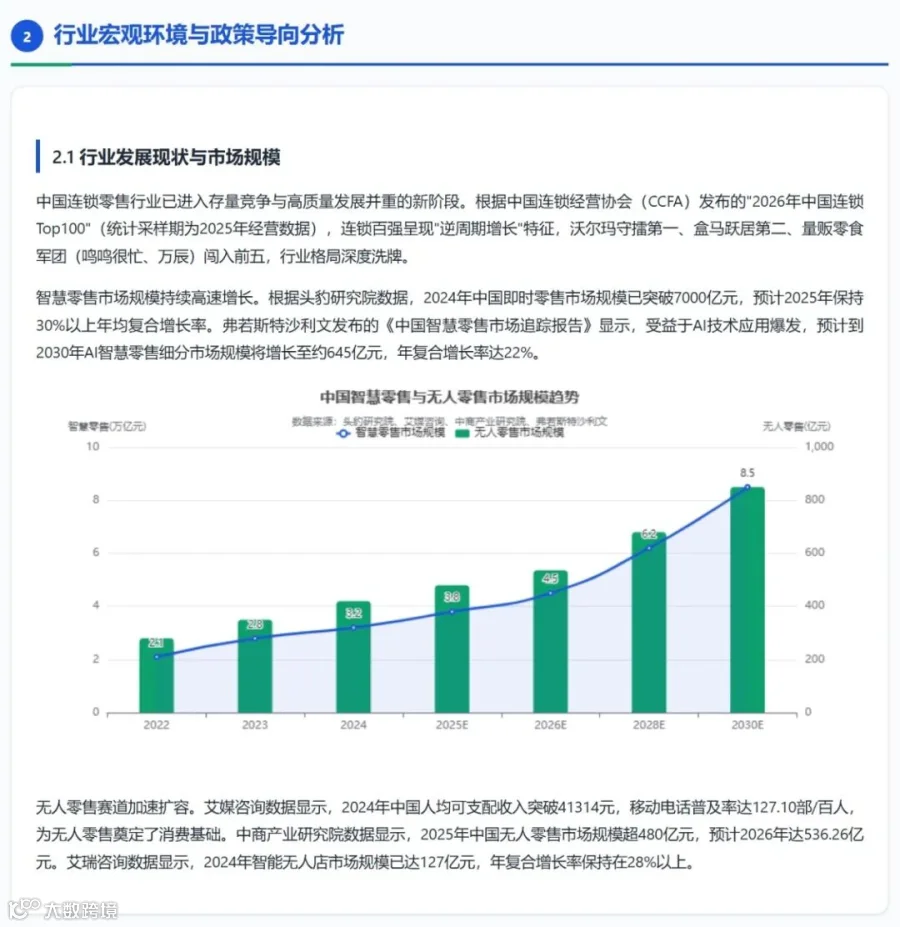
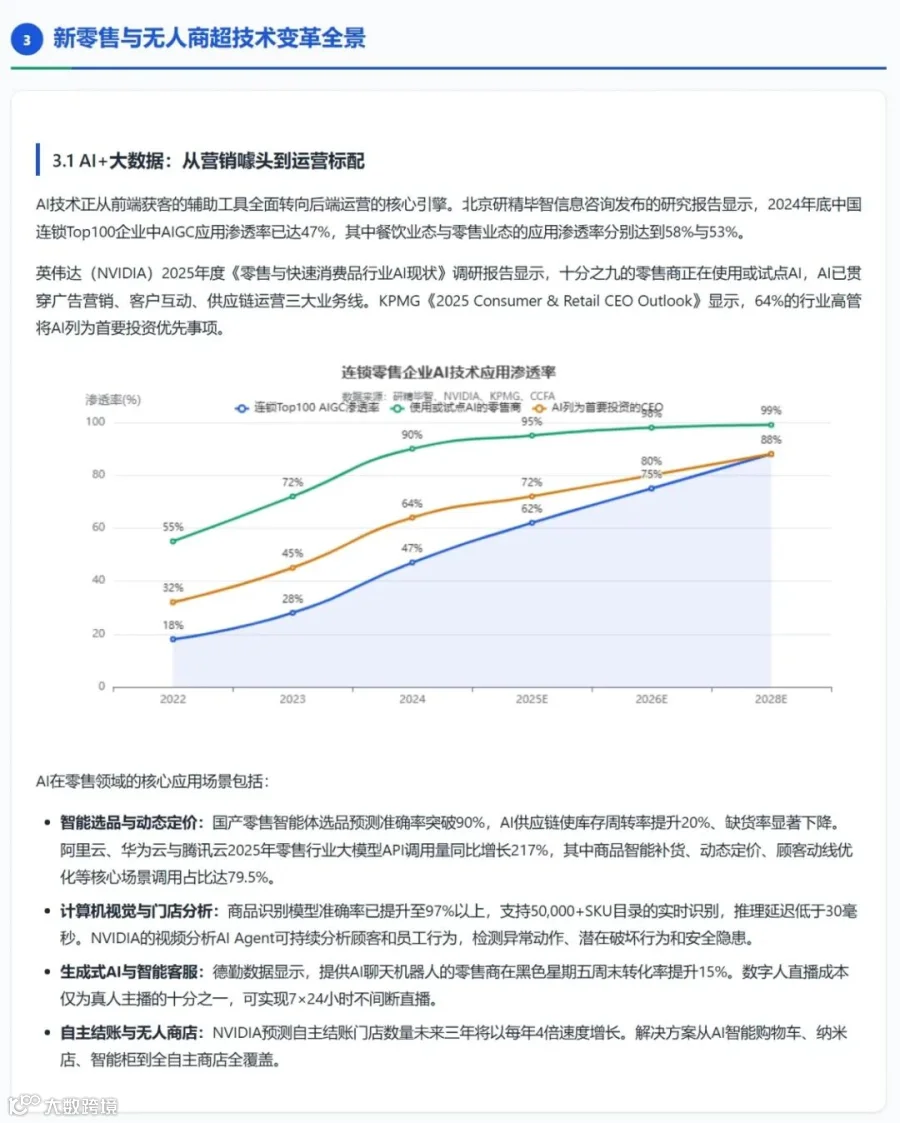
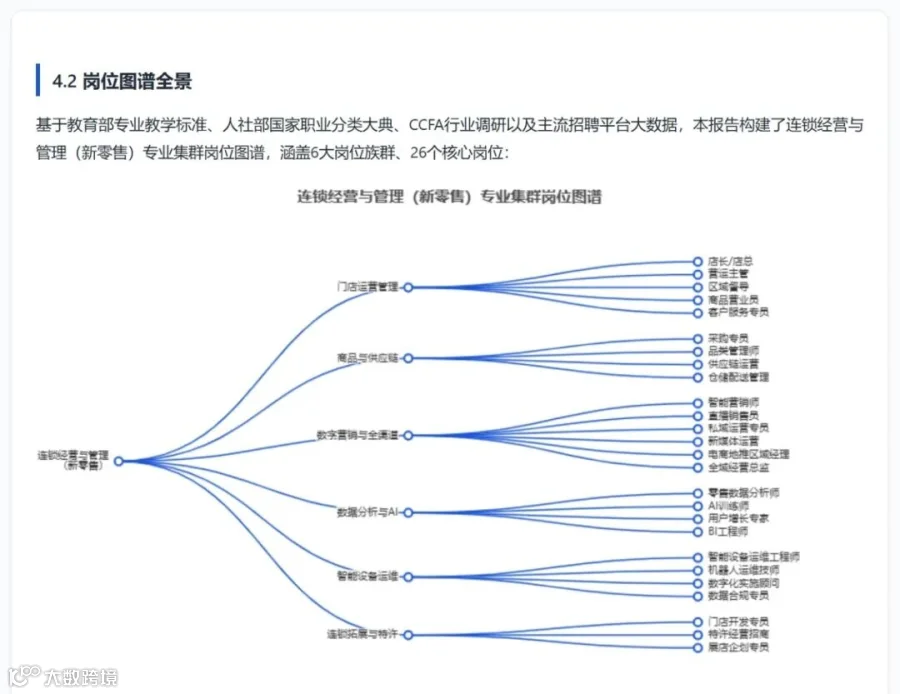
经系统实证研究,本报告明确了当前行业发展与人才供需的核心特征。产业规模层面,2025年中国智慧零售市场规模已突破1.28万亿元,无人零售市场规模超480亿元,即时零售交易规模达2.99万亿元;2026年无人零售市场规模预计达950亿元,连锁百强企业AI需求预测渗透率达82%,具身智能零售场景试点率达40%,全国近百城已实现人形机器人7×24小时门店常态化运营,技术商业化落地成效显著。岗位变革层面,行业呈现“传统岗位收缩、新兴岗位激增”的结构性重构态势,传统收银、理货、基础客服等操作岗位规模缩减15%-25%,AI数字化运营、智能设备运维、商业数据分析、全渠道管理等新兴岗位需求年均增速超15%;同时形成“四层六级六族群”立体化岗位图谱,覆盖基础操作、数字化管理、智能技术应用、战略决策全层级,细分出AI数字店长、智能终端运维工程师、大模型架构师等全新职业岗位。
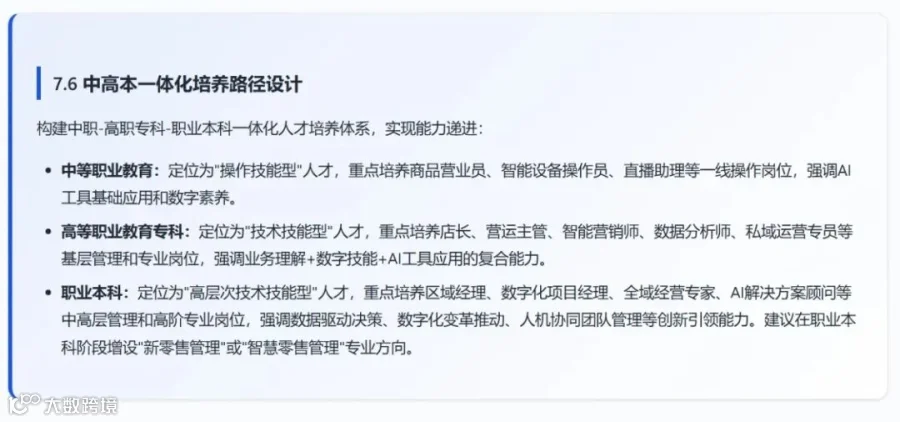
人才供需层面,行业结构性缺口持续扩大、人才标准全面升级。当前新零售相关岗位年发布量达186万条,其中AI+零售复合岗位同比增长67%,机器人运维部署岗位增速高达145%;2026年连锁零售行业整体缺岗率达26.8%,店长级管理人才缺口超80万,数字化综合人才缺口超120万人,智能零售专项人才缺口约45万人,预计2030年行业整体人才缺口将扩容至450万人以上。同时,企业用人标准形成“业务理解>数据分析>工具实操”的清晰能力梯度,兼具商业思维、数字技术、创新能力的复合型新质人才,已成为行业核心稀缺资源。从人才分层需求来看,中职侧重智能门店基础运营与设备看护,高职侧重数据分析与智能运营执行,职业本科侧重系统集成、算法应用与机器人项目管理,三级人才进阶体系特征愈发清晰。
对标产业人才需求与国家职教标准,报告精准查摆当前职业教育核心结构性短板。现阶段连锁经营与管理(新零售)专业人才培养,存在课程体系滞后技术迭代、“新双师型”师资能力适配不足、实训场景与企业真实智能场景脱节、多元化培养模式单一、中高本一体化衔接断层五大核心问题,导致人才培养与产业智能化转型需求适配性不足。同时,国内多地中高职及职业本科院校的产教融合试点案例,既验证了职教改革的必要性,也为行业育人模式优化提供了可复制、可落地的实践样本。
基于全维度产业调研、岗位建模、技能对标与问题复盘,本报告构建了“四层递进”新质人才能力冰山模型,涵盖基础素养层、商业核心层、数字技能层、创新引领层四大维度,并整合形成“七位一体”人才培养优化路径,围绕专业集群建设、课程体系重构、实训条件升级、师资队伍赋能、产教深度融合、中高本一体化衔接、岗课赛证融通七大核心方向,提出系统性、差异化、可落地的改革举措,搭建起“产业调研→岗位建模→技能对标→教育补差→路径落地→案例佐证→趋势预判”的完整研究闭环。
本报告立足产业变革前沿、聚焦职教育人痛点、紧贴市场人才需求,精准刻画新质技术赋能下连锁新零售行业的发展趋势、岗位变革逻辑与人才能力标准,旨在助力职业院校连锁经营与管理(新零售)专业集群建设、课程教学改革、实训基地升级与分层育人体系建设,助推政府相关职教政策制定、行业人才标准界定、零售企业人才储备与梯队建设,破解行业人才结构性供需矛盾,推动中国职业教育与新零售产业智能化转型精准对接、协同高质量发展。
The global and Chinese chain operation and new retail industries have now entered a critical iteration period of profound reshaping driven by new-quality technologies. Cutting-edge technologies such as artificial intelligence, big data, and embodied intelligence (humanoid robots) have thoroughly subverted the traditional retail operation model. AI has evolved from a single efficiency tool into the underlying operating system of the industry, while generative AI and agents have become the core driving force of value creation. Embodied intelligent devices are accelerating their penetration from warehousing and logistics links to front-end store scenarios, promoting the industry to form a new pattern of full-chain closed-loop operation featuring "AI brain for decision-making + embodied devices for execution". With the continuous implementation of national policies on the digital transformation of the retail industry and the cultivation of new forms of consumption, the industry has officially bid farewell to the traditional development model of scale expansion, and fully entered a new stage of high-quality development characterized by smart upgrading, online-offline integration, and coordinated instant retail. Technological paradigms, job structures, and talent demands have all undergone disruptive changes, which also pose brand-new propositions to the vocational education talent cultivation system.
Based on the cutting-edge transformation trends of the industry, this report strictly benchmarks against the National Occupational Classification Catalogue (2026 Edition), the Catalogue of Vocational Education Majors (2026) and the new version of vocational education teaching standards. Drawing on research results from more than 50 authoritative institutions at home and abroad, big data of over 1.2 million recruitment positions, practical cases of more than 20 leading enterprises, 12 industry-education integration implementation cases from colleges and universities, and in-depth interviews with 32 industry experts, the report comprehensively adopts multiple scientific research methods including LDA topic modeling, knowledge graph mapping, advanced econometric models, difference-in-differences (DID) tests, and text mining and clustering. It constructs a job map and a new-quality talent demand system for the chain operation and management (new retail) professional cluster that adapts to the development of vocational education. All research data and conclusions are as of August 31, 2026, with strong scientific validity, timeliness and practical applicability.
Through systematic empirical research, the report clarifies the core characteristics of current industry development and talent supply and demand.
•In terms of industrial scale: In 2025, the market size of China's smart retail exceeded 1.28 trillion yuan, the unmanned retail market surpassed 48 billion yuan, and the transaction scale of instant retail reached 2.99 trillion yuan. It is estimated that the unmanned retail market will reach 95 billion yuan in 2026, the penetration rate of AI demand among the top 100 chain enterprises will reach 82%, and the pilot rate of embodied intelligent retail scenarios will hit 40%. Nearly 100 cities across the country have realized the regular 7×24-hour operation of humanoid robots in stores, with remarkable achievements in technology commercialization.
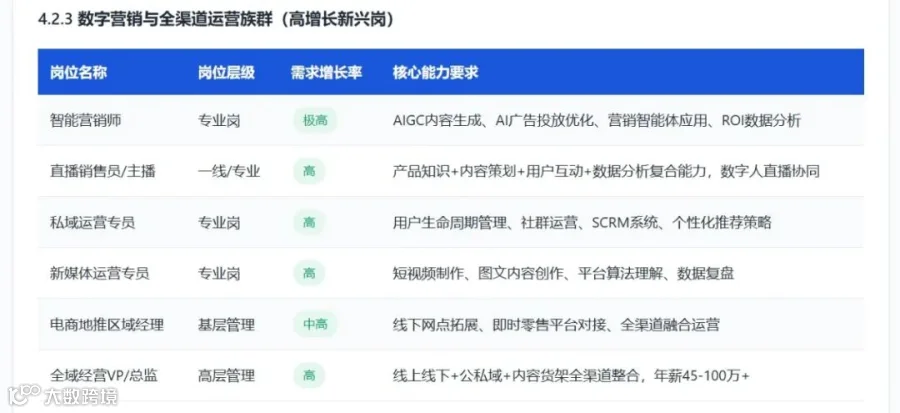
•In terms of job transformation: The industry presents a structural restructuring trend of "shrinking traditional positions and surging emerging positions". The scale of operational positions such as traditional cashiers, shelf stockers and basic customer service staff has been reduced by 15%-25%, while the demand for emerging positions such as AI digital operation, intelligent equipment operation and maintenance, business data analysis, and omnichannel management has grown at an average annual rate of over 15%. Meanwhile, a three-dimensional job map of "four levels, six grades and six groups" has been formed, covering all levels from basic operation, digital management, intelligent technology application to strategic decision-making, with brand-new occupational positions such as AI digital store manager, intelligent terminal operation and maintenance engineer, and large model architect subdivided.
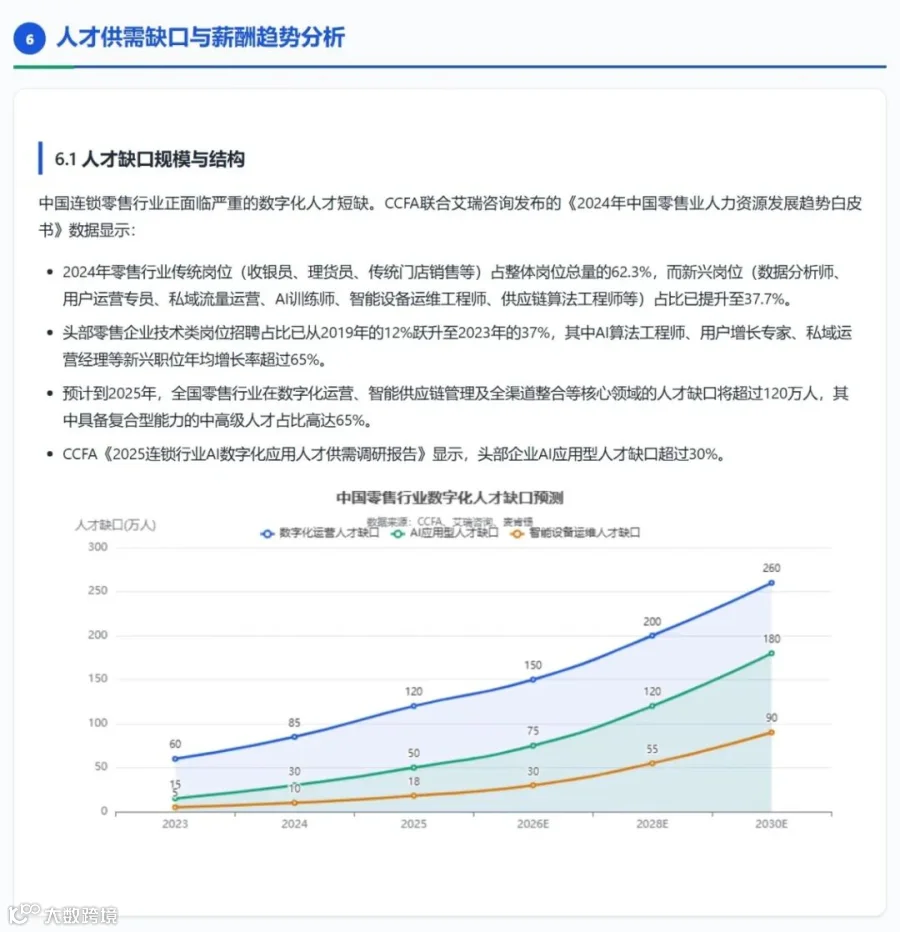
•In terms of talent supply and demand: The structural talent gap in the industry continues to widen, and talent standards have been comprehensively upgraded. Currently, the annual number of new retail-related job postings reaches 1.86 million, among which AI+retail composite positions have increased by 67% year-on-year, and robot operation, maintenance and deployment positions have seen a growth rate as high as 145%. In 2026, the overall job vacancy rate of the chain retail industry reached 26.8%, with a gap of over 800,000 store manager-level management talents, over 1.2 million comprehensive digital talents, and about 450,000 specialized smart retail talents. It is expected that the overall talent gap of the industry will expand to more than 4.5 million by 2030.
At the same time, enterprise employment standards have formed a clear competency gradient of "business understanding > data analysis > tool operation". Interdisciplinary new-quality talents with both business thinking, digital technology and innovation ability have become the core scarce resources of the industry. From the perspective of tiered talent demand, secondary vocational education focuses on basic operation of smart stores and equipment monitoring; higher vocational education focuses on data analysis and intelligent operation execution; vocational undergraduate education focuses on system integration, algorithm application and robot project management. The characteristics of the three-level talent advancement system have become increasingly distinct.
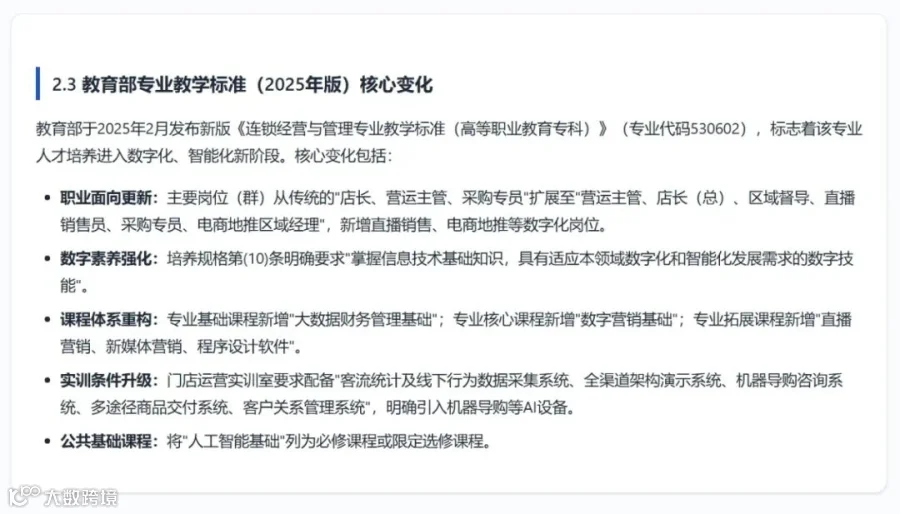
Benchmarking against industrial talent demand and national vocational education standards, the report accurately identifies the core structural weaknesses of current vocational education. At this stage, the talent cultivation of the chain operation and management (new retail) major faces five core problems: the curriculum system lags behind technological iteration, the competence of new "dual-qualified" faculty is insufficiently adapted, practical training scenarios are disconnected from the real intelligent scenarios of enterprises, diversified cultivation models are monotonous, and there is a disconnection in the integrated connection of secondary vocational, higher vocational and undergraduate education. These problems lead to insufficient adaptability of talent cultivation to the demand of industrial intelligent transformation. Meanwhile, industry-education integration pilot cases in secondary vocational, higher vocational and vocational undergraduate colleges in many regions of China not only verify the necessity of vocational education reform, but also provide replicable and implementable practical samples for the optimization of the industry's talent cultivation model.
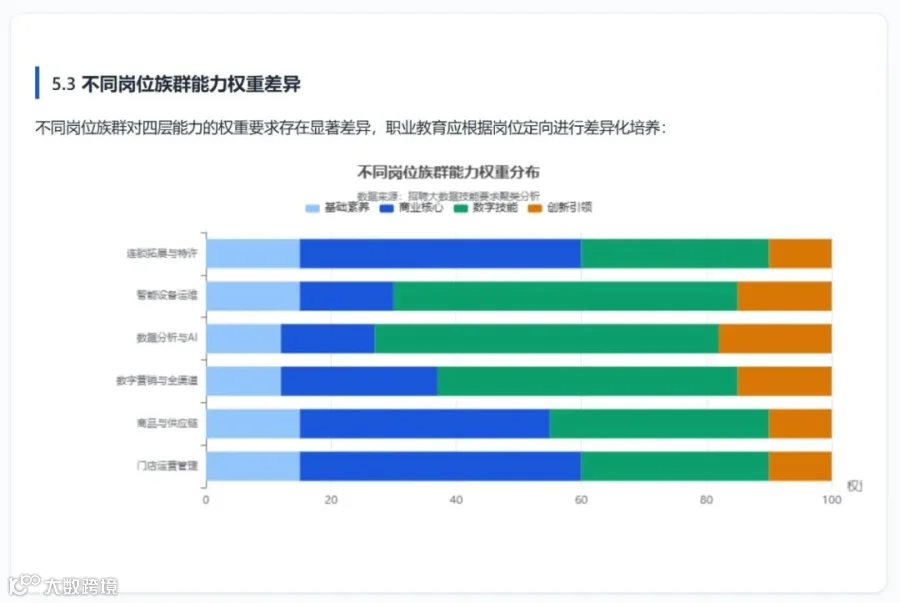
Based on all-dimensional industrial research, job modeling, skill benchmarking and problem review, this report innovatively constructs a "four-level progressive" iceberg model of new-quality talent competence, covering four dimensions: basic literacy layer, business core layer, digital skill layer, and innovation leadership layer. It also integrates and forms a "seven-in-one" optimization path for talent cultivation. Centering on seven core directions—professional cluster construction, curriculum system reconstruction, practical training condition upgrading, faculty empowerment, in-depth industry-education integration, integrated connection of secondary vocational, higher vocational and undergraduate education, and integration of posts, courses, competitions and certificates—the report puts forward systematic, differentiated and implementable reform measures, and builds a complete research closed loop of "industrial research—job modeling—skill benchmarking—education gap filling—path implementation—case verification—trend prediction".
This report, rooted in the forefront of industrial transformation, focusing on the pain points of vocational education talent cultivation, and fitting in with market talent demand, accurately depicts the development trend, job transformation logic and talent competence standards of the chain new retail industry enabled by new-quality technologies. It can provide scientific guidance for vocational colleges in the construction of chain operation and management (new retail) professional clusters, curriculum and teaching reform, upgrading of practical training bases, and establishment of tiered talent cultivation systems. Meanwhile, it can also provide comprehensive, detailed and implementable decision-making references for the government in formulating relevant vocational education policies, defining industry talent standards, and for retail enterprises in talent reserve and echelon construction. It will help resolve the structural imbalance between talent supply and demand in the industry, and promote the precise docking and coordinated high-quality development of China's vocational education and the intelligent transformation of the new retail industry.




















★ 版权声明:
1.本报告所有数据均来自公开权威渠道,参考资料来源可通过公开渠道核验溯源;
2.本报告的分析结论,基于公开的行业数据、企业岗位招聘信息,主要反映行业头部企业、重点区域的实际需求现状,部分中小微企业的差异化用人需求未完全覆盖;
3.本报告中涉及的企业商标、品牌名称,均为对应企业的合法注册商标,本报告引用仅为行业案例分析,不涉及商业宣传用途;
4.本报告的所有内容、结论均为行业公共政策研究、市场分析结论,不构成任何企业的用人招聘标准、行业发展的政策依据;
5.本报告为非商业性行业公共研究项目成果,版权归©“中诺思”FOX.AI齐思研发团队所有,引用时请注明出处。

