


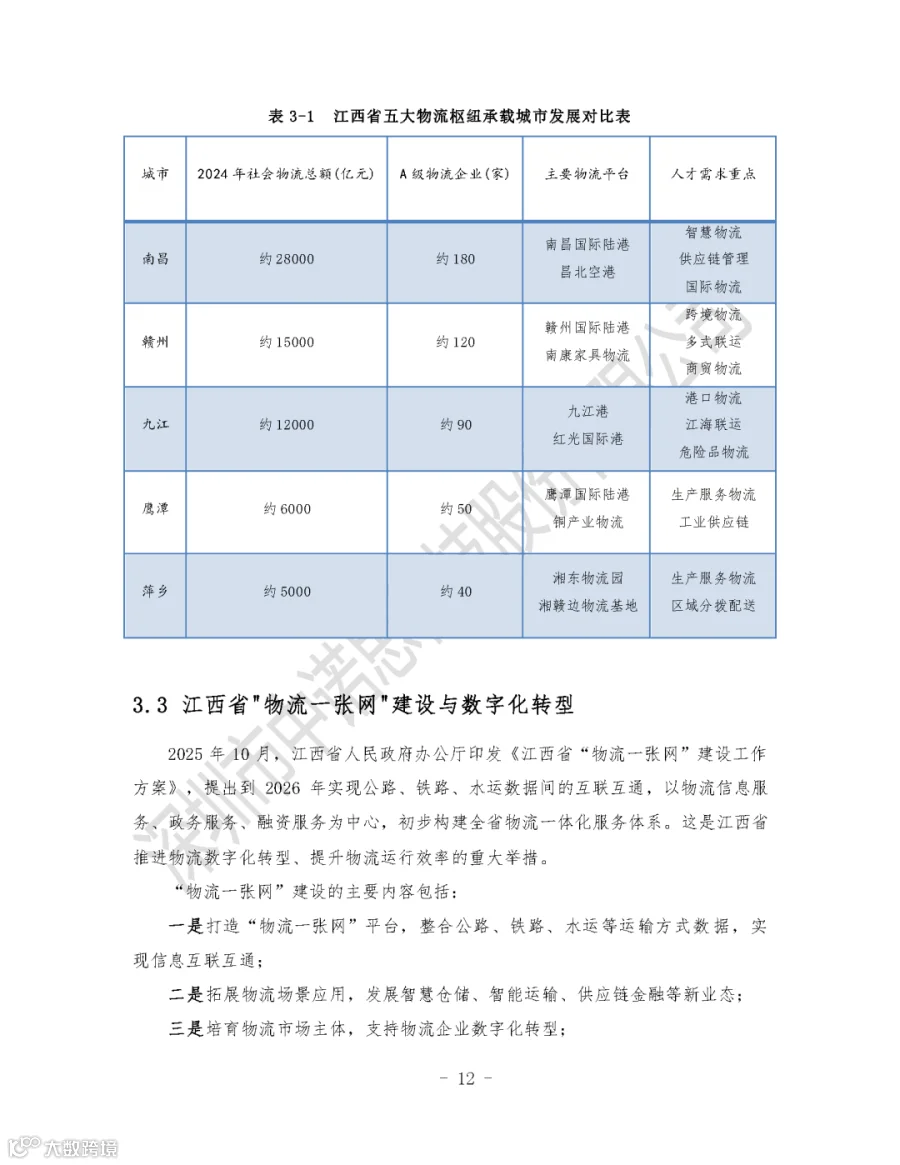
江西作为国家重点布局的物流枢纽承载省份,已构建形成南昌、九江、赣州、鹰潭、萍乡五大国家级物流枢纽承载城市格局,打造出“一核三极多节点”的现代化物流枢纽体系,各城市枢纽功能定位清晰、差异化发展格局凸显。2026年作为“十五五”开局之年,国内新质生产力加速迭代,以AI大模型垂直应用、具身智能装备、低空物流经济、绿色低碳技术、循环供应链为核心的新技术、新业态、新模式,全面重构物流产业形态、岗位结构与人才能力标准,推动江西物流业从传统运输仓储模式,向全链条智慧物流、供应链集成、国际物流、绿色低碳逆向物流深度转型,区域物流枢纽能级升级进入关键攻坚期。
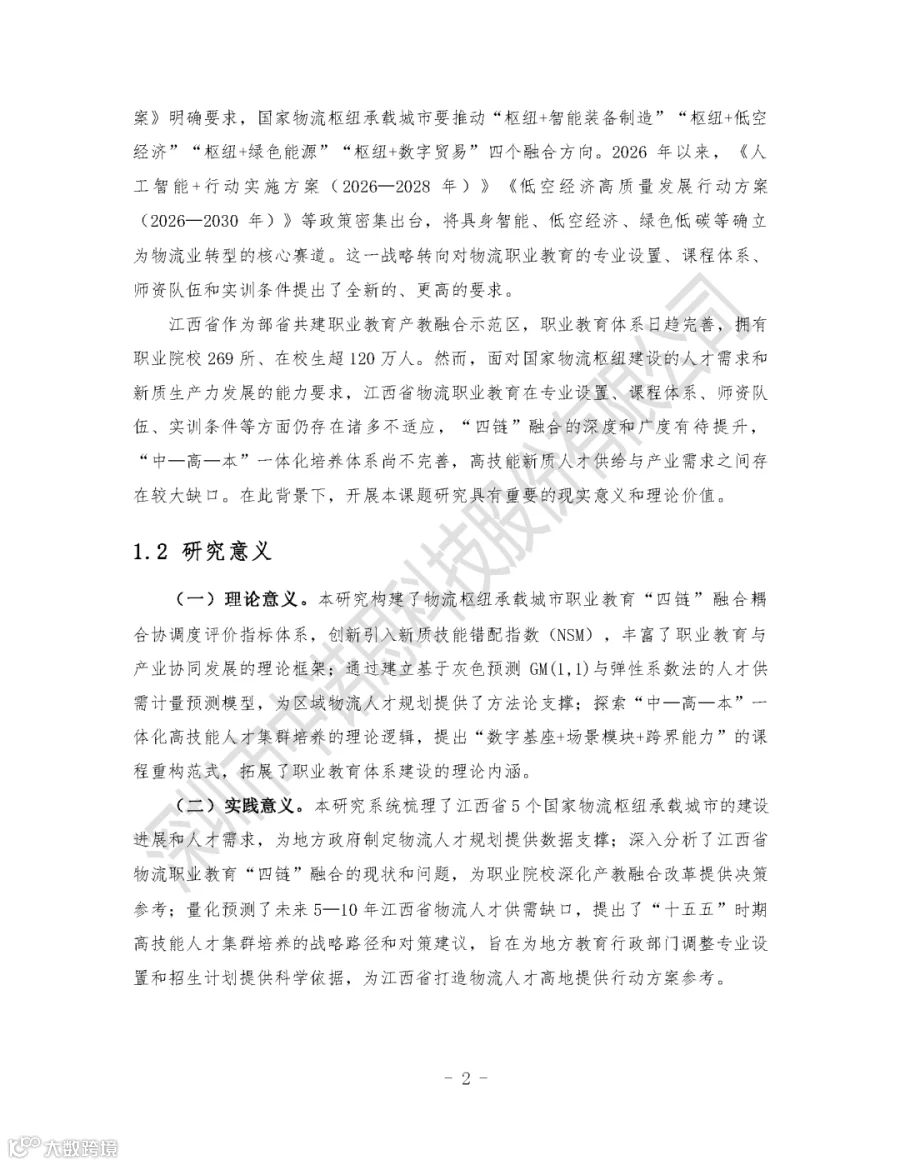
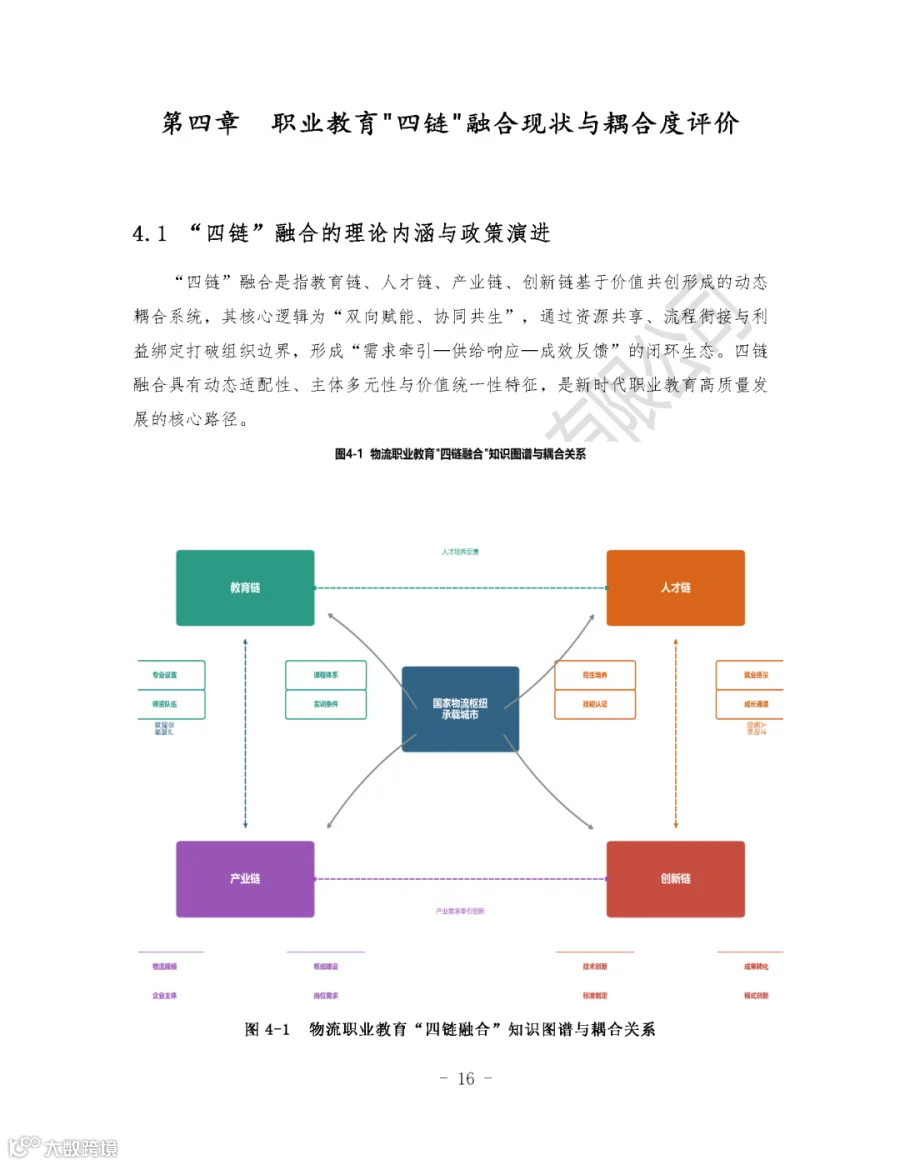
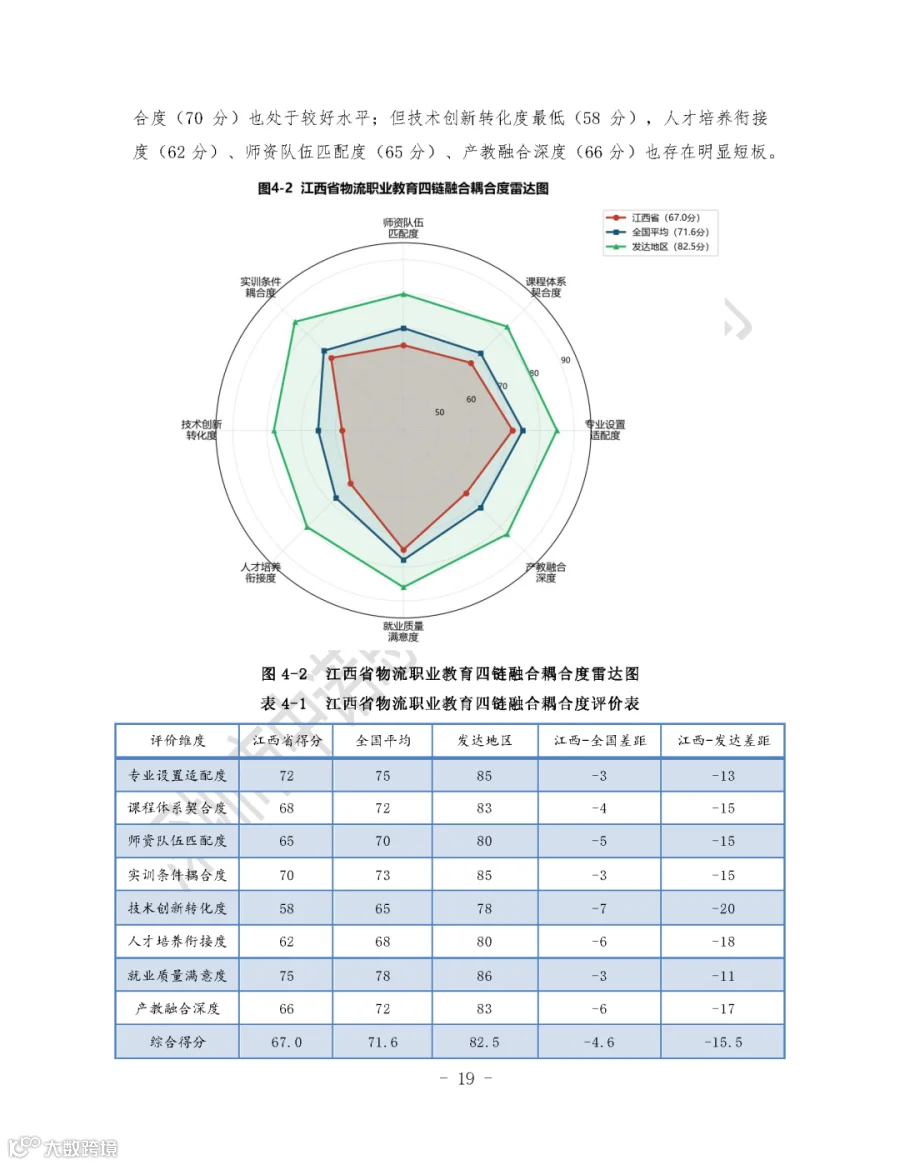
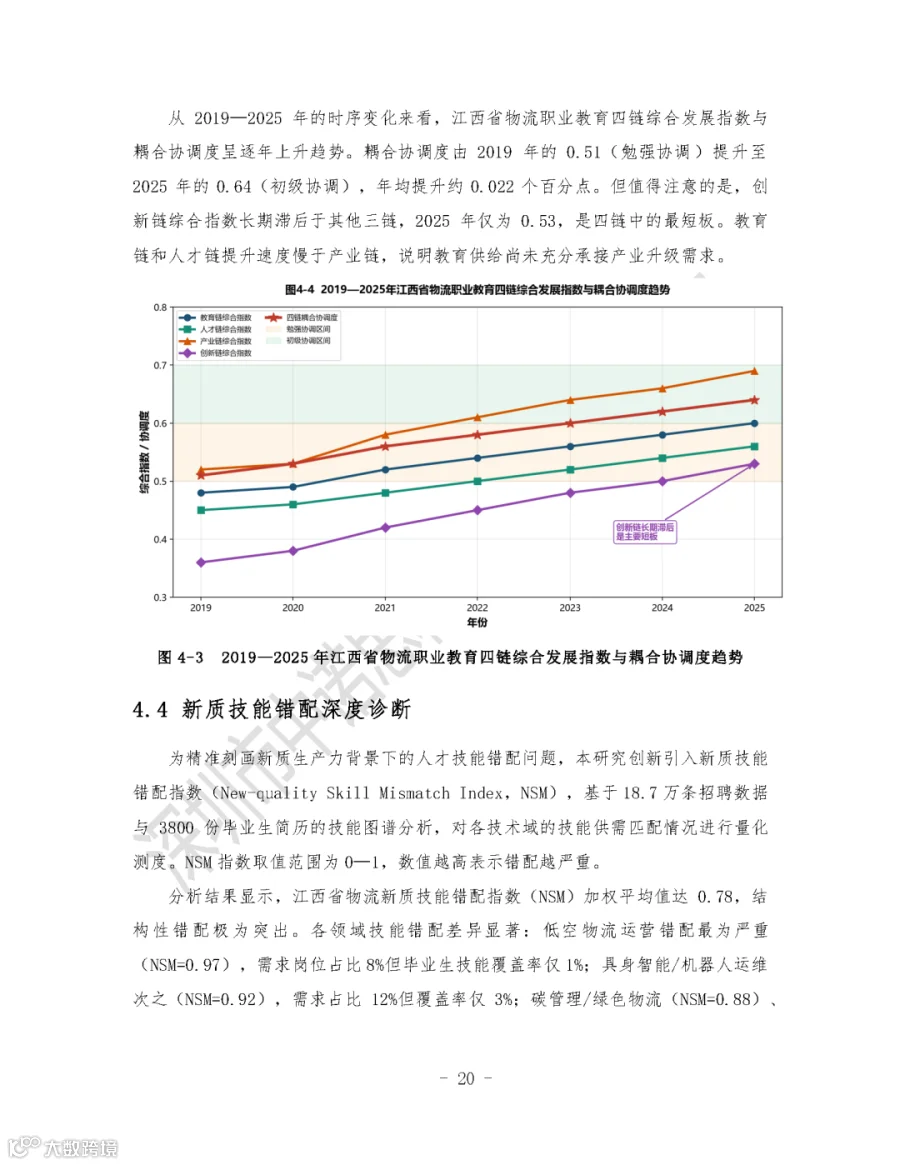
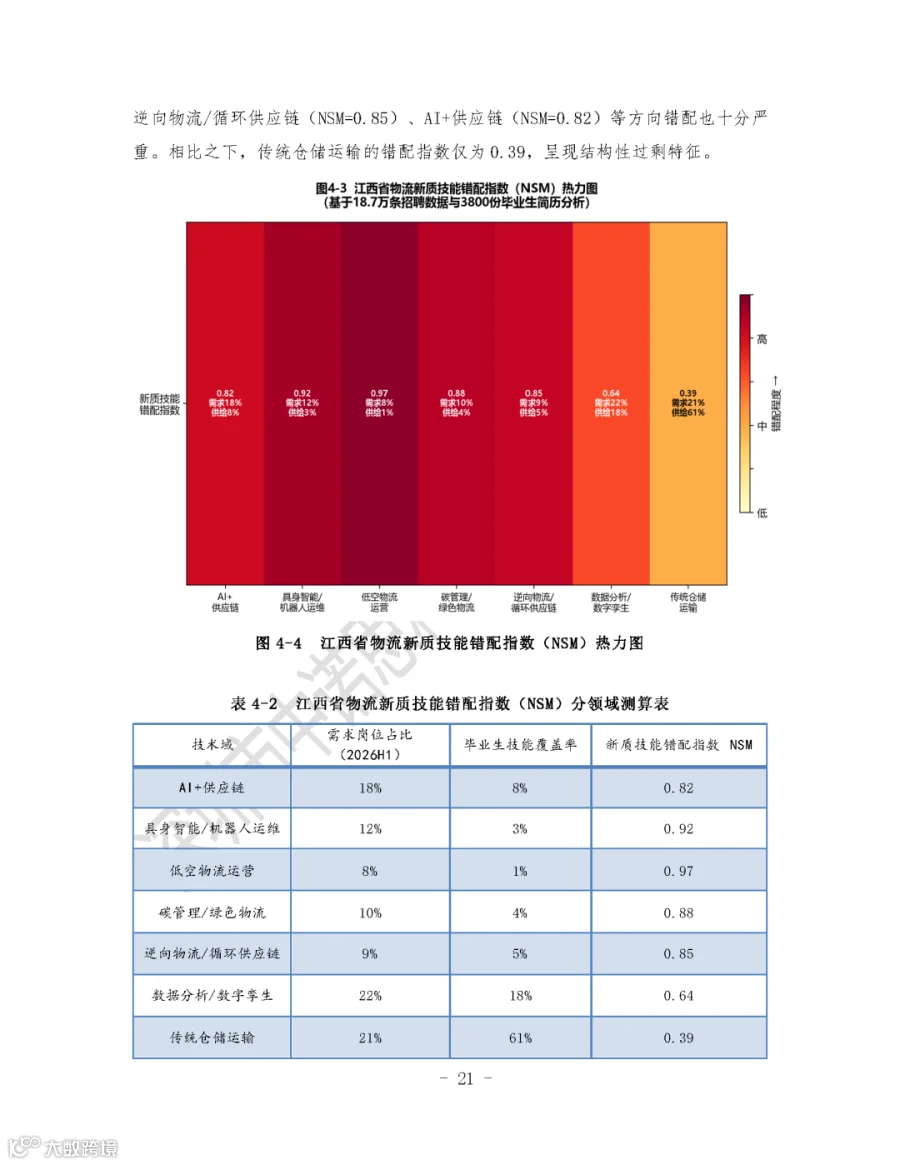
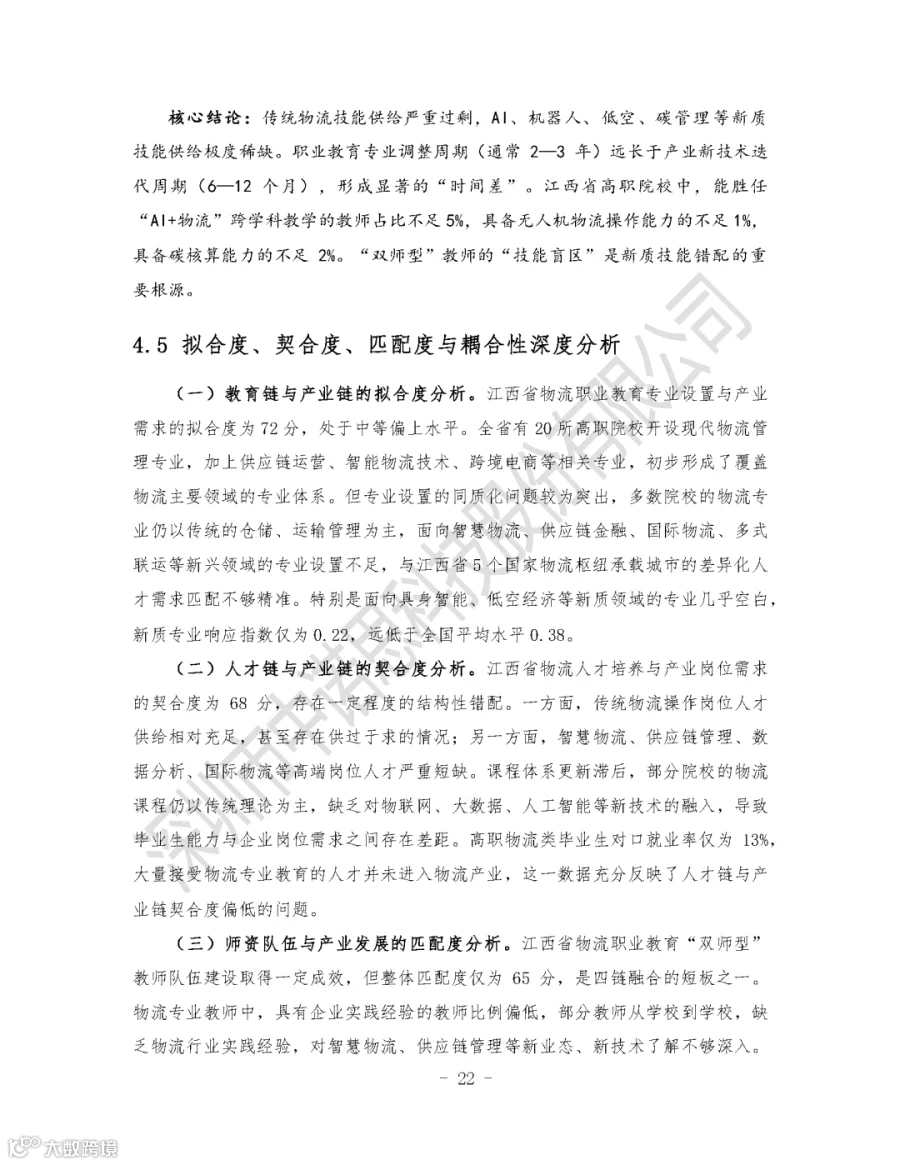
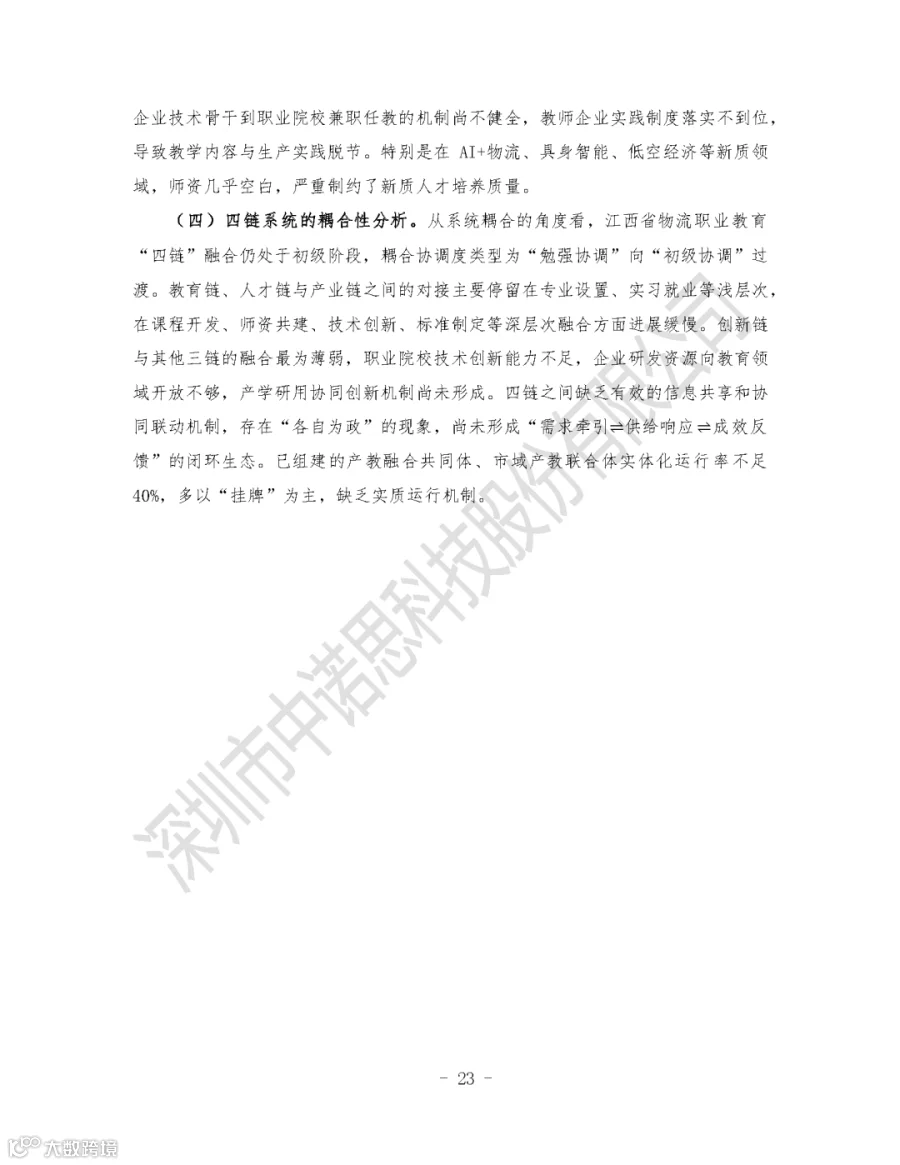
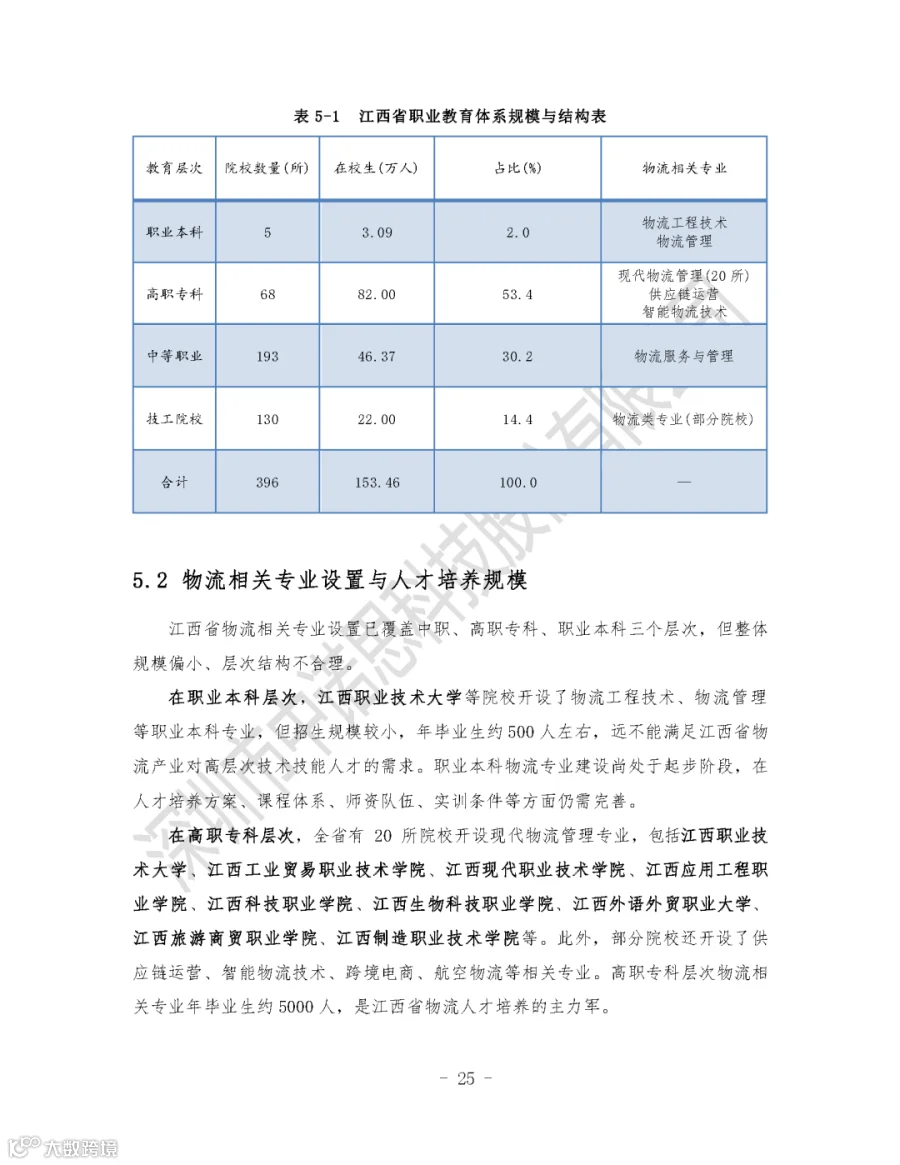
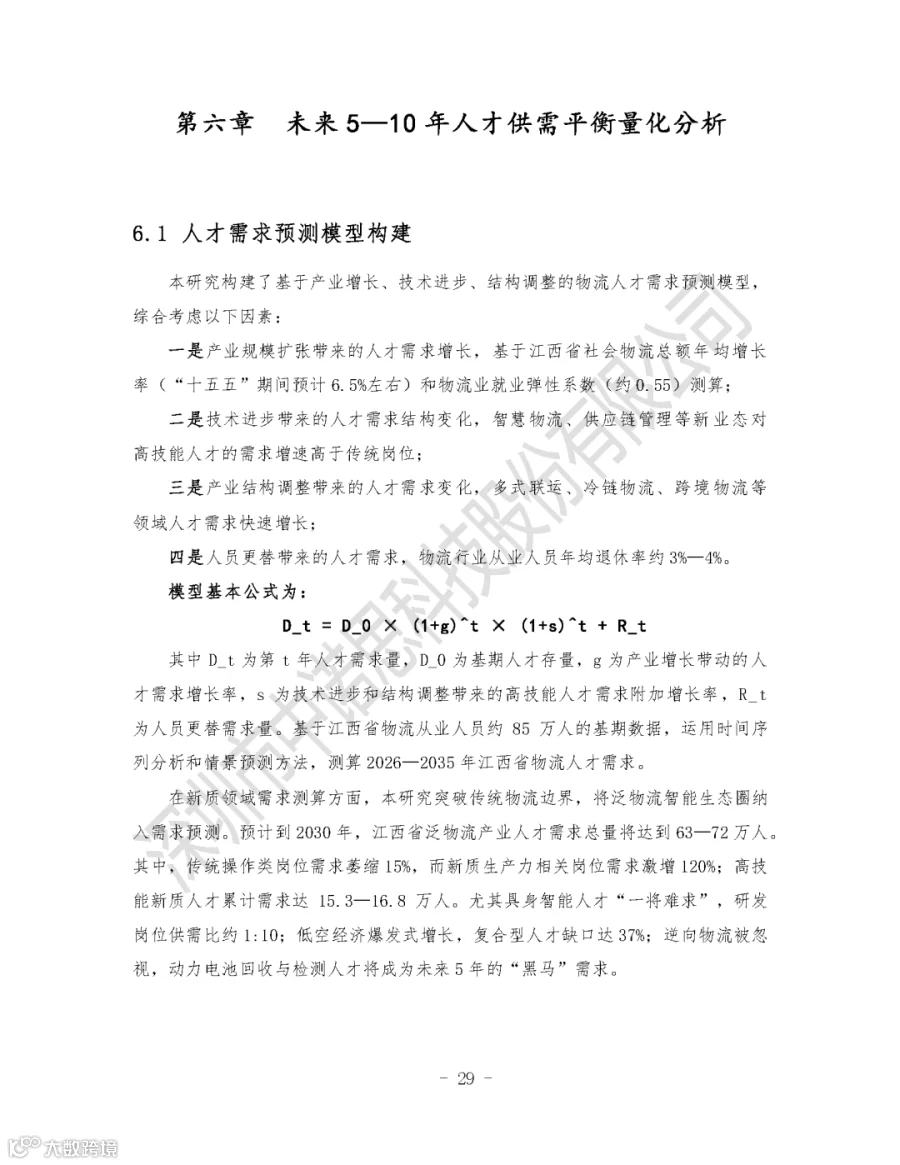
职业教育“教育链、人才链、产业链、创新链”四链深度融合,是赋能江西物流枢纽能级跃升、支撑产业新质化发展的核心支撑。课题组长期追踪测算显示,2019—2025年江西省物流职业教育四链综合耦合协调度由0.51提升至0.64,2026年上半年初步评估达0.66,整体维持初级协调发展态势,四链融合建设取得阶段性成效。但对标新质生产力发展需求,行业结构性错配问题愈发突出:纳入低空物流运营、具身智能设备运维、AI供应链决策、碳足迹核算、逆向物流设计等新质岗位评估维度后,四链结构错配度为0.58。物流职业教育人才培养体系建设方面,全省现有职业院校269所、在校生超120万人,职教资源体量充足,但物流专业人才供给效能不足,物流相关专业年毕业生仅约9000人,高职物流专业毕业生行业对口就业率仅13%,职业本科物流专业年毕业生规模不足500人。同时,全省中高职一体化长学制培养项目覆盖面有限,物流类专项培养项目数量、贯通深度无法匹配产业需求;四链融合综合得分67.0分,明显低于全国平均水平(71.6分)与发达地区水平(82.5分),其中技术创新转化、中高本人才贯通培养是核心短板,新质技能错配指数高达0.78。人才供需量化预测结果显示,江西物流新质高技能人才缺口呈持续扩大态势,2030年全省物流全链条高技能新质人才累计缺口将达7.8—9.6万人,2035年缺口将进一步扩大至17.5—22.0万人。
本报告主要基于三大维度:一是研究视域突破传统物流仓储运输的单一范畴,构建覆盖上游智能物流装备、中游多式联运物流服务、下游末端新零售配送及逆向循环物流的全产业链研究体系;二是研究主线紧扣“十五五”新质生产力发展主题,聚焦“AI+物流”“具身智能”“低空物流经济”“绿色低碳物流”“逆向供应链”五大核心新兴领域,紧密贴合国家新职业布局与产业落地趋势;三是研判基准以2025—2026年最新国家及省级政策、十五五开局部署为核心依据,确保研究结论的时效性与科学性。
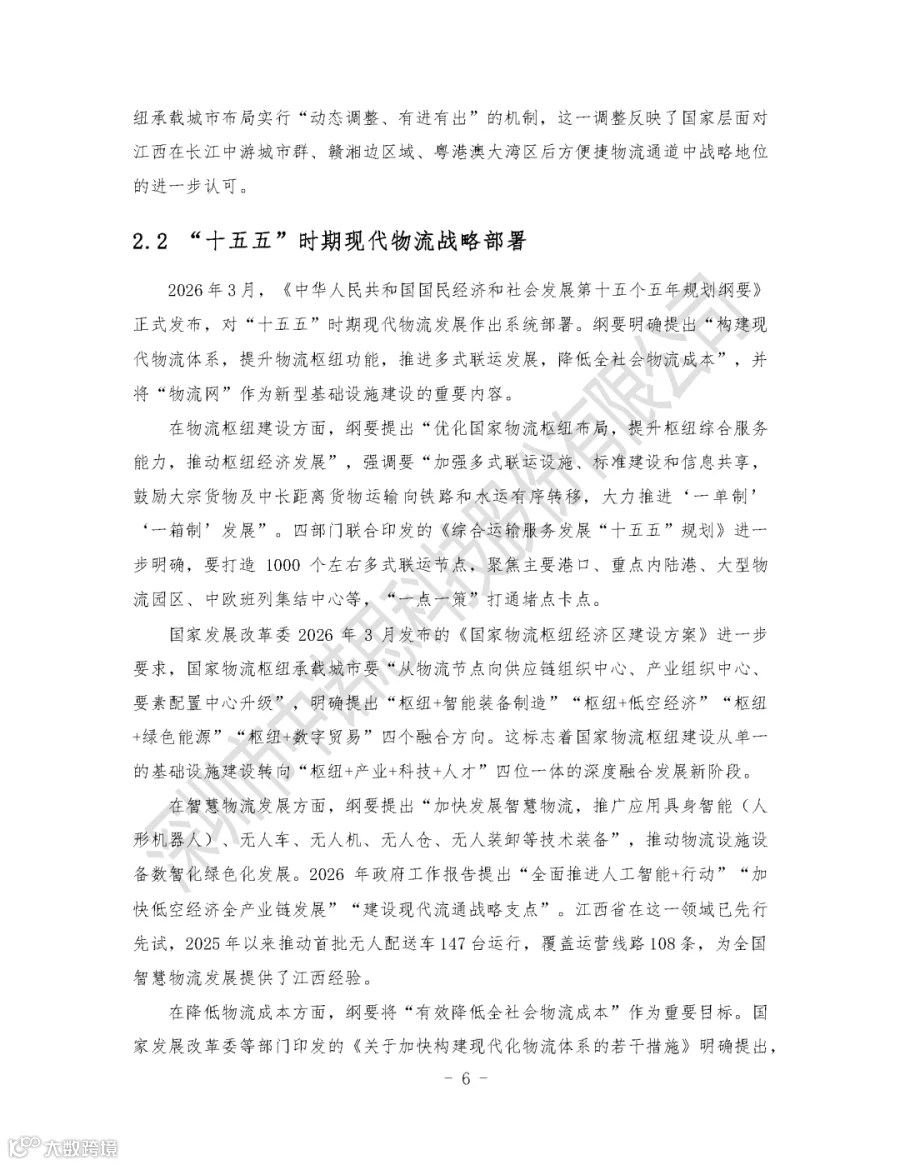
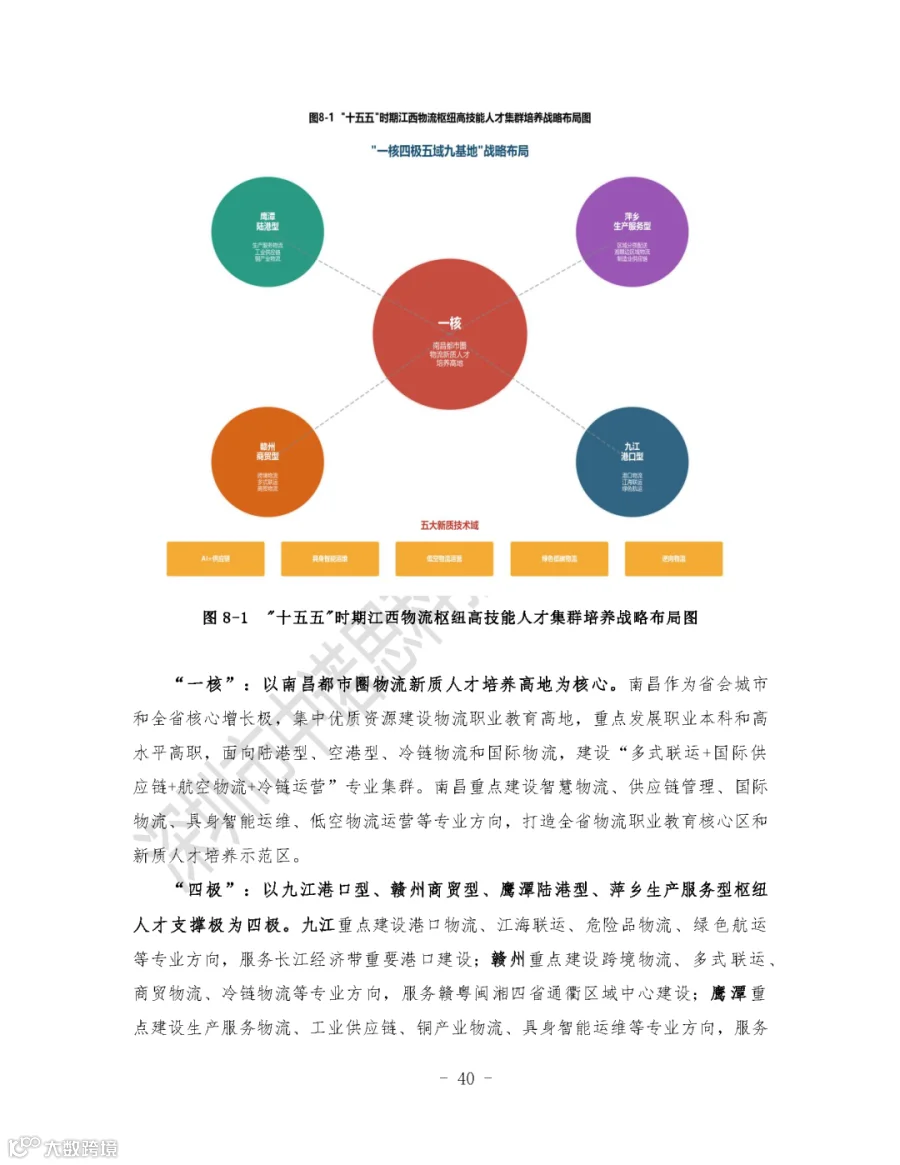
立足十五五发展窗口期,报告拟建议实施“赣鄱物流新质人才集群培育工程2.0”,构建“四链耦合监测—专业动态调整—中高本贯通培养—产教联合体实体化运营—新质技能重塑提升”五位一体发展机制,配套布局“一核四极五域九基地”发展格局,实施枢纽能级提升、产教融合深化、人才集群培养、创新驱动赋能四大核心工程,通过重构数字化课程体系、推行长学制贯通培养、开展存量人才技能重塑等专项举措,持续破解人才供需结构性错配难题。未来,江西完全有条件、有能力、有可能全力打造中部地区物流新质人才培养高地与全国物流枢纽产教融合示范标杆,为区域物流产业转型升级、新质生产力落地赋能、国家级物流枢纽高质量建设提供坚实的人才保障与智力支撑。
As a province strategically designated by the state as a key bearer of logistics hubs, Jiangxi has established a pattern of five national-level logistics hub cities, namely Nanchang, Jiujiang, Ganzhou, Yingtan, and Pingxiang, and has built a modern logistics hub system featuring "one core, three poles, and multiple nodes." The functional positioning of each city's hub is clear, and a differentiated development pattern has become prominent. As 2026 marks the opening year of the 15th Five-Year Plan, China's new quality productive forces are undergoing accelerated iteration. New technologies, new business forms, and new models centered on vertical applications of large AI models, embodied intelligent equipment, the low-altitude logistics economy, green and low-carbon technologies, and circular supply chains are comprehensively reshaping the industrial forms, job structures, and talent competency standards of the logistics industry. This is driving Jiangxi's logistics industry to undergo a deep transformation from the traditional transportation and warehousing model to full-chain smart logistics, supply chain integration, international logistics, and green and low-carbon reverse logistics. The upgrading of regional logistics hubs has entered a critical period of tackling key problems.
The deep integration of the four chains in vocational education—the education chain, talent chain, industrial chain, and innovation chain—is the core support for empowering Jiangxi's logistics hubs to leapfrog in capacity and for underpinning the new-quality development of the industry. Long-term tracking and measurement by the research group show that from 2019 to 2025, the comprehensive coupling coordination degree of the four chains in logistics vocational education in Jiangxi increased from 0.51 to 0.64, and a preliminary assessment for the first half of 2026 reached 0.66. Overall, it has maintained a trend of preliminary coordinated development, and phased achievements have been made in four-chain integration. However, measured against the development needs of new quality productive forces, the problem of structural mismatch in the industry has become increasingly prominent: after incorporating evaluation dimensions for new-quality positions such as low-altitude logistics operations, embodied intelligent equipment operation and maintenance, AI supply chain decision-making, carbon footprint accounting, and reverse logistics design, the structural mismatch degree of the four chains is 0.58. Regarding the construction of the logistics vocational education talent training system, the province currently has 269 vocational colleges and universities with more than 1.2 million enrolled students. Although the overall volume of vocational education resources is sufficient, the supply efficiency of logistics professionals is insufficient. The annual number of graduates from logistics-related programs is only about 9,000; the industry-matched employment rate of graduates from higher vocational logistics programs is only 13%; and the annual number of logistics graduates from vocational undergraduate programs is fewer than 500. At the same time, the coverage of integrated long-term training programs between secondary and higher vocational education in the province is limited, and the number and penetration depth of logistics-specific training programs cannot match industrial demand. The comprehensive score of four-chain integration is 67.0, significantly lower than the national average of 71.6 and the level of developed regions at 82.5. Among these weaknesses, the transformation of technological innovation and the through-training of talent across secondary vocational, higher vocational, and undergraduate levels are core shortcomings, and the new-quality skills mismatch index is as high as 0.78. Quantitative projections of talent supply and demand show that Jiangxi's shortage of new-quality, highly skilled logistics talent is continuously widening. By 2030, the cumulative shortage of high-skilled new-quality talent across the entire logistics chain in the province will reach 78,000–96,000, and by 2035, the gap will further expand to 175,000–220,000.
This report is mainly based on three dimensions. First, the research horizon breaks through the single scope of traditional logistics warehousing and transportation and constructs a whole-industrial-chain research system covering upstream intelligent logistics equipment, midstream multimodal transport logistics services, downstream last-mile new retail distribution, and reverse circular logistics. Second, the main research line closely follows the theme of developing new quality productive forces during the 15th Five-Year Plan period, focuses on five core emerging fields—"AI + logistics," "embodied intelligence," "low-altitude logistics economy," "green and low-carbon logistics," and "reverse supply chains"—and closely aligns with the national layout of new occupations and industrial implementation trends. Third, the assessment benchmark is based on the latest national and provincial policies in 2025–2026 and the deployment at the start of the 15th Five-Year Plan, thereby ensuring the timeliness and scientific rigor of the research conclusions.
Against the window period of the 15th Five-Year Plan, the report proposes the implementation of the "Ganpo (Jiangxi) Logistics New-Quality Talent Cluster Cultivation Project 2.0" and the establishment of a five-in-one development mechanism featuring "four-chain coupling monitoring—dynamic adjustment of academic programs—through-training from secondary vocational to higher vocational to undergraduate levels—substantive operation of industry-education consortiums—reshaping and upgrading of new-quality skills." It also proposes a supporting development layout of "one core, four poles, five domains, and nine bases" and the implementation of four core projects: upgrading hub capacity, deepening industry-education integration, cultivating talent clusters, and empowering development through innovation. Through special measures such as rebuilding digital curriculum systems, promoting long-term through-training, and carrying out skills reshaping for the existing workforce, these initiatives aim to continuously resolve the structural mismatch between talent supply and demand. In the future, Jiangxi fully possesses the conditions, capacity, and potential to build itself into a highland for cultivating new-quality logistics talent in central China and a national demonstration benchmark for industry-education integration in logistics hubs, thereby providing solid talent guarantees and intellectual support for the transformation and upgrading of the regional logistics industry, the implementation and empowerment of new quality productive forces, and the high-quality construction of national-level logistics hubs.

















★ 版权声明:
1.本报告所有数据均来自公开权威渠道,参考资料来源可通过公开渠道核验溯源;
2.本报告的分析结论,基于公开的行业数据、企业岗位招聘信息,主要反映行业头部企业、重点区域的实际需求现状,部分中小微企业的差异化用人需求未完全覆盖;
3.本报告中涉及的企业商标、品牌名称,均为对应企业的合法注册商标,本报告引用仅为行业案例分析,不涉及商业宣传用途;
4.本报告的所有内容、结论均为行业公共政策研究、市场分析结论,不构成任何企业的用人招聘标准、行业发展的政策依据;
5.本报告为非商业性行业公共研究项目成果,版权归©厦门中诺思教育科技有限公司江西团队所有,引用时请注明出处。

