点击蓝字关注雨生

**标题:AI泡沫要破?别慌!雨生带你抄底掘金,出海躺赢!**
**导语:** 啥?AI泡沫要破了?别听风就是雨!当年互联网泡沫破裂,成就了多少巨头?这次AI大浪潮,雨生云计算带你提前布局,抄底掘金,出海直接起飞!
---
嘿,大家好,我是雨生,你们在云计算领域最懂出海,在出海领域最懂云计算的老朋友。最近AI圈子不太平,一篇《AI泡沫要破?》的文章,看得我虎躯一震。
**雨生视角:**
这标题,够劲爆!但雨生我混迹科技圈二十年,啥大风大浪没见过?泡沫?不存在的!顶多就是挤挤水分,让那些浑水摸鱼的家伙现形。
**深度解读:**
文章里说,现在的AI,像极了2000年的互联网泡沫。当年搞互联网,先烧钱建基建,结果需求没跟上,boom!现在搞AI,疯狂建数据中心,动不动就是几万亿美元的投入。这不禁让人担心,历史会不会重演?
但雨生想说,时代变了!
* **基础设施不一样了:** 当年是光纤,现在是数据中心,数据中心可是AI的“粮仓”,是刚需!
* **应用场景不一样了:** 当年互联网主要在PC端,现在AI可是渗透到各行各业,消费、企业,无孔不入!
文章里还提到一个数据,让我眼前一亮:**40%的美国人已经在用AI,23%的人在工作中用AI。** 这速度,比当年PC和互联网普及还要快!
不过,MIT的研究也泼了盆冷水:**95%的AI项目没赚到钱!** 这是为啥?因为他们还在自己瞎鼓捣,而不是直接买现成的解决方案,没有把AI融入到现有的业务流程中。
**行动指南:**
所以,出海的朋友们,听雨生一句劝:
1. **别All in!** AI是好东西,但别把所有鸡蛋放在一个篮子里。
2. **拥抱变化!** 积极尝试AI工具,但别指望它能一夜暴富。
3. **专注业务!** 把AI融入到你的出海业务中,降本增效才是王道。
4. **Buy,Buy,Buy!** 别自己造轮子,直接买成熟的AI解决方案,省时省力。
**互动环节:**
* 你觉得AI是真风口,还是大泡沫?
* 你打算如何利用AI,在出海路上弯道超车?
* 你踩过哪些AI的坑?
快来评论区分享你的看法,雨生等你来battle!
**知识星球引流:**
想了解更多关于AI出海的干货?想和雨生以及各路出海精英一起交流学习?那就赶紧加入雨生的知识星球【雨生的VIP朋友们】!
在这里,你可以:
* **获取独家AI出海报告,** 避开雷区,少走弯路。
* **参与专家问答,** 解决你在出海过程中遇到的各种疑难杂症。
* **加入高质量的出海社群,** 拓展人脉,寻找合作伙伴。
现在加入,**可享受3天免费试用,** 更有专属折扣等你来拿!点击下方链接,了解更多详情:[知识星球链接]

(温馨提示:不要错过这次难得的机会哦~)
---
**#雨生云计算# #出海必读# #知识星球#**
**邀请有礼活动方案:**
邀请朋友关注“雨生云计算”公众号,即可参与抽奖,奖品为【雨生的VIP朋友们】知识星球免费体验券(价值550元/年)。
**朋友圈文案模板:**
1. 雨生大佬的最新解读,出海必读!强烈推荐加入知识星球,干货满满![文章链接]
2. AI泡沫要破?雨生带你抄底掘金,出海躺赢![文章链接]
3. 想在AI时代出海掘金?关注“雨生云计算”,带你避坑![文章链接]
---
**新闻原文中英文对照版本:**
好的,我将提供新闻原文的完整中英文对照版本。请注意,为了保持格式的清晰,我将分段呈现,一段英文原文对应一段中文翻译。
**Is The AI Bubble Bursting? Lessons From The Dot-Com Era**
**AI泡沫要破?从互联网泡沫时代汲取教训**
By Paulo Carvão
Paulo Carvão
One should be just as cautious about predicting the imminent burst of an AI bubble as skeptical of the exaggerated hype currently surrounding artificial intelligence.
我们应该对预测人工智能泡沫即将破裂保持谨慎,就像对目前围绕人工智能的夸大宣传持怀疑态度一样。
There are concerning signs. The “Magnificent Seven” stocks (Alphabet, Amazon, Apple, Meta, Microsoft, Nvidia and Tesla) make up more than a third of the S&P 500, with recent growth driven by an AI story. Investors are becoming uneasy with this level of concentration. At the peak of the dot-com bubble in 2000, the top technology stocks from the late 1990s (Cisco, Dell, Intel, Lucent and Microsoft) accounted for 15% of the index. Such concentration heightens risk. The parallels do not stop there.
有一些令人担忧的迹象。“七巨头”股票(Alphabet、Amazon、Apple、Meta、Microsoft、Nvidia 和 Tesla)占标准普尔 500 指数的 1/3 以上,最近的增长是由人工智能的故事驱动的。投资者对这种集中程度感到不安。在 2000 年互联网泡沫的顶峰时期,20 世纪 90 年代末的顶级科技股(Cisco、Dell、Intel、Lucent 和 Microsoft)占该指数的 15%。这种集中增加了风险。相似之处不止于此。
The AI Bubble And The Dot-com Era
人工智能泡沫与互联网时代
A massive telecommunications infrastructure buildout ushered in the e-commerce era. The world needed the internet pipes to enable high-speed connectivity. This triggered an overly optimistic deployment of fiber optic networks, which led to catastrophic bankruptcies when the demand did not materialize in the short term.
大规模的电信基础设施建设迎来了电子商务时代。世界需要互联网管道来实现高速连接。这引发了对光纤网络过于乐观的部署,当需求在短期内没有实现时,导致了灾难性的破产。
Today, the leading AI companies are investing hundreds of billions of dollars in new data centers. The total capital spending in this area is being discussed in the trillions of dollars, figures that were once only associated with large countries’ GDPs. Will history repeat itself, causing an imminent collapse?
今天,领先的AI公司正在投资数千亿美元建设新的数据中心。该领域的总资本支出正在以数万亿美元来讨论,这些数字曾经只与大国的GDP相关联。历史会重演,导致迫在眉睫的崩溃吗?
Meanwhile, the connectivity boom and investments from a quarter century ago enabled the always-on world we live in today. They created opportunities for value creation beyond infrastructure, at the application level, and drove the transformation of the information technology industry through the shift to the cloud. Some might argue that data centers are now the new utilities required to provide on-demand information services for an increasingly connected world.
与此同时,四分之一个世纪前的连接性繁荣和投资使我们今天生活在一个始终在线的世界中。它们在应用层面创造了超越基础设施的价值创造机会,并通过向云的转变推动了信息技术行业的转型。有些人可能会认为,数据中心现在是为日益互联的世界提供按需信息服务所需的新型公用事业。
Will The Demand For AI Materialize?
人工智能的需求会实现吗?
Much of the current attention is focused on the consumer space. OpenAI’s ChatGPT website received over 5 billion visits during July. But that is not the whole story.
目前的大部分注意力都集中在消费领域。OpenAI的ChatGPT网站在7月份收到了超过50亿次的访问。但这并不是全部。
The true economic impact will be measured by consumer and enterprise adoption. The National Bureau of Economic Research started publishing its survey of generative AI adoption about a year ago. As of late 2024, about 40% of the U.S. population reported using generative AI, and 23% reported having used it for work at least once in the week before they were polled. When comparing the level of adoption since the initial product launch, generative AI at work is taking off faster than personal computers or the internet, the study concludes. This underscores the potential of AI as what economists call a general-purpose technology, one with deep and pervasive impact on the economy.
真正的经济影响将通过消费者和企业的采用来衡量。美国国家经济研究局大约在一年前开始发布其关于生成式人工智能采用的调查报告。截至2024年末,约有40%的美国人口报告使用了生成式人工智能,23%报告在接受调查前的一周内至少使用过一次。研究表明,将自最初产品发布以来的采用水平进行比较,工作中的生成式人工智能的起飞速度比个人电脑或互联网更快。这强调了人工智能作为经济学家所说的通用技术(一种对经济具有深刻而广泛影响的技术)的潜力。
But challenges remain. A group of MIT researchers surveyed over 300 publicly disclosed AI initiatives, more than 50 companies and hundreds of senior leaders from January to June 2025 to conclude that 95% were not getting any return for their investment. They were also able to identify three elements that made the remaining 5% successful. Companies with successful AI initiatives are buying instead of building, executing within business units as opposed to central laboratories and choosing tools that integrate with their existing business workflows.
但挑战依然存在。麻省理工学院的一组研究人员在2025年1月至6月期间调查了300多项公开披露的人工智能计划、50多家公司和数百名高级领导人,得出的结论是,95%的项目没有获得任何投资回报。他们还能够确定使剩余5%的项目成功的三个要素。成功的人工智能计划的公司正在购买而不是构建,在业务部门而不是中央实验室执行,并选择与现有业务工作流程集成的工具。
While achieving the returns associated with business transformation is rare, adoption is high, with 90% seriously exploring buying an AI solution. This is a familiar pattern in enterprise technology adoption. It has been captured by what consultants call the hype cycle, tracking innovative technologies from their market entrance to when businesses are likely to benefit from them and the technology has become mainstream.
虽然实现与业务转型相关的回报很少见,但采用率很高,90%的企业都在认真探索购买人工智能解决方案。这是企业技术采用中常见的模式。它已经被顾问们所说的炒作周期所捕获,该周期跟踪创新技术从进入市场到企业可能从中受益以及该技术成为主流的整个过程。
How Far Can The Current AI Models Take Us?
目前的人工智能模型能带我们走多远?
As AI usage increases, so does the debate about its ultimate potential and whether the current development model is sustainable.
随着人工智能使用量的增加,关于其最终潜力和当前开发模式是否可持续的争论也随之而来。
Much of the progress to date has been made on the back of large language models that benefit from scale. Scale means that with more computing power and more data, one produces better outcomes. Richard Sutton, an AI pioneer, observed in 2019 that general methods leveraging computational power outperform those that rely on human ingenuity and complex heuristics (in what he coined “The Bitter Lesson” for humanity). He has recently criticized the industry’s fixation on scaling and called for a correction toward agents that learn continuously.
迄今为止,大部分进展都是建立在受益于规模的大型语言模型的基础之上的。规模意味着拥有更多的计算能力和更多的数据,就能产生更好的结果。人工智能先驱Richard Sutton在2019年观察到,利用计算能力的通用方法优于那些依赖人类智慧和复杂启发式方法的方法(他称之为人类的“痛苦教训”)。他最近批评了该行业对规模化的痴迷,并呼吁转向持续学习的智能体。
Gary Marcus, one of the most vocal critics of the artificial intelligence hype, commented on the mixed reviews received by OpenAI’s latest ChatGPT-5 release. He echoed the sentiment that a development model predicated on scaling is not the path forward, a position he has been sponsoring for decades.
Gary Marcus是人工智能炒作最直言不讳的批评者之一,他对OpenAI最新发布的ChatGPT-5收到的褒贬不一的评价发表了评论。他赞同这样一种观点,即基于规模化的发展模式并非前进的方向,这是他几十年来一直倡导的立场。
These scientists’ deep skepticism about the current progress represents a technical word of caution. The hype conditions created by investors and large AI laboratories can lead to disappointment. Both, however, are believers in AI’s ultimate potential, while suggesting that alternative approaches are necessary. These may necessitate more, instead of less, investment in research and development.
这些科学家对当前进展的深刻怀疑代表了一种技术警告。投资者和大型人工智能实验室制造的炒作条件可能会导致失望。然而,两者都相信人工智能的最终潜力,同时建议有必要采取替代方法。这可能需要更多而不是更少的研发投资。
Is There An AI Bubble?
存在人工智能泡沫吗?
One should pause when even OpenAI CEO Sam Altman, who helped spark the AI boom, warns that the market may be overheating. He and other investors mention soaring valuations, too much money chasing unproven business models and the risk of building infrastructure faster than demand will justify. Like in the MIT report, they worry that much of the capital outlays are flowing into projects unlikely to deliver results soon. The concern is less about AI’s long-term promise and more about inflated expectations setting the stage for a sharp correction.
即使是帮助引发人工智能热潮的OpenAI首席执行官山姆·奥特曼也警告说,市场可能过热,此时人们应该停下来思考。他和其他投资者提到估值飙升,过多的资金追逐未经证实的商业模式,以及基础设施建设速度快于需求所能证明的风险。与麻省理工学院的报告一样,他们担心大部分资本支出都流向了不太可能很快产生结果的项目。人们担心的不是人工智能的长期前景,而是膨胀的预期为大幅调整奠定了基础。
Binary thinking that swings between hype and the fear of an AI bubble may limit more nuanced analysis. AI’s long-term potential remains significant, but markets rarely move in straight lines. A correction could slow momentum in the short term while reinforcing the need for discipline. The next phase will depend on advancing research, improving model quality and directing enterprise investments toward measurable economic value.
在炒作和对人工智能泡沫的恐惧之间摇摆的二元思维可能会限制更细致的分析。人工智能的长期潜力仍然巨大,但市场很少以直线方式发展。调整可能会在短期内减缓势头,同时加强对纪律的需求。下一阶段将取决于推进研究、提高模型质量以及将企业投资导向可衡量的经济价值。
(The rest of the information is omitted.)[https://share.google/k30DzKmh7U24Sos6t](https://share.google/k30DzKmh7U24Sos6t)
---
**金句海报:**
* AI泡沫?不存在的!顶多就是挤挤水分。
* 别All in AI!专注业务,降本增效才是王道。
* Buy,Buy,Buy!别自己造轮子,买现成的!
* AI是出海的加速器,不是万能药。
* 想在AI时代出海躺赢?来雨生的知识星球!
小红书

雨生课程
现在单一云增长乏力,想实战的。《多云价值管理与增长》新课程出炉,雨生和SRE刘老师联袂授课,欢迎学友们关注!
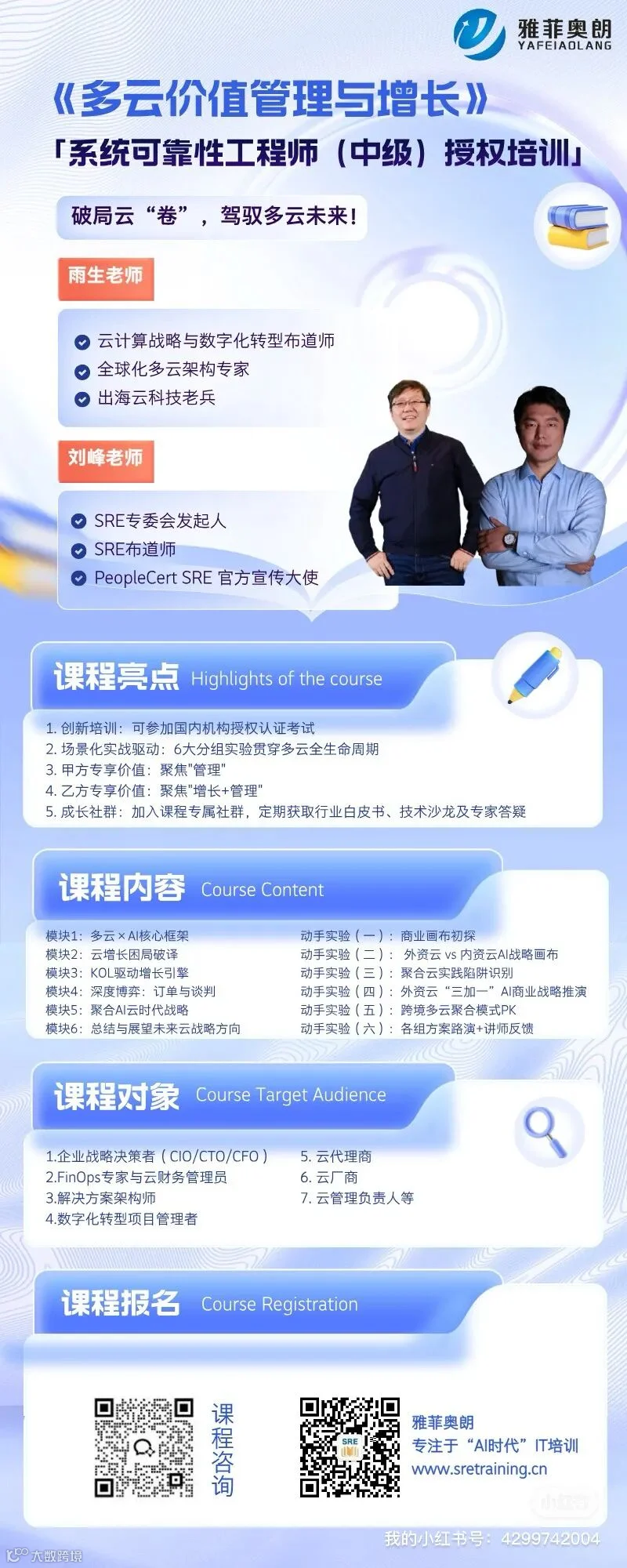
报名链接见二维码