


Beauty Products in China
the Rise of the Domestic Brand
Although the Chinese beauty market has been, and to a good extent still is, dominated by global brands, domestic lines are beginning to emerge from the shadows and to become important market forces, especially on the makeup side of the equation. Some of these native Chinese brands are even slowly acquiring an international market share, which makes them worth knowing something about, especially the ways in which the market leaders are using Chinese social media to obtain billions of RMB in sales. While the impact of the 2020 pandemic scrambled the revenue maps of many beauty brands, and, while some brands are facing serious difficulties, some have seen their popularity skyrocket and their products appear on the hot-selling lists of, not only Tmall, but other selling social media platforms such as Douyin (Tik Tok).
Indeed, the main result of the 2020 pandemic as far as beauty retail was concerned was that many brands turned to online promotion to get their product onto Chinese women’s dressing tables. Overall sales dropped drastically at the beginning of 2020, but quickly recovered as consumers embraced the convenience of shopping at home and the new model of social media-based ecommerce.
Moreover, Tmall found itself no longer to be the only game in town as other platforms entered the ecommerce picture. Merely putting your products up on Tmall and waiting for the customers to come is no longer the preferred business model in China, and such platforms as Doyuin with its live-streaming are taking an increasingly large slice of the online sales pie. This change provided opportunities to domestic brands. For example, OSM’s Pearl Lucent Whitening Essence, One Leaf’s Niacinamide Brightening Moisturizing Essence and UNIFON’s Amino Acid Mud Mask now appear regularly on Doyuin’s monthly top-seller list.
Although the sales volume in Tmall stores is no longer the only standard by which to measure a brand’s success in China, especially when it is selling heavily through other internet channels or even via traditional retail, the Tmall numbers still have considerable significance. Accordingly, we've compiled a list of the hottest skincare and makeup brands and products based on Tmall sales volume for the year 2020.
(Note: The retail sales and other numbers listed in this article are based on the Tmall public data as collected by neutral monitoring agencies. The numbers do not take into account the impact of such things as returns and hidden discounts, thus the actual figures may differ slightly from those listed below.)
Skincare

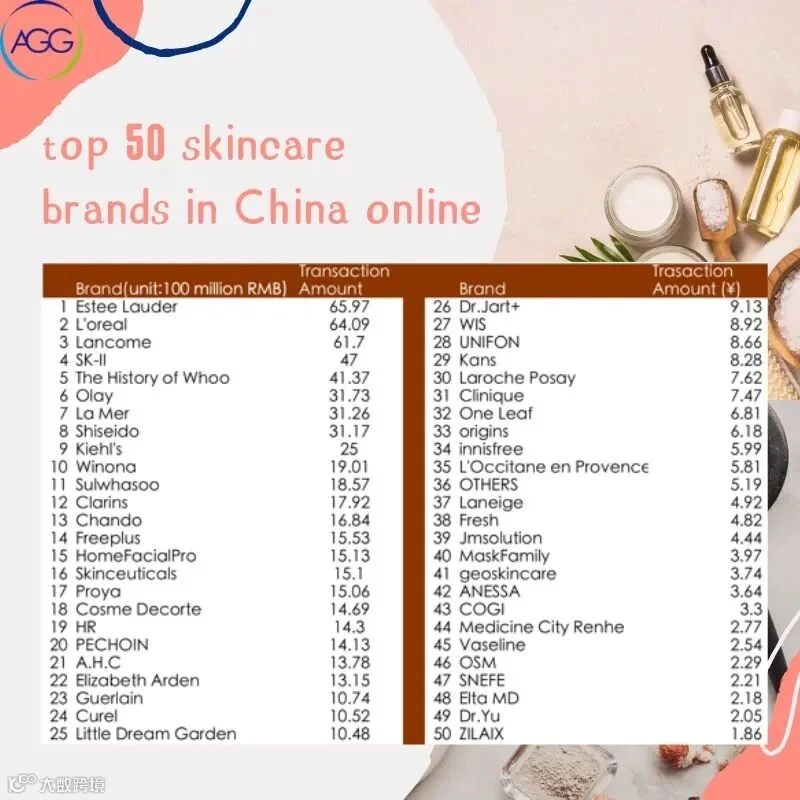
Skincare accounted for more than half the total sales of beauty products in China in 2019. Of the top fifty skincare brands on Tmall, seventeen of them are Chinese, the others being popular global brands, with giants Estée Lauder, L’Oréal and Lancôme leading the pack. The top-ranked Chinese skincare brand, Winona, is only number ten on the overall list, but its annual gross Tmall sales of ¥1.90 billion are still considerable.
In China today, one of the major trends in skincare is towards scientific or medical product formulations. Winona’s products are geared towards treating sensitive skin, and have sewn up an enormous proportion of that market. Estimates show that 35% of Chinese women suffer from sensitive skin, and millions and millions more perceive themselves to have some kind of clinical skincare need that dermatologically scientific skincare can help cure. Thus the sensitive-skin market in China is by no means a niche one. Analytics data for December 2020 show that, among all transactions conducted by Winona on Tmall, most are the result of direct traffic, suggesting that Winona occupies an influential market position with loyal customers and strong brand recognition.

Professional recommendations for Winona’s products are legion, which leads consumers to believe in the products’ scientific efficacy. Whether on Weibo, Xiaohongshu or even on medical websites, there is never a shortage of doctors and pharmacists endorsing Winona’s products with their core ingredients built around herbal extracts and the Chinease pharmacopoeia, with which Chinese consumers would be more familiar than with the ingredients used by competing global sensitive-skin brands such as Avène and La Roche-Posay.
The Winona Tmall flagship store was officially launched in 2012; in the first half year of 2020, online sales accounted for 83.2% of the firm’s revenue. Even before the pandemic, Winona began putting considerable effort and money into its social media marketing. In 2017, the company spent only ¥6.2 million on social media marketing; in 2019, the number rose to nearly ¥70 million with a dedicated staff of 50 employees. Winona has also taken advantage of the potential of live-streaming, and has collaborated with such celebrities in the field as Austin Li and Weiya. Although the company has worked with influencers on Douyin, Xiaohongshu, Bilibili and Weibo, its main focus has been on Douyin; it reserves Weibo, for example, mainly for announcements of big events and campaigns.

Although it ranks far below Winona in terms of total sales figures, Dr. Yu, as the name suggests, also sets itself up very much as a medical skincare line. The company bills itself as experts in skin repair, and collaborates with its own group of consulting dermatologists at Ruijin Hospital, which is affiliated to Shanghai Jiaotong University. The resulting Dr. Yu Skin Health Expert Committee consists of fourteen dermatologists who work with the brand on product formulation. Analytics reveal that Dr. Yu’s conversion rate from browsing to payment on direct traffic is the highest among all traffic sources, which points up consumers' recognition of, and faith in, the brand.
Among other domestic brands, another key leader is Proya (17th on the overall list, 4th among domestic companies), which is sold everywhere from department stores to the higher-end supermarkets as well as online. Proya invested heavily in its social media presence, although analytics show that its largest number of conversions for online sales again comes from direct traffic. One should note that Proya, tied with OSM (ranked 46th on the list, 14th among Chinese brands), has the highest price-per-transaction for skincare on Tmall. The figure is remarkable because Proya’s products are considerably less expensive than the big international brands with which it competes.

An interesting entrant on the list is One Leaf (32nd overall 10th among Chinese brands), a pioneer in the extremely lucrative sector of facial masks. One Leaf carved out its marketing niche throught the perceived freshness of its products. From individual face masks to complete treatment sets, the company has also been following the trend to launch a number of products containing Cannabiliol (CBD) and other new ingredients that appeal to younger consumers. Among their marketing strategies, One Leaf has sponsored the Idol-style reality show The Coming One and allowed viewers who purchased One Leaf products to vote for contestants more frequently than ordinary viewers can. The company also teamed with Taobao superstar Weiya, and did over ¥6 million the day of her live stream.
Other domestic brands such as COGI, Kans and Mask Family 1908 have also invested heavily in social media marketing. Taking Alibaba Group’s Double Eleven Global Shopping Festival in November, 2020 as an example, COGI used Douyin as a platform to build promotional opportunities for products like the Iron Man Mask, which has proven very popular with Generation Z customers.
UNIFON, also a big name among domestic line (ranked 28th on the list above, 8th among Chinese brand), focused more on the live-streaming selling channel on Douyin and brought in Weiya to publicize their videos. Rather cleverly, through cutting and replacing the product content in her videos, the company reuses the same footage of Weiya again and again to recommend other products, often in conjunction with discount coupons to boost sales.

Other innovative ways to harness social media platforms can be seen from newer brands, such as Little Dream Garden and WIS. Little Dream Garden collaborated with 200 multi-channel networks (MCNs) to distribute through Douyin, and, from 2018 to 2019, devoted nearly 80% of its advertising budget to collaborations with major beauty KOLs. The result has been tens of millions of views for their videos
As for WIS, the company’s founder has used its Weibo account from the beginning as a means of promoting the brand. She understands exactly what content will be effective and has entered the cosmetics industry more savvily than most. Among other strategies, she first advertises to smaller group of consumers and only then decides whether to add a larger flow based on the data she received from the first small sample.
Social media have been bombarded by some of the leading skincare products, including HFP’s Oligopeptides Original Fluid, Mask Family 1908’s Acne Skin Repair Gauze Facial Mask, and KANS’s Gold Honeycomb Active Mask. Very interestingly, face masks, with their relatively low unit price, have become the new must-have category among Chinese women. Masks accounted for 8 of the 19 domestic items on the top 50 list, including the top domestic grossing product, CHANDO’s Himalaya Mask. On the other hand, there were no masks at all among the top six items on the list (all from global brands.) In fact, only one non-Chinese mask made the list at all, L’Oréal’s Fresh Mix Ampoule Replumping Mask (at number 22.) Among other domestic products of which to be aware, some of the star performers are makeup behemoth Perfect Diary’s Amino Acid Makeup Remover, Dr. Yu’s Centella Asiatica Repairing Facial Mask and Little Dream Garden’s Shea Butter Body Scrub.
Make Up

In contrast to the skincare market, the Chinese makeup market is led by domestic brands: two of the top three and 19 out of the top 50 Tmall sellers are Chinese companies.
At the top of the list sits Florasis. The rest of the top ten is filled out by Giorgio Armani, MAC, Chanel, Dior and other well-known global brands. That Florasis and Perfect Diary outperformed even MAC and Chanel is remarkable, and shows that Chinese women are starting to shift away from prestige international brands into more affordable domestic lines targeted directly at the Chinese market. Morevoer, this degree of market penetration on the makeup side is not paralleled by comparable success by Chinese companies on the skincare side. This suggests that either Chinese women still perceive global brands as preferable where skincare is concerned, or that no Chinese skincare brand has been able to capture the imagination of Chinese women the way the very different makeup brands Florasis and Perfect Diary have. (Florasis outperformed domestic skincare leader Winona by ¥610 million, despite the fact that, overall, skincare outperformed makeup on Tmall by a considerable margin.)
One should also note that, while Florasis had annual Tmall sales in excess of ¥2.5 billion and while Perfect Diary was not far behind with over ¥2.4 billion in sales, a sizable drop ensues to get to the next domestic brand on the list. Carslan only ranks 14th overall, with considerably smaller sales of ¥792 million.
Those data have changed interestingly from the 2019 figures. For that year, Perfect Diary was the domestic leader with gross sales of more than ¥2.3 billion on Taobao/Tmall platforms, followed by Florasis, which ranked second with gross sales of more than ¥1.22 billion. , Carslan ranked third with sales. Thus, from 2019 to 2020, Perfect Diary’s sales increased slightly, Carslan’s declined, and Florasis’ went through the roof.
Florasis’ business model is thus worth some deeper examination. The brand advertises cosmetics made from floral and herbal ingredients, many of those known to consumers through Chinese medicine. That makes for a product that can be marketed as natural, healthy, and, in an interesting marketing twist, pregnancy-safe. They trade on the notion of bringing ancient Chinese beauty secrets to the modern market while combining those with modern research and development to create a best-of-both-worlds product.
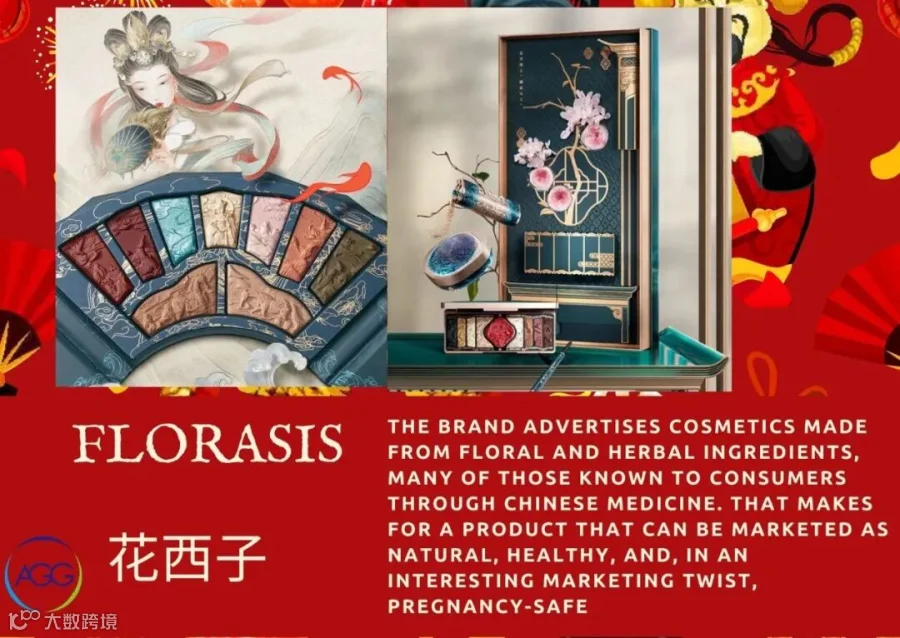
The compapny also places enormous emphasis on packaging and product design, which can be so gorgeous that people some collect Florasis cosmetics as works of art. The very Chinese-style look of the packaging trades on a certain nostalgia among younger Chinese for traditional art forms. As an example, one eye shadow palette suggests the look of a folding screen with each color of eye shadow in the palete embossed with a traditional Chinese design in relief. Florasis’ lipstcks are carved with designs based on traditional Chinese woodworking (a first for the industry) while other packaging turned to the silver working designs of China’s Miao ethnic group for inspiration.
In terms of marketing strategy, Florasis relies heavily on KOLs to promote their product, especially China’s über-KOL, LI Jiaqi, whom the company brought on board as Chief Recommendation Officer. Li Jiaqi does more than hawk the company’s products online: he is an active participant in research and development, and helps select which products make it to market. In still another aspect of his involvement with Florasis, Li collaborated on a promotional shoot for Bazaar magazine with well-known photographer Chen Man, again with emphasis on the artistic nature of the product.
Other KOLs brought in to support the brand include singer Ju Jingyi (an Idol champion with 19 million followers on Weibo, most of them from Generation Z) and internationally celebrated fashion model Du Juan.
As the figures readily show, Florasis concentrates its sales efforts on Tmall. They do everything they can to channel their traffic in that direction, and take full advantage of Tmall’s shopping events, such as the Double Eleven Shopping Festival, at which their 2020 sales showed an increase of 259% compared to their 2019 figures. With sales efforts orientated towards Tmall, Florasis reserves social media for other purposes. Their Weibo account is used to promote traditional Chinese culture, and, only some of the time, ancient Chinese makeup techniques. On the other hand, they employ Xiaohongshu, with its mainly female user base, to focus on tutorials and sales promotions.
The target Florasis customer is twenty to thirty years old, and attracted by the artistic look of the products’ authentic chinoiserie, as well as the price points. The average price of a Florasis product is only ¥10 ($1.52), while the most expensive products in the line cost around ¥100 ($15.20). This is highly attractive to younger women who are just learning to use makeup: in 2019, 26% of Florasis’ customers were under 18; the rest were almost all under 30.
The runner-up brand, Perfect Diary, tells a different story, although some of the elements are the same. Packaging again plays a big role, although, this time, inspiration is drawn globally, thus one eye shadow palette was inspired by the British Museum and another one was inspired by Li Jiaqi’s famous bichon frisé puppy, Never. (The puppy palette was an instant sell-out.)

As a novel marketing strategy, Perfect Diary came up with “virtual KOCs” who interact with customers on WeChat. The first of these is named Xiaowanzi, their online KOC who demonstrates products, acts as the brand users’ digital “friend” and guides them to discounts. The second is Xiaomeizi, the offline store virtual beauty assistant. (Perfect Diary had 40 brick-and-mortar shops in China in 2019.) Because the customer bases coming to the two virtual KOCs are different, Xiaowanzi and Xiaomeizi can be tailored to their specific constituencies, although, most importantly, both share the ability to redirect public traffic into private traffic in order to increase, among other things, repurchasing. (Obviously COVID has wrought havoc with the brand’s offline stores and has caused the company to double down on their online sales efforts.)
Perfect Diary makes use of seemingly every web platform, from their Tmall flagship store, to Douyin to We Chat to Xiaohongshu to Weibo, where extensive use of both KOLs and KOCs is made. The strategy runs from major beauty professionals through to celebrity endorsers (not all of them female and not all of them Chinese) and then to rising micro- and mid-sized KOLs to spread brand awareness. They also heavily stress discounts and other promotions; very cleverly, not all those are available on every platform.
In addition, Perfect Diary has realized that, while Tmall is still the dominant online sales channel, its traffic is gradually decreasing. Thus they use the community advantages of Xiaohongshu and the huge traffic of Douyin for conversions (whereas Florasis still funnels most everything through Tmall.)
As a brand, Perfect Diary is aimed at a slightly older clientele than Florasis: their customers are mostly in the 20-35 range, and are able to afford the brand’s higher price points.
All this success notwithstanding, both Florasis and Perfect Diary have come in for criticism for the actual quality of the makeup, regardless of price point. Florasis, some consumers perceive, places too much emphasis on the box and not enough on what’s in it, while Perfect Diary’s spends a huge part of its revenue on marketing. In the first nine months of 2020, only 1.3% of the company’s total revenues went to research and development, as opposed to Lancôme’s 7.8%, and whopping 62.2% of the company’s gross went for marketing and sales expenses. Although there’s no arguing with success, there is some arguing with the bottom line figures: for 2019, Perfect Diary, despite huge revenues, failed to post a profit.
In addition to the big two, Carslan, ColorKey, Little Ondine, Amortals, Chioture, Judydoll and Geoskincare all performed well. Comparatively speaking, newer cosmetic brands with more affordable pricing do better selling through Douyin; conversely, the more established brands do better on Tmall.
On Douyin, and in addition to Perfect Diary, ColorKey and Little Ondine do a great deal of marketing and have the page view figures to prove it. There are differences in the KOLs used, however: while more than half the web celebrity hosts that Perfect Diary collaborates with have more than one million followers, more than half of ColorKey’s have fewer than 10,000 followers.
Judydoll, Zeesea and ColorKey have a similar marketing approach when it comes to using WeChat to their advantage. They each have formed online communities not too far removed from the private traffic built around Perfect Diary’s Xiaowanzi. Judydoll’s WeChat customer service is called Duoduo, and the community name is Judydoll Girl Paradise. Zeesea’s WeChat customer service is called little Zee – XX, and the WeChat group name is Zeesea Girl’s Garden. ColorKey’s Chinese name is Key La I, and the customer service link Brother I. Its community is called ColorKey Chowan Benefit Club. All three brands conduct WeChat events very frequently, offering limited time discounts, “lucky money” and free gifts.
Finally, May Create, known for its comprehensive line of brushes and makeup tools, is also worth mentioning. It has occupied the top position in beauty tools for twelve consecutive months, making it the leading brand in the category..
Full range of a woman’s makeup needs are covered

The top cosmetics products list reflects the findings from the brand sales figures.
The dominant makeup brands are still Florasis and Perfect Diary, although, remarkably, Florasis’ Air Powder outsold the second product on the list (an Armani liquid lipstick) by 100%, despite a much lower unit price. Out of the 50 products listed, eight of them are from Florasis and six of them are from Perfect Diary, showing the firms’ abilities to create highly popular products.
The other conclusion to be drawn from the sales figures from individual products is that they cover the full range of a woman’s makeup needs.
The top ten items include powder (two, both by Florasis), primer, eye shadow, lip gloss, eyebrow pencil, foundation and a carved lipstick. The only item missing from what would otherwise be a Western woman’s complete makeup kit is blush, but, surprisingly, none of the top 50 products selling on Tmall, domestic or international, is a blush. But, of course, the whiteness so important to the Asian woman’s beauty ideal runs at cross-purposes to the rosy-cheeked look favored by their Western counterparts and the makeup used to achieve it. (On the other hand, the profusion of lipsticks on the list shows that red lips are indeed important to the Chinese woman’s made-up look.)
Conculsion

The story told by the figures above is an interesting one. The first point needing to be made is that Chinese brands are making inroads into a market that was formerly dominated by global companies such as Estée Lauder. If Chinese beauty lines haven’t caught entirely up with imports, especially in the skincare sector, sales there are steadily improving, while, for makeup, two Chinese companies already account for nearly ¥5 billion in Tmall business alone. That’s a lot of carved lipsticks and puppy-themed eye shadow palettes.
The most successful companies all make the most of the sales opportunities provided by social media platforms, although there doesn’t seem to be any hard and fast rule as to how to use them. There’s Winona’s prominent use of Douyin, Florasis’ heavy reliance on Li Jiaqi and Perfect Diary’s virtual KOCs to show just how much creative marketing potential can be found on the Chinese internet. There is also every reason to suppose that the possibilities for innovation haven’t been exhausted and that there is more to come in what has already become a highly lucrative field.

Editor's
Comments
One of the phenomena that surprised me the most working on this article was the way that Li Jiaqi lent his services to competing brands Florasis and Perfect Diary. Although he is the former brand’s chief recommendation officer, he lent his high-profile pooch to Perfect Diary for a hugely popular eye shadow palette. That seems surprising to Western eyes, where non-competition clauses must be more frequently encountered than in China. Consider the way in which actress Catherine Deneuve became the face of Chanel in the 1970s; Li Jiaqi is closer to being the face of Chinese beauty overall.
I must admit that I was very taken with the Florasis eye shadow palette that resembled the folding screen: I can’t recall having seen a makeup product look that lovely on its own. I showed it to a young (female) friend of mine to get her reaction. She agreed with me that the product looked wonderful, and was instantly taken by the tag line of “herbal cosmetics” on top of the photo of the palette. She said she was very intrigued by the idea…and asked what the palette’s price point was.
2021
阿侠谷

2021
Social Media Ecommerce