2021 China Media Resource Advertising Trends

The storm clouds have finally parted, 2020 is in the collective rear-view mirror, and we are beginning to get glimpses of what the post-pandemic world is going to be like. Expectations are running high for a return to normalcy in most sectors of the business world, although few doubt that the normal that awaits us is going to be tempered by the experiences and lessons of the past year.
We may assume that, as the economy recovers, so will the advertising market. However, there is no escaping the fact that the pandemic will have had a deep and long-lasting impact on every industry, marketing included.
The pandemic year forever changed the ways in which consumers purchase goods: there wasn’t much sense in advertising to get people inside brick-and-mortar stores when they were closed. There was a huge shift of business to the internet and ecommerce worldwide, a trend which will continue for the forseeable future. Offline sales may be a possibility again, but they may never again be the norm.
In post-pandemic China, the internet marketing model can be expected to continue to develop rapidly. Online media will demonstrate considerable resiliency, as new media are introduced and cutting-edge marketing techinques are developed
In 2020, China digital media were on the rise, but overall growth was slow
Data from Zhongguancun Interactive Marketing Laboratory show that, in 2020, China's online market survived the impact of the global pandemic.
The annual revenue of online advertising (excluding Hong Kong and Macao) reached ¥497.16 billion ($76.21 billion). Although that represents an increase of 13.9% over 2019, overall growth was actually 4.4% slower than the previous year. That nonetheless represents a growth trend, despite some of the worst economic challenges of the past fifty years.
In terms of proportion of advertising revenue, in 2020 display and e-commerce advertising maintained roughly the same market share as in 2019, while search advertising saw its market share decrease for the second year running. In contrast, video advertising expanded with an annual growth rate of 45.4%, thanks to the strong rise of short video on platforms such as Douyin. The video platform is rapidly supplanting the search platform in China as a sales tool, a key trend that is sure to continue througout 2021 and beyond.
Herewith, some marketing trends worth watching for in post-pandemic China.
The advertising market will rebound strongly in 2021
As a result of the outbreak of COVID-19, the entire advertising market in China suffered, as it did worldwide.
In 2020, China’s advertising spending per page decreased by 11.6%. The advertising market’s decline began in February, not long after the first lockdowns were imposed. Thanks to some marketing ingenuity, however, it began to rebound fairly quickly, so that, by December, its growth rate was again stable.
Nevertheless, although the growth rate stabilized, there was still a large gap in total output as compared to 2019. The advertising market is, however, expected to show considerble growth in 2021, correcting the drop-off in volume that resulted from the pandemic year.
New advertisers will emerge as a market force
The Zhongguancun data show that, in 2020, ads from small, micro and cutting-edge brand advertisers increased by 50%, 5 percentage points higher than those from established brands. Among the advertisers whose annual increase was greater than 10%, new small and micro advertisers accounted for 39%, whereas established brands accounted for only 28% of that total. Thus, small, micro and cutting-edge brand advertisers are emerging as a major market force.
With the pent-up energy of the privations of 2020 ready to release itself, now is the time to bring small brands to the marketing table. Although one cannot anticipate which brands will succeed in this new marketplace of possibility, there can be little doubt that 2021 will be a year of new products and substantial growth for intrepid smaller enterprises.
Advertising investment will increase in the health and fitness, household, and education sectors
Although the pandemic adversely affected most sectors of the economy, certain areas nonetheless managed to show growth. Among these were health and fitness, personal care, and household items .
Nielsen AIS all media advertising monitoring data show that, in 2020, all these areas grew substantially, led by health and fitness, which showed growth of 64.8%. There was also a large increase in advertising output for kitchenwares, home entertainment and pet supplies.
That mostly stands to reason, given that these are sectors with which consumers needed to engage despite the periods of lockdown. As long as people have pets, they’re going to need pet supplies, and purchasing them online was a solution to the problem of how to acquire them when stores were closed. Advertising trends quickly adapted and kept pace with that shift in the marketplace. Having learned to buy their groceries and pet supplies online, consumers are unlikely to return completely to the way things were pre-2020. Thus continued growth is expected in all these ecommerce sectors, with advertising expenditure following in due course.
On a very different front, the overall advertising investment in the online education industry also reached unprecedented heights. Again, this stands to reason: students were unable to attend school during the pandemic lockdowns, and education shifted to online learning. Projections anticipate that growth in this sector will continue, with learning paradigms unlikely to return to pre-pandemic “normal”, although the extent of future growth in online education is more questionable than that of household goods and pet supplies.
Marketing investment for lower-tier cities will be key

One of the words that anyone seeking to do business with China is going to have to learn is xiachen. Meaning “to sink” or “to submerge”, it’s the not very flattering way of describing the phenomenon of concentrating marketing efforts on China’s lower-tier cities. (China’s cities are unofficially divided into “tiers” for purposes of business and marketing. There is no one classification, although, as a general rule, lower-tier cities are defined by their smaller size, lower levels of affluence and less desirable locations within the country.)
Companies and marketers have begun to realize that smaller cities offer untapped commercial potential. From a marketing standpoint, that means realizing that what will work as a marketing campaign in Beijing or Shanghai probably won’t work in Weifang or Qiqihar.
The telecom, clothing and accessories, appliances, and computer sectors are among those that are focusing more and more on lower-tier cities , and, thus, are dedicating large portions of their marketing budgets on targeted regional media. Tier 3 and Tier 4 cities are a market ready to be taken seriously; the question that poses is how regional marketing needs to be different from marketing techniques that have worked across the Tier 1 Bei-Shang-Guang-Shen axis.
The era of video advertising has come: "advertising is content"
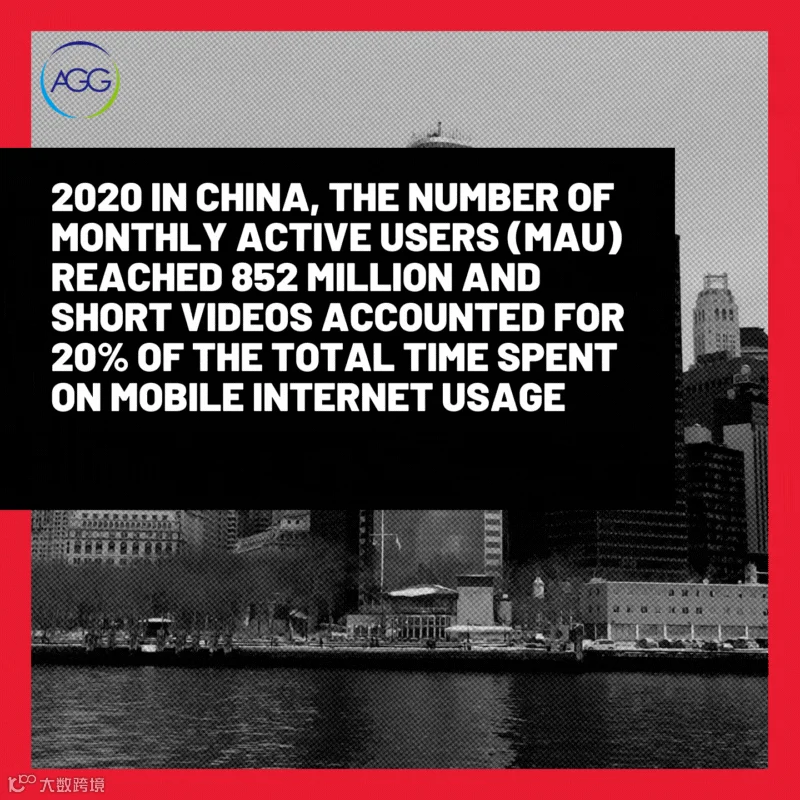
According to data from QuestMobile, in the first half of 2020, short video platforms grew rapidly. The number of monthly active users (MAU) reached 852 million and short videos accounted for 20% of the total time spent on mobile internet usage, second only to instant messaging.
The Zhongguancun data show that, in 2020, the revenue scale of video advertising was about ¥90.4 billion ($13.9 billion), which respresnts enormous year-on-year growth of 64.9%. This bonanza pushed video advertising ahead of search advertising into a position second only to e-commerce advertising. The growth of short-video ads more than doubled (the precise figure is 106%) in 2020, outpacing the 25% growth of long-video media.
With the advent of 5G, 4K/8K, zero-delay live broadcasting, VR/AR, interactive video and other cutting-edge technologies, the possibilities for video content will increase exponentially and the field wil continue to thrive. In 2021, video marketing is poised to become the biggest sector in the marketing industry. Leading marketing platforms will position themselves strategically in the video marketing sphere, such as the mobile video adveritsing platform of Pangolin Ads, a subsidiary of Ocean Engine, the enormously important mobile marketing platform that makes it possible to advertise on Bytedance’s apps such as Toutiao and Douyin.
A different tack for video advertising is that developed by Focus Media. They employ a model that takes advantage of the time people waste standing around with nothing better to do and advertise using digital signage screens in elevators, convenience stores and supermarkets, along with poster advertising in elevators on a massive scale throughout China.
Deep integration of brand & performance advertising
Brand advertising remains the primary mode of advertising in Internet marketing in China. The Zhongguancun report shows that it accounted for 66.78% of the total market share in 2020, while performance advertising accounted for 28.08% of the market.
In 2021, however, advertisers will show an increased interest in performance advertising. Ad placement will take into account the psychological influence on the consumer, efficiency of communication, flow coversion and asset precipitation. The key take-away is that brand and performance advertising will be increasingly integrated. There will be no way to favor one over the other in a future in which both will be called upon to work hand-in-hand.
The e-commerce festival will become an even larger force

The rise of e-commerce shopping festivals has greatly affected the consumption structure of the Chinese market. Nearly 40% of Chinese consumers allocate extra shopping budget for e-commerce holidays, while 13% said that they allocate most of their annual spending budget to events like Double Eleven. Because consumers expect prices to rebound following the festivals, a culture of stocking up on goods during the festivals has developed.
In 2020, e-commerce platforms increased the number of festivals and shopping holidays, which helped to release pent-up consumer demand. The advertising market kept pace: the Zhongguancun data show that, both before and after June 18, Double Eleven and other large e-commerce festivals, there was a significant increase in advertising expenditure.
In 2021, brands and platforms are developing and implementing still more themed events, so as to exploit the market potential with the help of consumers’ obvious desire for shopping festivals. With the growing involvement of more and more merchants and brands in these festivals, consumers will come to accept these new shopping holidays, which will then blend into a brand’s overall marketing plans for the year.
As public traffic becomes more expensive, private traffic will continue to develop as an important marketing tactic

In 2021, the trend of shifting online marketing traffic to private channels will continue. As the cost of maintaing public traffic continues to increase, private traffic constitutes a more cost-effective and productive way of managing customer flow, conversions and, perhaps most especially, repeat purchases.
Private traffic helps brands contact consumers directly and improve consumer retention rate. Brands can focus purely on target consumer groups while saving money on acquiring traffic.
Experts have broken the management of private traffic down to three models: the shopping assistant model (which corresponds to a sales associate at a department store), the topic expert model (in which an expert educates consumers) and the private partner model (often used by luxury brands, it corresponds roughly to a personal shopper.) The cosmetics company Perfect Diary has shown how practically all these roles can be filled virtually by the likes of their automated shopping assistant Xiao Wanzi.
Xiao Wanzi illustrates just how far private traffic can lead: its clever management of private traffic is one of the ways in which Perfect Diary has moved into position as one of the two leading made-in-China cosmetics brands. Because platforms like Taobao and JD are becoming more expensive to use, now is the time for brands to gain independence from these platforms by courting private traffic.
Continued emergence of the customized brand mode
China’s younger consumers have for several years already been attracted by customizable brands as a means of expressing their own individuality, a high prority among today’s Generation Z. Unique products are highly valued, with the personalization trend running from everything from skincare to clothing. This need not mean a full bespoke experience, although new technologies are placing that ever more within the reach of the average consumer. Sometimes customization can be as simple as hot-stamping initials onto a Louis Vuitton bag. The result may not exactly be unique, and it is far from designing your own product, but many consumers seem to be content with this kind of superficial personalization.
Customizable goods will continue as a powerful trend, especially at the upper end of the market. The trend will continue to refine itself and, especcderially taking new technology into account, will lead to the development of new types of personalizable and customizable merchandise.
Ongoing success of livestreaming

Perhaps the biggest lesson of the pandemic year is that livestreaming is here to stay. It was the sales model that thrived as a result of people being confined in their homes, as it provided a communal shopping experience when one was sorely needed. Mega-KOLs such as Viya and Li Jiaqi led the way with huge sales on their livestreams, although it is predicted that the the super-influencer may not be the be-all and end-all of livestreaming in the future.
KOLs pose a number of problems. The public is beginning to realize that they are paid for their endorsements, which is beginning to erode consumers’ trust in the big livestreaming hosts. Hiring someone like Viya also takes a serious bite out of an advertising budget. On top of that, livestreaming creates sales peaks and valleys, and leaves questions such as customer retention unanswered. Future trends may well see livestreaming as a branding tool at least as much as a sales medium. This may well lead to the emergence of more brand-specific KOLs, as well as to the far more economical alternative of KOCs to guide consumers to specific products.
For the moment, livestreaming is a must for getting a product before the Chinese consumer; immediate sales need perhaps to be viewed as a bonus rather than the primary goal of going live with merchandise. This represents a shift in focus from the ways in which livestreaming was understood during the pandemic year, but the medium is sure to continue evolving, especially as new technologies appear on the market: having Li Jiaqi interacting “live” with virtual pop diva and KOL Luo Tianyi on a livestream for L’Occitane is only the beginning of a world of high-tech marketing possibilities.
Summary
Overall, the trends in Chinese marketing will show the shifts of the pandemic year adapting themselves to a more normalized form of ecommerce as the marketplace stabilizes itself following the upheavals of 2020. The overall scheme will be adaptive rather than volatile, and show the reemergence of familiar trends against a new ecommerce backdrop.
Regardless, the market is ripe for the picking, with the all-important figure to bear in mind being that forecasts suggest that 52.1% of the country’s retail sales will come from ecommerce in 2021, up from 44.8% in 2020. That means that, for the first time anywhere, a majority of retail sales for an entire country will be transacted online.
Moreover, China’s pandemic ecommerce boom did not subside even as the economy reopened. Consumers who of necessity discovered shopping at home also discovered that they liked it. The persistence of the boom shows that they aren’t likely to go back to the way things were. Last year, brick-and-mortar sales declined by 18.6% in China, and expectations are that it will continue to decline this year, perhaps by as much as 10%. The same projections show that ecommerce grew by 27.5% in 2020 and will grow by another 21.0% in 2021.
There is therefore a bright future for ecommerce as the key means of achieving sales in China. Call it the silver lining in the cloud of the pandemic if you will, but the trend is here to stay.

Editor's
Comments
Anyone reading the above must be struck by how different some of the forecasted trends are from what we have in the United States. Concepts such as livestreaming, KOLs and private traffic are, for the time being unfamiliar in America while central to the Chinese ecommerce universe. What seems less unfamliar is the expectation that some kind of synthesis – a “new normal” – will emerge from the combination of pre-pandemic norms and the way things have been for the past year. There doesn’t seem to be much chance that things will ever be the same again, either here or in China, so the question is what is that synthesis going to look like…and will the United States and China arrive at the same, or different, syntheses?