By CHEN Yun (Robert),Andrew FEI and WANG Rong
Introduction
1. The China Bank Regulatory Commission (“CBRC”) has issued a set of new rules (“Rules”) aimed at:
controlling a broad range of risks in the financial system;
improving the regulatory and supervisory framework; and
ensuring that the banking sector better serves the real economy and national development policies
2. The Rules apply to both domestic banks and foreign banks in China. This publication focusses on key issues that are relevant to foreign banks operating in China
3. In addition to introducing many new requirements and guidelines, the Rules also strengthen and reinforce a number of existing CBRC policies
4. The Rules are the latest in a series of policy and enforcement measures taken by Chinese financial regulators to address financial and systemic risks
5. The Rules represent the first major rulemaking under the leadership of newly appointed CBRC chairman GUO Shuqing
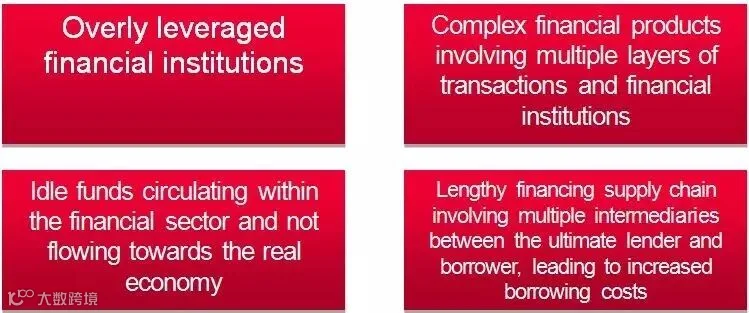
Underlying problems
The CBRC has identified the following underlying problems that has led to irregularities in the banking and financial sector:
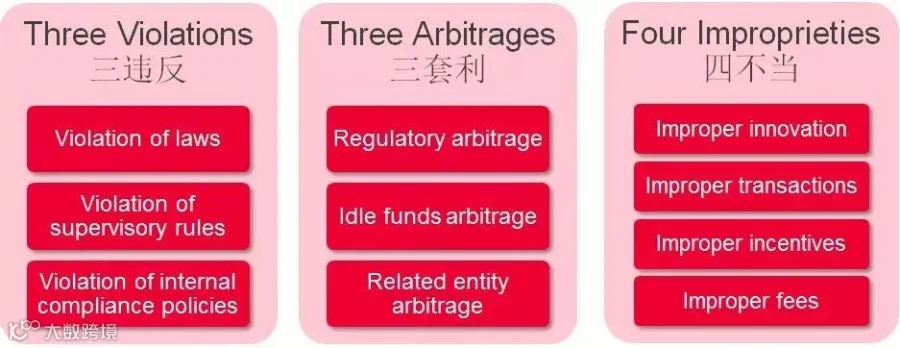
Irregular and improper behaviors in the industry
The CBRC has identified the following key irregularities and improper behaviors in China’s banking and financial sector:

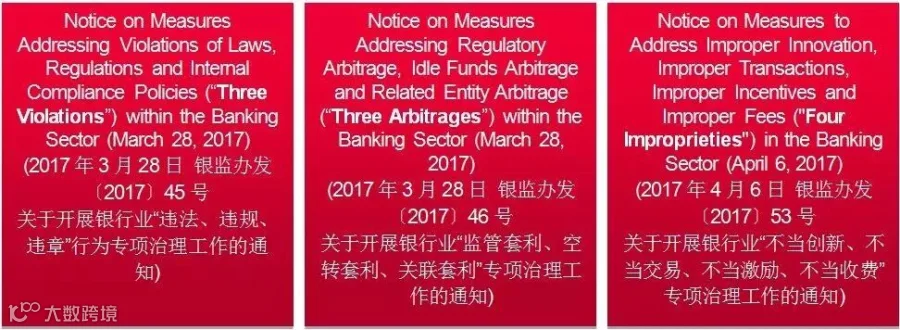
Package of tough new measures
The Rules represent the CBRC’s response to these underlying problems and irregular and improper behaviors. The Rules include the following key components:

Key objectives and outcomes
The Rules are intended to achieve the following key supervisory objectives for CBRC:

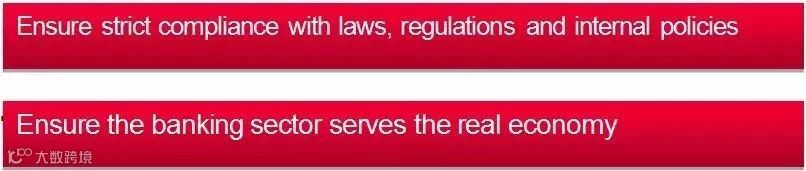
These supervisory objectives are intended to achieve the following key outcomes for the banking sector:
How can banks better manage risks?
To achieve the key outcome of better risk controls and compliance, the Rules require banks to do the following:


How can banks better serve the real economy?
To achieve the key outcome of better serving the real economy, the Rules require banks to do the following:


Specific actions that banks must take

Information-based risk controls: Requiring banks to use information systems to objectively control and manage all types of risks
Clear responsibility: Requiring the financial institution (e.g. bank) that originated the funds to assume responsibility for financial products that cut across multiple sectors within the financial industry (e.g. banking, securities and insurance sectors)
Strengthen control over activities between banks: Require board of directors oversight with respect to the development and risk management of wealth management activities between banks (i.e. within the banking sector)
Firewalls: Establish firewalls between the banking system and the capital markets, bond markets, insurance markets and FX markets
Ex ante review: Internal management framework and procedures must be established for any financial innovation, and the prior approval of the risk management department, the legal compliance department and the board of directors (or relevant committee) must be obtained before engaging in actual activities
Stress testing: Targeted stress testing of rapidly growing new products, new business lines and business areas with significant potential risks
Behaviors that banks must avoid
Engaging in business activities without first obtaining the required approval or making the required filing
Engaging in new and innovative business without establishing the required internal framework and procedures
Bank employees improperly accessing, searching, disclosing or selling customer information
Bank employees selling financial products that are not offered or authorized by the bank
Bank employees misleading customers to purchase wealth management financial products
Improper product bundling - forcing customers to purchase certain products and services in order to obtain other products or services from the bank
Making non-complying real estate related loans
Making non-complying loans the proceeds of which are used to invest in the stock market and futures market
Forming improper business cooperation with micro-lending companies and other non-financial institutions
Non-compliant sale, disposal and write-off of NPLs
Non-compliant transfers of performing loans
Non-genuine transfers of credit assets
Issuing bank acceptance bills that are not based on genuine underlying trades
Providing or accepting guarantees or similar arrangements in connection with investments between banks or otherwise for wealth management products
Forced bundling of wealth management products
Failure to comply with annual report and other disclosure requirements
Non-compliant conversion of NPLs into off-balance sheet items
Using refinancing and other methods to conceal NPLs
Failing to use the look-through approach and substance over form principle in accounting, risk and capital measurement practices
Converting assets under the discounting business into investments by contributing bills of exchange assets into asset management plans
Pooling of funds relating to different wealth management products
Providing financial services to illegal, non-regulated trading platforms
Using the bank’s own funds to purchase its own or another bank’s wealth management products
Passing mortgage registration fees onto the customer
Layering one wealth management product onto another wealth management product
Increasing leverage by entrusting funds to external fund managers for investment purposes
Banks investing in each other’s wealth management products and asset management plans to increase leverage and earn more spread
Banks transacting with each other to inflate their balance sheets
Non-compliant transfers of credit assets by investing in related funds or partnerships
Using related entities to engage in equity and real estate investments that are prohibited for banks
Using the Qualified Domestic Institutional Investor (“QDII”) regime to invest in offshore bonds issued by domestic real estate companies (as opposed to lending directly to these companies)
Transactions between wealth management products
Engaging non-financial institutions to provide investment management services for wealth management products
Wealth management products that invest in products issued by non-financial institutions
Wealth management products that directly invest in credit assets or receivables
Wealth management products that invest in NPLs, NPL asset-backed securities or other rights related to NPLs
Principal-guaranteed wealth management products that are not managed as deposits and no deposit reserves have been placed with the People’s Bank of China
Not complying with regulations relating to performance-based pay of senior management staff, including risk indicator adjustments and claw-back requirements
Charging fees in excess of prescribed levels
Failure to publicize fee schedule or fee adjustments in a timely manner
Failure to provide customer with 3-month’s advance notice of fees and charges
Enforcement principles
Violations of the Rules will result in severe supervisory and enforcement actions taken by CBRC.
CBRC will adhere to the following enforcement principles:

CBRC’s roadmap for enforcement
The Three “Ironclad Principles” and Three “Must Sees” form the basis of the following roadmap for enforcement by the CBRC:
1. Carry out targeted actions
Implement the “three responsibilities” (primary responsibility falls on the entity that caused the incident, secondary responsibility falls on management and tertiary responsibility falls on the supervisory department)
Secure the “three lines of defense” (the business line, the risk management and compliance function, and the audit function)
Create a culture of compliance where financial institutions are afraid to break the rules, unable to break the rules and unwilling to break the rules.
2. Address regulatory shortfalls
Where appropriate, enact new laws and regulations, amend existing laws and regulations, and repeal redundant laws and regulations
Close regulatory gaps and loopholes
3. Increase supervisory penalties
The penalty imposed should be proportionate to the violation
Regulatory arbitrage must be prevented
Financial institutions must not profit from their violations
4. Ensure accountability
When an incident occurs, the manager, the stakeholder and the person responsible must be held accountable
When a risk eventuates, the business originator, the person who approved the transaction and the person in charge of the organization must be punished
Establish an industry blacklist and implement industry-wide bans to prevent disqualified individuals from working in the industry or being promoted
5. Promoting compliance through tough enforcement
Encourage compliance by requiring remediation in each case and holding individuals accountable
Severe penalties for violations
The CBRC can impose the following penalties on banks and individuals for violations:
Combine a financial institution’s self-examination and with supervision inspection, severely punish problems and violations that were not fully addressed through self-examination
Depending on the facts and circumstances of each case, a financial institution may be ordered to suspend its business, cease starting any new business, cease opening new branches, change its directors and senior executives or comply with other prudential supervisory measures
Severe punishments will be imposed in cases involving repeat offenders, inadequate remedial measures, and failure to cooperate with regulators and inspectors
Severe punishments will be imposed in cases involving improper transactions with related entities and arbitrage activities
Penalties received by the financial institution will be reflected in its market access, performance evaluation and regulatory ratings etc.
“Double punishment” will be imposed on both the financial institution and the individual(s) responsible for the violation
Penalties already imposed by CBRC
Following is a snapshot of the CBRC’s enforcement efforts in the first quarter of 2017. We expect the CBRC to further strengthen enforcement over time.

Next steps for banks
1. Actively carry out self-examination and proactively remediate violations
For example, a bank should:
Comprehensively review the effectiveness and compliance of risk management framework and internal policies
Verify the compliance status of lending activities and fund flows
Remediate non-compliant structures and arrangements with respect to wealth management products
Address non-compliant fee arrangements and related contractual provisions (especially with respect to financial adviser fees, consulting fees and requiring the customer to bear mortgage registration fees)
Consider how the Rules will impact the relationship between a foreign bank’s Chinese operations and its operations outside of China
2. Cooperate with regulators in relation to supervisory inspections and examinations; diligently complete all remediation steps
For example, a bank should:
Strengthen communications with regulators
Be prepared to provide adequate explanations to regulators from a legal and compliance perspective
The Rules represent one of the most significant financial regulatory developments this year.
For more information about how the Rules will affect your business, please contact any member of our cross-border financial regulatory team.