


Legal Compliance of Drugs, Medical Devices, Healthcare Products and Medical Treatment Advertisement
内容摘要:本文旨在介绍药品、医疗器械、保健食品和医疗广告的合规要求,包括分析目前常见的软文、直播营销、社交平台推广等非典型广告形态的监管要求,以及分析药品、医疗器械、保健食品和医疗领域广告内容监管和审查的特殊要求,相关典型案例以及可能涉及的民事、行政或刑事责任。
中文版文章回顾:《药品、医疗器械、保健食品及医疗广告合规》
01
Overview of Advertisement Compliance
1.Basic Concepts
(1) What is “advertisement”?
1)Basic Definition of Advertisement
We refer the basic definition of “advertisement” under the People’s Republic of China (the “PRC”) laws and regulations to determine what content and format constitute “advertisement”:
Paragraph 1 of Article 2 of the Advertising Law provides that this Law shall apply to the commercial advertising activities within the territory of the PRC whereby business operators of goods or service providers directly or indirectly introduce their goods or services through certain media or forms.
Paragraph 1 of Article 3 of Interim Measures for the Administration of Internet Advertising (《互联网广告管理暂行办法》) provides that the term “Internet advertisement” as defined by this Measure shall mean commercial advertisement that directly or indirectly promote goods or services through Internet media such as websites, webpages, and Internet applications in the forms of text, picture, audio, video, or others.
Based on the above provisions, the key feature of “advertisement” under the PRC laws and regulations is to “introduce” business operator and its products or services for the purpose of “promotion”. If the promotional information released by business operators conforms to such feature, then regardless of the form in which the information is released, and regardless of whether the information is directly or indirectly conveyed to consumers, it constitutes “advertisement” as defined under the PRC laws and regulations.
In addition to the general compliance requirements for advertisement, this article will also focus on the compliance requirements for pharmaceutical and medical advertisements as required by the Advertising Law, i.e. the advertisement compliance requirements for drugs, medical devices, medical institutions, medical services and healthcare products.
2)New Types of Advertisements
Traditional advertisements mainly include television advertisement and newspaper advertisement. Article 2 of the Regulations on Administration of Advertising (《广告管理条例》) promulgated by the State Council in 1987 listed the forms of advertisements commonly used at that time. With the development of science and technology and the diversification of business models, we can see various types of atypical pharmaceutical and medical advertisements burgeoning in our daily life.
(a)Advertorial
Advertorial is a new media text pushed for indirect marketing. Advertorial spreads via Internet media such as WeChat and Weibo (mainly in the form of text and often supplemented by pictures, audio, video, etc.) to indirectly promote products for commercial purposes[1].
Article 3 of the Interim Measures for the Administration of Internet Advertising (《互联网广告管理暂行办法》) lists four types of Internet Advertisements: (1) Advertisements that contain links with text, picture, video etc. to promote goods or services; (2) E-mail advertisements that promote goods or services; (3) Sponsored search advertisements that promote goods or services; and (4) Advertisements in commercial displays that promote goods or services, as well as displays of information that are required to be provided by business operators to consumers under the requirements of laws, regulations and rules.
In a case where Shanghai- Financial Consulting Co., Ltd. illegally published an Internet advertisement, the party obtained the right to operate several WeChat official accounts on behalf of others, through which it carried out marketing activities including but not limited to article promotion and publication, daily update of accounts, and provision of advertisement services. Since May 2020, the party has repeatedly published advertorials which promoted the medical value of non-pharmaceutical products, guaranteed the potency of a medical device, sometimes even with obscene and pornographic contents. Those advertorials included a large number of texts, pictures, and QR codes containing product prices and links, etc. Putuo Administration of Market Regulation determined that the WeChat advertorials published by the party were illegal advertisements, and penalized the party with a fine of RMB 150,000 on October 9, 2020.
Based on the types of Internet advertisement listed in the above regulation and the identification of “advertorials” in some practical cases, although lacking use of familiar and traditional advertisement language, it is possible that sharing experience and scientific knowledge on Internet platforms would be regarded as a form of Internet advertisement, which is commonly found these days.
(b)Live-Streaming Marketing
Live-streaming marketing is a kind of Internet marketing strategy that has harvested significant popularity in recent years, in which commercial activities are carried by live streaming of audio, pictures or words, or a combination of all, through Internet websites, applications, applets, etc[2].
On April 23, 2021, seven departments, including the Cyberspace Administration of the PRC, the State Administration for Market Regulation and the National Radio and Television Administration, jointly promulgated the Administrative Measures for Online Live-streaming Marketing (for Trial Implementation) (《网络直播营销管理办法(试行)》), which laid down a systematic foundation of regulating live-streaming marketing activities. According to Article 19 of the above regulation, “if the live-streaming content broadcasted by live-streaming booth operators and live-streaming marketers constitutes commercial advertisement, the operators and marketers shall perform the duties and obligations of advertising publishers, advertising agents or advertising endorsers”.
Prior to the issuance of the Administrative Measures for Online Live-streaming Marketing (for Trial Implementation) (《网络直播营销管理办法(试行)》), in practice, several local regulators regulated the promotion of commodities by means of online live-streaming as they were advertising activities. Take a case of violation of Advertising Law by a Shanghai-based trading company as example[3]. On December 25, 2019, the aforementioned company entrusted Mr. Zhang, a natural person, to advertise its healthcare product, traditional chicken powder, through online live-streaming, and both parties signed a business entrustment contract. On December 28, 2019, Mr. Zhang in his Taobao’s personal broadcast studio alleged that the traditional chicken powder had “a little slimming effect”. Jing’an Administration for Market Regulation hereby determined that the acts of the parties violated Article 17 of the Advertising Law, and on June 8, 2020, imposed on the parties the following penalties: (1) a ban from publishing advertisements, and (2) a fine of RMB 3,000. Therefore, live-streaming marketing activities for sales purposes are usually closely related to “promotion”, which may also be deemed as Internet advertisement.
(c)Social Platform Promotion
In addition to the diversity of forms, advertisements platforms are also ready to variegate as social platforms continue to develop and enrich. Promotion through social platforms such as WeChat, Weibo and TikTok is also one of the common marketing methods. In this model, private, civilian, universal, autonomous disseminators, via modern and electronic means, transmit normative and non-normative information to a non-specific majority or a specific individual[4].
In practice, it is also common for a company which carries out promotional activities on social platforms to be deemed as advertising. In the case of illegal advertising by a Jingjiang-based trading company[5], the company released a post on WeChat Moments, and used the words such as “too good to be fiddled”, “supreme quality”, “large quantity comes with good price” to introduce the face masks it sells. Under the investigation by the authority, it was confirmed that the “N95 children’s face masks” posted by the company on WeChat Moments were actually ordinary protective face masks (GB/T 32610). Accordingly, on June 28, 2020, with respect to the company’s dissemination of false advertisement information in selling “three-dimensional face marks for children” or “disposable ordinary face marks”, Jingjiang Administration of Market Regulation ordered the company to stop publishing illegal advertisements and remedy the repercussions of such advertisements on WeChat Moments, and imposed a fine of RMB 2200.
From the above cases, it can be seen that, although the promotion information was released on different platforms and in different modes, it has the feature of “introducing” business operators and their products or services for the purpose of “promotion”. As such, the Administration for Market Regulation regards such promotion activities as advertising. Therefore, if a business operator in the pharmaceutical industry introduces itself or its products or services for the purpose of promotion, it would be deemed as advertisement, and shall be subject to general laws and regulations on advertising and general requirements set forth by the relevant authorities, as well as the special requirements for pharmaceutical advertising.
(2) Subjects of the Advertisements
According to Article 2 of the Advertising Law, advertising in a general sense involves advertisers, advertising agents, advertisement publishers, advertising endorsers and other subjects. Their respective meanings are as follows:
Advertisers refer to the natural persons, legal persons or other organizations that design, produce or publish advertisements themselves or through others to promote their products or services.
Advertising agents refer to the natural persons, legal persons or other organizations that accept entrustment to design or produce advertisement or provide agency services thereof.
Advertisement publishers refer to the natural persons, legal persons or other organizations that are entrusted by the advertisers or their advertising agents to publish advertisements.
Advertisement endorsers refer to the natural persons, legal persons or other organizations other than advertisers that recommend or endorse products or services with their names or images in the advertisement.
The subjects involved in traditional advertisements such as paper media and television broadcast usually fall into the four types of subjects set forth in Article 2 of the Advertising Law. In comparison, the subjects involved in Internet advertisements are more complicated. As for the identification of advertisement publishers, take the promotion of social applications as an example: when advertisements are advertised through social platforms, the identification of advertisement publishers related to two parties: the platform operator and the account operator. As to which party is the Internet advertisement publisher, Article 11 of the Interim Measures for the Administration of Internet Advertisements (《互联网广告管理暂行办法》) provides that “the natural persons, legal persons or other organizations that push or display Internet advertisements for advertisers or advertising agent and are able to verify the contents of advertisements and decide on the publication of advertisement shall be the publishers of Internet advertisements.” Compared with the advertisement publishers of traditional advertisements, there is an extra requirement for Internet advertisement publishers to “verify the advertisement content and decide on the publication of advertisement”. In practice, the publication of advertisement is usually determined by account operator. Therefore, in most cases, Internet advertisement publishers are account operators.
However, the identification of subjects under the procedural purchase model is more complicated. Procedural purchase refers to the placing of advertisement based on automation system (technology) and data. Advertisers do not identify the advertising publishers or the launch time of the advertisement in advance. Advertisement purchases are implemented via a specific platform. Articles 13 to 15 of the Interim Measures for the Administration of Internet Advertisements (《互联网广告管理暂行办法》) set out the most basic requirements on procedural purchase. Compared to traditional advertisements, procedural purchase has additional parties: demand-side advertisement platform (which integrates advertisers’ demands and provides advertisers with advertisement publication services); media platform (which integrates media resources and provides procedural advertisement distribution and screening services to media owners or managers); and advertisement information exchange platform (which provides data exchange, analysis matching, transaction settlement and other data processing services). The advertisement publisher or the advertising agent in procedural purchase shall be the operator of the demand-side advertisement platform.
2.Relevant Major Laws and Regulations
After years of development, the construction of pharmaceutical advertisement regulatory system in the PRC has been continuously developed and improved, and a “multi-level and multi-angle” pharmaceutical advertisement regulatory system has been established.
The existing pharmaceutical advertisement regulatory system involves a large number of regulatory documents, which can be divided into the following four categories:
General regulations on advertising:
This type of regulations mainly include the Advertising Law, the Interim Measures of the Administration of Internet Advertisement (《互联网广告管理暂行办法》), the Regulations for the Administration of Advertising (《广告管理条例》), etc. These laws and regulations, as the most basic and universal regulations in the field of advertising, set out the general requirements for commercial advertising activities, and forms the basis of the regulatory system for pharmaceutical and medical advertisement.
Basic regulatory requirements in the field of advertising
This type of regulations mainly includes: the Anti-Unfair Competition Law (《反不正当竞争法》) (prohibiting unfair competition behavior such as confusion, false advertising, and disparaging the reputation of competitors' business or goods), the Law on the Protection of Consumer Rights and Interests (《消费者权益保护法》) (specifying the legal liability for infringing consumer rights and interests by false advertising and false promotion), the Trademark Law (《商标法》), the Copyright Law (《著作权法》) and the Patent Law (《专利法》) (stipulating intellectual property matters involved in commercial advertising activities) and other laws and regulations.
Regulations on Pharmaceutical, Medical and Healthcare Product Advertisements
This type of regulations mainly includes the Measures for the Administration of Medical Treatment Advertisements (《医疗广告管理办法》), the Interim Measures for the Administration of Examination of Advertisements for Drugs, Medical Devices, Healthcare Products and Formula Food for Special Medical Purposes (《药品、医疗器械、保健食品、特殊医学用途配方食品广告审查管理暂行办法》) etc. These rules set out the specific regulatory requirements for pharmaceutical advertisements, which should be the focal point for pharmaceutical enterprises to meet the compliance requirements of pharmaceutical and medical advertisements.
Regulations for pharmaceutical industries that may be related to pharmaceutical and medical advertisements
This type of regulations mainly includes the Drug Administration Law (《药品管理法》), Regulations on the Supervision and Administration of Medical Devices (《医疗器械监督管理条例》), Food Safety Law (《食品安全法》), etc. Although these regulations do not directly target pharmaceutical advertisements, they still provide key regulatory requirements for pharmaceutical, medical and health product advertisements. Medical institutions and pharmaceutical products and/or service providers and operators shall draw great attention to such regulations.
3.Basic Requirements for Publishing Advertisements
All advertisements shall comply with the basic requirements of laws and regulations on advertising activities. Pharmaceutical, medical and healthcare product advertisements are no exception. Two basic aspects shall be considered before placing advertisements in the PRC: whether the channels and methods of advertising are legal, and whether the content of advertisements is legal.

(点击查看大图)
For the above-mentioned advertisement compliance requirements, the following issues highly related to and often arise in pharmaceutical, medical and healthcare product advertisements:
(1) Advertisements shall be identifiable
According to Article 14 of the Advertising Law, an advertisement shall be identifiable, and shall be identified as advertisement by consumers. The mass media shall not disguise an advertisement as a news report. Advertisements published through the mass media shall be marked as “advertisements” in a conspicuous manner, and should be distinguished from non-advertisements information such that no consumers would be misled. Article 7 of the Interim Measures for the Administration of Internet Advertisements (《互联网广告管理暂行办法》) similarly provides that an Internet advertisement shall be identifiable as such by consumers, and shall be clearly marked as an “advertisement”.
With respect to pharmaceutical advertisements, advertisements which are not identifiable usually appeared in traditional advertisements such as newspaper and TV advertisements. The content of such advertisements closely resembles news reports, TV programs and columns in newspapers and magazines, so that it may mislead consumers. Business operators shall check whether there is any vagueness in the content of an advertisement, which may be misunderstood by consumers as non-advertisement content. If there is a risk of misunderstanding, the business operator shall clearly mark the word “advertisement” in the advertisement to facilitate consumers’ correct understanding.
(2) The advertising channels involve primary and secondary schools, kindergartens, and their teaching materials and surrounding areas, etc.
According to Article 39 of the Advertising Law, no advertising activities shall be carried out in primary and secondary schools or kindergartens, nor shall the teaching materials, supplementary teaching materials, workbooks, stationary, teaching aids, school uniforms, school buses, etc. for primary and secondary school students or kindergartens be used to publish or publish in a disguised form advertisements, except for charitable advertisements. Article 40 of the Advertising Law specifically provides that advertisements for medical treatment, pharmaceuticals, healthcare products, medical devices, cosmetics, liquor, beauty products, and online games which are detrimental to the physical and mental health of minors, shall not be advertised in the mass media targeting minors.
In practice, common violations include the circumstance that after contacting with staff in primary and secondary schools and kindergartens, a business operator enters the schoolyard to carry out advertising activities under the disguise of charitable activities such as “oral health checks” and “vision health tests” and distribute promotion materials to primary and secondary school students[6]. Therefore, business operators shall, before publishing an advertisement, check whether the channels for promoting and publishing commercial advertisements involve primary and secondary schools and kindergartens, as well as the teaching materials, teaching aids, stationery, school uniforms, school buses, etc. for primary and secondary school students and children.
(3) Indication of unauthoritative quotation
According to Article 11 of the Advertising Law, the data, statistical information, survey findings, abstracts, quotations and other quoted content used in an advertisement shall be authentic and accurate, with the sources of such quoted content clearly indicated. Where there is any applicable scope or validity period for the quoted content, these shall be specified.
If an advertisement contains quotations, business operators shall review the followings:
Whether the quoted contents are true and accurate;
Whether the quoted contents are verifiable;
Whether the source of the quoted contents is clearly indicated;
Verify whether the applicable scope, validity period, etc. of the quoted contents are clearly stated in the advertisements, and whether the advertisement will constitute misleading information.
(4) Deceiving or misleading consumers with false or misleading contents
Article 4 of the Advertising Law provides that an advertisement shall not contain any false or misleading information, nor shall it deceive or mislead consumers. An advertiser shall be responsible for the authenticity of the contents of an advertisement. Article 8 of the Anti-Unfair Competition Law (《反不正当竞争法》) also provides that business operators shall not make false or misleading commercial promotions on the performance, function, quality, sales, user feedback, award received and so on for their products, so as to deceive or mislead consumers.
False advertisements have always been “disastrous areas” in which medical and healthcare goods advertisements frequently violate legal requirements. False advertisements in the pharmaceutical and medical sector mainly cover the following:
The ingredients or technology of pharmaceutical products or services are untrue. For example, naming products as “leonurus warm patches” or “lavender warm patches” while such products actually do not contain leonurus or lavender ingredients[7].
Boasting the unauthentic qualifications of medical institutions or their staff. For example, “attending physician” is advertised as “chief physician” [8].
The efficacy of medical products or services is untrue. For example, advertising that “dental implant technology surpasses real teeth in terms of both aesthetic and functionality” [9].
Business operators shall pay heed to determining whether the following descriptions regarding the advertised goods or services are clear, accurate and consistent with facts:
Performance, function, place of origin, use, quality, specification, ingredients, price, producer, validity period, sales, awards, guarantee, effect of use, user feedback, etc. of the goods.
The content, provider, form, quality, price, sales, awards, guarantee, outcome of services, user feedback, etc. of the services.
If the goods or services are accompanied by complementary gifts, whether the type, specification, quantity, time limit and form of such complementary goods or services are expressly indicated.
If relevant scientific research results, statistics, survey findings, abstracts, quotations, and other information are used as evidentiary materials, whether such information is authentic and verifiable.
(5) The contents of advertisements contain prohibitory content
Article 9 of the Advertising Law lists the following prohibited contents in advertisements: (1) use or covertly use the national flag, national anthem, national emblem, military flag, military anthem, military emblem of the PRC; (2) use or covertly use the name or image of State agencies, personnel of State agencies; (3) use wordings such as “national level”, “highest level”, and “best”; (4) harm the dignity or interests of the State, and divulge State secrets; (5) hinder social stability, and harm public interest; (6) endanger personal and property safety, and divulge personal privacy; (7) hinder public order or violate good social morality; (8) contain obscene, pornographic, gambling, superstitious, horrific or violent contents; (9) contain ethnic, racial, religious, gender discrimination contents; (10) hinder protection of environment, natural resources or cultural heritage; and (11) fall under any other circumstances prohibited by laws and regulations.
In advertisements for pharmaceuticals, medical treatment and healthcare products, common prohibitory contents include national flag, national anthem, national emblem, military flag, military anthem, military emblem[10]; name or image of State agencies and personnel of State agencies[11]; absolute wording[12]; and obscene, pornographic[13], horrific and bloody contents.
Please note that, with respect to the absolute wording, the former Shanghai Administration for Industry and Commerce issued the Review Requirements on Advertisement Terms for Healthcare Products (《关于保健食品广告用语的审查要求》) in 2012, which listed the following two types of absolute wording: exaggerated words and expressions (for example, impractical languages such as powerful, special effect, full effect, strong effect, wonderful effect, high efficiency, quick effect and magical effect) and absolute words and expressions (for example, the most, the first, the top, the ultimate, extraordinary, etc.). Chongqing Administration for Market Regulation also listed the followings in its Negative List of Advertising Activities (《广告活动负面清单》): Inducing contents such as “hot sales, panic buying and trial use”, “family necessities, free treatment, and free gifts”, comprehensive evaluation contents such as “evaluation, ranking, recommendation, designation, selection and awards”, as well as promissory contents such as “refund if ineffective, insured by insurance companies”, which instigate consumers to spend excessively and randomly. Business operators shall take initiative to keep themselves regularly updated regarding common prohibitory contents in advertisements, and review such contents before publishing.
(6) Where the content of an advertisement requires administrative license, such content is inconsistent with that of the license
Article 11 of as the Advertising Law provides that where the content of an advertisement requires administrative license, such content shall conform to the content of the license. As regards to the advertising materials requiring administrative license, for example, if the advertisement involves special products, such as pharmaceutical products and medical devices, it must obtain the advertisement approval for such pharmaceuticals products and medical devices; if the advertisement involves special activities that can only be carried out with permission under relevant laws and regulations , such as medical cosmetic services, it must obtain the Medical Institution Practice Permit. In case of any of the aforesaid circumstances, business operators shall further check and examine the relevant licenses to ensure that the content of the advertisement is consistent with that of the license.
(7) The content involving patent publication are untrue and invalid
According to Article 12 of the Advertising Law, where an advertisement involves a patented product or patented method, the patent number and patent category shall be clearly indicated. Where patent rights have not been obtained, an advertisement shall not state deceptively that the patent rights have been obtained. Patent applications which have not been granted patent rights and patents which are terminated, revoked, and voided shall not be advertised.
Where the content of an advertisement include promotion of a patented product, patented method, granted patent, etc., the business operator shall examine whether the product has in fact used the patents so promoted, whether the patents are valid and will remain so during the period of advertisement, whether the patents have been granted, whether the patents have been terminated, revoked or voided, and whether the patent number and patent type are stated in the advertisement. Where relevant products have in fact obtained patent rights upon examination and the relevant patents are planned to be promoted in the advertisement, the patent number and patent type shall be stated as required.
(8) Disparagement of other producers, business operators or their products
Pursuant to Article 13 of the Advertising Law, an advertisement shall not disparage the goods or services of other producers or business operators. Business operators shall pay attention to whether there is description of the goods or services of other producers or business operators in the advertisement, for example, comparing the advertised product with other brands or products, and stating that other products are inferior to the advertised products, etc.
(9) Advertisements not for medical treatments, drugs, and medical devices that contain or imply disease treatment and other functions
Article 17 of the Advertising Law provides that, except for advertisements for medical treatments, drugs, and medical devices, no other advertisements may claim disease treatment functions or use medical terms or terms that will easily cause confusion between the promoted products and drugs or medical devices.
For example, if a business operator advertises a healthcare product, the following shall be examined: whether the content of the advertisement expresses or implies that the product has certain disease treatment or prevention functions, whether any medical terms or other terms which is likely to mislead consumers into believing that the product may be used as drugs or medical devices are used. In addition, in practice, apart from clearly stating that the non-medical products or services have medical functions, citing the Chinese Pharmacopoeia (《中华药典》), the Compendium of Chinese Materia Medica (《本草纲目》), the Yellow Emperor’s Classic of Internal Medicine (《黄帝内经》) or other medical books in advertisements for non-medical products or services also constitutes a violation of Article 17 of the Advertising Law[14]. Business operators shall avoid citing contents of medical books in advertisements not for medical treatment, drugs, and medical devices.
(10) Improper use of advertisement endorsers
Pursuant to Article 38 of the Advertising Law, recommendation and/or endorsement for goods or services by advertisement endorsers in advertisements shall base on facts and comply with relevant laws and regulations. Advertisement endorsers shall not recommend and/or endorse goods or services they have not used or accepted. Minors under the age of ten shall not be engaged as advertisement endorsers. Natural persons, legal persons or other organizations upon which an administrative punishment has been previously imposed for recommending and endorsing false advertisement and the punishment has not expired for three years shall not act as advertisement endorsers.
If advertisement endorsers are engaged in advertisements, the following matters shall be examined:
Whether the advertised product is a special product for medical treatment, drugs, medical devices, healthcare products, etc., which cannot be recommended or endorsed by an advertisement endorser.
Whether the advertisement endorser has truly used the products or received the services he or she endorses.
Whether the advertisement endorser is a minor under the age of ten.
Whether the advertisement endorser has been subject to any administrative penalty for providing recommendations or endorsements in false advertisement in the recent three years.
4.Legal liabilities
Legal liability related to advertisements covers all three categories - civil liability, administrative liability, and criminal liability. Apart from the legal liability arising out of the violation of advertisement regulations by the advertisement itself, legal liability may also arise out of infringement, breach of contract, or illegal conducts.
(1) Civil liability
Under the current laws, civil liabilities for non-compliant advertising are mainly caused by infringement.
First of all, Article 56 of the Advertising Law provides that if false advertisements are published to deceive or mislead consumers in violation of this Law and damages are caused to the legitimate rights and interests of consumers who purchase the goods or accept the services, the advertisers shall bear civil liability. Where the advertising agent or advertisement publisher fails to provide the true name, address and valid contact details of the advertiser(s), the consumers may request the advertising agent or advertisement publisher to compensate. For false advertisements of goods or services related to the life and health of consumers which caused damages to consumers, the advertising agent, advertisement publisher and advertisement endorser shall be jointly and severally liable with the advertiser. For false advertisements of goods or services other than those provided in the preceding paragraph which cause damages to consumers, where the advertising agent, advertisement publisher and advertisement endorser are aware or should be aware of that the advertisement is false but still proceed to provide design, production, agency or publishing services, or provide recommendation or endorsement, they shall be jointly and severally liable with the advertiser. Similar provisions are also found in the Law on the Protection of the Rights and Interests of Consumers (《消费者权益保护法》) [15].
Secondly, according to Article 68 of the Advertising Law, an advertiser shall bear civil liability if it publishes an advertisement in violation of relevant laws and regulations and such act constitutes one of the following infringements: the advertisement is harmful to the physical and mental health of minors or disabled persons; the advertisement counterfeits other party’s patents; the advertisement disparages the goods or services of other producers or business operators; or the advertisement uses the names or images of others without their consent. In addition, in practice, the common acts of advertisement infringement also include infringement of other party’s copyrights, trademarks and personality rights, etc.
(2) Administrative liability
In the current pharmaceutical, medical and healthcare product advertisement regulatory regime of the PRC, most of the regulatory documents provide that Administration for Market Regulation, Medical Products Administration, Health Commission, and Cyberspace Administration at all levels are the enforcement bodies. Therefore, in most cases, violations of the advertisement regulations on pharmaceutical, medical, and healthcare product may also be subject to administrative liability. Details concerning the supervision of pharmaceutical and medical advertisements will be elaborated in the sections below.
(3) Criminal liability
In addition to administrative liability, serious violations of advertisement regulations on pharmaceutical, medical and healthcare product may offend multiple crimes stipulated in the Criminal Law.
First, the crime of false advertising. Article 222 of the Criminal Law provides that any advertiser, advertising agent or advertisement publisher which, in violation of the regulations, takes advantage of advertisement to make false publication of goods or services shall, if the circumstances are serious, be sentenced to a maximum custodial sentence of two years or criminal detention, and/or be fined.
Second, if the product promoted by a pharmaceutical and medical advertisement has serious defects in quality and is regarded as unqualified, counterfeit or inferior products, the advertiser, advertising agent or advertisement publisher may also violate Articles 141, 142, or 145 of the Criminal Law in assisting in the production and sale of counterfeit drugs, inferior drugs or substandard medical devices and medical sanitary materials. In addition, infringement of others’ intellectual property rights is a common type of advertisement requirement violations. The violation of a pharmaceutical advertisement may thus also constitute an intellectual property crime under Section 7 of the Criminal Law.
Finally, according to Article 221 of the Criminal Law, if an advertisement fabricates and spreads false information to impair others’ business reputation or commodity reputation and causes others to suffer heavy losses, or if there are other serious circumstances, the crime of impairing business reputation or commodity reputation may also be committed.
02
Supervision over the Content of Advertisements for Drugs, Medical Devices, Healthcare Products and Medical Treatment
1.Special requirements for advertisements for drugs, medical devices, healthcare products, and medical treatment
(1) Overview of advertisements for drugs, medical devices, healthcare products, and medical treatment
1)Drug advertisements
First, it is prohibited to publish advertisements for certain drugs. According to the Advertising Law and the Interim Measures for the Administration of Examination of Advertisements for Drugs, Medical Devices, Healthcare Products and Formula Food for Special Medical Purposes (《药品、医疗器械、保健食品、特殊医学用途配方食品广告审查管理暂行办法》), no advertisements may be published for narcotic drugs, psychotropic substances, toxic drugs for medical use radioactive drugs and other special drugs, pharmaceutical precursor chemicals, pharmaceuticals for drug addiction treatment, drugs specially needed by army and preparations made by army medical institutions, pharmaceutical preparations dispensed by medical institutions, as well as drugs that are stopped or prohibited from production, sale or use.
Second, the advertisement requirements for prescription drugs are different from those over-the-counter drugs (“OTC drugs”). For prescription drugs, they can only be advertised on the medical or pharmaceutical journals jointly designated by the Health Administration and Medical Products Administration of the State Council. Prescription drug advertisements shall also state that “this advertisement is meant to be read only by medical and pharmaceutical professionals” in a prominent position. Advertisement requirements for OTC drugs are relatively less stringent, they can be advertised on all mass media in accordance with relevant regulations on drug advertisement, but shall be clearly labelled as OTC drugs and shall state that “please purchase and use in accordance with the drug instructions or under the guidance of a pharmacist” in a prominent position.
Again, the contents of all drug advertisements shall not be inconsistent with the instructions approved by Medical Products Administration of the State Council, and contraindications and adverse reactions shall be stated in a prominent position.
2)Medical device advertisements
First, it is prohibited to publish advertisements for certain medical devices. According to the Interim Measures for the Administration of Examination of Advertisements for Drugs, Medical Devices, Healthcare Products and Formula Food for Special Medical Purposes (《药品、医疗器械、保健食品、特殊医学用途配方食品广告审查管理暂行办法》), no advertisement may be published for medical devices for drug addiction treatment, as well as medical devices that are stopped or prohibited from production, sale or use.
Second, medical devices have a wide range of applications and come with a broad variety. Medical devices may include medical devices for daily use such as band aids, cotton swabs, sphygmomanometers, thermometers, condoms, contact lenses, and wheelchairs, as well as sophisticated medical devices such as medical X-ray devices and medical magnetic resonance devices. In terms of regulatory, medical devices are legally classified into three categories in accordance with their risk level. However, in the field of advertisement, medical devices can be broadly categorized into “To B medical devices” and “To C medical devices”. Users of “To B medical devices” are mainly medical institutions whilst users of “To C medical devices” are mainly individual consumers. For advertisements of “To C medical devices”, i.e., those of medical devices recommended for self-use by individuals, it should be labelled with the statement of “please read the product instructions carefully or purchase and use the product under the guidance of medical professional” in a prominent position.
In addition, the contents of all medical device advertisements must be based on the registration certificates or record-filing certificates approved by Medical Products Administration and the registered or record-filed product instructions. Where the medical device advertisement involves the name, scope of application, functional mechanism or structure and composition of the medical device, such descriptions shall not exceed the scopes of the registration certificates or record-filing certificates and the registered or record-filed product instructions. Where there are contraindications and precautions on the registration certificate of medical devices product, the advertisement shall state prominently that “please refer to the instructions for contraindications or precautions”.
3)Healthcare products advertisements
First, according to the Interim Measures for the Administration of Examination of Advertisements for Drugs, Medical Devices and Formula Food for Special Medical Purposes (《药品、医疗器械、保健食品、特殊医学用途配方食品广告审查管理暂行办法》), similar to the advertising requirements of drugs and medical devices, the contents of advertisements for healthcare products shall also be subject to the registration certificate or record-filing certificate approved by the Administration for Market Regulation and the registered or record-filed product instructions, and shall not mention any disease prevention or treatment function. Where the advertisements for healthcare products suggest health maintenance functions, or indicate product functional ingredients or symbolic ingredients and contents, suitable population or dosage, etc., such statements shall not exceed the scope of the registration certificate or record-filing certificate and the registered or record-filed product instruction.
Second, given the significant size of the sales team of health products, and users are mainly individual consumers, especially middle-aged and elderly consumers. During the promotion of healthcare products, enterprises should avoid arousing unnecessary worries and fears of consumers about their health and disease, releasing inducing promotion information such as “panic-buying”, making promises on efficacy and safety such as “safe”, “safe, non-toxic and free of side effects” and “anti-aging”, or indicating expressly or implicitly that the healthcare products sold by enterprises could be used to treat the diseases.
Third, when selling healthcare products, some enterprises will first provide consumers with a free physical examination, and then recommend products to consumers based on the results of the physical examination. It should be noted that physical examination is a kind of diagnosis and treatment, and institutions which provide physical examination services must have a medical institution practicing license. If healthcare product distributors do not have a medical institution practicing license, it shall cooperate with a qualified medical institution and recommend products based on the health examination report issued by such medical institution and its interpretation. In addition, it should also bear in mind that healthcare products only have healthcare function, not disease treatment function. Therefore, when recommending healthcare products, enterprises must not expressly or impliedly indicate that the healthcare products sold by enterprises could be used to treat diseases.
Finally, Internet is one of the most important channels for advertising. In practice, many healthcare product enterprises introduce healthcare knowledge by publishing popular science articles, videos, expert interviews, etc., which has a direct or indirect effect in promoting their products and brands. When providing such information to consumers, enterprises should avoid associating their specific products with the contents of articles and videos in order to minimize the risk of advertising healthcare product under the disguise of sharing health and healthcare knowledge.
4)Medical treatment advertisements
According to the Measures for the Administration of Medical Advertisements (2006 Amendment) (《医疗广告管理办法(2006修订)》) and the Regulations for the Administration of Medical Institutions (2016 Amendment) (《医疗机构管理条例(2016修订)》), medical treatment advertisements means the advertisements which use various media or forms to directly or indirectly introduce medical institutions or medical services, and are applicable to hospitals, healthcare centers, sanatoriums, out-patient departments, clinics, health rooms, first-aid stations and other medical institutions engaged in disease diagnosis and treatment activities. Non-medical institutions shall not publish medical treatment advertisements, and medical institutions shall not publish medical treatment advertisements in the name of internal departments.
Supervision and administration of medical treatment advertisements are mainly divided into two aspects: advertisement examination, and advertisement supervision and administration. For medical treatment advertisements published by medical institutions, the Health Administration and the Administration of Traditional Chinese Medicine shall be responsible for examining the advertisements, the Administration for Market Regulation shall be responsible for supervising and administering the advertisements, and the Health Administration and the Administration of Traditional Chinese Medicine shall cooperate in the supervision and administration.
Compared with the advertisements for drugs, medical devices, and healthcare products, medical treatment advertisements are particularly required to not only comply with the prohibitive provisions (i.e., not violating the negative list below), but also the contents of medical advertisements may only include the followings: (1) the original name of the medical institution; (2) the address of the medical institution; (3) the form of ownership; (4) the type of the medical institution; (5) the diagnosis and treatment services; (6) the number of beds; (7) the service hours and (8) the contact telephone number. Meanwhile, the contents of the afore-mentioned items (1) to (6) shall be consistent with those stipulated in the Medical Institution Practice Permit (《医疗机构执业许可证》) or its duplicate issued by the Health Administration and the Administration of Traditional Chinese Medicine[16].
Although the restrictions on the scope of medical treatment advertisements in the above Items (1) to (8) were removed in the Measures for the Administration of Medical Treatment Advertisements (Amendment Draft) (Draft for Comment) (《医疗广告管理办法(修订稿)》(征求意见稿)) promulgated on July 9, 2015, since the aforementioned Amendment Draft has not yet been promulgated for implementation, the above restrictions on the contents of medical treatment advertisements still need to be complied with the requirements of the currently effective Measures for the Administration of Medical Advertisements (《医疗广告管理办法》).
(2)Negative list for advertising drugs, medical devices, healthcare products, and medical treatment
According to the Advertising Law, the Interim Measures for the Administration of Review of Advertisements for Drugs, Medical Devices, Healthcare Products and Formula Food for Special Medical Purposes (《药品、医疗器械、保健食品、特殊医学用途配方食品广告审查管理暂行办法》), and the Measures for the Administration of Medical Advertisements (《医疗广告管理办法》), the following negative list for advertising drugs, medical devices, healthcare products and medical treatment shall be complied with, i.e., the specific contents or circumstances prohibited in advertisements:
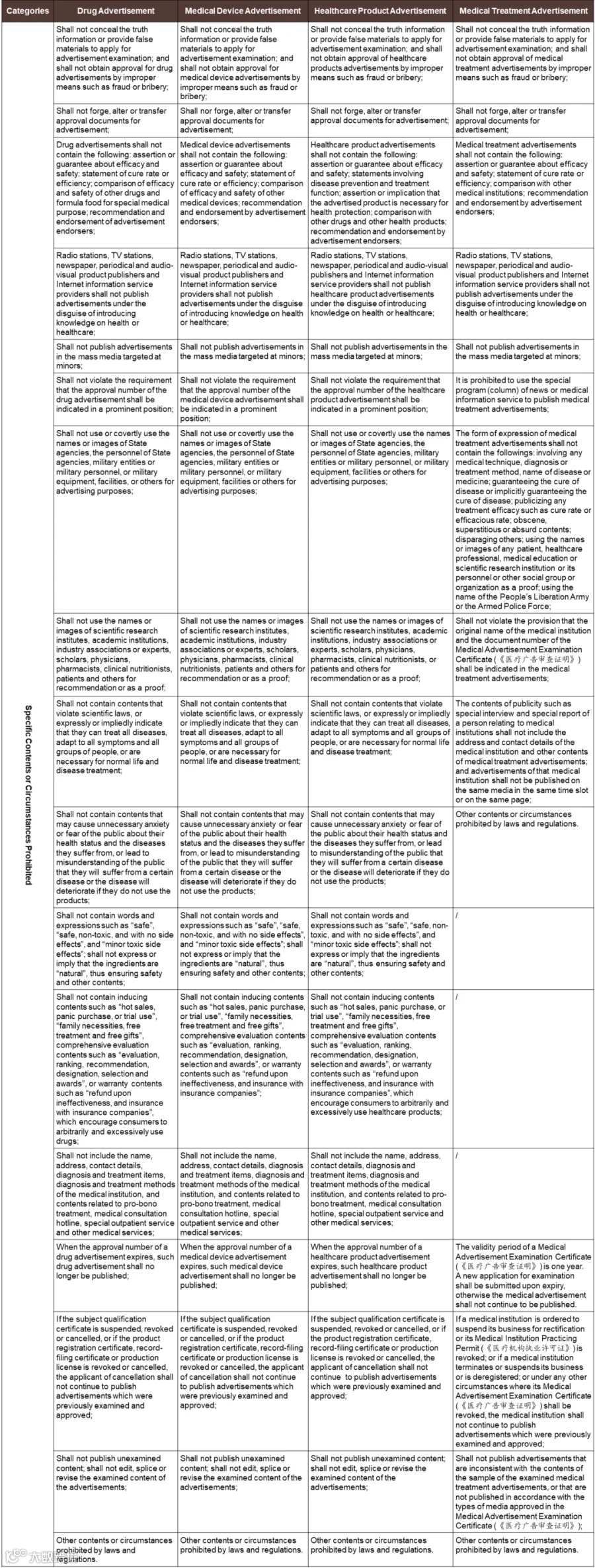
(点击查看大图)
(3) Analysis of typical violation cases in advertisements for drugs, medical devices, healthcare products and medical treatment
According to the negative list in the above table, the contents or circumstances prohibited in advertisements of drugs, medical devices, and healthcare products are similar, and the contents or circumstances prohibited in medical treatment advertisements are relatively different from the aforementioned ones. Therefore, this section is divided into two parts to analyze typical advertisement violation cases: the first part includes typical violation cases in advertisements for drugs, medical devices, and healthcare products; and the second part includes typical violation cases in medical treatment advertisements.
2.Analysis of typical violation cases in advertisements for drugs, medical devices and healthcare products
(1) The contents of advertisements that are inconsistent with the registration certificate or beyond the scope of the product instructions
In accordance with Articles 5, 6, and 7 of the Interim Measures for the Administration of Examination of Advertisements for Drugs, Medical Devices, Healthcare Products and Formula Food for Special Medical Purposes (《药品、医疗器械、保健食品、特殊医学用途配方食品广告审查管理暂行办法》), the contents of advertisements for drugs, medical devices and healthcare products shall base on the instructions approved by the relevant supervision and administration authority, the approved registration certificate or record-filing certificate, and the registered or record-filed product instructions and shall not exceed the scope of the afore-mentioned items.
However, according to the 2020 Bulletin of Shanghai Administration of Market Regulation on the Examination of Advertisements for Drugs, Medical Devices, Healthcare Products and Formula Food for Special Medical Purposes (《上海市市场监督管理局2020年“三品一械”广告审查情况通报》), in practice, some enterprises do exceed the approved scope in designing their advertisements in order to promote the sales and lure more users. For example, in a drug advertisement with graphics and text, the product was advertised as “broad-spectrum antibacterial” but the product instruction was in fact “aimed at fungus only”. Hence, the advertised statement “broad-spectrum antibacterial” was out of the scope of the product instruction of “aimed at fungus only”. Another example is that the registration certificate of a low-frequency therapeutic apparatus stated that it could “alleviate muscle aches, prevent muscle atrophy and promote muscle function recovery through massage and electrical nerve stimulation”. The advertisement falsely claimed that it could “relieve fatigue and strengthens intestinal peristalsis”. Therefore, the advertisement of “strengthening intestinal peristalsis” was beyond the scope of the registration certificate. Another example is that the registration certificate of a contact lens stated that it “could be used to correct myopia in people with no eye disease and/or lens eyes, and the astigmatism of patients with astigmatism less than -2.00D and would not interfere with their eyesight. However, the advertisement includes the statement “farsightedness”, which is out of the prescribed scope of the registration certificate.
(2) Advertisements are published by faking the name or image of an expert or an authoritative organization
According to the Typical Violation Cases regarding the Investigation and Punishment of Advertisements by “Pharmaceutical Advertisement Performers” (《全国工商和市场监管部门查处“医药广告表演者”违法广告典型案例》) issued by State Administration for Market Regulation in 2017, 13 typical cases involving “pharmaceutical advertisement performers” have been investigated and punished.
For example, in a case involving the publication of an illegal advertisement by Jilin Province TV station, the party concerned published an advertisement for a product named “Ming Mu 25 Wei Wan(明目二十五味丸)”, in which an actor “Gao Zhenzong(高振宗)” impersonated as an expert as proof of recommendation. This behavior violated Article 46 of the Advertising Law. Jilin Administration for Market Regulation imposed an administrative penalty, ordered the party concerned to stop publishing the illegal advertisement and imposed a fine. In another example, a case of publishing illegal advertisements by Yitong Information Media Co., Ltd. in Yiyang County, Henan Province, the party concerned published an advertisement for a product named “Kanggu Dan Shu Jin Huoluo Pill(康谷丹舒筋活络丸)”, which was recommended by a bogus expert played by “Li Zhiming(李炽明)”, and asserted the efficacy of the product and explained its cure rate, etc. This behavior also violated Article 16 of the Advertising Law. The Yiyang Administration for Market Regulation imposed an administrative penalty, ordered the party concerned to stop publishing the illegal advertisements and imposed a fine.
(3) The advertisement contains contents comparing with other competitive brands
Article 16 of the Advertising Law explicitly provides that advertisements for drugs and medical devices shall not contain contents regarding comparison with other drugs and medical devices in terms of efficacy and safety. However, in practice, in order to highlight the advantages of the products of their own brand, enterprises would compare their own products with products of other brands in the advertisements.
For example, the FAQs on Advertisement Examination (《广告审查常见问题》) issued by the Advertisement Examination Department of the Center for Certification and Evaluation in August 2020 singled out a case in which a producer compared its straight needle liquid path with the liquid path of its competitor and compared the internal surface area, average logarithmic colony formation and other values of such two products. The advertisement was considered to have compared its product with that of its competitors, and thus violated the Advertising Law.
(4) The advertisements contain assertions, warranties or promises of efficacy
Articles 16 and 18 of the Advertising Law explicitly provide that advertisements for drugs, medical devices, and healthcare products shall not contain assertions or warranties of efficacy and safety. However, in practice, advertisements of drugs, medical devices, and healthcare products continue to assert or guarantee efficacy and safety, despite repeated prohibitions.
According to the cases listed in the FAQs for Advertisement Examination (《广告审查常见问题》) issued by the Advertisement Examination Department of the Center for Certification and Evaluation in August 2020, a condom advertisement claiming to be a “condom with outstanding lubrication effect in China”, a contact lens advertisement with the statement of “not drying for eight hours” or “using appropriate moisturizing materials to prevent eyes from drying”, and a healthcare product advertisement promising to “fight fatigue and keep one energized at any time”, are all considered to fall under the definition of assertions or warranties of efficacy, and thus violate the Advertising Law.
(5) Promotion through group chats, Official Accounts and Moments of WeChat may also constitute advertisements
As the definition of advertisements mentioned above, using social platforms such as WeChat and its Moments as media to publicize and recommend goods sold by business operators in various forms such as texts, pictures, videos, or hyperlinks, etc. also fall into the scope of directly or indirectly recommending goods through certain media and forms. Such activities fall under the definition of advertisements defined in the Advertising Law and are considered to be commercial advertising activities, and shall be subject to the regulation and restrictions of the Advertising Law.
In practice, the regulatory authorities will also regulate the promotion of products through WeChat group chat, official accounts, Moments and other platforms by deeming them as advertising activities. For example, a party concerned published an advertisement on WeChat group or Moments and the contents of which violated the Advertising Law. The party concerned was eventually fined RMB 100,000 by Changchun Administration for Market Regulation[17]. In another case, the party concerned published an advertisement on the WeChat official account and the contents of which also violated the Advertising Law. The party concerned was fined RMB 10,000[18] by Taizhou Administration for Market Regulation. According to our searches through public channels, in several administrative penalty cases, the regulatory authorities imposed penalties on the parties concerned for their illegal advertising and publication activities through WeChat, official accounts and Moments.
3.Analysis of typical violation cases in medical treatment advertisements
On March 21, 2019, eight ministries and commissions including National Health Commission, Cyberspace Administration of the PRC and National Development and Reform Commission jointly issued the Action Plan for Special Rectification of Medical Treatment Irregularities (《医疗乱象专项整治行动方案》) which aims at cracking down illegal medical treatment advertisements and false information that jeopardize people’s rights and interests on health. Subsequently, in response to national policies, many provinces and municipalities issued their respective actions plans for rectifying medical treatment advertisement irregularities, such as the Action Plan of Shanghai for the Special Rectification of Medical Treatment Irregularities (《上海市医疗乱象专项整治行动方案》), the Implementation Plan of Hebei Province for the Special Rectification of Medical Treatment Irregularities (《河北省医疗乱象专项整治行动实施方案》), and the Notice of Eight Departments including the Health Commission of Guangdong Province on Carrying out the Special Rectification of Medical Treatment Irregularities (《广东省卫生健康委等8部门关于开展全省医疗乱象专项整治行动的通知》), which further provide for the investigation and punishment of illegal medical treatment advertising in their respective provinces and municipalities.
According to the above, typical illegal cases of medical treatment advertisements mainly include the following:
(1) Fraudulent or disguised use of famous national or international hospitals or famous experts to mislead and induce patients
Some non-compliant hospitals publish medical treatment advertisements through Internet to mislead consumers. In March 2019, Shanghai Administration for Market Regulation announced ten cases of infringement upon the rights and interests of consumers, including “a series of cases involving unfair competition among eight private hospitals”. In this series of cases, eight private hospitals including Shanghai Xupu Hospital of Traditional Chinese Medicine misled patients into believing that these hospitals have special relationship with well-known public hospitals by publishing false advertisements through Baidu bidding ranking, fabricating a close relationship with well-known hospitals by using similar WeChat applet name, and falsely adverting on their official websites or WeChat applet, etc. In the second half of 2018, the law enforcement department put the case on file for investigation and punishment, and then imposed administrative penalties on the relevant parties concerned according to the law[19].
(2) Publishing advertisements for medical institutions in disguised form
Article 16 of the Measures for the Administration of Medical Treatment Advertisements (《医疗广告管理办法》) provides that it is forbidden to use news or medical information services feature (column) to publish or covertly publish medical treatment advertisements. In practice, more and more medical institution advertisements are dressed up as news, health consultation programs or medical information programs and emerge in endlessly.
For example, a party concerned was found to be disguising medical treatment advertisements as news by introducing its patient’s treatment at the hospital and showing the photos of patient and the medical staff on the patient story webpage of its news center. The party concerned was fined RMB 4500 by Changping Administration for Market Regulation in Beijing[20]. In another case, a party concerned broadcasted a program called “Full Score Health” on channel FM88.7 of Qingyuan Radio and Television Station. The program mainly introduced the diagnosis and treatment of “lumbar intervertebral disc herniation”, which was suspected to introduce Qingyuan People’s Hospital under the disguised form of sharing health or healthcare knowledge. This behavior was finally found to be illegally publishing medical treatment advertisements. The party concerned was ordered to rectify its illegal act and was imposed a fine of RMB 10,000 by Qingyuan Administration for Market Regulation[21].
(3) Recommendation and endorsement by using the images of patients, doctors or advertisement endorsers
Article 16 of the Advertising Law provides that drug advertisements shall not use advertisement endorsers to make recommendations or endorsements. Article 7 of the Measures of the Administration of Medical Treatment Advertisements (《《医疗广告管理办法》》) provides that medical treatment advertisements shall not use the names or images of patients, medical personnel, medical education and research institutes and their personnel as well as other social groups or organizations for recommendation and endorsement.
In practice, many medical treatment advertisements were punished by regulatory authorities for violating the above-mentioned regulations. For example, among the 10 typical illegal advertising cases recently published by Heilongjiang Administration for Market Regulation, five were illegal medical treatment advertisement cases, among which three involved the use of patients, doctors or endorsers to recommend or endorse medical institutions. In a case of illegal medical treatment advertisement for a beauty hospital, the party concerned used the information and image of a contract model for publicity and such behavior constituted illegal medical treatment advertisement by engaging an advertisement endorser. The parties concerned was ordered to stop publishing illegal medical advertisements and was imposed a fine of RMB 110,000. In another case of illegal medical treatment advertisement for a dental hospital, the party concerned used the name and image of a patient for recommendation and proof of treatment effect. The advertisement was similarly ordered to stop and was imposed a fine of RMB 2000. Also in a case of illegal Internet medical treatment advertisement for a certain hospital, the party concerned used the recommendation of a doctor to introduce medical technology and diagnosis method. The hospital was ordered to stop publishing such advertisement and was imposed a fine of RMB 10,000.
03
Examination of Advertisements for Drugs, Medical Devices, Healthcare Products and Medical Treatment
1.Laws and regulations applicable to the examination of advertisements for drugs, medical devices, healthcare products, medical institutions and medical treatment
In addition to the requirements on the contents of advertisements for drugs, medical devices, healthcare products, medical institutions and medical treatment, enterprises shall also pay attention to the relevant advertisement examination requirements when publishing advertisements for drugs, medical devices, healthcare products, medical institutions and medical treatment through various media.
Before publishing such advertisements, enterprises shall submit the contents of such advertisements to the advertisement examination authority for examination and obtaining the corresponding approval number. Unexamined advertisements shall not be published. At present, the relevant provisions of the Advertising Law, the Drug Administration Law (《药品管理法》) and its implementing regulations, the Measures for the Supervision and Administration of Medical Devices (《医疗器械监督管理办法》) and its implementing regulations, and the Measures for the Administration of Medical Treatment Advertisements (《医疗广管理办法》) are applicable to the examination of advertisements for drugs, medical devices, healthcare products, medical institutions and medical treatment.
2.General items to be examined in advertisements for drugs, medical devices, healthcare products, and medical treatment
We summarize the usual items involved in the applicant’s application for the examination of advertisements for drugs, medical devices, healthcare products and medical treatment in the following table for readers’ reference. The summary include the examining authority, documents to be submitted, advertisement contents, mandatory items, etc.

(点击查看大图)
3.The scope of examination of advertisements for drugs, medical devices, healthcare products and medical treatment
(1) Not all advertisements for drugs, medical devices, healthcare products and medical treatment need to be examined before they are published.
As far as advertisements for drugs, medical devices and healthcare products are concerned, if only the product name (including the generic name of drugs and the trade name of drugs) is publicized in such advertisements, such advertisements are not required to be examined. That is to say, if the enterprise does not further introduce the product in the advertisement save for the name of the product, it is not required to submit the advertisement to the authority for examination.
As far as the medical treatment advertisements are concerned, medical institutions which indicate their names outdoor in their legally controlled areas are not required to apply for medical treatment advertisement examination and outdoor advertisement registration[22]. In addition, considering that it is very common and necessary for hospitals to use their own websites, internal journals and outpatient medical records to publish the hospital’s organization profile, department settings, specialty characteristics, outpatient arrangements and other contents, the introduction of the medical institution, its specialty characteristics, disease prevention and treatment knowledge and expert outpatient arrangements in the medical institutions’ outpatient medical records, internal journals or websites does not fall within the scope of medical treatment advertisement examination[23].
(2) In addition to traditional media, advertisements of drugs, medical devices, healthcare products and medical treatment published by new media such as online live-streaming are also subject to the examination requirements, but approval numbers may be unable to obtain in practice.
If online live-streaming of the goods constitutes an advertisement, it shall comply with the relevant provisions of the Advertising Law and other laws and regulations. The advertisements of drugs, medical devices, healthcare products and medical treatment published by online live-streaming shall also be submitted for advertisement examination for obtaining the corresponding approval numbers[24]. Similarly, using emerging media to publish advertisements for drugs, medical devices, healthcare products and medical treatment, such as TV drama advertisement implantation, broadcast by stars, and KOL or blogger online live-streaming, also need to be submitted for advertisement examination.
In practice, there are cases of online live-streaming which published unexamined advertisements that should have been examined in advance and the relevant parties were thus punished by regulatory authorities. For example, a party concerned entrusted an anchor to broadcast healthcare product advertisements through online live-streaming in his Taobao’s personal studio without acquiring prior examination of the contents of the advertisement from the authority. That constituted an act of publishing unexamined healthcare product advertisements, and Jinga’an Administration for Market Regulation in Shanghai imposed the parties a fine of RMB 3000[25]. In another case, the party concerned inserted a medical device advertisement of “OK Glasses” in the online live-streaming of the “Young People’s Myopia Prevention and Control Expert Seminar” without obtaining the Medical Advertisement Examination Certificate (《医疗广告审查证明》). That likewise constituted an illegal act of publishing unexamined advertisements and Wenzhou Administration for Market Regulation confiscated the advertisement fee of RMB 7050 and imposed a fine of RMB 14,100[26].
However, as parties are required to submit advertisement samples which are consistent with the advertisement to be published for examination, and that online live-streaming advertisements are different from traditional advertisements when advertising products (i.e. in traditional advertisements, fixed content is broadcasted in different places and channels for multiple times; and that in online live-streaming advertisements, the contents are impromptu, random and interactive), it is difficult for the online live-streaming advertisements to correspond exactly with the approved advertisement sample every time it is broadcasted. The result is that online live-streaming advertisements are unable to obtain the approval number in practice.
On this issue, there is a view that the impromptu and random interactions with fans in online live-streaming shall not constitute advertisements, while the contents related to the promotion and recommendation of goods in the online live-streaming are advertisements and shall be subject to prior examination and review[27]. Therefore, we suggest that, enterprises that seek to broadcast advertisements through online live-streaming need to pay attention to the legal and regulatory compliance requirements on advertisement examination, and pay particular attention to the update of such laws and regulations and their official interpretations and maintain mutual and amicable communication with local administration for market regulation.
向下滑动阅览
Authors

Huang Jianwen
Partner
Compliance&Regulatory
huangjianwen@cn.kwm.com
Areas of Practice:investments (including inbound and outbound investment), M&A (including domestic and cross-border M&A), business compliance, and general corporate matters
Ms. Huang is identified as a leading individual in the field of Healthcare & Life Sciences in the year of 2019, 2020, 2021 and 2022 by Legal 500. She is recognised as one of the 2020 ALB China Top 15 Female Lawyers by Asian Legal Business (ALB).
As the leading partner of the KWM healthcare group, Ms. Huang has acted for a number of domestic and multinational pharmaceutical companies, medical device companies, medical institution investors, and medical institutions with restructuring and reforming, setting up, investment, mergers, daily operations, hospital management consultancy and obtaining all types of relevant approvals (such as, product listed licensing, production and sales license).

Liu Ting

Partner
Compliance&Regulatory
liuting@cn.kwm.com
Areas of Practice:corporate compliance and employment
Ms. Liu has extensive experience in corporate compliance, internal investigations as well as compliance related government investigations and crisis management. She advises her clients on large-scale compliance projects involving anti-corruption, anti-commercial bribery, food safety management processes, and corporate internal control systems, and provides professional legal services for clients on the establishment of internal control systems, risk management, and the handling of employment related issues for violation of compliance requirements.

Zheng Ruchuan
Lead Associate
Compliance&Regulatory
封面图源:画作·林子豪
责任编辑:单珊
往期文章推荐
药品、医疗器械、保健食品及医疗广告合规 2021-07-13
优化监管体系,促进产业发展——《医疗器械监督管理条例(2021修订)》要点解读 2021-03-25
《药品上市后变更管理办法(试行)》要点解析 2021-01-17
“Pharmaceuticals and Healthcare in the PRC Civil Code:Inheritance and Development” (July 3, 2020)
对美国及欧盟出口防疫医疗物资合规指引 ——一文详解生产、通关、美欧产品责任及相关法律实践 2020-04-05
Guidelines for Epidemic Prevention Materials Exported from China to EU and U.S.(April 5, 2020)
疫情防控 | 中西医结合抗击疫情——解析我国中药管理的特殊制度 2020-02-21
“Analysis on the Special Regulatory Mechanisms of Traditional Chinese Medicine” (February 21, 2020);
新冠肺炎“特效药”距离我们还远吗?——简析加快药品注册上市及药品临床使用的若干制度 2020-02-26
“Is the ‘Miracle Drug’ for Covid-19 Far from Us: Brief Analysis of the Systems for Speeding up Drug Registration and Marketing and Clinical Use” (February 26, 2020);
疫情防控 | 抗疫之战粮草先行,医疗器械紧缺如何缓解?2020-02-19
“How to Alleviate the Shortage of Medical Devices?” (February 19, 2020);
疫情防控 | 与病毒赛跑——浅谈与新冠肺炎疫苗相关的法律问题 2020-02-15
“Discussion on the Legal Issues Related to Novel Coronavirus Pneumonia Vaccine” (February 15, 2020);
疫情防控 | 远程医疗应对NCP疫情发挥重要作用 2020-02-11
“The Important Role that Remote Medical Treatment Plays in Responding to Novel Coronavirus Pneumonia Outbreaks” (February 11, 2020);
金杜医药板块法律主题月丨我国干细胞领域的法律监管与外商投资展望 2019-09-18
“PRC Legal Regulation in Stem Cell and the Prospects of Foreign Investment in Stem Cell” (September 18, 2019);
金杜医药板块法律主题月 | 图文详解药品资产交易模式与协议 2019-09-11
“Detailed Analysis of Drug Asset Transaction Model and the Transaction Agreement” (September 11, 2019);
金杜医药板块法律主题月 | 药品上市许可持有人制度--新版药品管理法下重要制度 2019-09-09
“Market Authorization Holder System——An Important System under the Newly Revised Drug Administration Law” (September 9, 2019);
Major Changes in the Newly Revised Drug Administration Law 2019-08-29
新管法和新挑战—— 从实务角度评析新版《药品管理法》2019-08-28
Comments on the Newly Revised Drug Administration Law from a Practical Perspective (August 28, 2019);
《疫苗管理法》出台——从国家战略高度对疫苗全方位进行最严监管 2019-07-05
“The Promulgation of The Vaccine Administration Law of the People's Republic of China —— implementation of the most rigorous whole-process administration system of vaccines at national strategy level” (July 5, 2019).
我知道你 在看 哦