




在今年3月8日召开的第十三届全国人大第五次会议上,全国人大常委会委员长栗战书在工作报告中表示:《中华人民共和国期货和衍生品法》(“《期货和衍生品法》”)等40件法律案已纳入今年的年度立法工作计划。乐观估计,《期货和衍生品法》能在年内完成三读并顺利表决通过,市场对此翘首以盼。
如我们在《未来已来——试评<中华人民共和国期货和衍生品法>(草案二次审议稿)》文章中所归纳,《期货和衍生品法》一经最终通过并实施,极有可能从中国立法角度首次确认国内外场外衍生品文件所采用的“单一协议”和“终止净额结算”概念的法律效力,并将使境外交易对手普遍接纳中国的净额结算制度。
我们将简要讨论监管保证金要求对于与中资机构叙做的场外交易的影响。目前,我们理解部分国际机构在处理其与中资机构进行的衍生品交易时,尚能依赖若干豁免而不需要向中资机构提交或收取保证金(如EMIR项下关于就非中央清算型场外衍生品合约开展风险缓释措施的监管技术标准第31(1)条),或者以全额为基准向中资机构收取保证金。
在中国被普遍视为“干净”的净额结算司法管辖区之后,前述豁免则将不再可用。与“终止净额结算”概念相比,对覆盖交易适用保证金要求对于中资对手方更为陌生,原因包括:
中国未发布或实施任何与BCBS-IOSCO非中央清算型衍生品保证金要求相符的强制保证金规则;
国际保证金规则和文件架构纷繁复杂、技术性要求高,而部分中资机构的对其的熟悉程度还有待提高;
国际机构对于使用境内担保品以满足保证金要求持谨慎观望态度,而中资对手方持有的境外合格资产相对有限,他们对于使用境外资产作担保品同样缺乏足够信心。
基于前述原因,部分中资对手方需要时间熟悉监管保证金要求。《期货和衍生品法》有望于2022年得以通过。因此,现在正是国际机构积极关注其与中资对手方的场外衍生品监管保证金要求及相关法律文件问题的最佳时机;中资对手方也应当积极应对,提前准备与布局,因为如果不这样做,那么国际机构极有可能无法继续与之叙做非清算型场外衍生品交易(或者继续以全额为基础收取更高的保证金)。
基于金杜为主要的国际及中国金融机构、企业提供相关方面咨询的丰富经验,以下是我们对于这一重要议题一些常见问题的回答。
01. 什么是监管保证金要求?
2008年全球金融危机后,20国集团领导人致力于在各自的司法管辖区内制定和实施一系列的监管要求(包括监管保证金要求),以减少系统性风险并在全球范围内创造一个公平的竞争环境。

(点击查看大图)
根据监管保证金规则,场外衍生品的交易方之间需要互相提供和收取保证金(也被称为担保品)。这一规则旨在减少对手方的信用风险,因为担保品(通常是以优质流动性资产形式(HQLA),包括现金或较高流动性债券)可用于抵御衍生品交易对手方违约后的损失。
而发展至今,大多数主要的司法管辖区均已经采用并实施了监管保证金要求。虽然每个司法管辖区的详细规则有着重要的差异,但其基本要求是相似的,因为它们主要都是基于巴塞尔银行监理委员会和国际证监会组织共同制定的全球监管保证金标准(“全球保证金标准”)而制定的。
像大多数金融法律法规一样,全球保证金标准和每个司法管辖区内所实施的当地监管保证金规则(“当地保证金规则”)非常复杂,且充斥着大量专业技术术语。在本文中,我们将尝试用简单易懂的语言解释一些关键概念和相关的法律文件问题。
02. 什么是初始保证金(“IM”)和变动保证金(“VM”),两者之间有什么区别?
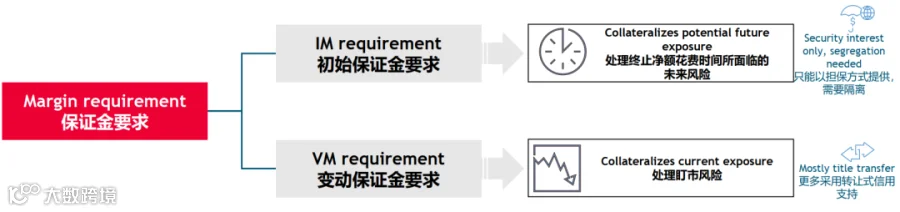
IM和VM的监管保证金要求有所不同。
变动保证金(“VM”)是保护衍生品交易方免其受对手方当前风险敞口的担保品。VM的数额反映了当前风险敞口的大小,而风险敞口可能因市场变动而定期产生变化。因此,通常需要每日交换VM以对应衍生品逐日盯市价值的变化,并使得该等逐日盯市计算的风险敞口能够获得充分的增信覆盖。
初始保证金(“IM”)是保护衍生品交易方在其对手方违约后进行平仓和替换衍生品所需的时间段内,避免因衍生品逐日盯市价值的未来变化而产生的潜在风险敞口的担保品。IM的数额反映了未来潜在风险敞口的大小。
(点击查看大图)
03. 谁需要遵守监管保证金要求?
一般来说,受监管的金融机构将直接受制于相关金融监管机构发布的当地保证金规则。这些规则通常要求受监管的金融机构向某些类型的对手方交纳和收取VM和IM。在本文中,我们将把两个交易方之间交纳和收取保证金称为“交换”保证金。
为遵守交换保证金的监管要求,受监管的金融机构将与其每一个交易对手协商并签订保证金文件,这将对每一方施加交换保证金的合同义务。因此,即使受监管金融机构的对手方并不直接受监管保证金规则的约束(例如,因为它没有受到金融监管),但由于其与受监管的金融机构签订了保证金文件,该交易方也会间接地、在合同上受到保证金要求的约束。由于中国尚未实施保证金要求,因此大部分中资对手方普遍面临的正是这种间接影响。

(点击查看大图)
金融和非金融对手方:需要注意的是,受监管的金融机构不需要与所有类型的对手方交换保证金。一般来说,受监管的金融机构只需要与“金融对手方”或某些“具有系统重要性的非金融对手方”交换保证金。每个司法管辖区的当地保证金规则都包含了这些关键术语的详细定义,它们各自之间都略有不同。
值得注意的是,根据某些当地保证金规则,金融对手方的定义可能相当广泛,且可以包括任何主要从事一种或多种金融活动(如银行、借贷、保险、证券、衍生品或资产管理活动)的国内或国外实体——即使该实体并不受监管。因此,就自身的属性和分类方面,任何实体(包括中资对手方)在业务交流中确保其准确性则显得尤其重要。否则,国际受监管机构将会因为依赖不准确的信息而面临监管风险,这反过来也将对前一实体(包括中资对手方)引发潜在的风险和责任。
受监管的金融机构一般不需要与作为主权国家、中央银行、公共部门实体或多边发展银行的对手方交换保证金。同样,这些关键术语在每个司法管辖区的当地保证金规则中都有不同的定义。
04. 什么类型的衍生品需要遵守监管保证金要求?
监管保证金要求一般适用于所有非集中清算型衍生品。对于清算型衍生品,中央对手方或清算所将规定其自己的保证金要求。
监管性保证金要求一般不适用于回购类和证券借贷交易,这些交易本身不是衍生品,但与衍生品有一些共同特征。
此外,许多司法管辖区的当地保证金规则将实物交割的外汇远期和外汇掉期以及某些其他类别的场外衍生品排除在监管保证金要求的范围之外。
05. 需要哪些法律文件来遵守监管保证金要求?
为了遵守监管保证金要求,受监管的金融机构需要与他们的对手方签订大量新的法律文件。这些法律文件对双方规定了详细的VM和IM计算和交换义务等要求。
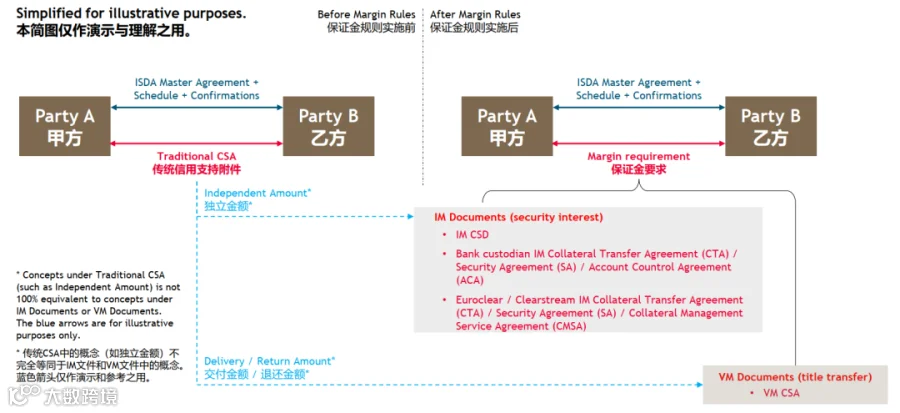
国际掉期与衍生工具协会(“ISDA”)已经制定了行业标准保证金文件,旨在遵守适用的当地保证金规则。由于VM和IM的计算方式不同,所要求的持有方式也不同,因此VM和IM有各自不同的法律文件。
尽管标准保证金文件得到了市场参与者的广泛使用,但这些法律文件非常复杂且须经过大量的谈判,因为每份文件都允许双方进行多种选择和进一步的修订,以适应其独特的商业和监管环境。
保证金文件的谈判的过程与ISDA补充协议(Schedule)或传统信用支持附件(CSA)的谈判过程相类似。然而前者可能要复杂得多,因为正如下文所解释的,为遵守VM和IM的要求,交易双方需要签订多种不同类型的保证金文件。因此,许多金融机构及其对手方会聘请外部律所协助其处理保证金文件、谈判和相关的法律及合规问题。
(点击查看大图)
标准VM文件概述:为帮助双方遵守VM要求,ISDA发布了受英国法律管辖的ISDA 2016年版变动保证金信用支持附件(“VM CSA”)等标准文件。VM CSA基于ISDA 1995年版的英国法CSA而制,是ISDA补充协议的一个附件。与1995年版CSA一样,VM CSA涉及转让方将担保品的法定和实益所有权直接转让给受让方,而受让方在合同上有义务在特定情况下向转让方提供同等的信用支持。VM CSA允许双方指定合格担保品的类型(受限于监管限制),并做出其他选择或修订以满足适用的商业和监管要求。
标准IM文件的概述:大多数司法管辖区的当地保证金规则通常要求在一个隔离的账户中持有IM,并且IM不得被再抵押、再质押或再使用(“隔离要求”)。具体而言,IM应存放在于独立第三方托管人处开立的账户中,该账户与担保品接收方和托管人的自有资产相隔离,且充分远离担保品提供方、担保品接收方和托管人的破产风险。隔离要求适用于IM而非VM,因此IM和VM有各自不同的法律文件。
为帮助双方遵守IM要求,ISDA制定了一系列标准的IM文件,旨在与不同类型的托管人与管辖法律相配合。例如,ISDA已经为托管人是银行和托管人是国际性中央证券存管机构(international central securities depository,“ICSD”)(如欧洲清算银行(“欧清”)或明讯银行(“明讯”))的情况制定了IM文件。
就英国法文件而言,ISDA的“旗舰性”IM文件是2018年版初始保证金信用支持契据(“IM CSD”)。IM CSD基于ISDA 1995年版英国法CSD而制,因此是一份单独的担保文件,其作为契据执行,不构成ISDA主协议的一部分。IM CSD不依靠担保品的所有权转让,而是对独立账户和其中的担保品设立担保权益。重要的是,根据监管保证金要求,IM通常须以全额为基础进行双向转让,这意味着每个交易方必须将担保品转让到对手方的隔离账户中,且这两个单独的转让义务不能相互抵销。IM CSD允许双方进行各种选择和修订,以满足适用的商业和监管要求。
银行托管人IM文件:除了IM CSD之外,ISDA还发布了适用于IM的银行托管人担保品交换协议(“银行托管人CTA”)和与其相配套的、由不同司法管辖区法律管辖的银行托管人担保协议(“银行托管人SA”)。实质上,银行托管人CTA和银行托管人SA代表了IM CSD的两个部分:(1)银行托管人CTA规定了保证金的交换流程,并受到与相关ISDA主协议相同的管辖法的约束;及(2)银行托管人SA涉及担保权益的设立和处置,并受隔离账户所在地法律的管辖。
除了银行托管人CTA和SA之外,担保品提供方、担保品接收方和银行托管人还需要签署一份账户控制协议(“ACA”)。ACA规定了担保品提供方或担保品接收方可以对隔离账户行使排他性控制权并指示托管人将担保品转出账户的情形和方式等。主要的托管人已经公布了标准格式的ACA,各方可以根据自己的商业和监管需求在ACA中进行特定的选择。另外,担保品提供方将签署一份托管协议以管理其在银行托管人处所开立的托管账户。为遵守监管保证金要求,IM将从担保品提供方的托管账户转入隔离账户。
欧清和明讯IM文件:如果托管人不是普通的商业银行而是欧清或明讯,各方将视情况而定签署(1)ISDA欧清CTA和SA或(2)ISDA明讯CTA和SA。与银行托管人IM文件类似,欧清/明讯CTA和SA代表了IM CSD的两个部分。欧清和明讯IM文件旨在分别与欧清和明讯的会员文件进行配合。因此,欧清和明讯IM文件中的选项与银行托管人IM文件中的选项有一些差异。欧清与明讯也可能要求交易双方与其签署担保品管理服务协议。我们可以后续系列中进一步介绍欧清和明讯IM文件。
06. 我在哪里可以更多地了解监管保证金要求和法律文件问题?
金杜团队经常协助国际和中国的金融机构及企业进行ISDA、NAMFII、CSA、VM与IM保证金文件的谈判。我们在最为复杂和最具创新性的跨境衍生工具和结构化融资领域引领市场,乐意为您设计、搭建具有创新性和复杂性的跨境衍生产品及其法律文件。我们还经常向国际和中国的客户提供有关衍生品交易保证金和其他监管要求的法律服务。
金杜是ISDA在中国的法律顾问,并一直积极参与中国的终止净额结算可执行性、担保品隔离和所有权转让安排的有关法律发展。我们熟悉中国的金融机构及其对手方所面临的独特情况,并很乐意与您分享我们的见解。请随时联系我们的核心团队成员(联系方式如下)。
重要说明:本文中对于保证金(margin)、担保品(collateral)的提述不完全等同于中国法项下设立的保证金担保、动产质押或权利质押。
Regulatory margin for OTC derivatives: Series 1 - What is it and why it is important? / Answers to frequently asked questions
During the 5th session of the 13th National People’s Congress ("NPC") held on 8 March 2022, the Chairman of the Standing Committee of the NPC ("NPCSC") announced that the PRC Futures and Derivatives Law ("FDL"), among other legislation, has been included in its 2022 annual legislative plan. The market anticipates and welcomes the passing of the FDL within this year.
As summarised in our article "To the Future and Beyond – Thoughts on the PRC Futures and Derivatives Law (Second Reading)", it is highly likely that the FDL (once finalised and effective) will confirm, for the first time, legislative recognition of the "Single Agreement" and "Close-out Netting" concepts contained in international and PRC domestic OTC derivatives documentation. This will provide a robust legal framework for the PRC to be regarded by foreign counterparties as a "clean" netting jurisdiction.
We will now briefly consider the impact of regulatory margin rules on OTC derivatives transactions with PRC counterparties. Currently, we understand that a number of international firms may be relying on certain exemptions (for example, Article 31(1) of the Regulatory Technical Standards for risk-mitigation techniques for OTC derivative contracts not cleared by a central counterparty under EMIR) from posting and collecting margin when trading with PRC-based counterparties, or they may be collecting margin collateral from PRC-based counterparties on a gross basis.
When the PRC becomes a clean netting jurisdiction, the above exemption from regulatory margin requirements may well become inapplicable. Unlike close-out netting issues, regulatory margin requirements may be less familiar to PRC counterparties for the following reasons:
(a) the PRC has not issued or implemented any mandatory margin rules that align with the BCBS-IOSCO's Margin Requirements for Non-centrally Cleared Derivatives;
(b) the international margin requirements and documentation are highly technical and complex and some PRC counterparties may be unfamiliar with the relevant legal and technical concepts;
(c) international firms have been reluctant to accept onshore collateral to satisfy margin requirements and PRC counterparties do not hold that many offshore eligible assets, and may in any event be reluctant to post offshore collateral.
As a result of these foregoing factors, some PRC counterparties may need time to familiarize themselves with regulatory margin requirements. With the anticipated passing of the PRC Futures and Derivatives Law in 2022, now is the time for international firms to actively focus on regulatory margin requirements for OTC derivatives with PRC counterparties and related legal documentation issues. It is also the time for PRC counterparties to get prepared because if they do not, international firms will have to quit trading non-centrally cleared OTC derivatives with them (or still charge higher margin on a gross basis).
Based on KWM's extensive experience in advising major international and Chinese financial institutions and corporates on these issues, below are our answers to some frequently asked questions on this important topic.
01. What are regulatory margin requirements?
After the global financial crisis in 2008, the G20 leaders committed to develop and implement series of regulatory requirements (including margin requirements) in their respective jurisdictions to reduce systemic risk and create a level playing field across the globe.

Under regulatory margin rules, counterparties to OTC derivatives are required to post and collect margin (also referred to as collateral) to and from each other. This is designed to reduce counterparty credit risk because the collateral (usually in the form of high quality liquid assets ("HQLA", including cash or highly liquid debt securities) is available to offset losses following the default of a derivatives counterparty.
Fast toward to today, most major jurisdictions have adopted and implemented regulatory margin requirements. While there are important differences in the detailed rules in each jurisdiction, the broad requirements are similar because they are largely based on the global regulatory margin standards established jointly by the Basel Committee on Banking Supervision and the International Organization of Securities Commissions ("Global Margin Standards").
Like most financial regulations, the Global Margin Standards and the local regulatory margin rules implemented in each jurisdiction ("Local Margin Rules") are highly complicated and full of technical jargon. In this article, we will try to explain some of the key concepts and related legal documentation issues in plain language.
02. What is initial margin ("IM") and variation margin ("VM") and what is the difference between the two?
Regulatory margin requirements distinguish between IM and VM.
Variation margin ("VM") is collateral that protects derivatives counterparties from the current exposure that one counterparty has to the other. The amount of VM reflects the size of the current exposure, which can change regularly due to market movements. Therefore, VM is generally required to be exchanged daily to track changes in the mark-to-market value of derivatives and to fully collateralise the mark-to-market exposure.
Initial margin ("IM") is collateral that protects derivatives counterparties from the potential future exposure that can arise from future changes in the mark-to-market value of the derivatives during the time it takes to close out and replace the derivatives following a counterparty default. The amount of IM reflects the size of the potential future exposure.

03. Who is subject to regulatory margin requirements?
Generally speaking, regulated financial institutions are directly subject to Local Margin Rules issued by the relevant financial regulator(s). These rules generally require a regulated financial institution to both post and collect VM and IM to and from certain types of counterparties. In this article, we shall refer to the posting and collecting of margin between two counterparties as "exchanging" margin.
To comply with the regulatory requirement to exchange margin, a regulated financial institution will negotiate and enter into margin documents with each of its counterparties, which will impose contractual obligations on each side to exchange margin. Therefore, even if a counterparty to a regulated financial institution is not directly subject to regulatory margin rules (e.g., because it is not financially regulated), the counterparty becomes indirectly and contractually subject to margin requirements by virtue of entering into margin documents with a regulated financial institution. Many PRC counterparties will likely be in this situation in the absence of any PRC regulatory margin rules.

Financial and non-financial counterparties: It is important to note that a regulated financial institution is not required to exchange margin with all types of counterparties. Generally speaking, a regulated financial institution is only required to exchange margin with "financial counterparties" or certain "systemically important non-financial counterparties". The Local Margin Rules in each jurisdiction contain detailed definitions of these key terms, which are all slightly different from each other.
It is important to note that the definition of financial counterparty can be quite broad under certain Local Margin Rules and can capture any domestic or foreign entity that mainly engages in one or more financial activities (such as banking, lending, insurance, securities, derivatives or asset management activities) – even if that entity is not regulated. Therefore, it is crucial for an entity (including a PRC counterparty) to make accurate communications about its status and catagorisation under the applicable Local Margin Rules. Otherwise, its regulated financial institution counterparty may be exposed to regulatory risks as a result of relying on inaccurate communications, which may in turn expose the entity in question to potential risks and liabilities.
A regulated financial institution is generally not required to exchange margin with a counterparty which is a sovereign, central bank, public sector entity or multilateral development bank. Again, these key terms are defined somewhat differently in each jurisdiction's Local Margin Rules.
04. What kind of derivatives are subject to regulatory margin requirements?
Regulatory margin requirements generally apply to all non-centrally cleared derivatives. For cleared derivatives, the central counterparty or clearinghouse will impose its own margin requirements.
Regulatory margin requirements generally do not apply to transactions such as repos and securities lending transactions that are not themselves derivatives but share some common features with derivatives.
In addition, the Local Margin Rules in many jurisdictions exclude physically settled FX forwards and FX swaps as well as certain other categories of OTC derivatives from the scope of regulatory margin requirements.
05. What legal documents are needed to comply with regulatory margin requirements?
To comply with regulatory margin requirements, regulated financial institutions need to enter into a large number of new legal documents with their counterparties. These legal documents impose, among other things, detailed VM and IM calculation and exchange obligations on both parties.
The International Swaps and Derivatives Association ("ISDA") has developed industry standard margin documents that are designed to comply with applicable Local Margin Rules. Since VM and IM are calculated differently and are required to be held in different ways, there are separate sets of legal documents for VM and IM.
Despite the development and widespread use of standard margin documents, these legal documents are highly complicated and heavily negotiated, because each document allows the parties to make a large number of elections and further amendments to tailor for their specific commercial and regulatory circumstances.
The process of negotiating margin documents is comparable to negotiating an ISDA schedule or the elections and variables paragraph of a Credit Support Annex ("CSA"). However, the process can be much more complicated because, as explained below, multiple margin documents are required to comply with the VM and IM requirements. Accordingly, many financial institutions and their counterparties engage external law firms to assist with margin documentation, negotiation and related legal and compliance issues.

Overview of standard VM documents: To help parties comply with VM requirements, ISDA has published, among other things, the English law governed ISDA 2016 Credit Support Annex for Variation Margin ("VM CSA"). The VM CSA is based on the ISDA 1995 English law CSA and is an annex to the ISDA Schedule. Like the 1995 CSA, the VM CSA involves the outright transfer of legal and beneficial title in the collateral from the transferor to the transferee, while the transferee has a contractual obligation to deliver equivalent credit support to the transferor in certain circumstances. The elections and variables paragraph of the VM CSA allows parties to specify eligible collateral types (subject to regulatory restrictions) and make other elections or amendments to meet applicable commercial and regulatory requirements.
Overview of standard IM documents: The Local Margin Rules in most jurisdictions generally require IM to be held in a segregated account and not to be rehypothecated, repledged or reused ("Segregation Requirement"). Specifically, IM should be held in an account with an independent third-party custodian which is segregated from the proprietary assets of the collateral taker and custodian, and adequately protected from insolvency of the collateral provider, collateral taker and custodian. The Segregation Requirement which applies to IM (but not VM) means that IM arrangements are documented separately from VM arrangements.
To help parties comply with IM requirements, ISDA has developed a wide range of standard IM documents designed to work with different types of custodians and governing laws. For example, ISDA has developed IM documents for circumstances where the custodian is a bank and where the custodian is an international central securities depository ("ICSD") such as Euroclear or Clearstream.
As far as the English law documents are concerned, ISDA's "flagship" IM document is the 2018 Credit Support Deed ("CSD") for Initial Margin ("IM CSD"). The IM CSD is based on the ISDA 1995 English law CSD and is therefore a separate security document executed as a deed and not forming part of the ISDA Master Agreement. Instead of relying on title transfer, the IM CSD involves creating a security interest over the segregated account and the collateral held in it. Significantly, pursuant to regulatory margin requirements, IM must generally be transferred on a two-way gross basis, which means that each counterparty must transfer collateral to the other counterparty's segregated account and these two separate transfer obligations cannot be netted or set off against each other. The elections and variables paragraph of the IM CSD allows parties to make various elections and amendments to meet applicable commercial and regulatory requirements.
Bank custodian IM documents: Besides the IM CSD, ISDA has published the Bank Custodian Collateral Transfer Agreement for IM ("Bank Custodian CTA") and separate corresponding Bank Custodian Security Agreements (each a "Bank Custodian SA") governed by the laws of different jurisdictions. In essence, the Bank Custodian CTA and Bank Custodian SA represent the two halves of the IM CSD: (1) the Bank Custodian CTA governs the mechanical and operational aspects of the margin exchange process and is subject to the same governing law as the relevant ISDA Master Agreement; and (2) the Bank Custodian SA relates to the creation and enforcement of the security interest and is governed by the law where the segregated account is located.
In addition to the Bank Custodian CTA and SA, the collateral provider, collateral taker and bank custodian will also need to enter into an account control agreement ("ACA"). The ACA governs, among other things, the circumstances and manner in which the collateral provider or collateral taker can exercise exclusive control over the segregated account and instruct the custodian to transfer collateral out of the account. Major custodians have published standard form ACAs, which are subject to certain elections that the parties can make to reflect their commercial and regulatory needs. Also, the collateral provider will enter into a custody agreement governing the terms of the custody account it has with the bank custodian. To comply with regulatory margin requirements, IM will be transferred from the collateral provider's custody account into the segregated account.
Euroclear and Clearstream IM documents: Where the custodian is not a bank but Euroclear or Clearstream, the parties would enter into (1) the ISDA Euroclear CTA and SA or (2) the ISDA Clearstream CTA and SA, as the case may be. The credit support document is split into a CTA and SA for similar reasons as in the bank custodian context. The Euroclear and Clearstream IM documents are designed to specifically work with the Euroclear and Clearstream membership documents, respectively. Therefore, the elections and variations provisions in the Euroclear and Clearstream IM documents are somewhat different to those found in the bank custodian IM documents. In addition, Euroclear or Clearstream (as the case may be) may also enter into a Collateral Management Services Agreement with parties. We can revisit the Euroclear and Clearstream IM documents in details in the following series.
06. Where can I learn more about regulatory margin requirements and legal documentation issues?
KWM regularly assists international and PRC-based financial institutions and corporates with ISDA/NAMFII, CSA, VM and IM margin document negotiations, as well as with designing and documenting innovative and complex cross-border derivatives products. We also regularly advise international and PRC-based clients on margin and other regulatory requirements that apply to derivatives transactions.
KWM is ISDA's legal counsel in the PRC and has been actively participating in legal developments relating to the enforceability of close-out netting, collateral segregation and title transfer arrangements in the PRC. We are familiar with the unique issues faced by PRC-based financial institutions and their counterparties and would be pleased to share our insights with you. Please feel free to contact our core team members below.
Important Note: "margin" and "collateral" used in this Article are not equal to security interest over cash margin, moveable assets or rights under PRC law.
本文作者

萧乃莹(Minny Siu)

合伙人
香港办公室
minny.siu@hk.kwm.com
业务领域:银行与融资、证券、国际基金
萧律师与领先的香港市场参与者及金融科技先导者紧密合作,积极研发创新金融产品平台和基建,推动传统银行和金融行业发展,以配合香港转型成智能城市的新一代监管政策。萧律师能操流利广东话、普通话及英语,拥有中国香港及英国律师执业资格。客户在2017年《钱伯斯亚洲》杂志中描述萧律师为“拥有丰富的监管专业知识,尤其是在场外衍生产品及证券化交易方面。” 萧律师“切实可行及令用户满意的建议”给客户留下了深刻的印象。

牟牧(David Mu)

合伙人
深圳办公室
david.mu@cn.kwm.com
业务领域:场内外衍生品及交易、跨境结构化票据交易、大湾区金融业务、金融基础设施、金融领域的咨询和文件制备有关的业务
牟律师擅长于制备并审阅各类场外衍生品协议文件(包括ISDA、NAFMII、自研版本主协议等),与贷款、发债有关的套期保值交易文件,贵金属租赁及回购交易文件(包括GMRA等)、搭建于(R)QDII基础之上的跨境结构化交易(股权、基金、信用、商品挂钩等)的文件,(R)QFII有关的文件,与国际监管改革(包括清算义务、报告义务、其他风险缓释措施等)有关的各类文件(包括ISDA发布的议定书或双边协议等),中央清算有关文件(会员清算及代客清算等),各类境外投资境内市场(包括期货市场、银行间债券市场、交易所市场等)的跨境架构与文件,跨境不良资产、保理资产转让等复杂交易项目。牟律师还经常为国际金融机构提供与跨境营销和中国大湾区展业有关的法律服务。

费思(Andrew Fei)

注册外地律师(纽约)
香港办公室
andrew.fei@hk.kwm.com
业务领域:银行与融资
费思律师经常就创新结构性融资交易、跨境衍生品交易、银团融资项目、巴塞尔III监管资本工具、证券融资交易和金融监管等事宜为大型金融机构及企业客户提供法律服务。费律师拥有哈佛法学院的法学硕士学位和英国剑桥大学的法学学士和硕士学位。费律师的工作语言为中文和英文。
感谢律师谢恬对本文作出的贡献。
Thanks to Dolores Xie for her contribution to this article.
转载声明:好文共赏,如需转载,请直接在公众号后台或下方留言区留言获取授权。
封面图源:白云与月亮·杜飞辰
责任编辑:赵天园

我知道你 在看 哦