By Jason Watts and Lauren Beasley, King & Wood Mallesons
In recent months there has been increasing regulatory focus on corporate culture, with ASIC prominent in the debate.
We do not consider that it is the role of regulators to enforce corporate culture and there is no “one size fits all” model as to what constitutes a good corporate culture.
Nevertheless we consider that a focus on improvement in corporate culture can be a catalyst to positive business outcomes and therefore should be on the agenda for boardroom discussion. In that sense the ASIC initiative is to be welcomed.
The regulatory initiative
Promoting investor and financial trust and confidence has been a stated priority for ASIC since the release of its four-year Corporate Plan[1] in August 2015. ASIC considers that establishing greater consumer trust and confidence in the Australian market is essential to achieving one of its core mandates: allowing markets to fund the real economy and in turn economic growth. ASIC officers have given a series of speeches urging organisations to think about their organisation’s culture and to reflect on some of the changes they can make to foster a more positive culture of “doing the right thing”.
ASIC’s focus on corporate culture follows the Financial System Inquiry (FSI) which underlined that culture in the finance sector matters because it impacts directly on trust and confidence in the Australian financial system. ASIC agreed with the observations and recommendations of the FSI in so far as they relate to the links between poor financial services and the culture of firms.
The focus on culture is also something that is being seen overseas, in particular in the UK the Financial Conduct Authority has also recently[2] emphasised the importance of culture in developing its policies. This material is also useful to reference.
What is culture and why does it matter?
Culture is an attitude, policy, course of conduct or practice existing within a corporate entity. This definition is taken from section 12 of the Criminal Code 1995 (Cth). Under the Criminal Code culture can be used by a Court to establish fault for corporate criminal culpability. The difficulty with corporate culture is that the concept is an inherently slippery and subjective concept and is therefore legally imprecise and difficult to objectively measure. In addition applying the concept, for example, to a large diversified financial services institution is by its nature difficult having regard to the broad range of different types of business units that are involved.
For these reasons we do not consider that it is appropriate or realistic for regulators to seek to enforce the existence of corporate culture.
Further culture can properly vary between different types of organisation having regard to the nature of the businesses and the kinds of stakeholders having contact with the business enterprise- for example a business that interfaces with unsophisticated consumers highly reliant on the products offered by the business may have different cultural imperatives to a business engaged in transactions with highly sophisticated counterparties who have free choice in their engagement with the business. In this sense no “one size fits all” model should exist as to the identification of good corporate culture.
It is widely accepted that there are a number of ways that having good culture can benefit an organisation. For ASIC[3] this importantly includes:
increasing customer loyalty, brand and reputation;
reducing or avoiding the financial impact of fines or remediation; and
attracting and retaining staff.
Driving good culture
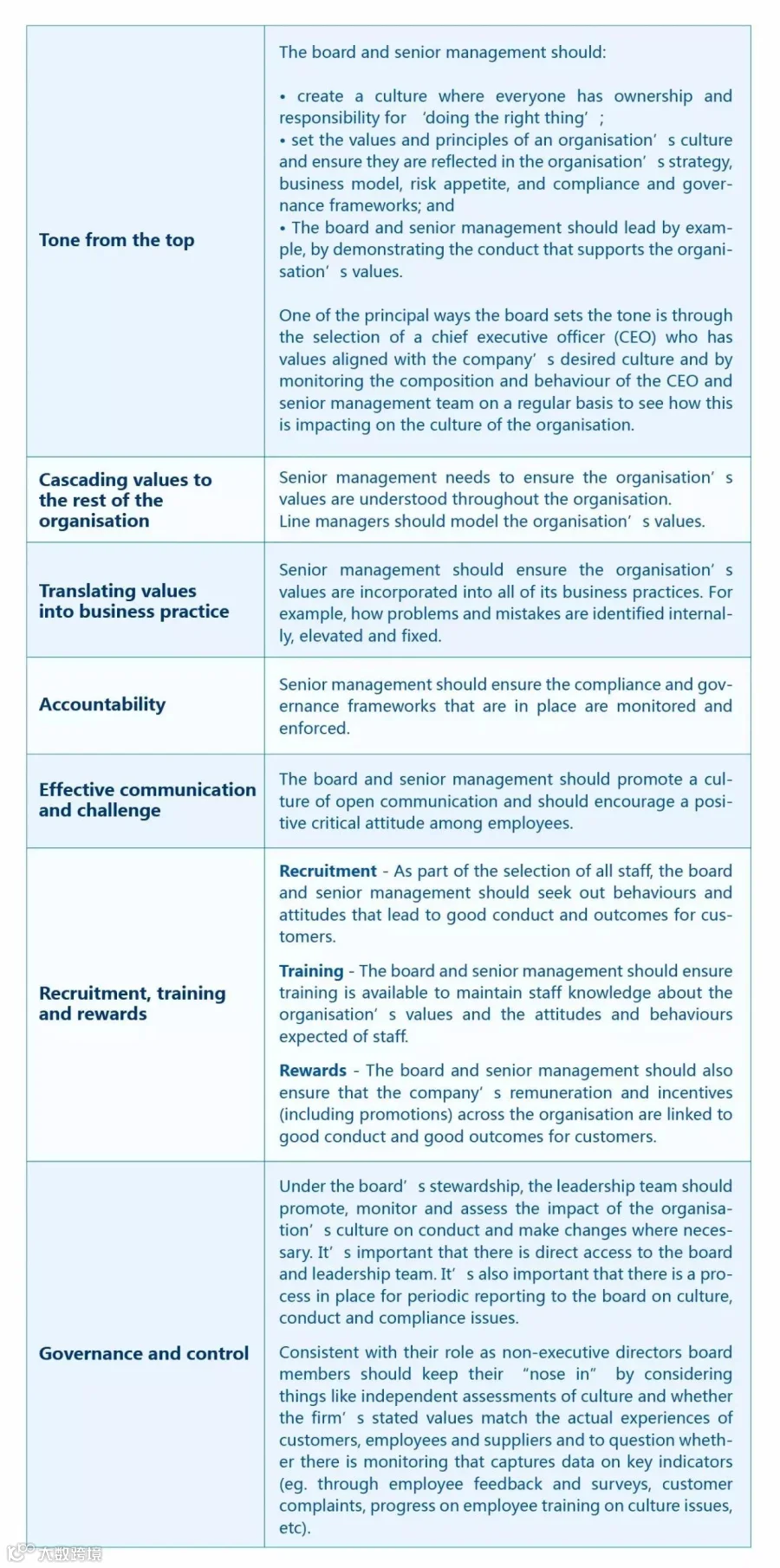
For a non-executive director sitting at the apex of a large diversified corporate group the ability to assess and monitor culture through the organisation might seem an unachievable goal. However, we consider that there are a number of strategies that can be employed by boards to improve their focus on culture. ASIC has identified 7 key drivers[4] of good culture, summarised below, which provides a useful starting point for boards to advance their thinking on culture:
Some conversation starters on culture
Has the company made a public commitment to its values?
Do we hold the chief executive to account when we see misalignment?
What percentage of board time is spent on behavioural performance management?
Do we see evidence of sub-cultures or pockets of autonomy in the business?
How embedded in HR processes are expected behaviours, from recruitment to exit interview?
Are behavioural objectives included in leadership and employee goals and formal employee assessments?
Have we considered if pay award methodologies could undermine culture?
How comfortable do employees report they are with challenging and reporting bad behaviour?
Do we consider our stated corporate values when addressing and resolving risk issues?
Are we clear about the company’s risk appetite and is it communicated effectively?
Note:
1. Australian Securities and Investments Commission’s (ASIC) Corporate Plan 2015-16 to 2018-19.
2. See speech by John Price, Commissioner, ASIC, ‘ASIC’s focus on culture – digging into the detail’, Governance Institute of Australia’s Corporate Governance Forum 2016 (Sydney, Australia) 25 May 2016, speech by Greg Medcraft, Chairman, ASIC, ‘Why culture matters’, BNP Paribas Conduct Month (Sydney, Australia), 24 May 2016.
3. Financial Reporting Council “Corporate Culture and the Role of Boards: Report of Observations” July 2016.
4. This definition is taken from section 12 of the Criminal Code (Cth). Under the Criminal Code culture can be used by a Court to establish fault for corporate criminal culpability.