



Under the global outbreak and continuous escalation of COVID-19, there has been a serious shortage of epidemic prevention medical supplies (mainly medical devices) such as medical masks, protective clothing, and test kits in multiple countries. China, thanks to its controlled approach in their handling of the epidemic in the country and continuous improvement of production capacity, is able to assist other countries by exporting these sought-after goods and materials to them. Recently, the frequency of activity in the trade and import and export businesses in relation to epidemic prevention medical materials has been very high between foreign importers and China's exporters.
In this context, clarifying China's requirements on export supervision in relation to epidemic prevention medical supplies, knowledge of entry criteria for importing countries and regions for epidemic prevention medical supplies and optimization of the terms and conditions of international trade contracts to minimise the risks of breach of contract and related liabilities are key to ensuring the smooth import of epidemic prevention medical supplies from China to destination countries and regions. In this regard, our firm’s Customs, Healthcare and International Trade team has the capabilities to combine the relevant laws and regulations with practical experience in order to assist clients from the United States and European Union in navigating the compliance processes for the import of epidemic prevention medical materials from China.
Compliance with the Supervision and Quality Requirements in the Country or Region where the Importer is Located
Common medical supplies for the prevention of COVID-19 include surgical masks, medical protective clothing and emergency ventilators. Most of these epidemic prevention supplies are medical devices, and each country has its own supervision and quality requirements for medical devices. Consequently, importers should firstly consider whether the epidemic prevention medical devices to be imported meet the supervision and quality requirements of the importing country.
Using surgical masks as an example, we set out below the supervision and quality requirements for surgical masks in the United States and the European Union:
1. United States
(1)
FDA registration, NIOSH certification
Sales of surgical masks in the United States require registration at the Food and Drug Administration (“FDA”) and certification from the National Institute for Occupational Safety and Health (“NIOSH”).
NIOSH classifies its certified particulate-resistant masks into 9 different categories, pursuant to the Department of Health and Human Services (“HHS”) code 42 CFR Part 84. The certification is conducted by the National Personal Protective Technology Laboratory (“NPPTL”), NIOSH's laboratory.
NIOSH classifies masks into the following three types according to the filtering characteristics of the filter:
N series: these masks are not resistant to oil and can be used to protect against non-oily, suspended particles.
R series: these masks are resistant to oil and can be used to protect non-oily and oily suspended particles.
P series: these masks are oil proof and can be used to protect non-oily and oily suspended particles.
Each type can also be further divided into the following three grades according to the lowest filtration efficiency of the filter material:
Level 95: represents a minimum filtration efficiency of 95%.
Level 99: represents a minimum filtration efficiency of 99%.
Level 100: represents a minimum filtration efficiency of 99.97%.
As such, a total of nine combinations can be used to categorise masks: N100, N99, N95, R100, R99, R95, P100, P99 and P95. In the examination process, NPPTL determines, by reference to three types of material (being A, B and C) and test time, whether or not the mask being tested meets any of these 9 classification standards, and if so, which one.
Applications for NIOSH certification are conducted in accordance with NIOSH guidelines. Every respirator submitted, including its parts, must comply with the requirements listed in code 42 CFR Part 84 H to L. Respirators which do not satisfy any one of the requirements under Part 84 must be supplemented with data evidence that it satisfies or surpasses the required standards in the NIOSH guidelines. Every application should include a full written description of the respirator, as well as drawings and product specifications showing all of the details of its structure, and materials used. The applicant must deliver a fully assembled respirator and the necessary components or parts required for its examination, inspection and testing. Only when each requirement is satisfied will NIOSH issue their approval. The main indicators used to assess the respirators include expiratory resistance, exhalation valve leakage, inspiratory resistance, particle testing (for filtration efficiency) and bench testing.
(2)
Emergency Use Authorizations (EUAs)[1]
The authority provided under the EUA allows the FDA to help strengthen the nation’s public health protections against chemical, biological, radiological and nuclear threats by facilitating the availability and use of medical countermeasures needed during public health emergencies.
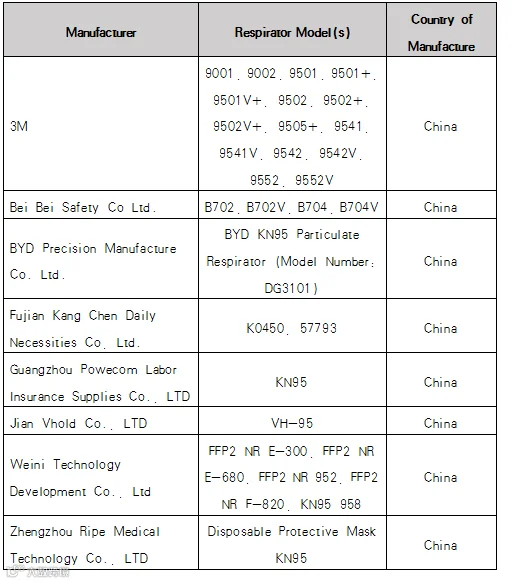
In response to continued respirator shortages, the FDA issued a new EUA for non-NIOSH-approved respirators made in China, which makes KN95 respirators eligible for authorization if certain criteria are met, including evidence demonstrating that the respirator is authentic.
On April 8, 2020, the FDA released the Authorized Imported, Non-NIOSH Approved Respirators Manufactured in China, as follows:
(3)
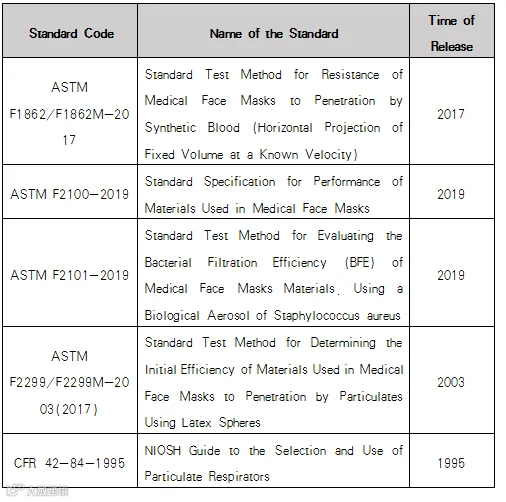
Main Quality Standards
2. European Union
(1)
CE certification
In the EU market, the "CE" mark is a compulsory certification mark. In order to sell the masks freely within the EU market, the "CE" mark must be added to show that the products meet the basic requirements of the EU New Methods of Technical Coordination and Standardization. In order for masks made outside of the EU to be sold freely within the EU, importers from outside of the EU must therefore obtain the certification mark so that they may do so.
CE certification is divided into two categories: bacteria-free and non-bacteria-free. The specific certification procedures are as follows:
· Bacteria-free: requires the involvement of the Notified Institution.
Establish the ISO13485 system. Enterprises with existing system certificates should consider the requirements of MDR (the EU Medical Device Regulation) to upgrade their systems.
Establish the UDI system of the product.
Prepare the technical documents relating to the product.
Test the biocompatibility and performance of the product.
Establish product technical documents that meet MDR requirements.
Audited by the Notified Institution.
Obtain CE certificate.
· Non-bacteria-free: there is no need for approval from the Notified Institution. The enterprise can register the product by way of a declaration of self-compliance, but the registration should be completed before it:
signs contracts with authorized representatives of EU;
establishes the UDI system for product registration; and
completes the CE technical documents.
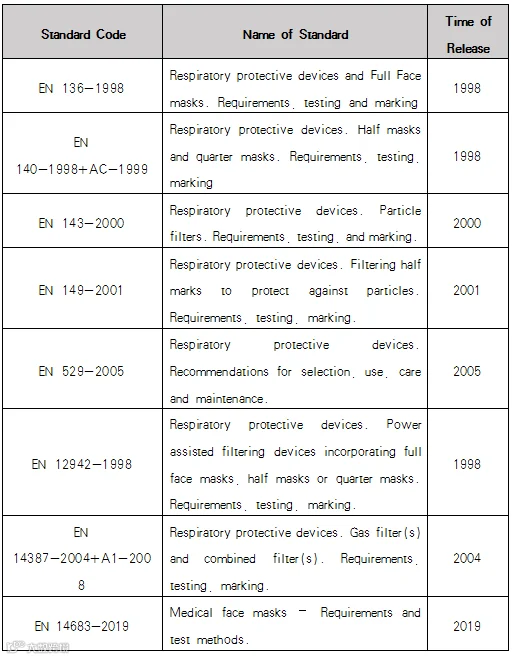
Against the backdrop of COVID-19, the European Commission is collaborating with the healthcare industry and member states to increase production capacity of existing manufacturing companies, while at the same time promoting the import of medical equipment and products. The European Committee for Standardization and the European Committee for Electrotechnical Standardization have agreed to provide several relevant European standards for certain medical equipment and personal protective equipment (such as filter masks, medical cloves and protective clothing). This was intended to assist the EU and third-country enterprises interested in producing these products to start production faster, and to sell them more conveniently within the EU market. This EU initiative supplements the recommendations of the European Commission with regards to conformity assessment and market surveillance procedures, and can provide guidance to relevant countries and institutions on the importation of non-CE certified personal protective equipment that meet the necessary European health and safety standards.
Compliance with the Qualification Requirements of Epidemic Prevention Medical Supplies in China
In addition to meeting the supervision and quality requirements of epidemic prevention medical supplies in the place where the importer is located, there are likewise compliance requirements of epidemic prevention medical products in the place where the exporter is located. The importer must therefore also pay due attention to these requirements. We set out below the compliance requirements for exporting epidemic prevention medical supplies from China.
1.
For the export of some epidemic prevention medical devices, it is necessary to obtain a ‘Registration Certificate For Medical Device’
In the current practice, for certain anti-epidemic medical devices (test reagents, surgical masks, medical protective suits, ventilators and infrared thermometers) produced in China and used for the purposes of the novel coronavirus, it is necessary to have a Registration Certificate for Medical Device when exported out of China. In addition, according to Article 44 of Regulations for the Supervision and Administration of Medical Devices, Chinese enterprises exporting medical devices must ensure that the medical devices they export meet the requirements of the importing countries and regions.
2.
The manufacturers of epidemic prevention medical devices generally need to obtain the necessary manufacturing qualification
According to Article 70 of the Measures for the Supervision and Administration of Medical Device Production, where a manufacturing enterprise accepts the commission of an overseas enterprise to produce medical devices sold on the overseas market, it must obtain a third-party certification of the medical device quality management system or a domestic production license or recordation of similar products.
In addition, if a medical device manufacturer in China produces medical device products for export, it must also ensure that the medical devices it produces meet the requirements of the importing country or region. It shall also file the relevant product information with the local Medical Products Administration.
3.
Other qualification certificates could be required from the exporter
In order to further guarantee the quality of imported products and the smooth progress of the cross-border trade, the importer may, in addition to the aforementioned product qualification and manufacturer qualification, request that the exporter provide additional certificates relating to product quality depending on the exporter’s country or region of origin, such as Certificate of Exportation of Medical Products, product testing reports, product quality certificates, medical equipment business licenses, declarations of exporting medical products, import and export licenses, etc.
However, with the global outbreak of COVID-19, epidemic prevention medical materials are in short supply around the world. If the importer insists that the exporter provide all necessary certificates before exporting goods, it may result in delays in obtaining epidemic prevention medical supplies for the timely treatment of patients.We suggest, therefore, that importers may consider making some compromises or trade-offs in requiring exporters to provide qualifications or certificates such as allowing exporters to provide non-essential qualifications or certificates after the goods are exported.
Pay Attention to China's Regulatory Requirements on Export of Epidemic Prevention Medical Materials
Medical supplies for epidemic prevention procured and exported from China shall, under normal circumstances, be subject to export supervision by the Chinese customs. Whether or not goods have passed the inspection of Chinese customs when they are exported relatively substantially reflects whether the source and circulation of those goods are in compliance. Especially where it is agreed in an international trade contract that the importer is to be responsible for the export customs clearance – e.g., by electing to incorporate EXW trade terms – attention should be paid more to the export compliance risks.
1.
Supervision and Administration Classification of Epidemic Prevention Materials from Chinese Customs
a) Medical supplies for epidemic prevention that are subject to statutory inspection and quarantine
Among the common medical materials, some materials are subject to the statutory scope of inspection and quarantine. The consigner or his agent must, at the place and within the time limit specified by the Customs Department, submit the relevant forms and certificates to the commodity inspection authorities for inspection, and, within the specified time limit, make and declare the export with the inspection certificate.

b) Special articles subject to export examination and approval
In accordance with relevant laws and regulations in China, the inspection and approval system is applicable to microorganism, human tissue, biological products, blood and blood products and other special articles specified in Administrative Provisions on the Sanitary Quarantine of Special Articles that Enter or Exit the Border.
Virus detection reagent kits generally fall within the scope of "special items" mentioned above among the common exported medical materials. For example, the IgM/IgG antibody detection reagent kits of new coronavirus (2019-nCoV) (colloidal gold method) fall within the scope of "other immune products, which have been mixed with certain doses or have been made into retail packages (reagents or kits for medical immunity experiments)" under the customs code of 3002.1500, and the new coronavirus 2019-nCoV nucleic acid detection reagent kits (fluorescent PCR method) fall within the scope of "other diagnostic or experimental preparation reagents (medical device registration certificate is required)" under the customs code of 3822.0090. Both of them are subject to the examination and approval procedures for export of special items.
c) General Anti-Epidemic Goods
The medical materials for epidemic prevention that do not involve the requirements for statutory inspection and quarantine, nor the health quarantine and approval, are subject to general regulatory export formalities.
2.
Export/Exit Route of Epidemic Prevention Medical Supplies
Currently, according to the public information released by China's Ministry of Commerce, the General Administration of Customs and related authorities, China does not have in place any policies or rules restricting the export of epidemic prevention materials. At a routine press conference held on March 25, China's Ministry of Foreign Affairs also made it clear that China has not taken any measures to restrict the export of epidemic prevention medical supplies. On the basis that there are no foreign trade restrictions, the importer may purchase epidemic prevention medical materials via the proper export route at its own discretion.
a) General trade route
The importing party may conclude a sales contract with a Chinese manufacturer or distributor, stipulating that the goods will be exported from China through the general trade route. Under this method, one Chinese entity which has obtained the consignee or consignor qualification of the Chinese customs is required to present the contract, invoice, packing list, etc. to complete export declaration formalities with Chinese customs, and perform the statutory inspection and quarantine and health quarantine examination and approval procedures (if any).
b) Access to Personal Consumption or Gift Items
If the importer requires purchasing a small quantity of face masks or other anti-epidemic products for its own purposes, it may do so by entrusting a PRC Person to purchase those items on their behalf, and then, through them, post, courier or personally bring those products out of the PRC. However, under these circumstances, it is required that the value of a single postal article to Hong Kong, Macao and Taiwan must not exceed CNY800, and that to other countries and regions the value must not exceed CNY1,000. At the same time, the importer must still comply with any limits set by the customs department of the importing country on the value of articles collected and delivered by individuals.
It is worth noting that if the items include any of the those described in Part 3, section 1(b) of this article above, the Approval Form for Sanitary Quarantine of Exit and Entry Special Articles must also be provided, in accordance with Administrative Provisions on the Sanitary Quarantine of Special Articles that Enter or Exit the Border.
c) Cross-border eCommerce route
The importer may also purchase epidemic prevention medical supplies from the sellers of cross-border eCommerce trading platforms within the territory of China. Where the sale of these supplies do not endanger public health safety in ports, biological safety, food safety or commodity safety, infringe upon any intellectual property rights or involve license management, the Chinese customs will permit sellers to mail such commodities up to a maximum value of CNY5,000 to the importers by way of parcel post.
3.
Procedures for Export Inspection at the Chinese Customs
a) Qualification Documents Concerning the Export of Products
In terms of export supervision with regards to epidemic prevention articles, medical masks, protective clothing, medical gloves, goggles, thermometers, respirators and other common medical supplies for epidemic prevention are not within the scope of the restricted export goods. An Export License does not need to be specially obtained. There are also no other trade control measures.
However, it is worth noting that according to the Announcement on Orderly Launching the Export of Medical Materials ([2020] No.5) issued by the Ministry of Commerce, the General Administration of Customs and the State Drug Administration, from 1 April 2020, enterprises exporting any epidemic prevention materials falling within any of five categories (new coronavirus detection reagents, medical masks, medical protective clothing, respirators and infrared thermometers) must, when making customs declaration with the customs, provide the following materials:
(1) a written or electronic statement promising that the exported products have obtained the Registration Certificate of Medical Instruments and meet the quality criteria of the importing country or region; and
(2) medical device registration certificate approved by the drug administration.
b) Export Inspection and Quarantine, and Health Quarantine Examination and Approval Procedures
As mentioned previously, materials listed in the list of "special goods" (such as testing reagent kits) shall be subject to the health quarantine approval procedures and statutory inspection and quarantine application procedures. Taking test reagent kits as an example, we will set out in detail below the customs health quarantine approval and the regulatory requirements for statutory inspection and quarantine.
Generally, test reagent kits fall under the customs tariff codes of 30021500 and 38220090 and fall under the category of "biological products", as defined in the Administrative Provisions on the Sanitary Quarantine of Special Articles that Enter or Exit the Border. Under normal circumstances, the subjects within the territory of China responsible for declarations shall submit the following materials to the Chinese customs to handle the formalities for verification and approval of sanitation and quarantine (for the purposes of epidemic prevention and control, and holding special approval documents issued by provincial drug regulatory departments that may be exempted from the verification and approval of sanitation and quarantine of special items that enter or exit the Border):
(1) the Application Form for Examination and Approval of Sanitation and Quarantine on Exit Special Articles;
(2) explanatory materials on the Chinese and English names, categories, ingredients, sources, purposes, main sales channels, exporting or importing countries or regions and manufacturers of the goods, etc. and
(3) sales certificate issued by the Drug Administration;
(4) the Inspection Certificate or Test Report for the exit goods; and
(5) if the applicant is an entity, it shall, when applying for examination and approval for the first time, provide materials on its basic information, and its laboratory bio-safety qualification certificate.
Where the materials are complete and satisfy the statutory criteria, the Chinese customs will grant the licensing within 20 working days from the date of acceptance of the application.
A declaration enterprise shall, after obtaining the approval for health quarantine, provide the Chinese customs with necessary documents including the application form for inspection of outward goods, foreign trade contract, invoices and packing lists etc. to apply for the exit declaration for inspection no later than 7 days before the declaration or shipment of outward goods in accordance with the Provisions on the Application for Entry-exit Inspection and Quarantine (Order of the General Administration of Customs No. 243). Meanwhile, the consigner shall, under Article 12 of the said provision, provide the materials proving that the exit goods declared for inspection have been inspected to be qualified by the manufacturer or operator, and attach the inspection certificate or test report. After passing the examination of Inspection and Quarantine Department of the Customs, exporters will be allowed to go through the customs formalities for export clearance.
Key Points in International Trade Contracts
The rights, obligations and responsibilities of buyers and sellers are usually specified in detail in international trade contracts. Therefore, importers need to pay close attention to their international trade contracts, especially core clauses such as payment and transfer of risk of loss. The final determination of contract terms still depends on the communication and negotiation between buyers and sellers.
1.
Selecting Appropriate International Commercial Terms (“Incoterms”)
For cross-border transactions, buyers and sellers usually adopt Incoterms to manage issues related to the delivery of goods, transportation, transfer of risk of loss, insurance, etc. as well as the responsibilities of each party in these arrangements. However, due to the impact of COVID-19, cross border buyers and sellers may face delivery risks caused by insufficient transportation capacity or increased control over imports and exportsby various countries. As more countries reduce or cancel flights or strengthen entry-exit control and take other restrictive measures, the uncertainty surrounding cargo transportation increases. Therefore, importers should choose not to accept onerous obligations in transportation, customs clearance and other phases of the transaction. For example, when choosing Incoterms, they should choose those Incoterms with less obligations and risks for the buyer.
In addition, if both parties wish to adopt the Incoterms, they must explicitly state as such in their international trade contract. Also, it should be noted that since 1 January 2020, Incoterms 2010 and Incoterms 2020, as issued by the International Chamber of Commerce, have both been in effect simultaneously. Therefore, both parties need to specify which version of Incoterms applies to their contract so as to avoid any ambiguity.
2.
Selecting Appropriate Payment Terms
As importers are responsible for the payment, the choice of payment terms is of great significance to importers. Common payment methods in international trade include Telegraphic Transfer (“T/T”), Letters of Credit (“L/C”) and Documentary Collection (“D/C”). The definition and subdivision of each payment method are as follows:
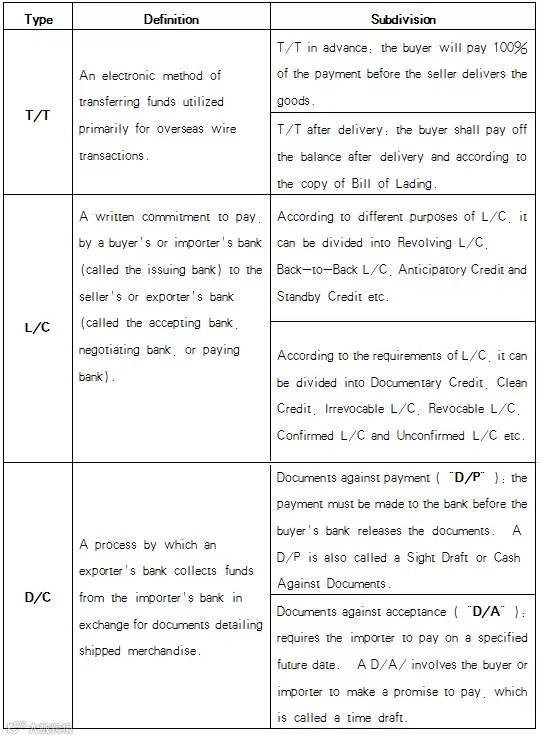
There are many payment methods used in international trade. Different payment methods contain different risks for importers. Therefore, before signing an international trade contract, each importer needs to know about common payment methods in international trade or, with the assistance of a professional international trade attorney, needs to choose a payment term that is conducive to both reducing risk for the importer and promoting the overall transaction.
3.
Requiring Appropriate Credit Enhancement Measures
In order to promote smooth progress in cross-border trade, most countries/regions offer some credit enhancement measures. Take China as an example, the Export-Import Bank of China can, on application by an exporter, issue certain bank guarantees with the importer as the beneficiary such as performance guarantee, advance payment guarantee and quality guarantee. However, due to the impact of COVID-19, the policy on bank guarantees may be updated with the development of the epidemic, and different banks in different countries have different requirements for issuing guarantees. Therefore, when the importer requires the exporter to issue a bank guarantee, the importer may consider hiring a local lawyer to provide some professional advices.
When importing epidemic prevention medical materials, it is necessary to consider the qualifications of Chinese exporters and/or manufacturers of medical products to be exported, the Chinese standards and the registrations/certificates of medical products in China, export and import customs clearance, applicable product standards and registrations/certificates of importing countries, contractual terms of international trade, etc. Due to the outbreak of the COVID-19 pandemic being on a global scale, the laws and policies related to it may change constantly in some countries around the world. King & Wood Mallesons has offices in 13 cities in China, as well as in London, Frankfurt, Milan, Madrid, Brussels, New York, Silicon Valley and other countries or regions. King & Wood Mallesons can offer domestic and international, full service, and one-stop professional legal services for importers of epidemic prevention medical materials.
This article constitutes only preliminary analysis which are based on our current experience and understanding of the laws and regulations and should not be regarded as formal legal opinions to be used by any party under any circumstance without the written consent of the King & Wood Mallesons.
[1]https://www.fda.gov/emergency-preparedness-and-response/mcm-legal-regulatory-and-policy-framework/emergency-use-authorization
https://www.fda.gov/news-events/press-announcements/coronavirus-covid-19-update-daily-roundup-april-3-2020
https://www.fda.gov/media/136663/download
Authors

Huang Jianwen
黄建雯

Partner
Regulatory & Compliance Group
huangjianwen@cn.kwm.com
Ms. Jianwen Huang specializes in investments (including inbound and outbound investment), M&A (including domestic and cross-border M&A), and general corporate matters. Ms. Huang is a leading partner in KWM’s healthcare group. She is identified as a leading individual in the field of Healthcare & Life Sciences in the year of 2019 and 2020 by Legal 500. She was identified as a highly recommended lawyer in the field of corporate and M&A in the year of 2015 by Legal 500. Moreover, she was recognized as one of the Top 10 Lawyers Returning to China after Overseas Study by the Beijing Bar Association in 2011. She has also received multiple KWM awards, including the 2015 Outstanding Cross-border Cooperation of the Year; the 2012 Outstanding Partner of the Year Award; the 2010 Outstanding Partner Award; and the 2006 Outstanding Lawyer Award. Additionally, Ms. Huang represented Pfizer for Pfizer’s acquisition project, which was awarded the Cross-Border Deal of the Year and the Healthcare/Life Science Deal of the Year by M&A Advisor in 2010.

Feng Xiaopeng
冯晓鹏

Partner
Regulatory & Compliance Group
fengxiaopeng@cn.kwm.com
Mr. Feng specializes in trade compliance and customs matters. Based on his nearly 20 years of customs work experience, Mr. Feng has extensive professional knowledge and practical experience in customs compliance, import and export customs planning, customs inspection, customs valuation, case investigation, defense for the crime of smuggling, dispute resolution of classification, foreign investment, cross-border e-commerce, border protection of intellectual property and other areas. Mr. Feng was listed on Chambers' "2020 Asia Pacific Law Guide". In 2019, Mr. Feng published his monograph "Cross-border E-commerce Customs Clearance: Operations and Compliance" at Law Press.

Mike Wang
王良华

Partner
Corporate & Commercial Group
mike.wang@eu.kwm.com
Mr. Wang Lianghua has represented many multinational and medium-sized enterprises in their investments in China. The investment transactions in which Mr. Wang has participated have involved clients in various industries, including transportation (ports), energy, chemicals, machinery, and infrastructure facilities. Mr. Wang provides ongoing legal and compliance advice to domestic, wholly-foreign owned and sino-foreign invested enterprises.

Aaron Wolfson

Partner
Dispute Resolution & Litigation
Aaron.wolfson@us.kwm.com
Mr. Wolfson is a New York partner in the Dispute Resolution & Litigation group specializing in financial crimes compliance. Mr. Wolfson represents clients nationally and internationally in a variety of matters, including white-collar criminal cases, administrative enforcement matters, trade-related due diligence, complex financial disputes, internal investigations, entity list designations, and corporate compliance issues.Mr. Wolfson has extensive public- and private-sector experience. As a prosecutor in the Manhattan District Attorney’s Office, he led numerous investigations and prosecutions of global financial institutions for violations of U.S. sanctions laws. He also served as a Trial Attorney in the U.S. Department of Justice, Antitrust Division, where he was a member of a trial team that prosecuted fraud and price fixing in the municipal bond industry. Mr. Wolfson also held senior positions in a global investment bank’s Anti-Money Laundering and Economic Sanctions programs.

Ramón García-Gallardo

Partner
Dispute Resolution & Litigation
Ramon.GarciaGallardo@eu.kwm.com
Ramón specialises in international and EU litigation, EU trade and regulatory law and EU and Spanish competition law. He also has a wide corporate practice as well as public procurement and commercial law. He acts for a range of companies, trade associations and governments in the following sectors:Agri-food& fisheries,Transport, particularly maritime,Energy,Engineering and public procurement and EU funds. He regularly represents clients before both the European Commission and the Spanish Competition Authority (CNC) and before the competent courts in cases involving competition issues, including mergers and antitrust infringements (including abuse of dominance, cartels). He provides competition law compliance support to international clients and has expertise in dawn raids, cartel defence work, leniency matters and damages claims.
团队成员

Daniel Lopez Rus
Senior Associate

Deng Hui邓惠
Managing Associate

Zhang Yu张宇
Associate

Patrick Yu 俞天栋
Trainee Solicitor

Vicky Yao姚冬桂
Director Assisstant

Hao Xiaoyu郝晓宇
Legal Assisstant

Wang Yimei王溢美
Legal Assisstant
Thanks to Zeng Keyao(曾珂尧)for his contribution.
感谢关注金杜研究院
