
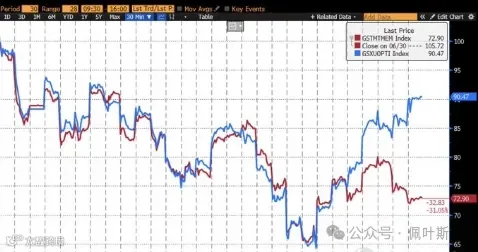
这种板块分化,背后既有业绩兑现、资金筹码结构变化,也源于市场对下一代AI系统架构的重新定价。
一、为何市场资金大举切换至“光进存退”主线?
首先,两大板块所处的市场预期阶段截然不同。存储芯片板块此前已经充分计价供需紧张、产品涨价、盈利上调等利好。进入三季度,DRAM、NAND闪存涨价幅度逐步放缓,市场关注点也从“价格是否还在上涨”转向“涨价节奏是否已经见顶”。花旗下调美光科技目标价,进一步放大了市场的担忧情绪。
而光通信板块迎来密集业绩验证。AAOI超出市场预期的财报,不仅大幅改善了自身估值预期,也让资金重新定价1.6T光模块放量、数据中心高速互联、AI算力集群扩容带来的增量需求。Coherent等龙头标的大幅上涨,本质是资金从预期已经透支的存储板块,转向业绩增长弹性更高的光通信赛道。
其次,这一交易主线的升温,和SemiAnalysis披露的产业链消息密切相关。据SemiAnalysis消息,英伟达Vera处理器搭载的SOCAMM缓存容量,或将从1.5TB下调至768GB;Rubin Ultra芯片搭载的HBM4E显存层数,也计划从16层缩减至8层或12层。市场由此推演:AI芯片正在降低单颗GPU的存储配置,转而依靠更多GPU节点、内存池化技术以及高速光互联,扩大整个算力集群的规模。
知名存储板块多头Jukan也在社交平台发文,建议短期采取“低配存储、超配光通信”的交易策略,核心依据有三点:第一,韩国杠杆ETF市场流动性出现问题,相关投资者面临集中赎回压力,会给存储板块带来额外抛压;第二,英伟达正在迭代下一代AI架构,Rubin Ultra将降低单机架HBM显存配置,依靠光互联实现多机架之间的数据互通;第三,市场对于未来两个季度存储产品价格见顶的预期持续强化。
同时Jukan也强调,自己依然看好存储行业的长期发展,短期转向谨慎仅属于交易层面的判断。在他看来,AI基础设施的投资重心,已经从单纯提升单卡HBM容量,转向优化整个数据中心架构效率,而高速光互联正是核心增量环节。
二、核心争议:单颗GPU存储容量下降,不等于整个AI系统存储总需求下降?
各大机构观点分歧并不在于存储需求是否存在,而在于需求增长的节奏与周期持续时间。综合摩根士丹利、伯恩斯坦、花旗、德意志银行、瑞银、摩根大通最新研报:机构普遍并不看空存储行业基本面,分歧集中在本轮涨价周期还能延续多久、盈利高速增长阶段是否已经结束。
-
摩根士丹利、伯恩斯坦:价格仍在上涨,但上涨斜率已经放缓
伯恩斯坦价格跟踪数据显示,三季度DRAM合约价预计环比上涨17%,包含SSD产品后NAND整体涨幅接近20%。涨幅本身并不疲软,但相较二季度已经明显收窄,部分产品价格甚至低于市场此前乐观预期。PC、手机厂商持续缩减产能,NAND晶圆采购客户拒绝继续接受涨价,服务器DRAM长协价格也已经触及上限。
大摩渠道调研同样显示,三季度DRAM合约涨幅约15%,低于此前20%的市场预期。随着渠道库存回升、行业供给增加,依靠产品超预期涨价拉动盈利上行的难度大幅提升。这一派观点并非认为存储价格即将大跌,而是涨价的二阶导数已经走弱:价格依旧上行,但上涨速度明显放缓。
-
瑞银:存储价格高企,正在挤占AI整体资本开支
瑞银的观点更为直接:持续走高的存储价格,正在不断侵蚀云厂商的AI资本开支预算。
测算数据显示,存储支出在AI资本开支中的占比,预计将从2025年的14%,攀升至2026年的42%、2027年的89%。2026年AI新增资本开支中,约60%将用于覆盖存储涨价成本;到2027年,这一比例或将达到97%。
也就是说,云厂商整体投入仍在增加,但大部分资金仅用于支付更高昂的存储成本,而非新增算力部署。这也解释了英伟达主动下调部分存储规格的原因:并非AI对存储需求减弱,而是存储成本过高、供给紧张,迫使芯片厂商寻求性价比更优的系统架构。 -
摩根大通、花旗:单卡配置下调,不代表整体系统需求下滑
摩根大通将英伟达此次规格调整定义为“供给紧张背景下的容量优化”。下调SOCAMM与Rubin Ultra存储配置后,大摩下调2026-2028年HBM位元需求预测4%-19%,即便采用保守假设,模型依然显示未来三年HBM将持续处于供不应求状态。
原因在于:单颗GPU存储容量下降的同时,AI系统会横向扩充GPU、CPU数量来弥补。新增GPU以及Vera、Rosa系列CPU出货量,足以抵消单芯片存储容量缩减带来的影响,大摩反而上调2026-2028年全球存储市场规模预测4%-8%。
花旗测算更为直观:即便单张GPU的HBM显存减少,下一代AI算力集群的GPU数量将从72颗提升至576颗,整套系统HBM总容量从20.7TB提升至110.6TB,增幅高达434%。分布式集群架构利好光通信赛道,但并不会压制存储整体需求。单卡削减HBM配置,目的是生产更多GPU、搭建规模更大的算力集群。
-
德意志银行:需求并未消失,只是向多层级存储体系分散
德银与美光管理层沟通后表示,AI基础设施正从高度依赖HBM的单一架构,转变为分层式存储体系。
未来架构分工:HBM负责低延迟的高频核心数据;SOCAMM承接KV Cache溢出数据;DDR5内存池处理长尾数据;HBF与企业级SSD负责大容量、低访问频率数据。
光互联的价值,是把分布在不同服务器、不同机架的存储资源打通整合。真正的产业变化并非“用光通信替代存储”,而是光互联与存储池化技术同步普及,存储需求从单卡堆叠,升级为系统级分层配置。
三、低配存储、高配光模块:是产业趋势反转,还是阶段性交易行情?
综合各方观点,“超配光通信、低配存储”在短期具备明确的交易逻辑:光通信迎来业绩兑现与架构升级双重利好,存储则面临涨价放缓、预期溢价过高、杠杆资金撤离多重压力。即便两个行业基本面均向上,光通信的业绩弹性与预期差依旧更强,有望持续跑赢存储板块。
但如果把这种相对收益分化,直接判定为“HBM需求见顶”“存储超级周期终结”,目前还缺乏充足依据。机构达成的共识是:存储行业周期并未反转,但依靠产品涨价、盈利上调获取超额收益的黄金阶段,大概率已经过去。
因此“光进存退”更精准的表述应为:光进存优。光互联在AI系统中的价值占比快速提升;存储板块则告别单卡堆叠模式,走向容量优化、内存池化、多层级配置的发展路径。
后续市场重点跟踪指标:Rubin及Rubin Ultra最终HBM规格、单套系统GPU部署数量、四季度存储产品涨价幅度、客户渠道库存变化。如果单卡HBM配置下降,但GPU出货量、系统整体存储容量持续增长,那么“光进存退”仅仅是板块风格轮动;只有当存储总需求、产品价格、长期订单三者同时走弱,才能确认存储超级周期出现反转。
In-depth Analysis: Trend Shift of AI Hardware — Is "Optics Outperforming Memory" A New Industrial Mainstream or Just A Short-term Trading Theme?
Behind this sector divergence lie catalysts from corporate earnings, changes in capital and chip positions, as well as market repricing of the next-generation AI system architecture.
I. Why Has the Market Suddenly Shifted to the Theme of "Optics Outperforming Memory"?
First of all, the two sectors are at completely different stages of market expectations.Memory chip stocks have already fully priced in positive factors including tight supply and demand, rising product prices and upward earnings revisions. As price growth of DRAM and NAND flash slows down in Q3, market focus has shifted from "whether prices are still rising" to "whether the pace of price hikes has peaked". Citigroup’s downgrade of Micron Technology’s target price has further intensified market concerns.
The optical communication sector, however, is seeing intensive earnings verification. Applied Optoelectronics (AAOI) reported better-than-expected financial results, which not only greatly improved its valuation outlook but also prompted capital to reprice incremental demand brought by mass deployment of 1.6T optical transceivers, high-speed interconnection of data centers and expansion of AI computing clusters. The sharp rally of leading stocks such as Coherent essentially reflects capital rotation from the memory sector with overpriced expectations to the optical communication sector with higher earnings growth elasticity.
Secondly, the rising popularity of this trading theme is closely related to industrial chain news disclosed by SemiAnalysis. According to SemiAnalysis, the capacity of SOCAMM cache equipped with Nvidia’s Vera CPU may be cut from 1.5TB to 768GB; the number of HBM4E layers on Rubin Ultra chips is also planned to be reduced from 16 layers to 8 or 12 layers. The market therefore deduces that AI chips are lowering memory configuration of a single GPU, and instead expanding the scale of the entire computing cluster through more GPU nodes, memory pooling technology and high-speed optical interconnection.
Jukan, a well-known bull investor on the memory sector, also published an article on social platforms, suggesting a short-term trading strategy of "underweight memory, overweight optical communication", based on three core judgments:
-
Liquidity problems in South Korea’s leveraged ETF market have led to concentrated redemption pressure among relevant investors, which will bring additional selling pressure to the memory sector; -
Nvidia is iterating its next-generation AI architecture. Rubin Ultra will reduce HBM configuration per rack and realize data interconnection between multiple racks through optical interconnection; -
Market expectations that prices of memory products will peak in the next two quarters continue to strengthen.
Meanwhile, Jukan emphasized that he still holds an optimistic outlook on the long-term development of the memory industry, and his short-term caution is only a trading judgment. In his view, the investment focus of AI infrastructure has shifted from simply increasing HBM capacity of a single card to optimizing the overall efficiency of data center architecture, and high-speed optical interconnection is the core incremental link.
II. Core Controversy: Does Reduced Memory Capacity Per GPU Equal Declining Total Memory Demand of The Entire AI System?
Institutional disagreements do not lie in the existence of memory demand, but in the pace of demand growth and the duration of the current cycle.According to the latest research reports from Morgan Stanley, Bernstein, Citi, Deutsche Bank, UBS and JPMorgan Chase: institutions generally do not bearish the fundamentals of the memory industry, and their differences focus on how long the current price hike cycle can last and whether the stage of rapid earnings growth has come to an end.
-
Morgan Stanley & Bernstein: Prices Are Still Rising, But The Growth Rate Is Slowing Down
Bernstein’s price tracking data shows that the contract price of DRAM in Q3 is expected to rise by 17% month-on-month, and the overall price increase of NAND including SSD products is close to 20%. The growth rate itself is not weak, but it has narrowed significantly compared with Q2. Prices of some products are even lower than the previously optimistic expectations of the market. PC and mobile phone manufacturers continue to cut production capacity, NAND wafer customers refuse to accept further price hikes, and the long-term contract price of server DRAM has also reached the upper limit.
Channel research from Morgan Stanley also shows that the contract price of DRAM in Q3 rose by about 15%, lower than the previous market expectation of 20%. With rising channel inventory and increasing industry supply, it has become much more difficult to drive earnings growth through better-than-expected product price hikes. This school of thought does not argue that memory prices are about to plummet, but that the second derivative of price growth has weakened: prices are still moving up, but at a significantly slower pace.
-
UBS: High Memory Prices Are Crowding Out Overall AI Capital Expenditure
UBS holds a more straightforward view: continuously rising memory prices are constantly eroding cloud vendors’ AI capital expenditure budgets.
Its estimates show that the proportion of memory expenditure in AI capital expenditure is expected to climb from 14% in 2025 to 42% in 2026 and 89% in 2027. About 60% of incremental AI capital expenditure in 2026 will be used to cover the cost of memory price hikes; by 2027, this proportion may reach 97%.
In other words, although cloud vendors’ overall investment continues to grow, most of the funds are only used to pay for more expensive memory, rather than deploying additional computing power. This also explains why Nvidia took the initiative to downgrade some memory specifications: it is not that AI has less demand for memory, but that high memory costs and tight supply force chip manufacturers to seek system architectures with better cost performance. -
JPMorgan Chase & Citi: Lower Per-Card Configuration Does Not Mean Declining Overall System Demand
JPMorgan Chase defines Nvidia’s specification adjustment as "capacity optimization under tight supply constraints". After downgrading the configuration of SOCAMM and Rubin Ultra, JPMorgan Chase lowered its 2026-2028 HBM bit demand forecast by 4% to 19%. Even under conservative assumptions, its model still shows that HBM will continue to be in short supply for the next three years.
The reason is that while memory capacity of a single GPU declines, AI systems will expand horizontally by increasing the number of GPUs and CPUs. The growing shipments of new GPUs and Vera/Rosa series CPUs are enough to offset the impact of reduced memory capacity per chip. JPMorgan Chase instead raised its forecast for the global memory market size from 2026 to 2028 by 4% to 8%.
Citi’s calculation is more intuitive: even if HBM memory on a single GPU is reduced, the number of GPUs in the next-generation AI computing cluster will increase from 72 to 576, and the total HBM capacity of the entire system will rise from 20.7TB to 110.6TB, a surge of 434%.The distributed cluster architecture is beneficial to the optical communication sector, but it will not suppress the overall demand for memory. Reducing HBM configuration per card aims to produce more GPUs and build larger-scale computing clusters.
-
Deutsche Bank: Demand Has Not Disappeared, But Diversified Into Multi-level Memory Systems
After communicating with Micron’s management, Deutsche Bank pointed out that AI infrastructure is transforming from a single architecture highly dependent on HBM to a hierarchical memory system.
Division of labor in the future architecture: HBM processes high-frequency core data with low latency; SOCAMM undertakes overflow data of KV Cache; DDR5 memory pool deals with long-tail data; HBF and enterprise SSDs are responsible for large-capacity data with low access frequency.
The value of optical interconnection is to integrate memory resources distributed in different servers and racks. The real industrial change is not "replacing memory with optical communication", but the simultaneous popularization of optical interconnection and memory pooling technology. Memory demand has upgraded from single-card stacking to system-level hierarchical configuration.
III. Underweight Memory & Overweight Optical Modules: An Industrial Reversal or A Phased Trading Trend?
Comprehensive views from all parties show that "overweight optical communication, underweight memory" has clear short-term trading logic: optical communication benefits from both earnings verification and architecture upgrade, while memory faces multiple pressures including slowing price hikes, overvalued expectations and capital outflows of leveraged funds. Even if the fundamentals of both industries are improving, optical communication still has stronger earnings elasticity and expectation gap, and is expected to continue to outperform the memory sector.
However, it is still lack of sufficient evidence to regard such relative performance divergence as "HBM demand has peaked" or "the super cycle of memory has ended".
The consensus among institutions is: the memory industry cycle has not reversed, but the golden stage of obtaining excess returns through product price hikes and earnings revisions has most likely passed.
Therefore, a more accurate description of "optics outperforming memory" should be:Optics advances, memory optimizes. The value proportion of optical interconnection in AI systems rises rapidly; the memory sector abandons the single-card stacking model and moves towards capacity optimization, memory pooling and multi-level configuration.
Key indicators to be tracked by the market subsequently: final HBM specifications of Rubin and Rubin Ultra, number of GPUs deployed per system, price increase of memory products in Q4, and changes in customer channel inventory.
If HBM configuration per card declines, but GPU shipments and total memory capacity of the system continue to grow, then "optics outperforming memory" is only a sector style rotation. Only when total memory demand, product prices and long-term orders all weaken at the same time can we confirm the reversal of the memory super cycle.
以寻找我的绿泡泡:NBWcat
TG:@president16888 QQ:1747393914
以下是专属福利,可按需自取:
【券商】
❥复星专属公开渠道:3N5AZV (使用海外网络)
❥复星公开页面:https://h5.fotechwealth.com/pages/startAccount.html?channel=030016&aeCode=B2&invitationCode=3N5AZV&langType=zhCn
❥致富专属公开渠道:DQ3638 (使用海外网络)
❥致富公开页面:https://www.chiefgroup.com.hk/hk/open?rl=ECR&PromoCode=DQ3638
❥盈立(香港)公开渠道码:gx4c(使用海外网络)
❥盈立(新加坡)7d41(使用海外网络)
❥腾达证券:XDYFMU7P
❥公开页面:https://gigamoney.activity.wbrks.com/pages/winner/10849/index.html?app_id=winner&org_id=1&account_channel=hk_winner&lang=zh-HK&channel=kol&invite-code=XDYFMU7P
❥卓锐公开渠道:ZR89e0(必须在HK注册)
❥公开页面:https://channel.zr.hk/zhuorui_web_h5?inviteCode=ZR89e0
❥立桥HK---没有邀请码,直接使用公开页面:https://sec.zbjjt.com:6003/webstatic/sign/index.html#/register?channelId=qo4y9n0tRluU7MyvxW9X%2Fw%3D%3D&customerSourceId=qS1Sg19wHd1Q2FmITTG92Q%3D%3D&aeCode=J7eqeH2ozpGDhEwMabuqiw%3D%3D&lang=zh_HK
❥ 宝时公开渠道:3R1SL
❥ 宝时公开页面:https://hmsca.iqdii.com/view/accountopening/hms/#/?lang=chs&channel=30&custno=&openaccttype=0&typeno=¤tClient=0&InvitationCode=3R1SL&org=hms
❥云锋有鱼公开渠道:SXNG48 (使用海外网络)
❥ 云锋有鱼公开页面:https://open-acct.youyu.cn/open-account/#/accounts/login?code=SXNG48
❥必贝BBAE (使用海外网络)
邀请码:sth9ppat3
公开页面:https://landing.bbae.com/m/h5/new-user-reward-v4?lang=zh-CN&f=invite&referral=sth9ppat3
❥盈透IBKR(中国护照+海外地址证明)
❥公开页面:https://ibkr.com/referral/yuanyuan933
【银行】
❥中银香港专属公开渠道:M23756872072
❥ZA众安银行公开渠道:VUJ474
❥恒生银行公开渠道: GXHDSQ
❥恒生银行邀请亲友进行登记https://www.hangseng.com/camp16
❥信银国际(中信银行国际)公开渠道:1G2T4Y2
❥平安数字银行公开渠道:WIG6TY
❥平安数字银行公开页面https://mobilebanking.paob.com.hk/h5/mgm.html#/mgeBeRecommenderNew?referralCode=WIG6TY&activityCode=A202606260001
❥工银亚洲专属公开渠道:26042152716854
❥象象银行公开页面https://app.airstarbank.com/apph5/friendsInvite_appLink.html#/detail
❥汇立银行公开渠道:FPJYXH
❥美国华美银行公开页面 (1008元材料费用+210美金(你自己付))https://buy.italkbb.com/chs/cu/PkM?q=874266
❥英国Ifast公开页面https://www.ifastgb.com/tellafriend/yuanyuanc6480
❥德国N26公开渠道:yuanyuac44482c
公开页面https://n26.com/r/yuanyuac44482c?cid=0JY⟨=en
❥瑞士杜高斯贝银行公开页面:https://www.dukascopy.bank/swiss/open-mca-account/?ref=⟨=zh
❥澳门蚂蚁银行(先注册再澳门开户)LPE22RM9
https://render.alipay.com/p/c/180020570000149153/index.html?invite-code=LPE22RM9
❥Wise公开页面:https://wise.com/invite/arhn/4v9di89
❥熊猫速汇 公开页面https://p.pandaremit.com/h5ditui/launchIndex?invtCode=11429942&area=HKG&type=ditui
❥新加坡 Starryblu邀请码:MPPK00Q
❥新加坡 Starryblu公开页面https://sg.starryblu.com/x/6RzmANtj
【数字货币】
❥B安专属公开渠道:CPA_00N0KYMEP1
❥B安公开页面:https://www.bsmkweb.cc/activity/referral-entry/CPA?ref=CPA_00N0KYMEP1&utm_source=referral_entrance
❥Gate专属公开渠道:PRESIDEN
❥Gate公开页面:https://www.gatewebsite.app/share/PRESIDEN
❥Bybit公开渠道:PRE88
❥Bybit公开页面:https://partner.bybit.com/b/PRE88
❥O意专属公开渠道:67834863
❥O易公开页面:https://www.nzdcvhpxqwy.com/join/67834863
❥H币公开页面:https://www.htx.com.ph/invite/zh-hk/1f?invite_code=48qfd223
❥OSL HK公开页面:https://trade-hk.osl.com/invite/activities?invitecode=7g7xF
❥OSL Global公开页面:https://trade-hk.osl.com/register?channel=cjySdK
❥Weex邀请码:presi88
❥Weex专属链接https://weasexx.online/zh-TW/register?vipCode=presi88
❥BIT专属邀请马: PRE88 (注册时手动填写)
❥BIT专属邀请:https://invest.matrixport.com/newRegister/cn?invite_code=PRE88