


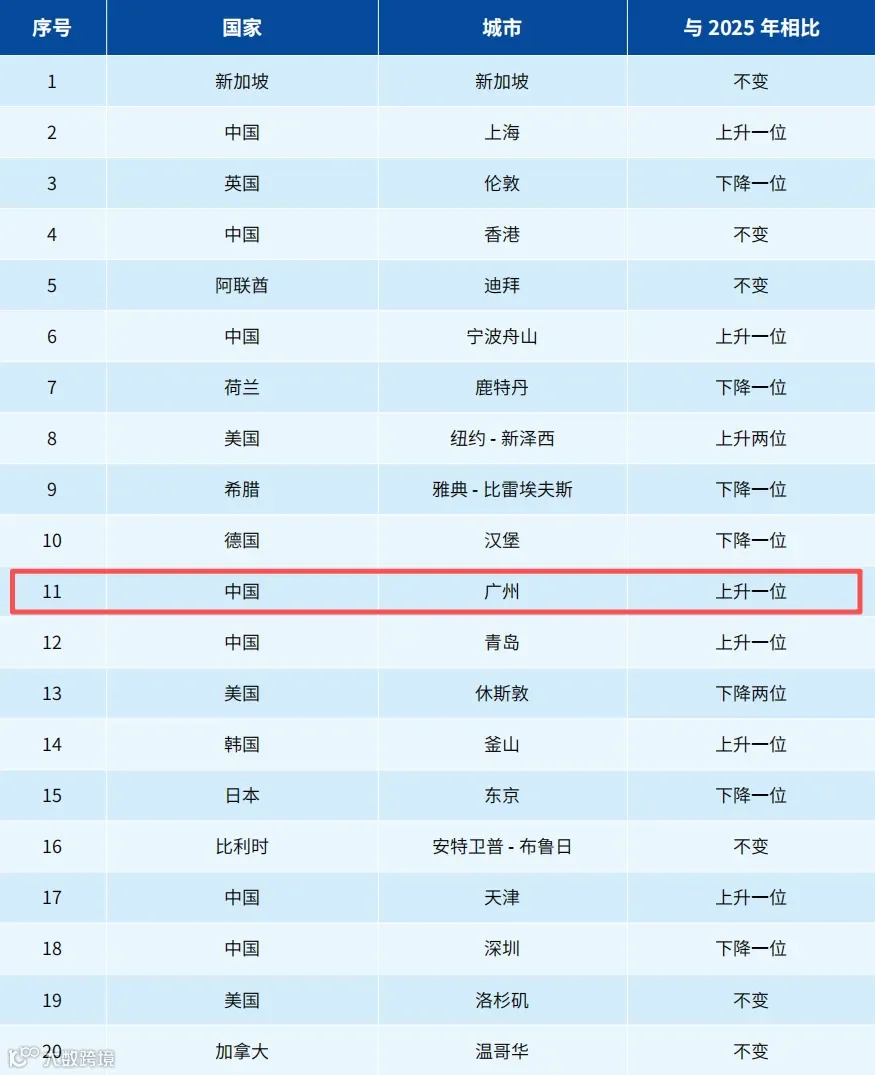
7 月 10 日,由新华社中国经济信息社与波罗的海交易所联合编制的《新华・波罗的海国际航运中心发展指数报告(2026)》正式发布。作为衡量全球航运中心综合竞争力的权威评价体系,广州综合排名较 2025 年提升 1 位,升至全球第 11 位。继上一年度赶超东京后,今年再度进阶,位次超越美国休斯顿。自 2015 年首次纳入样本城市位列全球第 28 位以来,广州十余年间累计攀升 17 个位次,进位势头稳健。在中国区排名中,广州位列第四,仅次于上海、香港、宁波舟山,我国沿海港口集群整体竞争力持续向上。
Jointly compiled by Xinhua China Economic Information Service and the Baltic Exchange, the 2026 Xinhua-Baltic International Shipping Center Development Index Report launched officially on July 10. As an authoritative evaluation system measuring the comprehensive competitiveness of global shipping hubs, the index shows Guangzhou climbed one spot year-on-year to rank 11th worldwide in 2026. Having overtaken Tokyo last year, the city moved up another notch to surpass Houston of the United States this year. Since its first inclusion in the sample cities in 2015 when it ranked 28th globally, Guangzhou has risen a total of 17 places over more than a decade with steady upward momentum. Among Chinese shipping centers, Guangzhou takes the fourth position, following Shanghai, Hong Kong and Ningbo Zhoushan. The overall competitiveness of China's coastal port clusters continues to grow.
报告显示,上海、宁波舟山、广州、青岛、天津等国内航运中心榜单位次同步提升,直观反映我国海上互联互通水平与综合航运服务能力稳步增强。本次指数设置港口硬件、航运专业服务、综合营商环境三大一级维度,权重分别为 20%、50%、30%,全方位衡量全球主要港口城市航运发展综合实力。
The report notes that domestic shipping hubs including Shanghai, Ningbo Zhoushan, Guangzhou, Qingdao and Tianjin all registered higher global rankings, a clear reflection of steady improvements in China's maritime connectivity and comprehensive shipping service capacity. The index assesses the overall shipping performance of major port cities worldwide across three core primary dimensions with assigned weightings: port infrastructure (20%), professional shipping services (50%), and comprehensive business environment (30%).
港口硬件根基扎实,枢纽承载能力持续跃升
港口硬件权重占比 20%,是广州排名稳步上行的重要基础。广州拥有规模化深水集装箱泊位集群,集装箱、干散货、液体散货综合吞吐规模优势显著,码头起重配套设施完备,硬件指标表现亮眼。
Accounting for 20% of the total index weight, port infrastructure serves as a critical foundation for Guangzhou's steady rise in global rankings. Boasting large-scale clusters of deep-water container berths, Guangzhou boasts prominent advantages in the comprehensive throughput of containers, dry bulk and liquid bulk cargo, alongside complete terminal lifting supporting facilities, delivering outstanding performance in hardware indicators.
2025 年,广州港货物吞吐量达 6.99 亿吨,集装箱吞吐量 2805 万标准箱,分列全球第五、第六位;外贸集装箱增长势头强劲,同比增幅近 20%,外贸箱量占比超五成,完成从国内第一大内贸港向内外双循环枢纽港的转型。其中南沙港区外贸集装箱增速高达 25.5%,增速领跑国内沿海港区。航线布局持续拓展,全年新增 11 条国际航线,外贸班轮航线达 182 条,2026 年上半年继续扩容至 186 条,集装箱航线总数突破 300 条。
In 2025, Guangzhou Port recorded a cargo throughput of 699 million tonnes and a container throughput of 28.05 million TEUs, ranking fifth and sixth globally respectively. Foreign trade container volume maintained robust growth with a year-on-year increase of nearly 20%, accounting for over half of total container throughput. The port has completed its transformation from China's largest domestic trade port to a hub facilitating both domestic and international economic circulations. Nansha Port Area stood out with a 25.5% year-on-year surge in foreign trade container volume, leading all coastal port areas nationwide. The port kept expanding its shipping network: 11 new international routes were added throughout 2025, bringing the number of foreign trade liner routes to 182. The figure further rose to 186 in the first half of 2026, with the total number of container shipping routes exceeding 300.
航运服务提质增效,绿色智慧建设走在前列
航运专业服务为指数核心评价维度,权重占比 50%,广州在航运指数创新、口岸通关、绿色低碳、船舶服务等领域多点突破,软实力持续增强。广州发布国内首个粤港澳大湾区出口集装箱(东盟)航运运价指数、珠江航运指数,完善区域航运价格定价体系,提升区域航运话语权。
Professional shipping services constitute the core evaluation dimension of the index, accounting for 50% of the total weight. Guangzhou has made breakthroughs across shipping index innovation, port clearance, green low-carbon development and vessel services, steadily elevating its soft power in the maritime sector. Guangzhou has rolled out two pioneering domestic indices: the Greater Bay Area ASEAN Export Container Freight Index and the Pearl River Shipping Index. These initiatives have refined the regional shipping pricing system and strengthened Guangzhou's pricing discourse power in the maritime market.
2026 年上半年以来,大湾区航运联合交易中心香港平台正式揭牌运营,形成“广州—香港”双平台一体两翼协同发展格局,服务功能有效拓展。口岸服务持续优化,全面推行 24 小时不间断引航,实现引航调度“零等待”,集装箱船舶平均在泊时间压缩至 0.87 天,作业效率位居全球前列。南沙港区四期建成全球首个江海铁多式联运全自动化码头,部署 158 台无人驾驶智能导引车,实现 24 小时不间断作业,装卸效率提高 30%。绿色航运建设成果突出,广州成为华南首个同时具备锚地、码头双模式保税 LNG 加注能力的港口,顺利落地 LNG 船对船同步加注业务;全港泊位岸电实现全覆盖,2025 年靠港船舶岸电使用量累计超 1700 万千瓦时,累计减少碳排放 11730 吨,绿色低碳转型成效获行业认可。
Since the first half of 2026, the Hong Kong platform of the Greater Bay Area Joint Shipping Exchange has officially opened for operation, forming a coordinated dual-platform development pattern integrating Guangzhou and Hong Kong as two complementary pillars, which has effectively expanded the scope of service functions. Port service efficiency has been continuously optimized. Round-the-clock pilotage services are fully implemented to achieve zero waiting time for pilot scheduling. The average berthing time of container vessels has been cut to 0.87 days, placing Guangzhou among the world's top ports for operational efficiency. Phase IV of Nansha Port Area hosts the world's first fully automated river-sea-rail intermodal terminal, equipped with 158 unmanned intelligent guided vehicles (IGVs) to enable non-stop 24-hour operations, lifting handling efficiency by 30%. Remarkable progress has been achieved in green shipping development. Guangzhou is the first port in South China capable of bonded LNG bunkering via both anchorage and berth modes, with ship-to-ship synchronous LNG bunkering services successfully launched. Shore power systems now cover all berths across the port. In 2025, the total shore power consumption by calling vessels exceeded 17 million kWh, cutting carbon emissions by 11,730 tonnes, earning wide industry recognition for its green and low-carbon transformation outcomes.
营商环境持续优化,港产融合赋能发展
综合营商环境权重 30%,依托粤港澳大湾区完备产业基础,广州统筹完善海铁、江海联运等多层次集疏运网络,并持续深化跨境贸易便利化改革,创新落地“船舶不停航办证”改革,船舶运营期间即可同步办理各类资质证书,切实为航运企业减负增效。
The comprehensive business environment accounts for 30% of the index weighting. Leveraging the complete industrial foundation of the Guangdong-Hong Kong-Macao Greater Bay Area, Guangzhou has built and refined a multi-level cargo collection and distribution network covering sea-rail and river-sea intermodal transport. It has also deepened reforms to facilitate cross-border trade, launching the innovative "certificate handling while vessels remain in operation" policy. Shipping companies can apply for various qualification certificates during vessel voyages, effectively reducing operational burdens and boosting efficiency for maritime enterprises.
2026 年以来,广州港集团与马士基签署港航合作备忘录,粤港澳游艇自由行政策正式落地,开放合作格局持续深化。临港产业集聚效应凸显,目前已培育形成汽车制造、海洋工程装备、石油化工、冷链物流、粮油加工等多元临港产业集群,港产城深度融合发展格局基本成型,城市航运综合营商评分稳步向好。
Since 2026, Guangzhou Port Group has signed a port-shipping cooperation memorandum with Maersk, while the yacht free travel policy within the Greater Bay Area has officially taken effect, further expanding the city's opening-up and cooperation landscape. The port-side industrial agglomeration effect is prominent. Diversified industrial clusters centering on automobile manufacturing, offshore engineering equipment, petrochemicals, cold chain logistics and grain & oil processing have taken shape. A mature integrated development model linking ports, industries and cities has basically been established, driving steady improvement in Guangzhou's comprehensive business environment score for shipping.
连续两年在新华・波罗的海国际航运中心发展指数中实现进位,是广州加快建设国际航运枢纽的有力佐证。下一步,广州将对标上海等全球顶尖航运中心找准差距、补齐短板,持续加密远洋特色航线,做强整车、生鲜等外贸特色航运品牌,迭代升级智慧化、绿色化港口基础设施,深化航运协同联动,不断提升全球航运资源配置能力,全力打造具有全球影响力的广州国际航运枢纽。
Guangzhou will benchmark top global shipping hubs including Shanghai to identify gaps and shore up weak links. The city will keep expanding its network of distinctive ocean-going shipping routes, strengthen signature foreign trade shipping sectors such as finished vehicles and fresh produce, and upgrade smart and low-carbon port infrastructure. It will further deepen cross-regional shipping coordination, continuously elevate its capacity to allocate global maritime resources, and strive to build Guangzhou into an internationally influential global shipping hub.
来源:广州外事港澳,广州日报