


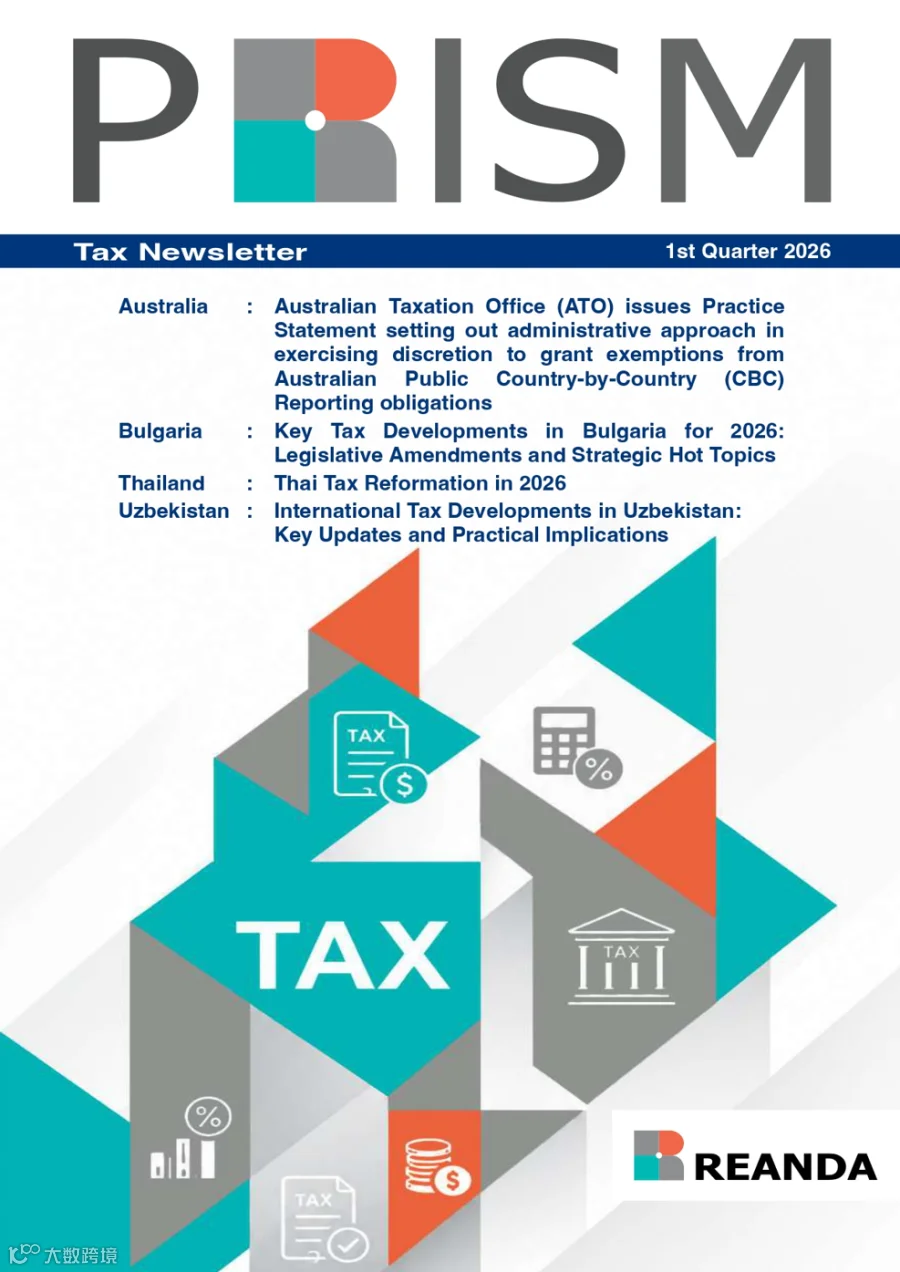
利安达国际最新一期税务季刊PRISM,让您掌握最新的国际税务动态与热门话题。
本期焦点内容:
澳大利亚税务局(ATO)发布指引,阐述在行使自由裁量权以授予澳大利亚公共国别报告(Public Country-by-Country,CBC)义务豁免时的行政处理方式
公共国别(Public CBC)报告要求大型跨国集团公开披露关于澳大利亚、特定司法管辖区以及全球运营的部分税务和财务信息。该要求适用于自2024 年 7 月 1 日起开始的报告期,除非获得税务局局长的豁免,否则首份报告须在2026 年 6 月 30 日前提交。ATO已发布指引 PS LA 2025/2,阐明局长的审查和裁量方法。企业应迅速行动,评估披露风险,考虑因汇率波动导致的门槛不一致等资格因素,准备有力证据,并在认为PS LA 2025/2 的指南适用于其情况时尽早向ATO 提交申请。
保加利亚
2026年保加利亚主要税收变化及战略性重点议题
2026年,保加利亚税收体系在保持企业所得税和个人所得税稳定的同时,出现了重要的结构性变化。增值税法规进行了关键修订,同时实施了欧盟全球最低税(Pillar Two),完成了经合组织税务审查,并自2026年1月1日起正式采用欧元。这些变化重塑了合规环境,加强了与欧盟及经合组织标准的衔接。本文概述主要税收变化及其对国内和跨国企业的实际影响。
喀麦隆
2026年喀麦隆数字税务转向:应对全新的 “显著经济存在” 标准与简化税务系统的废除
2026 年《财政法》引入了 “显著经济存在” (SEP)标准,重新定义了非居民数字实体的税务义务。同时,简化税务系统的废除强制要求中小企业向 “实际税务系统” 或 “全球综合税” (IGS)转型。本文探讨了第23 条 bis 规定的强制性数字申报要求。
哥斯达黎加 2026:新立法周期与结构性改革议程
2026年5月,哥斯达黎加将在全国大选后开启新的立法周期。新一届立法大会面临推动结构性改革的挑战,以加强财政可持续性、提升国家竞争力并增强国际信心。近年来,哥斯达黎加在财政纪律、透明度、国际税务合规及国际标准的采纳方面取得了显著进展,但仍需进一步深化改革。重点领域包括税制现代化、公共财政可持续性、税务管理数字化改革(TRIBU-CR)、转让定价监管以及BEPS合规。财政、贸易与投资政策的协调,将有助于巩固哥斯达黎加作为区域专业服务和国际商业运营枢纽的地位。
塞浦路斯
塞浦路斯税制改革2026:从具竞争力的税收制度迈向以合规为导向的新框架
塞浦路斯议会通过的税制改革标志着该国税收框架近年来最重要的变革之一。该改革主要自2026年1月1日起生效,不仅涉及税率调整,更体现出向合规性、透明度及实质要求提升的整体转变。主要措施包括公司所得税率提高至15%、股息税制的调整、未来利润取消视同分配制度,以及税务机关执法与审计权力的加强。本文概述税制改革的主要内容,并探讨其对塞浦路斯税收环境的影响。
希腊
住房、守时和官僚主义方面的新措施
2025年以初级财政盈余收官,超出目标约27.5亿;经济增长预计收于2%,显著高于欧洲0.9%—1.1%的平均水平。新的一年在经济方面延续了同样的良好势头,但也面临重大挑战,包括提升守时性、满足住房需求以及减少官僚主义。政府在新年伊始将针对上述三个领域推出一揽子重大措施。主要措施包括:投入26亿用于住房补贴并降低房地产税,提高最低工资,以及推进与司法和公共部门交易相关流程的数字化。
马来西亚
印花税
马来西亚依据1949年《印花税法令》来征收印花税。印花税是对文书(即任何书面文件)征收的税款,而非对交易本身征收。印花税分为两种:从价印花税和固定印花税。自行评估印花税制度(STSDS)将根据文书或协议的类型,分阶段实施。为鼓励提交未加印花税的文件,并尽可能减少罚款,马来西亚于2026年1月1日至2026年6月30日期间推出一项特别自愿披露计划(SVDP)。
马耳他
马耳他——企业税务发展与国际接轨(2025–2026)
本文分析了马耳他在 2025–2026 年期间不断演变的企业税收框架,重点关注其在经合组织“支柱二”最低税改革及欧盟监管趋同背景下的制度调整。文章探讨了全球最低税机制的延期实施、可选择适用的15% 最终企业税制,以及强化转让定价规则、公司治理改革和税务数字化合规对企业运营的影响。本文进一步阐明了跨国企业面临的战略影响,包括跨境补税风险、合规准备以及中长期税务规划考量。
摩洛哥
在摩洛哥《2026年财政法》框架下应对预提税制度的变化
摩洛哥《2026年财政法》通过扩大预提税的适用范围,对国家税收征管体系进行了结构性改革。该改革将更多服务支付纳入预提税机制,并强化大型企业作为代扣代缴义务人的角色,旨在提高税收合规性、保障财政收入并增强交易透明度。本文分析了该改革的背景、适用范围及其对在摩洛哥经营的跨国集团和外国服务提供方的影响,并将摩洛哥的做法置于国际视角下,说明其与全球税收治理和反避税趋势的趋同。
尼泊尔
尼泊尔海关法最新修订案
尼泊尔已颁布新的《2082 年海关法》(2025 年),并于 2025 年 12 月 8 日起正式施行,同时废止已实施近二十年的《2064 年海关法》(2007 年)。新法全面现代化海关管理制度,引入以计算机为基础的「四信道」风险分析系统,取代以往的人工查验方式。主要改革内容包括:在机场对入境旅客实施「双通道」通关制度、扩大海关人员对航空器的检查权限,以及对易腐货物提供实时清关机制。此外,新法允许航运公司在缴纳应缴关税后办理进口货柜清关手续,并加强执法力道,规定如发生低报货值(少开发票)行为,将处以相当于应征关税 100% 的罚款。
尼日利亚
尼日利亚数字企业和非居民企业的税收——最新趋势和政策方向
尼日利亚逐步改革其税收框架,旨在从在其市场运营但无实体存在的数字企业和非居民企业中征收税款。
该体系通过一系列财政法案和“重大经济存在”(SEP)规则的引入而不断发展,使尼日利亚与经合组织(OECD)的税基侵蚀和利润转移(BEPS)项目等全球税收倡议接轨。
2024年和2025年的政策重点是加强执法力度、明确合规义务并改善对跨境数字交易的监管。
这些举措扩大了公司所得税和增值税的适用范围,使其涵盖从尼日利亚获得收入的外国服务提供商。
巴基斯坦
第4C条下的超级税
超级税是通过2001年《所得税条例》的修正案引入的(主要是通过2015年和2022年的《金融法案》)。根据第4B条,2015年首次对高收入者和收入超过一定利润门槛以产生收入的公司征收超级税。第4C条在2022年扩大了征税范围,对高收入公司和个人征收高达10%的超级税,特别是在银行、水泥、钢铁、糖、石油和天然气、化肥等特定行业,以及应税总收入超过设定门槛的其他行业。这是为了在经济压力下,特别是在通货膨胀和国际货币基金组织计划承诺的情况下,增加联邦收入。
菲律宾
菲律宾税收制度的最新动态
2025年,菲律宾颁布新立法,旨在加强投资激励、规范数字经济以及提高资本市场效率,为其税收框架进行重大改革。值得注意的改革包括全面实施《创造更多法案》(CREATE MORE Act)、对数字服务征收增值税(VAT),以及《资本市场效率促进法案》(CMEPA)带来的变革。
根据避免双重征税协议执行税款扣缴
沙特阿拉伯王国不对境内支付征收预提税——即由王国内的居民或常设机构支付给同在王国内的其他居民的款项——因为预提税的规定主要适用于王国内居民或常设机构支付给本通告所涵盖的非居民的款项。
新加坡作为国际总部
在新加坡设立或扩展全球或区域总部的企业,可申请国际总部奖励(International Headquarters Award,IHQ)。该奖励对符合条件的收入提供为期最长五年的优惠税率,税率为 5%、10% 或15%,具体适用税率取决于企业是否满足规定的就业人数及总业务支出要求。符合资格的职能活动包括管理、采购、供应链、市场管控、人力资源、法律、财务及品牌管理等。此外,IHQ企业应评估新加坡国内补充税(Domestic Top-up Tax)可能带来的潜在影响。
塔吉克斯坦
塔吉克斯坦税制改革进展与税务数字化
2025年12月22日,杜尚别举行联合会议,总结了 “税制改革行动” (Tax Reform Operation)项目的实施成效,并明确了推进塔吉克斯坦税收征管进一步数字化的重点方向。该项目对接国家发展目标,着力提升透明度、优化纳税服务、推进自动化及数据驱动的管理模式,以强化税收遵从性并提升税收征管效率。世界银行对项目成果给予高度评价,称其为最成功的项目之一,并确认将继续支持旨在推动税制改革的相关举措。同时,2026—2030年税收征管发展规划的编制工作也已启动,重点将放在数字化转型与进一步提升税收透明度。
泰国
泰国税制改革将于2026年进行
即将进行的税制改革不仅仅是一项增加财政收入的举措,更是一次根本性的结构调整,旨在确保泰国保持竞争力和韧性。泰国希望通过平衡国际标准与人口老龄化和工业化带来的现实情况,保障未来十年的财政安全。
阿联酋2025 年第四季度主要税务变化——公司税、增值税、消费税与电子发票
在 2025 年第四季度,阿联酋税制在公司税、增值税、消费税及电子发票领域全面进入“落地与执法”阶段。经修订的税务程序法与增值税法确立了税款退还的严格时效、强化了税务稽查权并对进项税抵扣提出更高合规要求。公司税方面,对合格投资基金及 REIT 规定了具有法律约束力的登记、申报和缴纳时间表。同期发布的电子发票违规罚则以及按含糖量计征的含糖饮料消费税新模式,将自2026 年起实施,企业需立即做好准备。
英国
多家信托及其他单位未能按时完成自动信息交换注册
多家英国信托、投资合伙企业及公司可能尚未意识到, 已错过二〇二五年十二月三十一日的自动信息交换注册截止日期。根据注册要求的最新变更,如果信托拥有法人受托人,或单位大部分收入主要来自于由金融机构委托管理的投资,则该单位必须进行注册。可能受影响的单位应立即评估其是否符合注册条件,以及未来是否需要提交自动信息交换报表。
乌兹别克斯坦
乌兹别克斯坦国际税收发展:关键更新与实践影响
本文概述了乌兹别克斯坦近期的国际税收发展,重点介绍企业所得税(15%)、增值税(12%)以及为外国投资者提供的税收优惠政策。特别分析纳沃伊、安格连和吉扎克等自由经济区内的税收减免措施,包括企业所得税、土地税、财产税及关税优惠。文章从实践角度为跨国企业提供进入乌兹别克斯坦市场时在税务结构设计和合规管理方面的指导。
阅读全文:http://upload.reanda-international.com/PRISM_2026-1stQ.pdf
Reanda International’s PRISM Tax Newsletter – 1st Quarter 2026 Issue
Here is the latest issue of PRISM – the quarterly tax newsletter of Reanda International, aiming to stay in touch with our clients by sharing updates and insights on recent taxation changes and current hot topics.
Insights include:
Australia
Australian Taxation Office (ATO) issues Practice Statement setting out administrative approach in exercising discretion to grant exemptions from Australian Public Country-by-Country (CBC) Reporting obligations
Public CBC reporting requires large multinational groups to publicly disclose selected tax and financial information for Australia, specified jurisdictions, and global operations. Applying to periods from 1 July 2024, the first reports are due by 30 June 2026 unless an exemption is granted by the Commissioner of Taxation. The ATO has issued its Practice Statement PS LA 2025/2 setting out the Commissioner’s approach. Companies should act quickly to assess disclosure risks, consider eligibility factors such as threshold misalignment due to currency fluctuations, prepare strong evidence and make early submissions to the ATO where they believe the guidelines in PS LA 20252/2 are applicable to their circumstances.
Bulgaria
Key Tax Developments in Bulgaria for 2026: Legislative Amendments and Strategic Hot Topics
Bulgaria’s tax framework in 2026 combines legislative stability with significant structural developments. While corporate and personal income taxation remain largely unchanged, important amendments have been introduced in VAT. In parallel, Bulgaria implemented the EU global minimum tax (Pillar Two), completed the OECD tax review, and adopted the euro as of 1 January 2026. These changes reshape the compliance landscape and strengthen Bulgaria’s alignment with EU and OECD standards. The article outlines the key developments and their practical implications for domestic and multinational businesses.
Cameroon
Cameroon’s 2026 Digital Tax Pivot: Navigating the New "SEP" Standard and the End of Simplified Taxation
The 2026 Finance Law introduces the "Significant Economic Presence" (SEP) standard, fundamentally redefining tax liability for non-resident digital entities. Simultaneously, the historic abolition of the Simplified Tax System forces a nationwide migration toward the Actual Tax System (Régime du Réel) for SMEs and the Impôt General Synthétique (IGS) for micro-enterprises.
Costa Rica
Costa Rica 2026: New Legislative Cycle and Structural Reform Agenda
Costa Rica will begin a new legislative cycle in May 2026 following the recent national elections. The new Assembly faces the challenge of advancing structural reforms aimed at strengthening fiscal sustainability, competitiveness, and international confidence. While the country has made progress in fiscal discipline, transparency, international tax compliance, and adoption of global standards, important reforms remain pending. Key priorities include modernization of the tax system, public finance sustainability, technological strengthening of tax administration (TRIBU-CR), transfer pricing regulation, and BEPS compliance. Coordinated fiscal, trade, and investment policies will be essential to consolidate Costa Rica as a regional hub for professional services and international business operations.
Cyprus
Cyprus Tax Reform 2026: From a Competitive Tax Regime to a New Compliance-Driven Framework
The Cyprus tax reform approved by Parliament introduces one of the most significant changes to the country’s tax framework in recent years. Effective mainly from 1 January 2026, the reform goes beyond tax rate adjustments and reflects a broader shift towards increased compliance, transparency and substance. Key developments include the increase of the corporate income tax rate to 15%, changes to dividend taxation, the abolition of the deemed dividend distribution regime for future profits, and enhanced enforcement powers for the tax authorities. This article outlines the main features of the reform and discusses how the evolving framework reshapes the Cyprus tax landscape.
Greece
New Measures on Housing, Punctuality and Bureaucracy
2025 closed with a primary surplus greater than the target by approximately 2.75 billion, and economic growth is forecast to close at 2%, well above the European average of 0.9-1.1%. The new year begins with the same good omens regarding the economy, but also major challenges regarding the fight against punctuality, the need for housing and the reduction of bureaucracy. The government is launching a large package of measures for the three sectors mentioned above at the start of the new year. The main measures concern spending 2.6 billion on housing subsidies and a reduction in real estate taxes, an increase in minimum wages, and the digitalisation of procedures related to justice and transactions with the public sector.
Malaysia
Stamp Duty
The imposition of stamp duty in Malaysia is governed by the Stamp Act 1949. Stamp duty is levied on instruments i.e., any written document; it does not impose duty on transactions. There are two types of stamp duty: Ad Valorem Duty and Fixed Duty. The Self-Assessment Stamp Duty System (STSDS) will be implemented in phases based on the types of instruments or agreements. A special voluntary disclosure program (SVDP) will be introduced from 1 January 2026 to 30 June 2026 to encourage the submission of unstamped documents with minimal penalty.
Malta
Malta – Corporate Tax Developments and International Alignment - (2025- 2026)
This article analyses Malta’s evolving corporate tax framework during 2025–2026 in the context of OECD Pillar Two implementation and increasing EU regulatory convergence. It examines the deferred application of global minimum tax mechanisms, the introduction of the elective 15 per cent final corporate tax regime, and the operational impact of strengthened transfer pricing rules, governance reforms and digitalised compliance. The paper highlights the strategic implications for multinational groups, including cross-border top-up exposure, compliance readiness and long-term tax planning considerations.
Morocco
Navigating Withholding Tax Changes Under Morocco’s Finance Law 2026
Morocco’s Finance Law 2026 introduces a significant expansion of withholding tax mechanisms, marking a structural shift in the country’s tax collection framework. By extending withholding obligations to a broader range of service payments and reinforcing the role of large taxpayers as tax collectors, the reform aims to improve compliance, secure public revenues, and enhance transaction traceability. This article analyses the rationale, scope, and implications of this reform, particularly for multinational groups and foreign service providers operating in Morocco. It also places the Moroccan approach within a broader international context, highlighting its convergence with global best practices in tax administration and anti-evasion strategies.
Nepal
Recent Amendment in Nepalese Customs Law
Nepal has enacted a new Customs Act, 2082 (2025 CE), effective from 08 December 2025, repealing the nearly two-decade-old Customs Act, 2064 (2007 CE). This new Act has updated the customs practices by introducing a four-channel computer-based Risk Analysis System replacing the previous system of manual inspections. Key changes include a Dual-Channel System for the entrance of passengers at the airport, expansion of power to inspect the aircraft, and immediate clearance of perishable goods. A shipping company may clear the imported containers by paying the leviable duties. The new Act has provisioned to impose a 100% penalty on the leviable duty in case of under-invoicing.
Nigeria
Taxation of Digital and Non-Resident Companies in Nigeria - Recent Trends and Policy Direction
Nigeria has progressively reformed its tax framework to capture revenue from digital and non-resident companies operating within its market without physical presence.
The regime has evolved through successive Finance Acts and the introduction of Significant Economic Presence (SEP) rules, aligning Nigeria with global tax initiatives such as the OECD BEPS project.
Policy focus in 2024 and 2025 has centered on strengthening enforcement, clarifying compliance obligations, and improving oversight of cross-border digital transactions.
These developments expand the application of Company Income Tax and Value Added Tax to foreign service providers deriving income from Nigeria.
Pakistan
Super Tax Under Section 4c
Super Tax was introduced through amendments to the Income Tax Ordinance, 2001 (primarily via the Finance Acts of 2015 and 2022). Under Section 4B, a super tax was first levied in 2015, mostly on high earners and corporations earning above certain profit thresholds to generate revenue. Section 4C expanded the levy in 2022, imposing a higher super tax (up to 10 %) on high-earning companies and individuals — especially in select sectors like banking, cement, steel, sugar, oil & gas, fertilizer, and others, where total taxable income exceeded set thresholds. This was aimed at boosting federal revenue during economic stress — especially amid inflation and IMF program commitments.
Philippines
Recent Developments in the Philippines’ Taxation
In 2025, the Philippines tax framework experienced substantial reform through the enactment of new legislation aimed at enhancing investment incentives, regulating the digital economy, and improving capital market efficiency. Notable developments include the full implementation of the CREATE MORE Act, the application of Value-Added Tax (VAT) on digital services, and changes introduced by the Capital Markets Efficiency Promotion Act (CMEPA).
Saudi Arabia
Application of Tax Withholding in Accordance with Double Taxation Avoidance Agreements (DTAs)
The Kingdom of Saudi Arabia does not impose withholding tax on domestic payments — payments from a resident or a permanent establishment in the Kingdom to another resident in the Kingdom — as the provisions of withholding tax primarily apply to payments made by residents in the Kingdom or permanent establishments to non-residents covered by this notice.
Singapore
Singapore as International Headquarters
Companies establishing or expanding global or regional headquarters in Singapore may apply for the International Headquarters Award (IHQ), which grants concessionary tax rates of 5%, 10% or 15% on qualifying income for up to five years. The applicable rate depends on meeting specified employment and total business expenditure. Qualifying activities include management, procurement, supply chain, marketing control, human resources, legal, finance, and brand management services. Additionally, IHQ companies should assess the potential impact of Singapore’s Domestic Top-up Tax, where applicable.
Tajikistan
Tax Reform Progress and Digitalization in Tajikistan
A joint meeting in Dushanbe on December 22, 2025, reviewed achievements of the “Tax Reform Operation” Project and outlined priorities for further digitalization of Tajikistan’s tax administration. The initiative supports national development goals and focuses on transparency, improved taxpayer services, automation, and data-driven management to strengthen compliance and enhance the efficiency of tax administration. The World Bank praised the results, calling the project among its most successful and confirming continued support for tax reform initiatives. Work has also started on the 2026–2030 tax administration program, prioritizing digital transformation and greater tax transparency.
Thailand
Thai Tax Reformation in 2026
The upcoming tax reform is more than a revenue-gathering exercise; it is a fundamental restructuring to ensure Thailand remains competitive and resilient. By balancing international standards with the realities of an aging, industrialized population, Thailand aims to secure its fiscal future for the next decade.
UAE
Major UAE Tax Developments in Q4 2025 – Corporate Tax, VAT, Excise and E Invoicing
During the last quarter of 2025, the UAE tax landscape moved decisively into an implementation and enforcement phase across corporate tax, VAT, excise, and e invoicing. Key Federal Decree Laws amended the Tax Procedures Law and VAT Law, introducing hard limitation periods for refunds, enhanced audit powers, and stricter input tax controls. Targeted corporate tax rules set binding timelines for qualifying investment funds and REITs. A new penalty framework for mandatory e invoicing and a redesigned, sugar content–based excise regime for sweetened drinks will apply from early 2026, demanding immediate readiness from taxpayers across sectors.
UK
Missed Deadline for Automatic Exchange of Information (AEOI) Registration for Many Trusts and Other Entities
Many UK trusts, investment partnerships and companies are likely unaware that they have missed a 31 December 2025 Automatic Exchange of Information (AEOI) registration deadline. Recent changes to the registration requirements mean that registration is now required where a trust has a corporate trustee or where the majority of the entity’s income arises from investments that are discretionary managed by a financial institution. Potentially impacted entities should immediately assess whether they meet the requirements for registration and whether they may need to complete AEOI returns in the future.
Uzbekistan
International Tax Developments in Uzbekistan: Key Updates and Practical Implications
This article outlines key international tax developments in Uzbekistan, focusing on Corporate Income Tax (15%), Value Added Tax (12%), and tax incentives available to foreign investors. Particular attention is given to Free Economic Zones such as Navoi, Angren, and Jizzakh, where qualifying investors may benefit from multi-year exemptions from corporate income tax, property tax, land tax, and customs duties. The article provides practical guidance for multinational enterprises assessing market entry, tax structuring considerations, and compliance requirements within Uzbekistan’s evolving regulatory framework.