


//
The Precision Motion and Intelligent Robotics Technology Group from the Ningbo Institute of Materials Technology and Engineering (NIMTE) of the Chinese Academy of Sciences (CAS), in collaboration with the Hong Kong Polytechnic University, has developed a robust feature selection method to improve interaction stiffness estimation for human-robot collaboration.
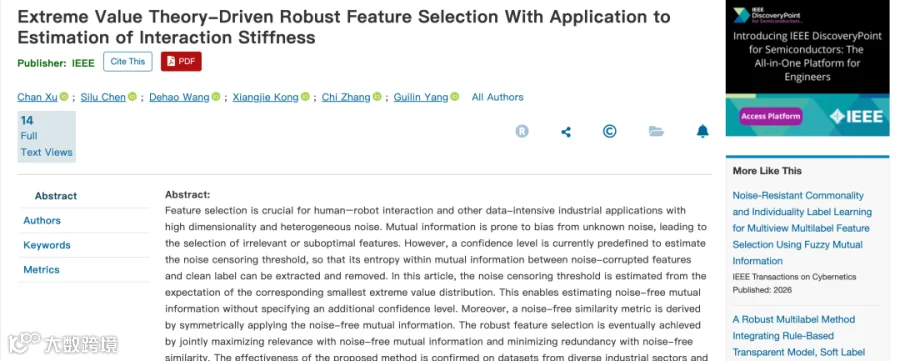
The study was published in IEEE Transactions on Industrial Electronics.
Embodied intelligence and humanoid robots are increasingly deployed in real-world tasks. Beyond human motion trajectories, robots are expected to master contact skills such as compliance, force adaptation, and stiffness regulation.
In contact-intensive tasks like assembly and wiping, interaction stiffness governs how softly or firmly a robot should contact the environment, which is essential for learning from human demonstration. However, stiffness estimation typically relies on multimodal sensing systems, while surface electromyography (sEMG) signals are often compromised by muscle crosstalk, motion artifacts, and other noise.
To address this issue, researchers at NIMTE proposed an extreme value theory (EVT)-driven noise-free maximum-relevance and minimum-redundancy (NF-MRMR) method. The method uses EVT to estimate the noise censoring threshold without requiring a predefined confidence level, and introduces a noise-free similarity metric to evaluate redundancy among noisy features.
By maximizing noise-free relevance while minimizing noise-free redundancy, NF-MRMR selects compact and informative feature subsets from high-dimensional data affected by unknown noise.
Researchers validated NF-MRMR on 15 benchmark datasets from manufacturing, pharmacy, image recognition, and other fields. "It outperformed 11 representative feature selection methods, achieving the highest average classification accuracy across all classifiers," said Prof. CHEN Silu, a corresponding author of the study.
The team further applied NF-MRMR to a human-robot collaborative wiping task. Using only 10 selected sEMG features, NF-MRMR reconstructed continuous interaction stiffness, reducing the mean absolute error by about 37.73% compared with three baseline methods. The estimated stiffness was then used to guide a robot’s autonomous wiping of traces with different pressure levels.
This study provides a data-driven tool for extracting reliable human-robot interaction cues from noisy physiological signals. It may support stiffness-aware skill learning for humanoid robots and other embodied robotic systems performing contact-rich tasks such as polishing, assembly, surface finishing, and human-guided skill transfer.
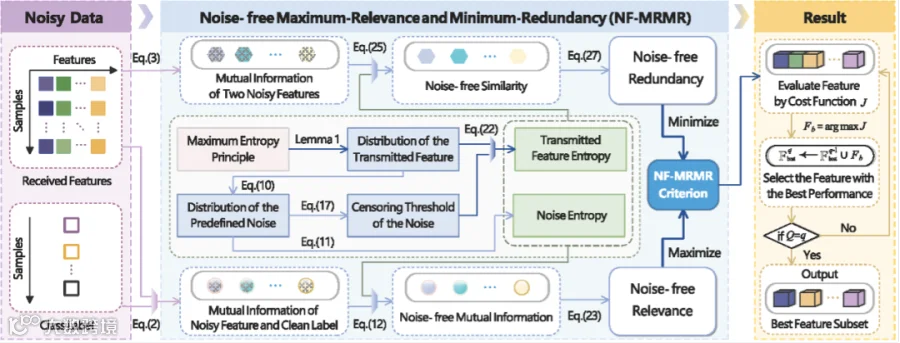
Fig.1 The NF-MRMR method for interaction stiffness estimation in human-robot collaboration (Image by NIMTE)
Latest Research
|
|||
|
|||
|
Thanks for Reading
编辑|材华君

👇 Full Issue 点击“阅读原文”查看详细信息