
May 2026 Compilation
of Export Import Policies
上海泓明供应链有限公司

Import and Export Trade Data
In May 2026, China’s total import and export value reached 648.13 billion US dollars, representing a month-on-month increase of 2.3% compared to April of this year and a year-on-year increase of 22.6% compared to May of last year. Regarding exports, the export value in May was 376.78 billion US dollars, marking a month-on-month increase of 4.9% compared to April of this year and a year-on-year increase of 19.4% compared to May of last year;Regarding imports, the value in May was 271.35 billion US dollars, representing a month-on-month decrease of 1.1% compared to April of this year and a year-on-year increase of 27.4% compared to May of last year.The merchandise trade surplus was 105.43 billion US dollars, with a cumulative surplus of 451.71 billion US dollars for January to May.
In May 2026, imports of mechanical and electrical products totaled 787.5 (exports: 1654.86) billion yuan, while cumulative imports from January through May totaled 3542.51 (exports: 7576.6) billion yuan, representing a year-on-year increase of 25.3% in imports (and 18.4% in exports);In May, imports of integrated circuits totaled 49.69 (exports: 307.3) billion units, with an import value of 388.3 (exports: 243.85) billion yuan. From January to May, imports of integrated circuits totaled 1655.75 (exports: 965.05) billion yuan, representing a year-on-year increase of 47.1% in imports (and 83.4% in exports);In May, imports of medical devices totaled 6.1 (exports: 13.18) billion yuan; from January to May, imports of medical devices totaled 32.35 (exports: 62.65) billion yuan, representing a year-on-year decrease of 6.7% in imports (while exports increased by 9.8%).
General Administration of Customs Announcement No. 57 of 2026 (Announcement on Conducting Random Inspection of Imported and Exported Goods Beyond Statutory Inspection for the Year 2026)
Release Date:May 8, 2026
Effective Date:May 8, 2026
To protect the legitimate rights and interests of consumers and safeguard the life and health of the public, in accordance with the relevant provisions of the “Law of the People’s Republic of China on the Inspection of Imported and Exported Commodities” and its implementing regulations, the General Administration of Customs has decided to conduct random inspections of certain imported and exported commodities not subject to statutory inspection (see the annex for the scope of commodities) in accordance with the law, effective June 1, 2026.
The random inspection work shall be carried out in accordance with the “Measures for the Administration of Random Inspection of Imported and Exported Commodities” (originally promulgated as Decree No. 39 of the former General Administration of Quality Supervision, Inspection and Quarantine, and amended by Decrees No. 238 and No. 263 of the General Administration of Customs).
Upon the issuance of this announcement, General Administration of Customs Announcement No. 150 of 2025 (Announcement on Conducting Random Inspections of Imported and Exported Commodities Other Than Those Subject to Statutory Inspection in 2025) is hereby repealed.
Attachment: Scope of Import and Export Commodities Subject to Random Inspection
Scope of Commodities Subject to Random Inspection
I. Imported Goods: Infant and children’s products, food contact products, daily-use accessories, adult shoes and boots, electronic products, low-voltage electrical appliances, etc.
II. Exported Goods: Infant and children’s products, low-voltage electrical appliances, etc.
Link
http://www.customs.gov.cn/customs/2026-05/08/article_2026050820254669719.html
Measures of the People’s Republic of China for the Supervision and Administration of Import and Export Cosmetic Inspection and Quarantine (General Administration of Customs Order No. 284)
Release Date: May 16, 2026
Effective Date:December 1, 2026
Policy Interpretation:
The General Administration of Customs recently issued the “Announcement on Matters Concerning the Implementation of the ‘Measures of the People’s Republic of China for the Supervision and Administration of Import and Export Cosmetic Inspection and Quarantine by Customs’” (hereinafter referred to as the “Announcement”). To ensure that administrative parties and the general public fully understand and accurately grasp the background and key provisions of this Announcement, the following interpretation of relevant issues is provided:
I. Background and Purpose of the Announcement
On May 6, 2026, the General Administration of Customs revised and issued the “Measures of the General Administration of Customs of the People’s Republic of China on the Supervision and Administration of Inspection and Quarantine of Imported and Exported Cosmetics” (Order No. 284 of the General Administration of Customs, hereinafter referred to as the “Measures”), which officially took effect on December 1, 2026. As some provisions of the “Measures” are stated only in general terms, this “Announcement” is necessary to provide further details to ensure that enterprises clearly understand the specific declaration requirements and the primary responsibilities they must fulfill.This Announcement supplements and refines the specific content and format of materials required for the declaration of imported and exported cosmetics, further details the scope of information to be recorded for imported cosmetics, and provides interpretations of relevant terms in the Measures, thereby promoting the standardized and orderly conduct of customs supervision over the import and export of cosmetics.
II. Key Issues Requiring Clarification
(I) Regarding the Declaration of Imported Cosmetics.
Clarification of the Entity Responsible for Import Cosmetic Declarations.
Pursuant to Article 45, Paragraph 2 of the “Regulations on the Supervision and Administration of Cosmetics” (hereinafter referred to as the “Regulations”), importers shall verify whether the cosmetics intended for import have been registered or filed and whether they comply with the “Regulations” and mandatory national standards and technical specifications; if the verification fails, the cosmetics shall not be imported. To clarify the responsible party, cosmetics importers shall declare to customs in the capacity of “domestic consignee” when filing their declarations.
2. Clarification of Requirements for Filling Out Regulatory Certificates for Imported Cosmetics.
Article 6, Paragraph 2 of the “Measures” requires that imported cosmetics must complete registration for special cosmetics or filing for general cosmetics in accordance with the law, and customs verifies compliance through automatic electronic data comparison. This Announcement specifies the exact fields on the customs declaration form where the required regulatory documents must be entered when declaring imported cosmetics.
3. Clarification of circumstances under which regulatory documents need not be reported.
In accordance with Articles 13 and 14 of the Measures, as well as the relevant provisions of the “Notice of the General Administration of Customs, the National Development and Reform Commission, the Ministry of Finance, the Ministry of Transport, the Ministry of Commerce, the National Health Commission, the State Taxation Administration, the State Administration for Market Regulation, the National Railway Administration, and the Civil Aviation Administration of China on Further Deepening Reforms to Facilitate Cross-Border Trade and Optimizing the Business Environment at Ports” (Shu’an Fa [2021] No. 85), samples used for the registration or filing of imported cosmetics,non-trial samples used by enterprises for testing, research and development, and promotional purposes; cosmetics imported by foreign diplomatic and consular missions in China, as well as representative offices of international organizations in China enjoying diplomatic privileges and immunities, when declared as official supplies; and exhibition cosmetics not intended for trial use or sale are exempt from inspection. The “Announcement” further clarifies that when declaring the import of the aforementioned cosmetics, there is no need to provide the special cosmetics registration number or the general cosmetics filing number.
4. Clarification of “other materials required by customs” for imported samples.
Article 13 of the Measures is elaborated upon, primarily categorizing samples into three types based on their intended use and nature.For samples used for the registration or filing of imported cosmetics, relevant supporting documents—such as proof of acceptance of inspection and testing applications—issued by cosmetic registration and filing inspection and testing institutions must be provided; for non-trial samples used for testing and R&D, documents such as testing and R&D plans and proof of the testing and R&D unit’s capabilities must be provided; if testing is entrusted to a third-party testing institution, a testing entrustment agreement must also be provided; for non-trial samples used for promotional purposes, a promotional plan must be provided, which should clearly specify the location of sample use, method of use, target audience, and method of sample disposal.
5. Refine the declaration requirements and required materials for imported cosmetic semi-finished products.
The declaration requirements for cosmetic semi-finished products specified in Article 34, Paragraph 2 of the Measures are hereby clarified. To better distinguish and manage imported cosmetic semi-finished products from finished products, it is specified that for imported cosmetic semi-finished products, “Cosmetic Semi-Finished Product” must be entered under the “Other” declaration element within the “Specifications and Model” section; “15-Non-Prepackaged” must be selected in the “Goods Attribute” column; and the name, address, and cosmetic production license number of the product filling or repackaging enterprise must be noted in the “Remarks” column.Since imported cosmetic semi-finished products are exempt from registration or filing verification and label verification at the import stage, enterprises shall fulfill their relevant responsibilities and declare that the imported cosmetic semi-finished products comply with the mandatory requirements of national technical specifications.
(2) Refine the content of information records for imported cosmetics.
Article 12, Paragraph 1 of the Measures has been further specified. To strengthen traceability management of imported cosmetics and ensure their quality and safety, the specific details that importers must record have been refined by referencing the declaration fields on customs declaration forms and taking into account the needs for product traceability. To facilitate better management by enterprises, importers with the necessary capabilities are encouraged to use information systems to record and retain relevant information.
(3) Specifying the materials required for pre-export inspection applications for cosmetics.
This provision refines Article 19 of the Measures. It clarifies that when applying for pre-export inspection, enterprises must declare that they have obtained a cosmetics production license and possess label samples and Chinese translations. Additionally, in accordance with the requirements of the Regulations, they must declare that the exported cosmetics comply with the standards or contractual requirements of the importing country (region).
(4) Clarifying the scope of “mandatory requirements of national technical specifications.”
Pursuant to Article 79 of the Regulations, “technical specifications” refer to supplementary technical requirements for the quality and safety of cosmetics formulated by the State Council’s drug regulatory authority in response to supervisory and administrative needs, where mandatory national standards have not yet been established.To ensure consistency with higher-level laws, it is clarified that the “mandatory requirements of national technical specifications” referred to in Article 7 of the Measures include not only relevant laws, administrative regulations, customs regulations and announcements issued by the State, as well as mandatory national standards, but also supplementary technical requirements for the quality and safety of cosmetics formulated by the State Council’s drug regulatory authority in accordance with the needs of supervision and management.
Link
http://www.customs.gov.cn/customs/2026-04/22/article_2026042215072579517.html
General Administration of Customs Announcement No. 61 of 2026 (Announcement on Matters Concerning the Implementation of the “Administrative Measures of the People’s Republic of China on the Inspection, Quarantine, and Supervision of Imported and Exported Cosmetics”)
Release Date: May 11, 2026
Effective Date: December 1, 2026
To effectively implement the “Measures of the People’s Republic of China on the Supervision and Administration of Inspection and Quarantine of Imported and Exported Cosmetics” (General Administration of Customs Order No. 284, hereinafter referred to as the “Measures”), the following matters are hereby announced:
I. Declaration of Imported Cosmetics
When importing cosmetics, importers shall declare the “Customs Declaration Form for Imported Goods of the People’s Republic of China” to customs in the capacity of “domestic consignee.” Such declarations must comply with the following requirements:
(1) Under the “Product License” section of the customs declaration form, in the “Administrative Approval Document for Imported (Non-)Special-Use Cosmetics” field (license category code “526”), importers shall correctly enter the special-use cosmetics registration number or general-use cosmetics filing number obtained from the drug regulatory authorities.
(2) Samples used for the registration or filing of imported cosmetics; non-trial samples used by enterprises for testing, research and development, and promotional purposes; cosmetics imported by foreign diplomatic and consular missions in China, as well as representative offices of international organizations in China enjoying diplomatic privileges and immunities, declared as official supplies; and imported cosmetic exhibits not intended for trial use or sale do not require the entry of a special cosmetic registration number or a general cosmetic filing number.
(3) Samples for the registration or filing of imported cosmetics, as well as non-trial samples used by enterprises for testing, research and development, and promotional purposes, shall be declared in accordance with the requirements of Article 13 of the Measures. The “other materials required by customs” referred to therein are specifically as follows:
1. For samples used for the registration or filing of imported cosmetics, relevant supporting documents issued by the testing and inspection institutions for cosmetic registration and filing must be provided.
2. For non-trial samples imported for testing and R&D purposes, a testing and R&D plan and documents certifying the capabilities of the testing and R&D entity must be provided. If testing is outsourced to a third-party testing institution, a testing service agreement must also be provided.
3. For non-trial samples imported for promotional purposes, a promotional plan must be provided. The plan must clearly specify the location and method of sample use, the target audience, and the method of sample disposal.
(IV) For imported cosmetic semi-finished products, enter “Cosmetic Semi-Finished Product” under the “Other” declaration element in the “Specifications and Model” section; check “15-Non-Prepackaged” in the “Goods Attributes” column; and specify the name, address, and cosmetic production license number of the filling or repackaging enterprise in the “Remarks” column. Additionally, declare that the imported cosmetic semi-finished products comply with the mandatory requirements of national technical specifications.
II. Regarding the Record-Keeping of Imported Cosmetic Information
The information on imported cosmetics recorded by the importer shall include the customs declaration number, date of entry, name, brand, registration number for special cosmetics or filing number for general cosmetics, specifications, quantity/weight, production batch number and expiration date or production date and shelf life, country or region of origin, country or region of trade, name of the manufacturing or processing enterprise, name of the overseas exporter (agent), storage location, name and contact information of the sales recipient, and sales date and quantity. Cosmetics importers are encouraged to use information technology to record the above information.
III. Application for Pre-export Inspection of Cosmetics
When applying for pre-export inspection of cosmetics, the manufacturer, shipper, or their agent shall truthfully declare that the manufacturer has obtained a Cosmetics Manufacturing License, possesses label samples and Chinese translations thereof, and that the exported cosmetics comply with the standards or contractual requirements of the importing country (region). If verification is required during customs supervision, the manufacturer, shipper, or their agent shall present the relevant materials mentioned above for inspection.
IV. Regarding “Mandatory Requirements of National Technical Specifications”
The term “mandatory requirements of national technical specifications” as used in these Measures includes supplementary technical requirements for cosmetics quality and safety formulated by the State Council’s drug regulatory authority in accordance with the needs of supervision and management.
This Announcement shall take effect on December 1, 2026. In the event of any inconsistency between previously issued relevant provisions and this Announcement, this Announcement shall prevail.“Announcement of the General Administration of Quality Supervision, Inspection and Quarantine on Matters Concerning the Implementation of the ‘Measures for the Supervision and Administration of Inspection and Quarantine of Imported and Exported Cosmetics’” (Announcement No. 110 of 2012 of the former General Administration of Quality Supervision, Inspection and Quarantine), “Announcement of the General Administration of Quality Supervision, Inspection and Quarantine on the Issuance of the ‘Regulations on the Filing of Domestic Consignees, Import Records, and Sales Records for Imported Cosmetics’” (Announcement No. 77 of 2016 of the former General Administration of Quality Supervision, Inspection and Quarantine),the former General Administration of Quality Supervision, Inspection and Quarantine’s “Notice on Matters Concerning the Implementation of the ‘Measures for the Supervision and Administration of Inspection and Quarantine of Imported and Exported Cosmetics’” (Guo Zhi Jian Shi Han [2012] No. 242), and the “Notice of the General Office of the General Administration of Quality Supervision, Inspection and Quarantine on the Implementation of the ‘Regulations on the Filing of Domestic Consignees, Import Records, and Sales Records for Imported Cosmetics’” (Zhi Jian Ban Shi Han [2016] No. 1462) are hereby repealed simultaneously.
Link
http://www.customs.gov.cn/customs/2026-05/12/article_2026051211114383082.html
General Administration of Customs Announcement No. 74 of 2026 (Announcement on Matters Concerning the Electronic Data Linkage of Rules of Origin Between China and Malaysia)
Release Date:May 31, 2026
Effective Date: June 01, 2026
To further facilitate the compliant clearance of goods under free trade agreements, the “China–Malaysia Electronic Information Exchange System for Rules of Origin” will officially commence operations on June 1, 2026, enabling the real-time transmission of data on certificates of origin,back-to-back certificates of origin, and certificates of origin and movement certificates (hereinafter collectively referred to as “proofs of origin”) under the “Framework Agreement on Comprehensive Economic Cooperation between China and the Association of Southeast Asian Nations” (hereinafter referred to as the “China-ASEAN Framework Agreement”) with Malaysia. The relevant matters are hereby announced as follows:
I. When the consignee of imported goods or their agent (hereinafter referred to as the “importer”) applies for preferential tariff rates under the RCEP or the “China-ASEAN Framework Agreement” upon importation of goods by presenting proof of origin issued by Malaysia,and select the “paperless customs clearance” method for declaration in accordance with the provisions of General Administration of Customs Announcement No. 34 of 2021, they are not required to submit electronic data for proofs of origin or declarations regarding direct transport rules through the “Preferential Trade Agreement Origin Element Declaration System,” nor are they required to electronically upload proofs of origin.
II.
When selecting the “paperless customs clearance” method for declaration, if the system prompts “Electronic data for the Certificate of Origin cannot be found,”from June 1 to November 30, 2026, importers may, in accordance with the relevant provisions of General Administration of Customs Announcement No. 34 of 2021, enter the electronic information of the certificate of origin and the declaration regarding the direct transport rule through the “Preferential Trade Agreement Origin Element Declaration System” and upload the certificate of origin electronically.Effective December 1, 2026, if the system displays the message “Electronic data for the certificate of origin cannot be found” and the importer requests early release of the relevant goods from customs, the importer shall apply to customs for customs duty security procedures in accordance with regulations; subsequently, upon confirming through the “Online Certificate of Origin Status Inquiry” function on the China Customs Origin Service Platform that the electronic data for the certificate of origin has been successfully transmitted, the importer shall complete the procedures for the refund of the customs duty security with customs in accordance with regulations.
II. Importers who choose the “paper-based customs declaration” method shall submit a paper copy of the certificate of origin when declaring the import.
Link
http://www.customs.gov.cn/customs/2026-06/01/article_2026060108483037184.html
Ministry of Commerce Announcement No. 21 of 2026: Issuance of a Blocking Order Regarding U.S. Sanctions Measures Against Five Chinese Enterprises Involved in Iranian Oil Transactions
Release Date: May 2, 2026
Effective Date: May 2, 2026
Pursuant to the National Security Law of the People’s Republic of China, the Law of the People’s Republic of China on Foreign Relations, the Law of the People’s Republic of China on Countering Foreign Sanctions, their implementing regulations, and the Measures for Blocking the Improper Extraterritorial Application of Foreign Laws and Measures (hereinafter referred to as the “Blocking Measures”),the working mechanism under the “Measures to Block the Improper Extraterritorial Application of Foreign Laws and Measures” has conducted a comprehensive assessment in accordance with the law regarding the sanctions measures imposed by the United States on Hengli Petrochemical (Dalian) Refining & Chemical Co., Ltd. and other enterprises—including their inclusion on the “Specially Designated Nationals List” (SDN List), asset freezes, and transaction bans—on the grounds of their involvement in Iranian oil transactions. The assessment has confirmed that the U.S. sanctions against the aforementioned enterprises constitute cases of improper extraterritorial application.
To safeguard national sovereignty, security, and development interests, and to protect the lawful rights and interests of Chinese citizens, legal persons, or other organizations, the Ministry of Commerce, pursuant to Articles 2, 4, 6, and 7 of the “Blocking Measures” and the decision of the working mechanism, hereby issues the following prohibition:
No entity shall recognize, enforce, or comply with the sanctions imposed by the United States pursuant to Executive Orders 13902 and 13846, among other provisions, on the grounds of participation in Iranian oil transactions against Hengli Petrochemical (Dalian) Refining and Chemical Co., Ltd.,Shandong Shouguang Luqing Petrochemical Co., Ltd., Shandong Jincheng Petrochemical Group Co., Ltd., Hebei Xinhai Chemical Group Co., Ltd., and Shandong Shengxing Chemical Co., Ltd. on the grounds of their involvement in Iranian oil transactions, including their inclusion on the “Specially Designated Nationals List,” the freezing of assets, and the prohibition of transactions.
Link
https://www.mofcom.gov.cn/zcfb/blgg/art/2026/art_78dd015b3fb94aa0b25d5ac98994aa4f.html
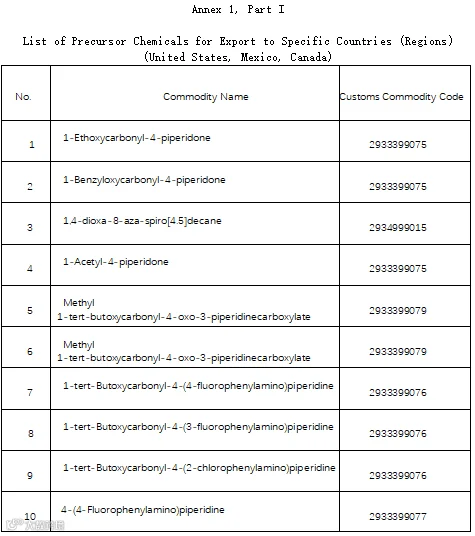
Announcement by the Ministry of Commerce and Four Other Departments on Adjusting the “Catalog of Precursor Chemicals for the Manufacture of Narcotics Exported to Specific Countries (Regions)”
Release Date:April 15, 2026
Effective Date: April 15, 2026
To further improve the management of exports of precursor chemicals, in accordance with the “Interim Provisions on the Export of Precursor Chemicals to Specific Countries (Regions),” the Ministry of Commerce, the Ministry of Public Security, the Ministry of Emergency Management, the General Administration of Customs, and the National Medical Products Administration have decided to amend the “Catalog of Precursor Chemicals Exported to Specific Countries (Regions),”adding three substances, including methyl 1-tert-butoxycarbonyl-4-oxo-3-piperidinecarboxylate, to Part I of Annex 1.
The revised “Catalog of Precursor Chemicals for the Export to Specific Countries (Regions)” is hereby published.Effective from the date of this announcement, exports of chemicals listed in Part I of Annex 1 to the United States, Mexico, and Canada, as well as exports of chemicals listed in Part II of Annex 1 to Myanmar, Laos, and Afghanistan, shall be subject to licensing in accordance with the “Interim Provisions on the Administration of Exports of Precursor Chemicals to Specific Countries (Regions).” Exports to other countries (regions) do not require a license.
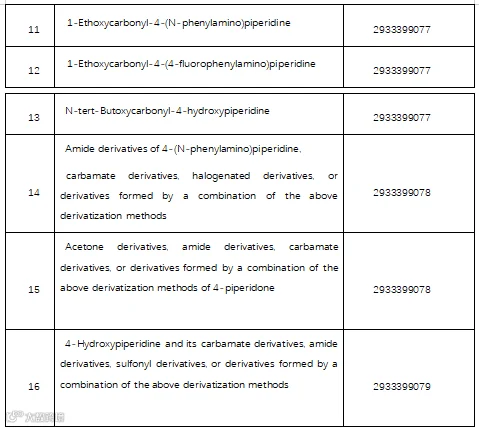
Notes:
1. Any salts of the substances listed in the above 16 items are also subject to control.
2. The trade names of the above chemicals shall prevail; customs commodity codes are provided for customs declaration purposes only.
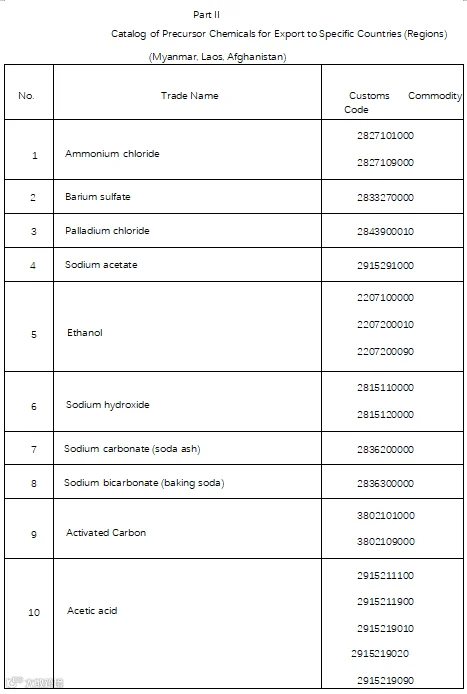
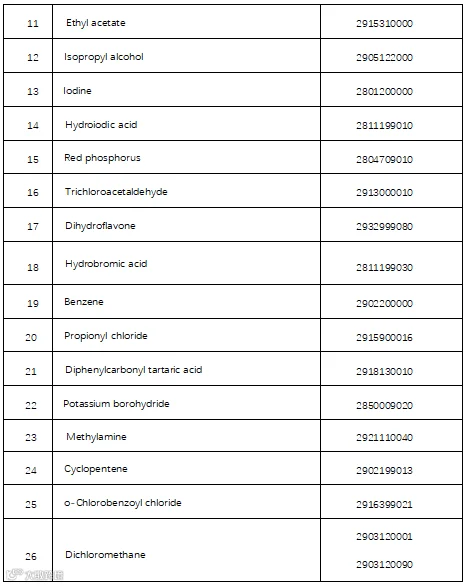
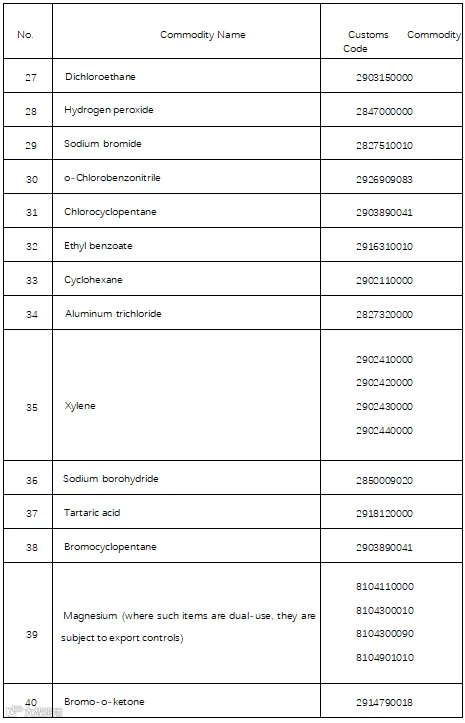
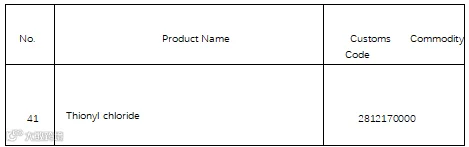
Note: The trade names of the above chemicals shall prevail; the customs commodity codes are provided for customs declaration purposes only.
Appendix 2
List of Specific Countries (Regions)
1. Myanmar
2. Laos
3. Afghanistan
4. United States
5. Mexico
6. Canada
Link
https://www.mofcom.gov.cn/zcfb/blgg/art/2026/art_10dc1acab316456b83f69aff7c18e086.html
The Office of the National Narcotics Control Commission Issues a Notice to Prevent the Diversion of Eight Chemicals for Drug Manufacturing
Release Date: April 24, 2026
Effective Dates: April 24, 2026
To the Development and Reform Commissions, Industrial and Information Technology Authorities, and Finance Departments (Bureaus) of all provinces, autonomous regions, municipalities directly under the central government, cities with separate planning status, and the Xinjiang Production and Construction Corps; the Guangdong Branch of the General Administration of Customs and all directly affiliated customs offices; and the tax bureaus of the State Taxation Administration in all provinces, autonomous regions, municipalities directly under the central government, and cities with separate planning status:
To promote the sustained and healthy development of China’s integrated circuit and software industries, in accordance with the relevant provisions of the “Notice of the State Council on Issuing Several Policies to Promote the High-Quality Development of the Integrated Circuit and Software Industries in the New Era” (hereinafter referred to as the “Several Policies”) and supporting policies, as well as the relevant provisions of the “Announcement of the Ministry of Finance, the State Taxation Administration, the National Development and Reform Commission, and the Ministry of Industry and Information Technology on Increasing the Additional Deduction Ratio for R&D Expenses of Integrated Circuit and Machine Tool Enterprises” (hereinafter referred to as the “Announcement”),after careful consideration, we hereby issue the following notice regarding the formulation of the list of integrated circuit enterprises or projects and software enterprises eligible for tax preferential policies in 2026 (hereinafter referred to as the “List”).
I. The “List” referred to in this Notice refers to the list of integrated circuit production enterprises or projects with line widths of 28 nanometers or less (inclusive), 65 nanometers or less (inclusive), and 130 nanometers or less (inclusive), as mentioned in Article (I) of the “Several Policies”;Articles (3), (6), (7), and (8) of the "Several Policies," as well as the "Notice of the Ministry of Finance, the General Administration of Customs, and the State Taxation Administration on Import Tax Policies to Support the Development of the Integrated Circuit and Software Industries" (Cai Guan Shi [2021] No. 4),the "Notice of the Ministry of Finance, the National Development and Reform Commission, the Ministry of Industry and Information Technology, the General Administration of Customs, and the State Taxation Administration on the Administrative Measures for Import Tax Policies Supporting the Development of the Integrated Circuit and Software Industries" (Cai Guan Shi [2021] No. 5), which list key integrated circuit design enterprises and software enterprises encouraged by the state, as well as manufacturers of logic circuits and memory devices with a line width of 65 nanometers or less,manufacturers of specialty-process integrated circuits with line widths of 0.25 micrometers or less (inclusive), manufacturers of compound semiconductor integrated circuits with line widths of 0.5 micrometers or less (inclusive), and advanced packaging and testing enterprises; a list of key raw materials and components for the integrated circuit industry (including target materials, photoresists,masks, packaging substrates, polishing pads, polishing slurry, 8-inch and larger monocrystalline silicon, and 8-inch and larger silicon wafers), as well as a list of major integrated circuit projects and their contractors; a list of enterprises to which the state-encouraged integrated circuit manufacturing enterprises or projects mentioned in the "Announcement" belong, and a list of state-encouraged integrated circuit design enterprises.
II. Enterprises already included in the 2025 list that wish to enjoy tax preferential policies for the new fiscal year (excluding the installment payment policy for import VAT) must reapply in 2026.Enterprises applying for inclusion on the list must submit their applications via the information reporting system (https://yyglxxbs.ndrc.gov.cn/xxbs-front/) between April 7 and April 19, 2026. (For applications to be included in the list of major integrated circuit projects and construction enterprises eligible for the installment payment policy for import VAT,applications may also be submitted between September 7 and September 20, 2026). Applicants must generate a hard copy of the application, affix the company’s official seal, and submit it along with the necessary supporting documents (both electronic and hard copies) to the Development and Reform Commission or the competent authority for industry and information technology of their respective province, autonomous region, municipality directly under the central government, city with separate planning status, or the Xinjiang Production and Construction Corps (hereinafter referred to as “provincial-level authorities”), as designated by the provincial-level Development and Reform Commission.Audited corporate financial statements must be submitted concurrently with the application. Software enterprises developing first-edition software are encouraged to actively apply for tax incentives.
III. Local development and reform and industry and information technology departments shall conduct a preliminary review of the information submitted by enterprises based on enterprise eligibility and project standards (attached). Upon approval, the information shall be forwarded to the National Development and Reform Commission and the Ministry of Industry and Information Technology.The lists of key raw material and component manufacturers for the integrated circuit industry mentioned in Articles (1), (3), (6), and (7) of the "Several Policies," as well as in Document No. 4 [2021] of the Ministry of Finance, shall be jointly reviewed, confirmed, and issued by the National Development and Reform Commission, the Ministry of Industry and Information Technology, the Ministry of Finance, the General Administration of Customs, and the State Taxation Administration.Major integrated circuit projects referred to in Article (8) of the "Several Policies" shall be listed by the NDRC and MIIT and submitted in writing to the Ministry of Finance, which shall finalize the list in consultation with the General Administration of Customs and the State Taxation Administration.The lists of state-encouraged integrated circuit manufacturing enterprises or enterprises associated with such projects, as well as state-encouraged integrated circuit design enterprises, referred to in the Announcement, shall be jointly reviewed, confirmed, and issued by the National Development and Reform Commission, the Ministry of Industry and Information Technology, the Ministry of Finance, and the State Taxation Administration.
IV. Enterprises included in the list may independently determine whether they meet the eligibility criteria when filing their corporate income tax advance payment returns for the following year. If eligible, they may enjoy the preferential treatment in advance during the advance payment filing. During the annual tax settlement, if they are not included in the list for the following year, they shall make up the tax payment in accordance with regulations, and no late payment penalties shall be imposed in accordance with the law.Enterprises applying for the tax incentives mentioned in Articles (1), (3), (6), and (7) of the "Several Policies," the tariff incentives mentioned in Document Cai Guan Shi [2021] No. 4, and the R&D expense super-deduction policy mentioned in the "Announcement" may check whether they are included in the list through the information reporting system before the annual tax settlement is completed.For enterprises eligible for the preferential policy under Article (8) of the "Several Policies," the direct-affiliated customs office at the enterprise’s location shall notify the relevant enterprises.
V. Enterprises or projects that have already enjoyed the tax preferential policies mentioned in Articles (1), (3), (6), and (7) of the "Several Policies," the tariff preferential policies mentioned in Document No. 4 [2021] of the Ministry of Finance and the General Administration of Customs, or the R&D expense super-deduction policy mentioned in the "Announcement," and where the parent enterprise has undergone a name change, division,merger, reorganization, or other major changes—such as the exclusion of business activities corresponding to the type of tax preferential policy enjoyed by the enterprise from its scope of operations—shall promptly report such changes to the local development and reform and industry and information technology departments. Within 60 days from the date of completion of the change registration, they shall submit the Form on Major Changes in the Enterprise and relevant materials to the National Development and Reform Commission and the Ministry of Industry and Information Technology (based on the date of the provincial-level department’s submission).The National Development and Reform Commission and the Ministry of Industry and Information Technology, in conjunction with relevant departments, shall determine whether the enterprise or project continues to meet the eligibility criteria for preferential policies following such changes.
VI. Local development and reform and industry and information technology departments, in conjunction with finance, customs, and tax authorities, shall strengthen daily supervision of enterprises on the list. If, during the course of supervision, it is discovered that an enterprise has obtained tax exemption or reduction qualifications by providing false information, a joint investigation shall be conducted promptly, and the findings shall be jointly reported to the National Development and Reform Commission and the Ministry of Industry and Information Technology for review.Following review by the NDRC and MIIT in conjunction with relevant departments, enterprises or projects that are determined to no longer meet the conditions and standards for preferential policies shall be notified in writing to the Ministry of Finance, the General Administration of Customs, and the State Taxation Administration for handling in accordance with relevant regulations.
VII. Enterprises are responsible for the authenticity of the materials and data they provide. Applicant enterprises shall sign a written commitment stating that, in the event of any breach of trust in their application, they will accept handling by the relevant authorities in accordance with laws, regulations, and relevant national provisions; information regarding illegal acts will be recorded in the enterprise’s credit record, incorporated into the National Credit Information Sharing Platform, and disclosed on the “Credit China” website.
VIII. This notice shall take effect from the date of issuance and applies to enterprises eligible for the 2025 corporate income tax preferential policies, the import tax policies stipulated in Document No. 4 [2021] of the Ministry of Finance and the General Administration of Customs, as well as the R&D expense super-deduction policy mentioned in the Announcement. The National Development and Reform Commission and the Ministry of Industry and Information Technology, in conjunction with relevant departments, will adjust the eligibility criteria for enterprises or project standards in a timely manner based on industrial development and technological progress.
Link
https://jiangsu.chinatax.gov.cn/art/2026/4/7/art_23636_12641.html
Tax Refunds Begin! U.S. Customs Releases Refund Rules and Operational Guidelines; Tariff Refund System Goes Live Tomorrow
Release Date: April 21, 2026
Effective Dates: April 22, 2026
According to a report by CCTV News citing Reuters, the Trump administration plans to officially launch a tariff refund system on April 20 (local time) to reimburse importers for $166 billion (approximately 1.13 trillion yuan) in tariffs, which were ruled “illegal” by the U.S. Supreme Court in February of this year.
The U.S. Customs and Border Protection (CBP) recently stated in a court filing submitted to the Court of International Trade that it has largely completed the first phase of developing a customs clearance system for large-scale refunds to importers and will commence the relevant tariff refund process on the 20th. Refunds will be distributed electronically in a unified manner, with interest applied where applicable, replacing the previous method of processing each case individually.
The refund system, known as the “Comprehensive Arrival Processing and Enforcement” (CAPE) tool, enables “one-click refunds.” Importers or authorized customs brokers need only upload a CSV file via the web listing customs declarations subject to IEEPA tariffs; the system will automatically verify the declaration data, calculate the refund (including interest), and ultimately disburse the funds.
Detailed Procedures for Refunds
U.S. Customs stated that in the first phase, it will prioritize processing refund claims for certain simple and recently imported shipments, which account for approximately 63% of the total. The remaining 37% of refunds will be processed in subsequent phases, as these imports entered the automated clearance process and require reconciliation, making the refund process relatively more complex. In other words, goods imported one year ago (approximately those imported before May 2025) will undergo refund processing in subsequent phases.
U.S. Customs and Border Protection (CBP) states that after accepting an importer’s refund claim, the review and settlement process will be completed and the refund issued within 45 days at the latest.
Importers seeking refunds must register an ACH electronic refund account in the ACE system in advance; otherwise, they will be unable to receive the refund. U.S. Customs has fully transitioned to electronic processing, and all refunds will be directly transferred via electronic funds transfer to the importer’s designated bank account.
The refund process consists of four steps:
1. Claim Portal: Importers or authorized customs brokers upload a CSV file via the web portal listing the customs entries subject to IEEPA duties. The system automatically verifies the format and confirms that the submitter is either the importer on record or the customs broker.
2. Mass Processing: The system automatically removes the IEEPA tariff codes and recalculates the remaining duties owed.
3. Review and Liquidation/Reliquidation: Customs reviews the results.
4. Refund: Refunds are transferred directly via electronic funds transfer to the importer’s designated bank account.
Data shows that as of April 9, approximately 56,000 importers have completed the electronic refund process, involving a total amount of $127 billion (approximately 866 billion yuan). Previously, it was reported that the Trump administration was facing 2,000 tariff-related lawsuits due to new companies filing claims for tariff refunds.Well-known companies such as FedEx, Dyson, and Bausch & Lomb have joined the ranks of those seeking refunds, and the total refund amount may set a new record for the largest government refund in U.S. history.
Link
https://www.gov.cn/lianbo/202604/content_7065570.htm?f_link_type=f_linkinlinenote&flow_extra=eyJkb2NfaWQiOiIwNWQzMDMzZjg5OGEwY2U0LWE5NDBkZDE4MDk1ZDIxZWMiLCJpbmxpbmVfZGlzcGxheV9wb3NpdGlvbiI6MCwiZG9jX3Bvc2l0aW9uIjowfQ%3D%3D

编辑 | 泓明数字营销部
声明:本公众平台发布内容(文字、图片及影音等素材)部分来源于网络,转载内容不代表本平台观点,如涉及版权请直接与我们联系。