
编者按
5月30日,由人民日报社主办的国际新闻报刊《环球时报》发表《Global Times: A growing gateway to ASEAN》一文,关注到广西北部湾国际生鲜冷链物流园服务防城港市港口海洋经济发展,打造国内国际双循环冷链物流产供链集成服务平台,推动防城港国家骨干冷链物流基地高质量发展的成效。以下为报道原文:
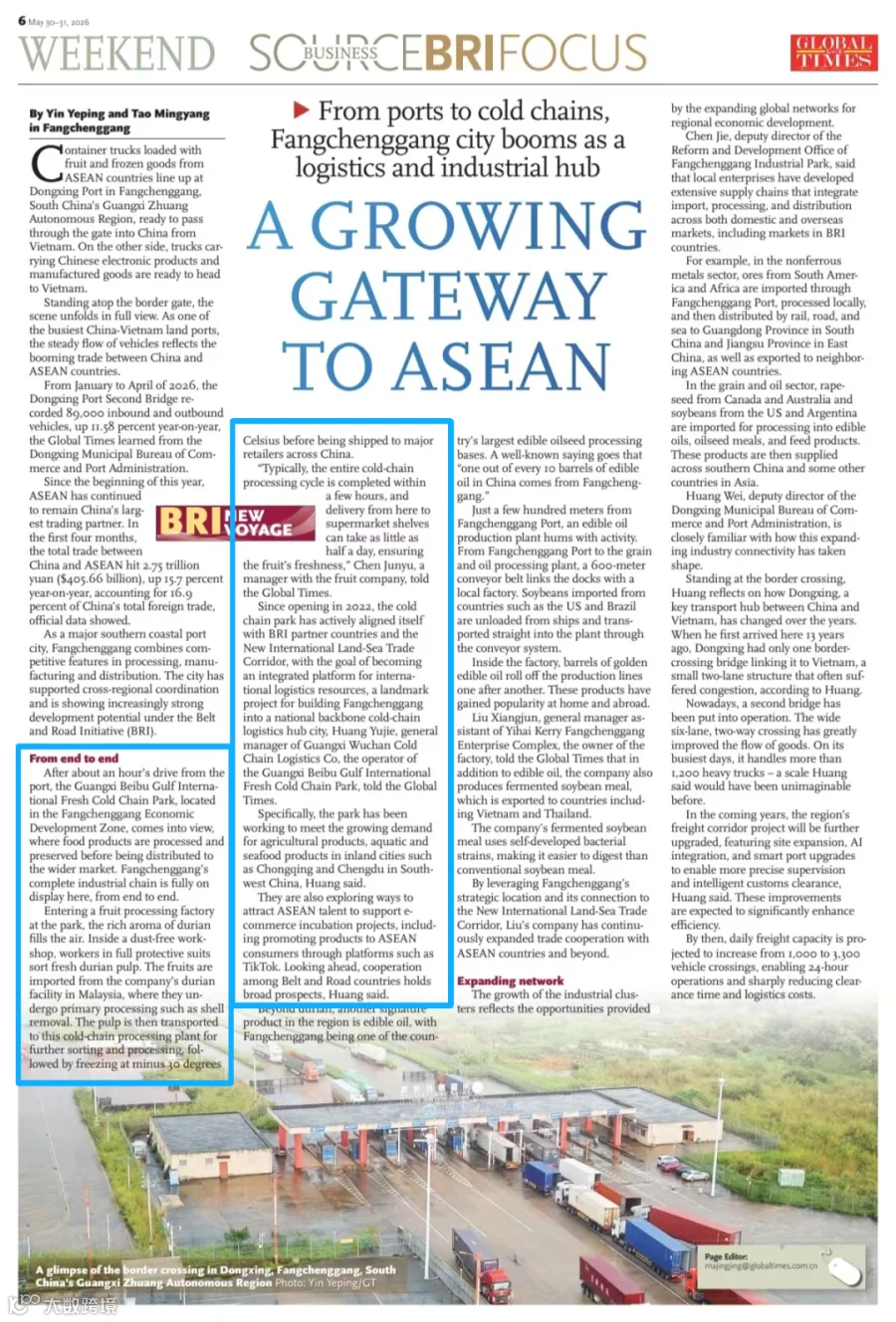
Global Times: A GROWING GATEWAY TO ASEAN
From ports to cold chains, South China's Fangchenggang rapidly emerges as a logistics and industrial hub
《环球时报》:通向东盟的新兴门户
从港口到冷链 防城港正成为南中国物流和产业中心
Container trucks loaded with fruit and frozen goods from ASEAN countries line up at Dongxing Port in Fangchenggang, South China's Guangxi Zhuang Autonomous Region, ready to pass through the gate into China from Vietnam. On the other side, trucks carrying Chinese electronic products and manufactured goods are ready to head to Vietnam.
Standing atop the border gate, the scene unfolds in full view. As one of the busiest China-Vietnam land ports, the steady flow of vehicles reflects the booming trade between China and ASEAN countries.
From January to April of 2026, the Dongxing Port Second Bridge recorded 89,000 inbound and outbound vehicles, up 11.58 percent year-on-year, the Global Times learned from the Dongxing Municipal Bureau of Commerce and Port Administration.
Since the beginning of this year, ASEAN has continued to remain China's largest trading partner. In the first four months, the total trade between China and ASEAN hit 2.75 trillion yuan ($405.66 billion), up 15.7 percent year-on-year, accounting for 16.9 percent of China's total foreign trade, official data showed.
As a major southern coastal port city, Fangchenggang combines competitive features in processing, manufacturing and distribution. The city has supported cross-regional coordination and is showing increasingly strong development potential under the Belt and Road Initiative (BRI).
They are also exploring ways to attract ASEAN talent to support e-commerce incubation projects, including promoting products to ASEAN consumers through platforms such as TikTok. Looking ahead, cooperation among Belt and Road countries holds broad prospects, Huang said.
Beyond durian, another signature product in the region is edible oil, with Fangchenggang being one of the country's largest edible oilseed processing bases. A well-known saying goes that "one out of every 10 barrels of edible oil in China comes from Fangchenggang."
Just a few hundred meters from Fangchenggang Port, an edible oil production plant hums with activity. From Fangchenggang Port to the grain and oil processing plant, a 600-meter conveyor belt links the docks with a local factory. Soybeans imported from countries such as the US and Brazil are unloaded from ships and transported straight into the plant through the conveyor system.
Inside the factory, barrels of golden edible oil roll off the production lines one after another. These products have gained popularity at home and abroad.
Liu Xiangjun, general manager assistant of Yihai Kerry Fangchenggang Enterprise Complex, the owner of the factory, told the Global Times that in addition to edible oil, the company also produces fermented soybean meal, which is exported to countries including Vietnam and Thailand.
The company's fermented soybean meal uses self-developed bacterial strains, making it easier to digest than conventional soybean meal.
By leveraging Fangchenggang's strategic location and its connection to the New International Land-Sea Trade Corridor, Liu's company has continuously expanded trade cooperation with ASEAN countries and beyond.
Expanding network
The growth of the industrial clusters reflects the opportunities provided by the expanding global networks for regional economic development.
Chen Jie, deputy director of the Reform and Development Office of Fangchenggang Industrial Park, said that local enterprises have developed extensive supply chains that integrate import, processing, and distribution across both domestic and overseas markets, including markets in BRI countries.
For example, in the nonferrous metals sector, ores from South America and Africa are imported through Fangchenggang Port, processed locally, and then distributed by rail, road, and sea to Guangdong Province in South China and Jiangsu Province in East China, as well as exported to neighboring ASEAN countries.
In the grain and oil sector, rapeseed from Canada and Australia and soybeans from the US and Argentina are imported for processing into edible oils, oilseed meals, and feed products. These products are then supplied across southern China and some other countries in Asia.
Huang Wei, deputy director of the Dongxing Municipal Bureau of Commerce and Port Administration, is closely familiar with how this expanding industry connectivity has taken shape.
Standing at the border crossing, Huang reflects on how Dongxing, a key transport hub between China and Vietnam, has changed over the years. When he first arrived here 13 years ago, Dongxing had only one border-crossing bridge linking it to Vietnam, a small two-lane structure that often suffered congestion, according to Huang.
Nowadays, a second bridge has been put into operation. The wide six-lane, two-way crossing has greatly improved the flow of goods. On its busiest days, it handles more than 1,200 heavy trucks - a scale Huang said would have been unimaginable before.
In the coming years, the region's freight corridor project will be further upgraded, featuring site expansion, AI integration, and smart port upgrades to enable more precise supervision and intelligent customs clearance, Huang said. These improvements are expected to significantly enhance efficiency.
By then, daily freight capacity is projected to increase from 1,000 to 3,300 vehicle crossings, enabling 24-hour operations and sharply reducing clearance time and logistics costs.
来源 | 《环球时报》2026年5月30日期刊